Unit Blueprint Teacher Guide
Grade 6 Social Studies Curriculum
Cradle of Humanity Blueprint
A 10-Day Instructional Guide: Geography, Prehistory & Early River Civilizations
Unit Overview
This unit bridges physical geography, early human prehistory, and the rise of the first river valley civilizations. Students explore spatial thinking through the Five Themes of Geography, examine the dramatic societal shift of the Neolithic Revolution, and analyze how water and fertile soil drove the formation of complex societies in Mesopotamia, Egypt, India, and China.
Essential Questions
-
- How does where we live shape how we live?
-
- Why was farming the most revolutionary change in human history?
-
- Why did complex societies emerge near river systems?
Instructional Pacing: Days 1 to 5
| Day | Lesson Focus & Theme | Learning Objectives | Key Materials |
|---|
| Day 1 | The Geographer's Eyes Focus: Five Themes Overview | Define and distinguish the Five Themes of Geography (Location, Place, HEI, Movement, Region). Apply themes to global case studies. | Five Themes Slides, Student Notebooks |
| Day 2 | Spatial Connections Focus: Applied HEI & Place | Analyze spatial maps to discover human movement patterns. Categorize environmental modifications vs. adaptations. | Five Themes Worksheet (Part 1-2) |
| Day 3 | Nomadic Wanderers Focus: Paleolithic Lifestyles | Reconstruct daily life in the Paleolithic Era. Evaluate resource hunting-gathering limits and spatial range constraints. | Neolithic Revolution Slides |
| Day 4 | The Great Transition Focus: Neolithic Agriculture | Identify factors causing the shift to agriculture. Evaluate the impacts of plant/animal domestication on human settlement density. | Neolithic Slides & Worksheet |
| Day 5 | The Farming Revolution Focus: Paleolithic vs. Neolithic | Contrast food security, shelter durability, and division of labor between nomadic and agricultural groups. Formulate thesis statements. | Stone Age Shift Worksheet |
Grade 6 Social Studies Unit: Cradle of Humanity Page 1 of 2
Instructional Pacing: Days 6 to 10
| Day | Lesson Focus & Theme | Learning Objectives | Key Materials |
|---|
| Day 6 | Rivers of Abundance Focus: Geography of River Basins | Investigate how annual flooding patterns (silt deposition) made early agriculture highly productive. Introduce the four cradles. | Map Worksheet (Part 1 - Rivers) |
| Day 7 | Natural Shields & Gates Focus: Geographic Barriers | Contrast geography-based isolation (China, India) with vulnerable flat topography (Mesopotamia). Connect barriers to safety and trade. | Map Worksheet (Part 2 - Barriers) |
| Day 8 | The Four Cradles Map Focus: Spatial Map Integration | Examine historical maps to locate Mesopotamia, Egypt, India, and China. Synthesize physical geography and resources. | Map Worksheet (Part 3 - Analysis) |
| Day 9 | Civilization's Spark Focus: Surplus & Specialization | Synthesize learning: trace the causal chain from surplus crops to division of labor, social classes, technology, and government. | River Valleys Exit Ticket |
| Day 10 | The Great Inquiry Focus: Unit Synthesis Assessment | Demonstrate unit mastery by answering critical spatial prompts and analyzing early civilization source documents. | Unit Summative Exam / Portfolio |
Assessment Strategy
Formative Assessments:
- Five Themes Graphic Organizer (Day 2)
- Paleolithic vs. Neolithic Venn (Day 5)
- Cradle of Rivers Exit Ticket (Day 9)
Core Historical Standards:
CCSS.ELA-LITERACY.RH.6-8.7: Integrate visual information (e.g., charts, graphs, maps) with print texts.
High-Leverage Tips
Visual Anchors: Construct a class-wide "Causal Flowchart" on the wall, showing how rivers lead to irrigation, which leads to surplus, and ultimately to civilization.
Geographic Scaffolding: For struggling readers, focus on "Place" and "Human-Environment Interaction." Have them sketch quick visual icons representing adaptions (fur coats) and modifications (dams).
Grade 6 Social Studies Unit: Cradle of Humanity Page 2 of 2
Five Themes Slides
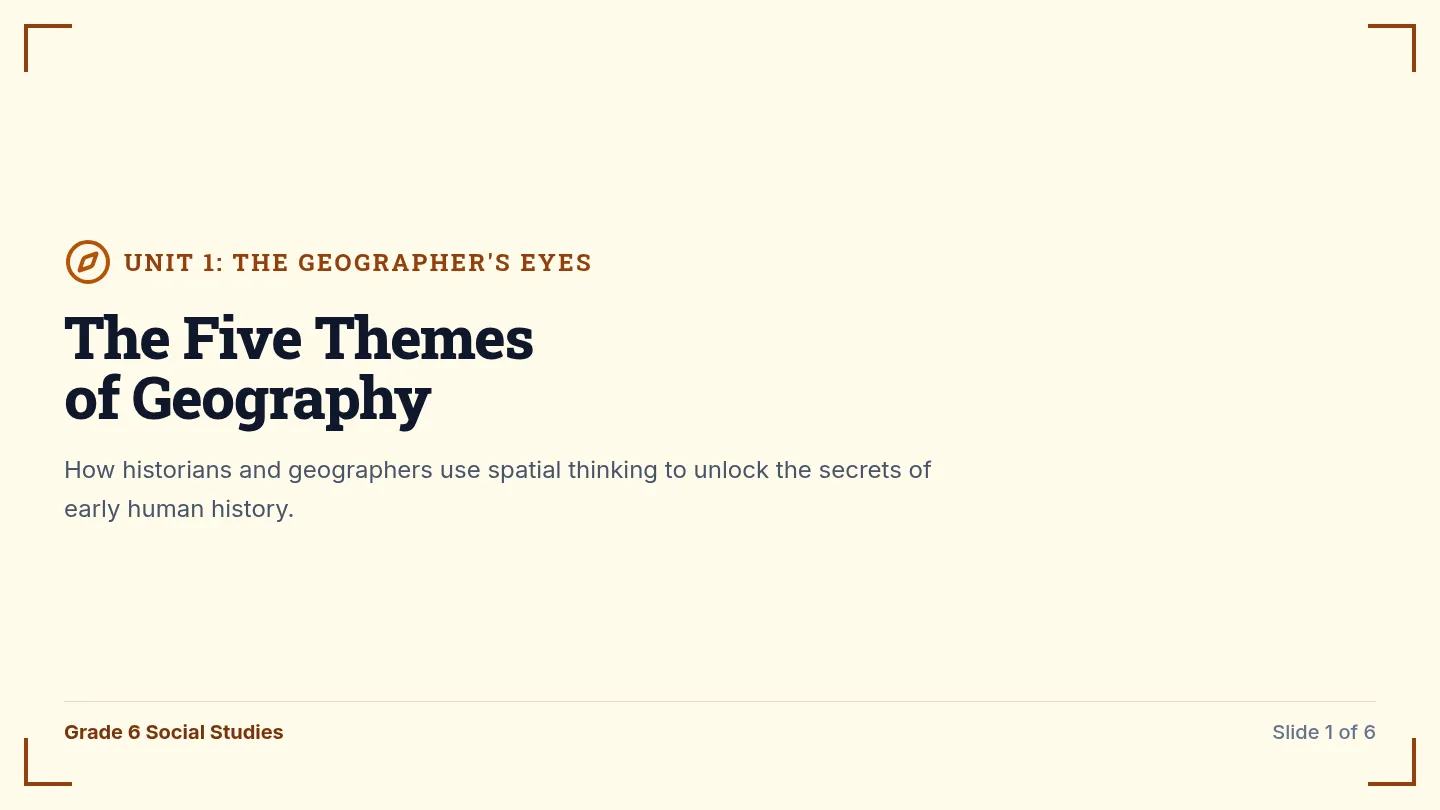
Unit 1: The Geographer's Eyes
The Five Themes
of Geography
How historians and geographers use spatial thinking to unlock the secrets of early human history.
Grade 6 Social Studies Slide 1 of 6
The Geographer's Quest
Intro to Spatial Thinking
What is Spatial Thinking?
History isn't just about when things happened—it is deeply shaped by where they happened.
By asking "Why is it there?" geographers discover patterns of resources, paths of trade, and reasons why empires rose or fell.
Core Questions
Where is it located?
Why is it there?
How does it impact human life?
Cradle of Humanity Slide 2 of 6
Theme 1 & 2: Location & Place
Where & What?
1
Location: Where is it?
- Absolute Location: Exact address or coordinates (latitude and longitude).
- Relative Location: Described by landmarks nearby (e.g., "east of the river").
2
Place: What is it like?
- Physical Features: Nature-made (mountains, rivers, climates, soil types).
- Human Features: Person-made (languages, religions, architecture, population).
Cradle of Humanity Slide 3 of 6
Theme 3: Human-Environment Interaction
How We Connect
The Dynamic Relationship
Humans do not just live in a landscape; they actively interact with it.
Throughout history, humans have had to make key choices to survive when environmental realities changed.
We ADAPT (Change Ourselves)
Wearing heavy animal furs in cold northern climates, or traveling at night to avoid harsh desert sun.
We MODIFY (Change nature)
Building massive irrigation dams to direct river water to thirsty crops, or clear-cutting forests.
Cradle of Humanity Slide 4 of 6
Theme 4 & 5: Movement & Region
How Ideas & Areas Connect
4
Movement: The Flow
How people, goods, and ideas travel from one place to another.
- Migration of nomadic bands following herds.
- Trade of valuable resources like salt and obsidian.
5
Region: Common Bonds
An area unified by one or more matching characteristics.