Citizen Quest Questionnaire PA CIVICS 2026
CITIZEN QUEST
Unit 1 Launchpad: Introduction to Democracy & Community Engagement
Student Name
Class Period
Date
PART 1: MY CIVIC IDENTITY
1. If you were given a $50,000 grant to improve your local Pennsylvania neighborhood, what specific issue would you address?
2. In your own words, what is the biggest difference between a "right" (what you are allowed to do) and a "responsibility" (what you should do)?
PART 2: PA CIVICS KNOWLEDGE MAP
Don't worry if you aren't sure—this helps us see where we are starting! Select one option for each question.
3. Pennsylvania's state legislature is officially known as which of the following?
A The PA Congress
B The General Assembly
C The Harrisburg Council
4. Which principle of democracy guarantees that no citizen or government official is above the law?
A Popular Sovereignty
B Rule of Law
C Federal Representation
5. Under federalism, some powers belong to the US Government, and some belong to the Commonwealth of Pennsylvania. Name one service or law managed directly by state or local governments:
PART 3: CIVIL DISCOURSE ALLIANCE
Civics involves talking about big ideas, rules, and structures that impact us all. To build a classroom where everyone is respected, we will commit to these guidelines. Read them and complete the response below.
1. Attack the Idea, Not the Person: Focus disagreements on claims, arguments, and facts rather than labels or character.
2. Active Listening First: Strive to understand your peers' perspectives before formulating a counter-argument.
3. Support with Evidence: Back up claims with logical reasoning, constitutional text, historical examples, or data.
4. Leave Room for Growth: Be willing to change your perspective when presented with convincing facts.
Pledge: I agree to actively practice these guidelines. One norm that I find most important is:
Unit 1: Foundations of Pennsylvania Civics Pennsylvania Core Standards 5.1 & 5.2 Page 1 of 1
Civic Map Graphic Organizer PA CIVICS 2026
CIVIC LANDSCAPE MAP
Standard 5.1-5.2: Mapping Core Principles & PA State Powers
Student Name
Class Period
Date
Pillar 1: Four Foundational Principles of American Democracy
💡 MATCHING CLUE BOARD:
[A] Citizens voting in local PA elections.
[B] PA Governor gets pulled over for speeding (applies to all).
[C] Paying federal tax AND state sales tax at the counter.
[D] Laws made by General Assembly, signed by Governor.
Popular Sovereignty Power to People
The authority of government is sustained by the consent of its citizens (voting).
Which clue matches? (A, B, C, or D)
Rule of Law No One is Above
The law applies equally to everyone, including all government leaders and rulers.
Which clue matches? (A, B, C, or D)
Federalism Dual Power Map
Power is shared and divided between national (federal) and state governments.
Which clue matches? (A, B, C, or D)
Separation of Powers Three Branches
Government branches have unique roles to prevent any single entity from absolute control.
Which clue matches? (A, B, C, or D)
Pillar 2: Comparative Power Matrix (PA vs. Federal)
📦 PA STATE WORD BANK (Copy into the matching boxes below):
PA Governor PA General Assembly PA Supreme Court
EXECUTIVE
Enforces the Law
Federal Level President of the United States
PA Commonwealth Level
LEGISLATIVE
Makes the Law
Federal Level US Congress (Senate + House)
PA Commonwealth Level
JUDICIAL
Interprets the Law
Federal Level US Supreme Court
PA Commonwealth Level
💡 Synthesis Question (Select the best statement):
How does Federalism (dividing power between PA and the US Government) protect your personal freedom?
It ensures no single government or leader has absolute control over everything in our lives.
It makes laws identical across all fifty states so that there are never any regional differences.
Unit 1: Foundations of Pennsylvania Civics Pennsylvania Core Standards 5.1 & 5.2 Page 1 of 1
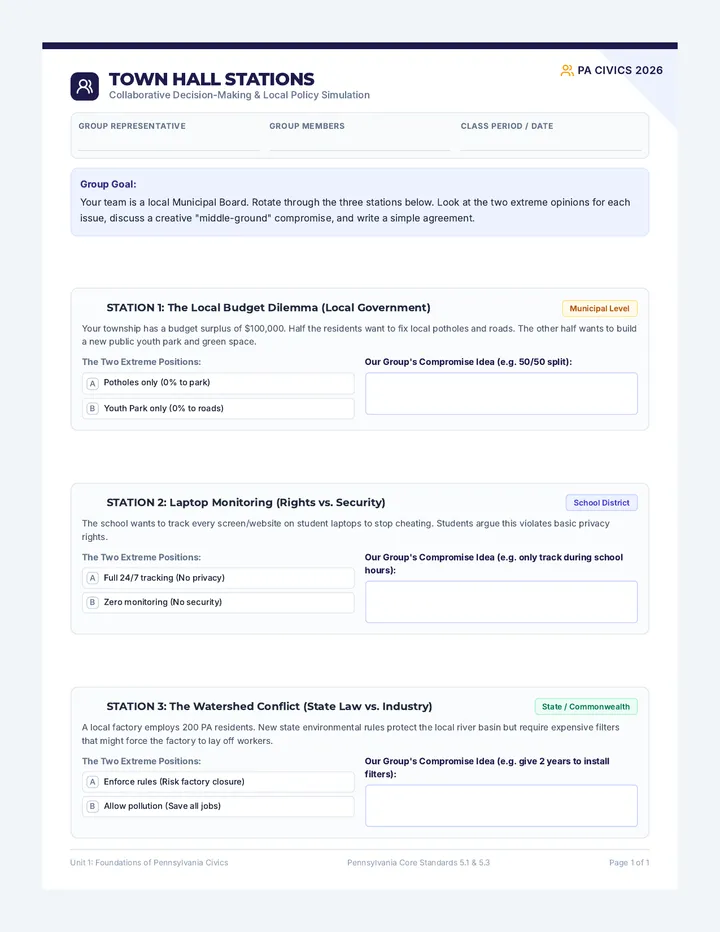
Town Hall Station Activity PA CIVICS 2026
TOWN HALL STATIONS
Collaborative Decision-Making & Local Policy Simulation
Group Representative
Group Members
Class Period / Date
Group Goal: Your team is a local Municipal Board. Rotate through the three stations below. Look at the two extreme opinions for each issue, discuss a creative "middle-ground" compromise, and write a simple agreement.
1 STATION 1: The Local Budget Dilemma (Local Government)
Municipal Level
Your township has a budget surplus of $100,000. Half the residents want to fix local potholes and roads. The other half wants to build a new public youth park and green space.
The Two Extreme Positions:
A Potholes only (0% to park)
B Youth Park only (0% to roads)
Our Group's Compromise Idea (e.g. 50/50 split):
2 STATION 2: Laptop Monitoring (Rights vs. Security)
School District
The school wants to track every screen/website on student laptops to stop cheating. Students argue this violates basic privacy rights.
The Two Extreme Positions:
A Full 24/7 tracking (No privacy)
B Zero monitoring (No security)
Our Group's Compromise Idea (e.g. only track during school hours):
3 STATION 3: The Watershed Conflict (State Law vs. Industry)
State / Commonwealth
A local factory employs 200 PA residents. New state environmental rules protect the local river basin but require expensive filters that might force the factory to lay off workers.
The Two Extreme Positions:
A Enforce rules (Risk factory closure)
B Allow pollution (Save all jobs)
Our Group's Compromise Idea (e.g. give 2 years to install filters):
Unit 1: Foundations of Pennsylvania Civics Pennsylvania Core Standards 5.1 & 5.3 Page 1 of 1
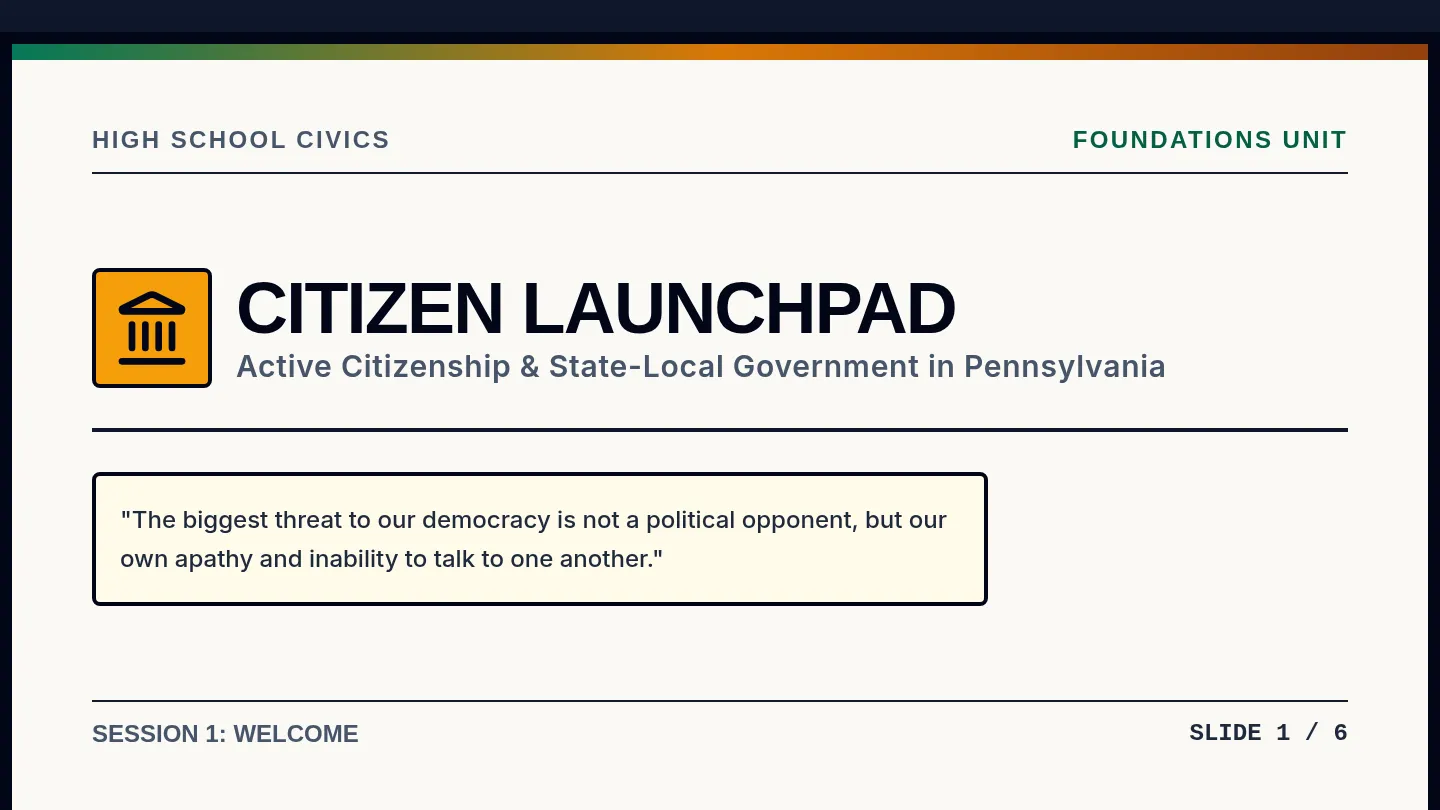
Citizen Launchpad Slides HIGH SCHOOL CIVICS FOUNDATIONS UNIT
CITIZEN LAUNCHPAD
Active Citizenship & State-Local Government in Pennsylvania
"The biggest threat to our democracy is not a political opponent, but our own apathy and inability to talk to one another."
SESSION 1: WELCOME SLIDE 1 / 6
CIVIL DISCOURSE OUR COMMITMENT
Rules of Engagement
Establishing our norms for meaningful discussion and civil debate.
Discourse Norms
Focus on Ideas, Not Identities: Challenge the policy or argument, never attack the person.Listen to Understand: Don't just plan your next argument; truly process your peer's viewpoint.
Our Civic Contract
"We agree to maintain an open mind, back our claims with evidence, and prioritize mutual compromise over winning arguments. This room is a lab for civic ideas, and everyone's voice has value."
Student Signatures: Class Agreement ✓
CIVIC DISCOURSE CONTRACT SLIDE 2 / 6
ICEBREAKER STUDENT SURVEY
Your Citizen Quest
Connecting our personal skills and everyday passions to community actions.
Who are you in your community?
Civics isn't just about politicians in Washington or Harrisburg—it starts with your hobbies, your family, and your local streets.
1
Daily Infrastructure
What is one specific local issue that directly impacts your day-to-day life?
2
Your Civic Footprint
How can your unique interests (sports, arts, technology) help improve your neighborhood?
3
The Magic Wand Question
If you could change one state or local law in Pennsylvania tomorrow, what would it be?
CITIZEN QUEST PREVIEW SLIDE 3 / 6
GOVERNMENT STRUCTURES PA CIVICS
Mapping Pennsylvania Power
Understanding the division of labor between your state capital and your hometown.
State Level
Harrisburg • Governor & General Assembly
Highways & Transportation (PennDOT)
Statewide Education Standards & Funding
Professional Licensing (Doctors, Teachers)
Local Level
Boroughs, Townships, Cities, & School Boards
Trash, Recycling, & Local Road Paving
Zoning, Housing, Parks, & Public Safety
Local School District Policies & Calendars
CLASSROOM DEBATE QUESTION: Which level of government impacts your day-to-day routine more? Why?