BOLD BOLD unclear words and define in a comment.
💬 Write questions as comments.
Source 1 (With Your Teacher) Annotate text directly
Eric (Max’s good friend): “The new kid (Justin) definitely started it. He really just attacked out of nowhere. He’s a freak, and he seriously thinks he’s better than everyone because of his dad.”
Annotation Check: Who is blamed? Symbol: ________ Blames: _______________________
Bias / Loaded Word Detected: Circled Word: __________________________________
Source 2 (Independently) Annotate text directly
Megan (Max’s girlfriend): “I wasn’t there. All I can say is that Max has been really different lately and kind of mean. I don’t know what’s going on, but he’s not himself.”
Was Megan an eyewitness? Yes / No — Evidence: __________________________
What does she reveal about Max? Annotation: _____________________________________
UNIT G1.0.B.3 | Historical Thinking Page 2 of 5 SQ 3: What practices do historians use to examine sources?
Guided Notes & Sourcing Cases
🔍 Guided Notes (Slide 8):
Source (v.): Determining _________________ created a document, _________________ it was created, _________________ it was created, and _________________ it was created.
⚠️ Confusion Caution: You source (verb) a historical source (noun).
Sourcing Practice #1: Witness Account Lunchroom Case
Max wrote this account because the principal asked all witnesses to write down what they saw.
Max: “That kid is psycho. He turned around and punched me out of nowhere. Me and my friends were standing in line just joking around, and he turned around and punched me for no reason. He’s messed up and creepy. Ask anyone.”
1. Who wrote this? What do we know about the author?
2. Why was it written? What was the author's purpose?
3. What is the author's point of view as to why the fight happened?
Sourcing Practice #2: Historical Illustration Primary vs. Secondary
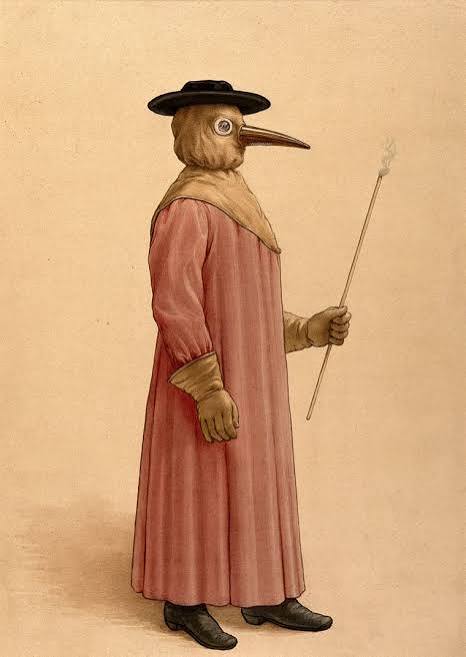
The image to the right was made in 1910. It depicts clothing worn by doctors when treating patients with the plague, a disease that killed large numbers of people in Europe in the 14th century (1300s) and 17th century (1600s). The artist based the drawing on information from a book written in 1721 by Jean Jacques Manget.
Plague Doctor Costume (1910)
4. Why might the artist have drawn this image? (Author's purpose)
5. When was this drawn? How do you know?
6. Primary or secondary source? Why?
UNIT G1.0.B.3 | Historical Thinking Page 3 of 5 SQ 3: What practices do historians use to examine sources?
Guided Notes & Passage
📖 Guided Notes (Slide 11):
Close Read (v.): The act of reading a source to identify the author's ____________________ or point of view and examine ____________________ they are making it.
1. What claims are made?
2. What evidence is used?
3. What persuasive language is used?
4. How does language show POV?
Close Reading Practice Passage Read carefully & answer questions below
1Home-cooked food is healthier than fast food. According to a recent study by the Palo Alto Medical
2Foundation, fast food burgers have on average 71 calories per ounce compared to homemade burgers
3that contain 67 calories per ounce. That means that a fast food quarter pound burger (4 oz.), has sixteen
4more calories than the same burger made at home. Those added calories could lead to weight gain,
5which can be bad for one’s health. In addition, in a 2005 study, Dr. Harold Haines states “people who
6eat fast food meals more than twice a week gain about 9.92 pounds and are more likely to get diabetes
7than people who eat home cooked meals (2).” The more fast food you eat, the more overweight you will
8be, and the more likely it is that you will have health problems like heart disease, or diabetes which can
9prevent you from living an enjoyable and long life with your loved ones.
7. What claim does the author make about home-cooked food?
8. What specific evidence does the author use to support his/her claim?
9. In addition to evidence, how does the author try to persuade the reader in lines 7 through 9?
UNIT G1.0.B.3 | Historical Thinking Page 4 of 5 SQ 3: What practices do historians use to examine sources?
Independent Assessment
SQ: What practices do historians use to examine sources?
Task 1 Describe how historians evaluate sources with sourcing, annotating, and close reading:
Practice Historians Use
How historians use the practice to evaluate sources
Annotate
Source
Close Read
Task 2 Read the statement below from Max’s mother, then annotate, source, and close read.
Max’s mother: “Max would never start a fight. He’s the sweetest boy. I know he’s had a hard time lately with me and his dad losing our jobs, but he still would never start a fight with anyone. He’s a mentor to the younger boys and helps out at church. You can ask anyone in this town.”
2a. Who wrote this? What do we know about the author?
2b. Why was it written? (Author's purpose)
3. Close Read: From this author’s point of view, who started the fight? Why does she believe that?
UNIT G1.0.B.3 | Historical Thinking Page 5 of 5 SQ 3: What practices do historians use to examine sources?