Forum Debates Teacher Guide CKLA Grade 3 • Unit 4 Reader: Stories of Ancient Rome
Chapter 1: "Rome: Then and Now" Seminar Guide
Reader pp. 2–11
Estimated Time: 65–75 Min
Indiana Academic Standards (IAS 2023)
3.RC.1: Ask and answer questions referring explicitly to Chapter 1 as the basis for answers.3.RC.2: Explain how key details about Roman structures support the main idea of Rome's enduring legacy.3.SL.1: Engage in collaborative fishbowl discussions with diverse partners.3.SL.3: Ask and answer questions about peer claims with specific elaboration.
Learning Objectives
Content: Students will analyze how Chapter 1 contrasts modern Rome (cars, tourists, gelato) with ancient Roman ruins (Colosseum, Pantheon, Forum, aqueducts), evaluating which Roman legacy is most significant.
Discourse: Students will substantiate claims by quoting Chapter 1 page numbers (pp. 2–11) and using sentence frames to elaborate and question peers respectfully.
Fishbowl Structure: Inner Circle (Orators debating Chapter 1) • Outer Circle (Scribes tracking quotes)
10–12 Min Per Group
1
Before Reading: Then vs. Now Schema (15 min)
Student Organizer: Part A
1. Visual Contrast Hook
Display a picture of a modern Vespa scooter parked next to the Roman Colosseum. Ask: "How can a 2,000-year-old building stand in the middle of a modern city?"
2. Chapter 1 Anticipation
Have students complete the 3 Agree/Disagree statements focusing on modern Rome, ancient concrete, and Roman Latin roots in English.
3. Vocabulary Unpack
Review Chapter 1 vocabulary: ruins, Forum, Colosseum, Pantheon, aqueduct, concrete . Note their pronunciation and meanings.
2
During Reading: Evidence Mining in Chapter 1 (20 min)
Student Organizer: Part B
Read Chapter 1 ("Rome: Then and Now", pp. 2–11) in CKLA Reader Stories of Ancient Rome . Students read in pairs with teacher check-ins, logging text evidence on their organizers.
Track Modern vs. Ancient Contrast (pp. 2–5): Record how the author describes life in Rome today (cars, food, crowds) vs. ancient ruins standing right next to modern buildings.
Track Architectural Marvels (pp. 6–9): Note exact text facts about the Colosseum (gladiators), the Pantheon (dome and oculus), and the Roman Forum (heart of public life).
Track Inventions & Language (pp. 10–11): Identify details on aqueducts bringing clean water, paved stone roads, and Latin words that survive in modern English.
Stories of Ancient Rome • Chapter 1: "Rome: Then and Now" • Socratic Seminar Plan Page 1 of 2
Chapter 1 Seminar Dialogue, Prompts & Debrief
Phases 3 & 4
3
Fishbowl Seminar Protocol (25 min total)
Two 12-Min Fishbowl Rounds
Teacher Facilitation: Act as moderator and timekeeper. When conversation lulls, ask: "Who can point to a sentence on pages 6–9 that supports or challenges what was just said?"
Opening Prompt (Round 1 • Text Analysis): "On pages 2–5, the author describes modern Rome with motor scooters, buses, and coffee shops right next to 2,000-year-old ruins. Why does the author start the story by comparing 'Then' and 'Now'?"
Core Analytic Prompt (Round 1 & 2 • Central Debate): "Of all the Roman achievements highlighted in Chapter 1—the Colosseum, the Pantheon dome, the Roman Forum, the aqueducts, or paved roads—which was the greatest achievement, and why? What evidence from Chapter 1 proves it?"
Synthesis Prompt (Round 2 • Modern Connection): "In what ways are our communities today in Indiana built like ancient Rome? Look at what Chapter 1 says about public gathering places, water systems, and roads."
4
Post-Seminar Debrief & Scribe Check (15 min)
Student Organizer: Part C & D
Scribe Partner Debrief (4 min)
Outer circle scribes share their tracking sheet with their partner, highlighting one piece of Chapter 1 text evidence they quoted accurately.
Written Exit Synthesis (10 min)
Students complete Part D on their organizer, recording a peer's idea that broadened their perspective and setting a goal for the next seminar.
Differentiation & Support for Chapter 1
Striving Readers / ELL
Provide sticky notes marking Reader pp. 6–7 (Colosseum) and pp. 8–9 (Pantheon). Pair with a strong reader during evidence mining.
Reluctant Speakers
Prompt with a direct fill-in: "On page 8, the text describes the Pantheon's dome made of..." Allow them to read from their organizer.
Advanced / Extension
Ask students to explain why Roman concrete was an engineering breakthrough and how modern sports stadiums mirror the Colosseum.
Stories of Ancient Rome • Chapter 1: "Rome: Then and Now" • Socratic Seminar Plan Page 2 of 2
Forum Explorer Student Organizer CKLA Grade 3 • Unit 4 Stories of Ancient Rome
Chapter 1: "Rome: Then and Now" (pp. 2–11)
Name: ______________________
A
Before Reading: Anticipation Guide & Key Terms
Read each statement before reading Chapter 1. Check whether you Agree or Disagree:
1. Nobody lives in Rome today because it is only made of ancient ruins and empty stones.
Agree Disagree
2. Roman engineers made concrete so strong that buildings like the Pantheon and Colosseum still stand today.
Agree Disagree
3. Ancient Roman words from their Latin language are still hidden inside English words we use today.
Agree Disagree
Chapter 1 Vocabulary Spotlight:
Ruins Broken pieces of old buildings
Colosseum Massive stadium for public games
Pantheon Temple with huge concrete dome
Aqueduct Bridge channel carrying fresh water
B
During Reading: Chapter 1 Evidence Miner
Read pages 2–11 & record details with page numbers
1. Modern Rome vs. Ancient Ruins (pp. 2–5) Page #: _______
What the text describes seeing in Rome today:
What ancient ruins stand right beside the streets:
2. Roman Marvel (Colosseum, Pantheon, Aqueduct, or Roads) (pp. 6–11) Page #: _______
Exact quote or fact explaining how it was built or used:
Why this invention or building was so impressive:
Stories of Ancient Rome • Chapter 1: "Rome: Then and Now" Turn page for Seminar Prep • Page 1 of 2
Phase 3 & 4
Chapter 1 Seminar Prep & Reflection
Name: ______________________
C
After Reading: Prepare Your Seminar Claim
Chapter 1 Central Debate Question
"In Chapter 1, the author writes that ancient Rome is still alive all around us. Which Roman achievement described in this chapter—the Colosseum, the Pantheon dome, aqueducts, or paved roads—was the most important for people? Why?"
My Claim (Write a complete sentence naming your choice and reason):
Evidence #1 from Chapter 1
Quote or fact with Page # (pp. 2–11):
Evidence #2 from Chapter 1
Quote or fact with Page # (pp. 2–11):
Connection: Where can we see a similar building, road, or water system today in America?
D
Post-Seminar: Self-Reflection & Peer Debrief
Roman Orator Stems Handout CKLA Unit 4 • Chapter 1 Rome: Then and Now
Roman Orator Discussion Stems
Use these frames during our Chapter 1 seminar to quote text evidence, ask deep questions, and debate like scholars!
Name: ____________________
1. Quoting Chapter 1 Evidence
• "On page _____, the author writes that..."
• "According to Chapter 1, the Colosseum/Pantheon..."
• "The text states on page _____ that Roman roads..."
• "When the author describes Rome today on page _____..."
2. Asking Inquiring Questions
• "Where in Chapter 1 did you find evidence for that?"
• "Why do you think Romans built with concrete?"
• "What did the author mean by 'Rome is all around us'?"
• "How does that building connect to places we have today?"
3. Building on a Peer's Idea
• "I agree with [Peer] because on page _____..."
• "Adding to what was said, Chapter 1 also shows..."
• "That connects with the description of the Forum..."
• "Another example of that modern connection is..."
4. Respectful Disagreement
• "I see your point, but on page _____ it says..."
• "Another way to view that evidence from Chapter 1 is..."
• "I thought the aqueduct was more important because..."
• "Could you read the sentence from the text again?"
Fishbowl Scribe Tracker (Outer Circle Partner)
Track your partner while they speak!
Listen carefully to your speaking partner during the Chapter 1 debate. Make a tally mark each time they use one of these orator moves:
Quoted Chapter 1 Page #
Asked a Question to a Peer
Built on Someone's Point
Listened Without Interrupting
Partner Shout-Out: The best evidence or idea my partner shared about Chapter 1 was:
Stories of Ancient Rome • Chapter 1: "Rome: Then and Now" • IAS 3.SL.1 & 3.SL.3 Keep on desk during seminar
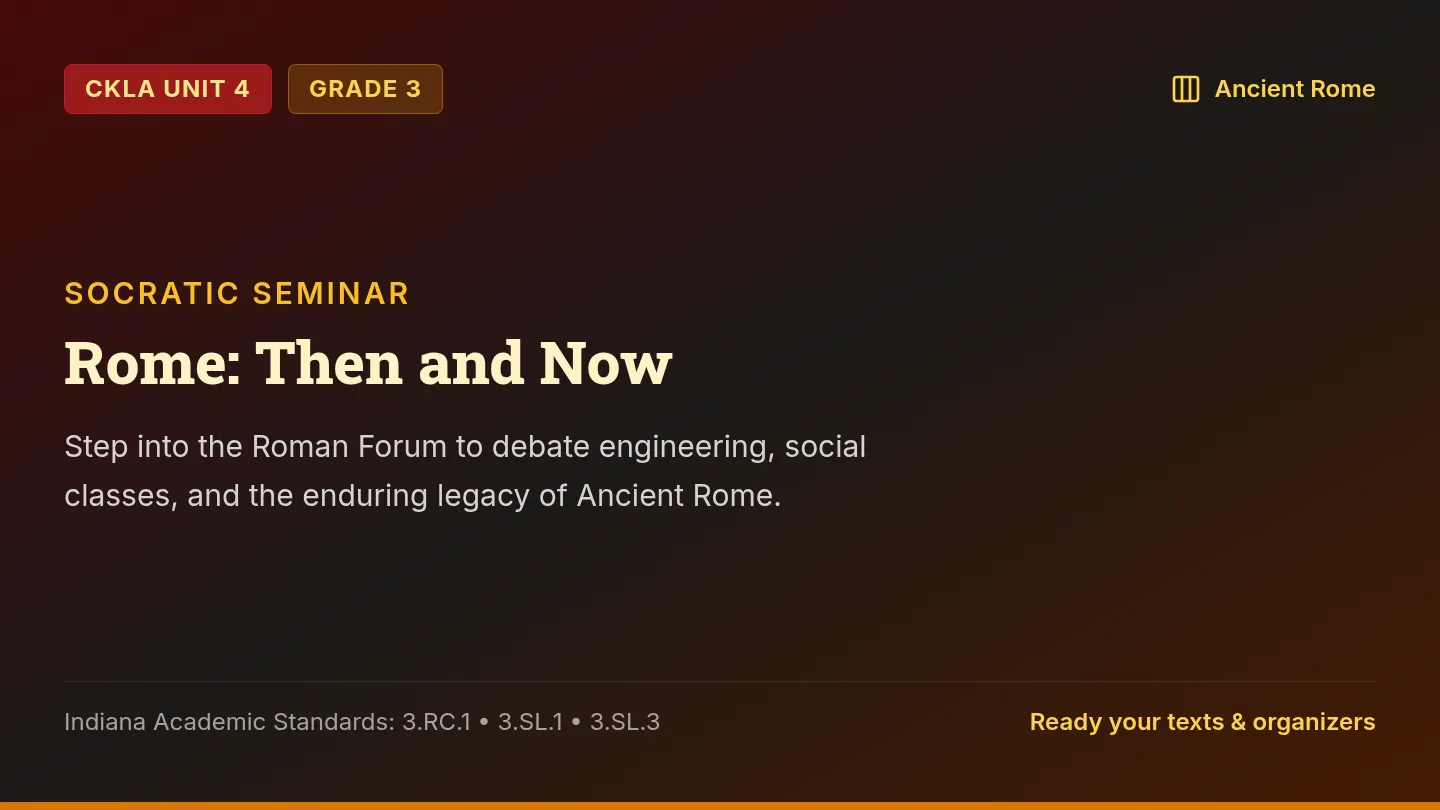
Roman Forum Seminar Slides Stories of Ancient Rome Chapter 1
CKLA Grade 3 Unit 4
Socratic Seminar Discussion
Rome: Then and Now
Debating Chapter 1: Ancient ruins, Roman engineering, and why Rome is still all around us today.
Reader Pages 2–11 • Indiana Academic Standards: 3.RC.1 • 3.SL.1 Ready your texts & organizers
I
The Forum Debate Norms
How 3rd grade scholars speak, listen, and cite evidence:
1. Look at Each Other
Speak directly to your classmates across the circle.
2. Quote Chapter 1 Pages
Always state the exact page number (pp. 2–11).
3. Connect and Build
Link your idea to what a classmate just said.
4. Disagree with Proof
Use text details from the reader to explain your view.
Inner Circle: Orators debate • Outer Circle: Scribes record quotes
II
Chapter 1 Discussion Stems
Choose a stem to start your turn in the circle:
To Cite Evidence
“On page ___, the author writes that...”
“In Chapter 1, it describes the Colosseum as...”
To Ask a Classmate
“Where in Chapter 1 did you read that detail?”
“Why do you think the Romans built with concrete?”
To Build on an Idea
“I agree with [Peer] because on page ___...”
“Adding to that, the text also mentions...”
To Disagree Respectfully
“I see your point, but on page ___ it says...”
“Another way to think about that ruin is...”
Challenge: Try asking one question to a classmate during your round!
Round 1 Modern Rome vs. Ancient Ruins
12 Minutes
Prompt (Reader pp. 2–5):
“Why does the author begin the story by showing modern buses and scooters right beside 2,000-year-old stone ruins? What feeling does that give the reader?”
Check descriptions on pages 2, 3, 4, and 5
Read exact words from the reader
Group A: Orators in the Forum Group B: Scribes recording page quotes
Round 2 Roman Marvels & Legacy
12 Minutes
Central Debate (Reader pp. 6–11):
“Which Roman achievement in Chapter 1—the Colosseum, the Pantheon dome, aqueducts, or paved roads—was the most important achievement, and why?”
Support your choice with text facts