Visual Merchandising Guided Notes
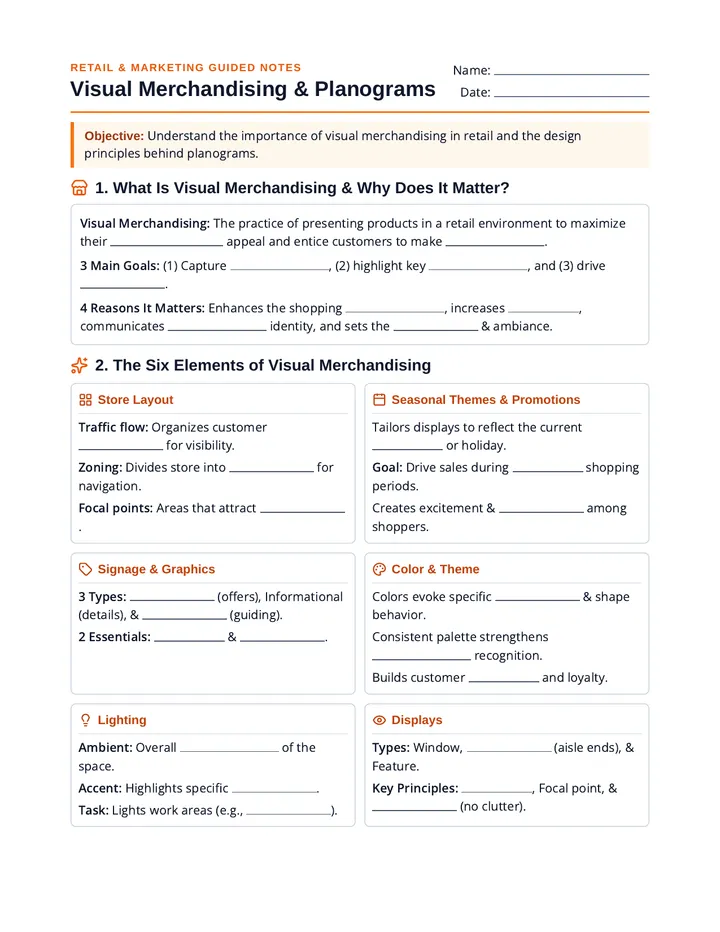
Retail & Marketing Guided Notes
Visual Merchandising & Planograms
Name:
Date:
Objective: Understand the importance of visual merchandising in retail and the design principles behind planograms.
1. What Is Visual Merchandising & Why Does It Matter?
Visual Merchandising: The practice of presenting products in a retail environment to maximize their appeal and entice customers to make .
3 Main Goals: (1) Capture , (2) highlight key , and (3) drive .
4 Reasons It Matters: Enhances the shopping , increases , communicates identity, and sets the & ambiance.
2. The Six Elements of Visual Merchandising
Store Layout
- Traffic flow: Organizes customer for visibility.
- Zoning: Divides store into for navigation.
- Focal points: Areas that attract .
Seasonal Themes & Promotions
- Tailors displays to reflect the current or holiday.
- Goal: Drive sales during shopping periods.
- Creates excitement & among shoppers.
Signage & Graphics
- 3 Types: (offers), Informational (details), & (guiding).
- 2 Essentials: & .
Color & Theme
- Colors evoke specific & shape behavior.
- Consistent palette strengthens recognition.
- Builds customer and loyalty.
Lighting
- Ambient: Overall of the space.
- Accent: Highlights specific .
- Task: Lights work areas (e.g., ).
Displays
- Types: Window, (aisle ends), & Feature.
- Key Principles: , Focal point, & (no clutter).
Part 2: Planograms & Retail Strategy
Slides 10–17
3. What Is a Planogram & Why Use One?
Planogram: A visual or diagram illustrating the placement of products on . It serves as a to maximize visual appeal, , and sales potential.
1. Consistent Product
3. Maximized per Square Foot
2. Optimized Space
4. Streamlined Management
4. The Four Steps of Planogram Design
Step 1: Understand Store Layout & Customer Flow
Examine how shoppers navigate and identify areas, focal points, and potential .
Step 2: Analyze Sales Data & Consumer Behavior
Use data on product , purchasing patterns, and seasonal to optimize assortment, placement, and strategies.
Step 3: Categorize Products & Determine Hierarchy
Sort by function, usage, or target market. Categorize by type, , or price range to prioritize or high-margin items.
Step 4: Principles of Effective Planogram Design
- Logical Grouping: Arrange products in a logical to guide shoppers.
- -Level Placement: Position best-selling items where shoppers look first.
- Cross-Merchandising: Group items (e.g., batteries near electronics).
- Efficient Space: Minimize and maximize .
5. Implementing & Maintaining Planograms
1. Staff Training: Teach staff to read diagrams and reinforce learning with practice.
2. Maintenance & Updates: Monitor levels, replace underperforming items, and update for seasons.
3. Monitor & Analyze: Track sales and sell-through rates, gather feedback, and run observational .
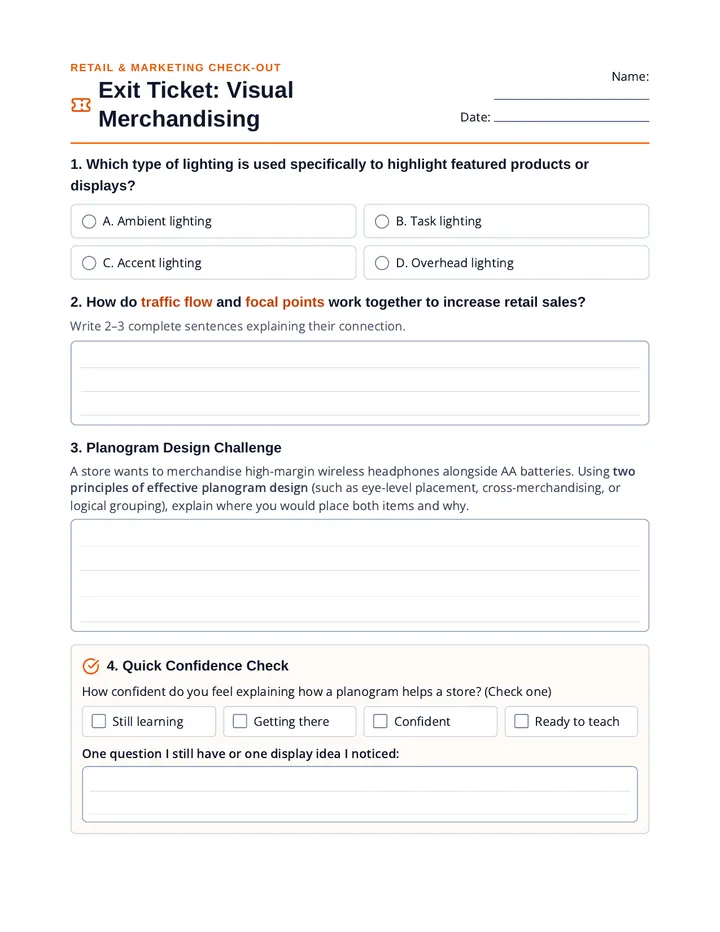
Retail Display Exit Ticket
Retail & Marketing Check-Out
Exit Ticket: Visual Merchandising
Name:
Date:
1. Which type of lighting is used specifically to highlight featured products or displays?
A. Ambient lighting
B. Task lighting
C. Accent lighting
D. Overhead lighting
2. How do traffic flow and focal points work together to increase retail sales?
Write 2–3 complete sentences explaining their connection.
3. Planogram Design Challenge
A store wants to merchandise high-margin wireless headphones alongside AA batteries. Using two principles of effective planogram design (such as eye-level placement, cross-merchandising, or logical grouping), explain where you would place both items and why.
4. Quick Confidence Check
How confident do you feel explaining how a planogram helps a store? (Check one)
Still learning
Getting there
Confident
Ready to teach
One question I still have or one display idea I noticed: