DBQ Why Wall Anchor Chart DBQ Strategy • The “E” Step
🧱 THE WHY WALL 🧱
Never write: “This shows life was hard.” → Follow the 3 Steps to Score 4!
Start
The Artifact (Evidence)
Foundation of your DBQ analysis
1844 Lowell Mill Rules: “All persons in the employ of the mills must be at their looms by 5:00 a.m. and work until 7:00 p.m., with factory gates locked during shifts.”
1
Why #1: Historical Context
What was happening at this time?
Exemplar Thought:
Industrialization was booming in New England, and mill owners used strict schedules to maximize textile output.
Sentence Stems:
• “During this era, ...”
• “Created in response to ...”
2
Why #2: Evidence Meaning
What do specific details reveal?
Exemplar Thought:
Locked gates and 14-hour shifts reveal that workers had almost no personal freedom or control over their time.
Sentence Stems:
• “This detail reveals that ...”
• “The mention of [X] shows ...”
3
Why #3: The Historical Claim
How does this answer the DBQ?
Exemplar Thought:
Early industrial growth came at the cost of worker autonomy, fueling demands for labor reform.
Sentence Stems:
• “Ultimately, this proves ...”
• “Therefore, this artifact shows ...”
Put It Together: The Score 4 “E” (3 Sentences)
Combine all 3 answers!
“During the rise of New England industrialization, mill owners relied on rigid schedules to maximize textile output. The specific detail of locked gates and 14-hour shifts reveals that factory workers had almost no control over their daily lives. Ultimately, this artifact proves that early industrial growth came at the cost of worker autonomy, fueling demands for labor reform.”
Formula: 1 Sentence for Context + 1 Sentence for Evidence Meaning + 1 Sentence for Historical Claim
Score 4 Formula
Papal Decree Why Wall Chart DBQ Strategy • The “E” Step
🧱 THE WHY WALL 🧱
Never write: “This shows they wanted to help.” → Follow the 3 Steps to Score 4!
Start
The Artifact (Evidence)
Foundation of your DBQ analysis
Pope Alexander VI’s Speech to the Spanish King (after Columbus’s return): “I command you, our beloved Spanish King, to lead the [native] peoples dwelling in those islands to embrace the Christian religion. You shall send experienced men to instruct the island’s people in the Christian faith, bringing them out of ignorance and into salvation.”
1
Why #1: Historical Context
What was happening at this time?
Exemplar Thought:
Spain had just funded Columbus’s 1492 voyage, and European monarchs sought papal backing to claim new lands.
Sentence Stems:
• “During this era, ...”
• “Created in response to ...”
2
Why #2: Evidence Meaning
What do specific details reveal?
Exemplar Thought:
Phrases like “command you” and “out of ignorance” reveal that European leaders viewed Indigenous cultures as inferior.
Sentence Stems:
• “This detail reveals that ...”
• “The mention of [X] shows ...”
3
Why #3: The Historical Claim
How does this answer the DBQ?
Exemplar Thought:
Religious conversion served as a primary justification for Spanish colonization and authority over Indigenous peoples.
Sentence Stems:
• “Ultimately, this proves ...”
• “Therefore, this artifact shows ...”
Put It Together: The Score 4 “E” (3 Sentences)
Combine all 3 answers!
“Following Columbus’s 1492 voyage, Spain sought the Catholic Church’s backing to legitimize its claims in the Americas. The Pope’s command to bring native peoples ‘out of ignorance’ reveals that European leaders viewed Indigenous societies as inferior and used religion to justify authority over them. Ultimately, this artifact proves that spreading Christianity served as a central justification for Spanish colonization in the New World.”
Formula: 1 Sentence for Context + 1 Sentence for Evidence Meaning + 1 Sentence for Historical Claim
Score 4 Formula
DBQ Why Wall Worksheet Name: ____________________________________
Date: ________________
DBQ Strategy • The “E” Step
🧱 THE WHY WALL WORKSHEET 🧱
Start
The Artifact (Evidence)
Record the source title and key quote or detail
1
Why #1: Historical Context
What was happening at this time?
Your Thought:
Sentence Stems:
• “During this era, ...”
• “Created in response to ...”
2
Why #2: Evidence Meaning
What do specific details reveal?
Your Thought:
Sentence Stems:
• “This detail reveals that ...”
• “The mention of [X] shows ...”
3
Why #3: The Historical Claim
How does this answer the DBQ?
Your Thought:
Sentence Stems:
• “Ultimately, this proves ...”
• “Therefore, this artifact shows ...”
Put It Together: Your Score 4 “E” (3 Sentences)
Combine all 3 answers below!
Formula: 1 Sentence for Context + 1 Sentence for Evidence Meaning + 1 Sentence for Historical Claim
Score 4 Formula
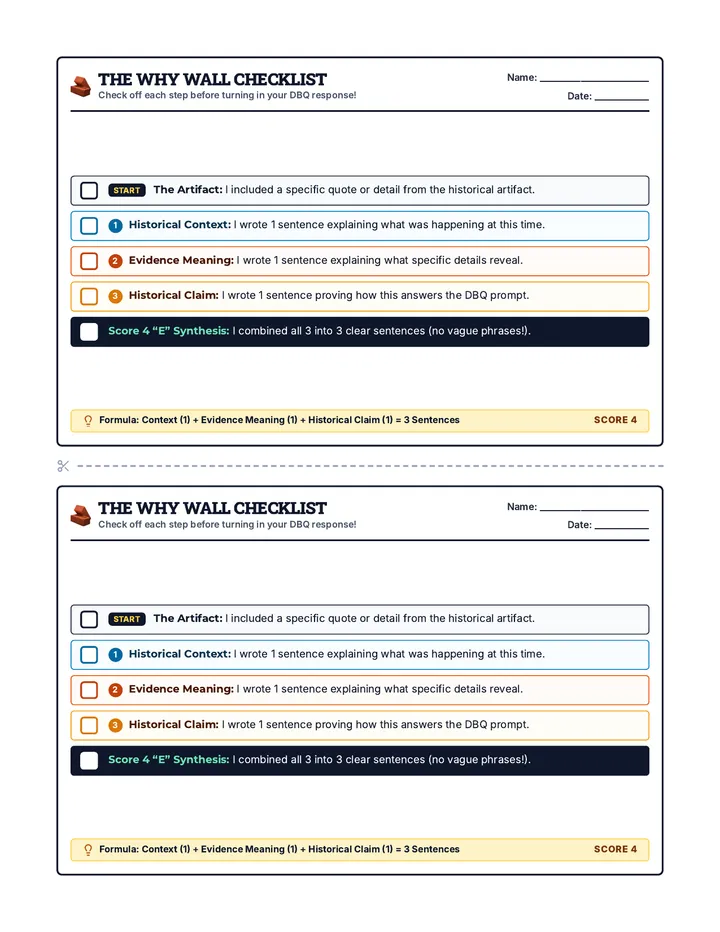
DBQ Why Wall Checklist 🧱
THE WHY WALL CHECKLIST
Check off each step before turning in your DBQ response!
Name: ________________________
Date: ____________
Start The Artifact: I included a specific quote or detail from the historical artifact.
1 Historical Context: I wrote 1 sentence explaining what was happening at this time.
2 Evidence Meaning: I wrote 1 sentence explaining what specific details reveal.
3 Historical Claim: I wrote 1 sentence proving how this answers the DBQ prompt.
Score 4 “E” Synthesis: I combined all 3 into 3 clear sentences (no vague phrases!).
Formula: Context (1) + Evidence Meaning (1) + Historical Claim (1) = 3 Sentences
Score 4
🧱
THE WHY WALL CHECKLIST
Check off each step before turning in your DBQ response!
Name: ________________________
Date: ____________
Start The Artifact: I included a specific quote or detail from the historical artifact.
1 Historical Context: I wrote 1 sentence explaining what was happening at this time.
2 Evidence Meaning: I wrote 1 sentence explaining what specific details reveal.
3 Historical Claim: I wrote 1 sentence proving how this answers the DBQ prompt.
Score 4 “E” Synthesis: I combined all 3 into 3 clear sentences (no vague phrases!).
Formula: Context (1) + Evidence Meaning (1) + Historical Claim (1) = 3 Sentences
Score 4
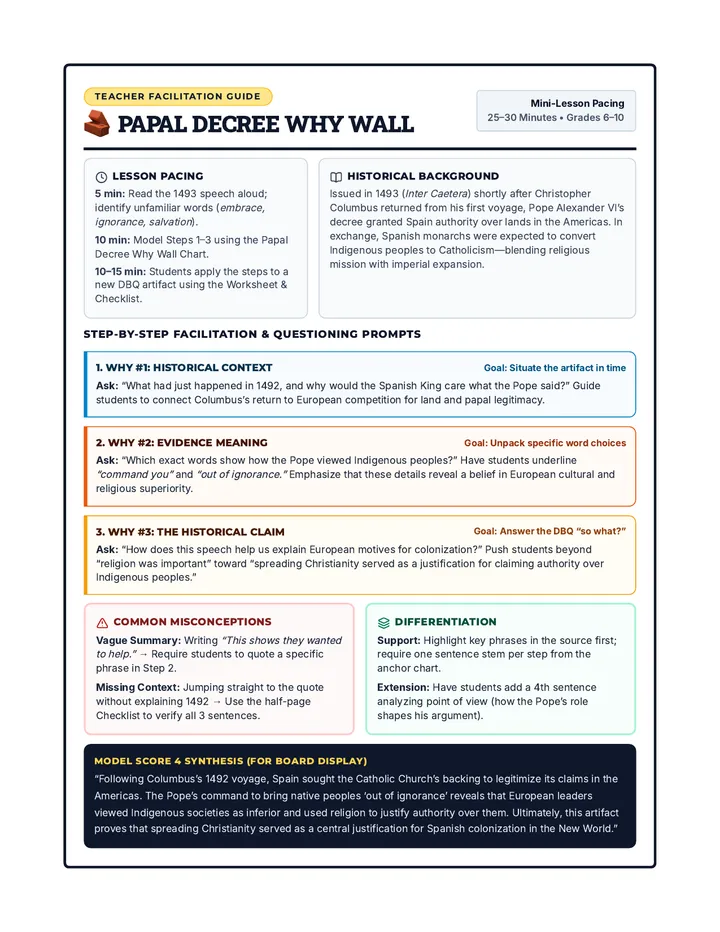
Papal Decree Teacher Guide Teacher Facilitation Guide
🧱 PAPAL DECREE WHY WALL
Mini-Lesson Pacing
25–30 Minutes • Grades 6–10
Lesson Pacing
5 min: Read the 1493 speech aloud; identify unfamiliar words (embrace, ignorance, salvation ).10 min: Model Steps 1–3 using the Papal Decree Why Wall Chart.10–15 min: Students apply the steps to a new DBQ artifact using the Worksheet & Checklist.
Historical Background
Issued in 1493 (Inter Caetera ) shortly after Christopher Columbus returned from his first voyage, Pope Alexander VI’s decree granted Spain authority over lands in the Americas. In exchange, Spanish monarchs were expected to convert Indigenous peoples to Catholicism—blending religious mission with imperial expansion.
Step-by-Step Facilitation & Questioning Prompts
1. Why #1: Historical Context Goal: Situate the artifact in time
Ask: “What had just happened in 1492, and why would the Spanish King care what the Pope said?” Guide students to connect Columbus’s return to European competition for land and papal legitimacy.
2. Why #2: Evidence Meaning Goal: Unpack specific word choices
Ask: “Which exact words show how the Pope viewed Indigenous peoples?” Have students underline “command you” and “out of ignorance.” Emphasize that these details reveal a belief in European cultural and religious superiority.
3. Why #3: The Historical Claim Goal: Answer the DBQ “so what?”
Ask: “How does this speech help us explain European motives for colonization?” Push students beyond “religion was important” toward “spreading Christianity served as a justification for claiming authority over Indigenous peoples.”
Common Misconceptions
Vague Summary: Writing “This shows they wanted to help.” → Require students to quote a specific phrase in Step 2.Missing Context: Jumping straight to the quote without explaining 1492 → Use the half-page Checklist to verify all 3 sentences.
Differentiation
Support: Highlight key phrases in the source first; require one sentence stem per step from the anchor chart.Extension: Have students add a 4th sentence analyzing point of view (how the Pope’s role shapes his argument).
Model Score 4 Synthesis (For Board Display)
“Following Columbus’s 1492 voyage, Spain sought the Catholic Church’s backing to legitimize its claims in the Americas. The Pope’s command to bring native peoples ‘out of ignorance’ reveals that European leaders viewed Indigenous societies as inferior and used religion to justify authority over them. Ultimately, this artifact proves that spreading Christianity served as a central justification for Spanish colonization in the New World.”