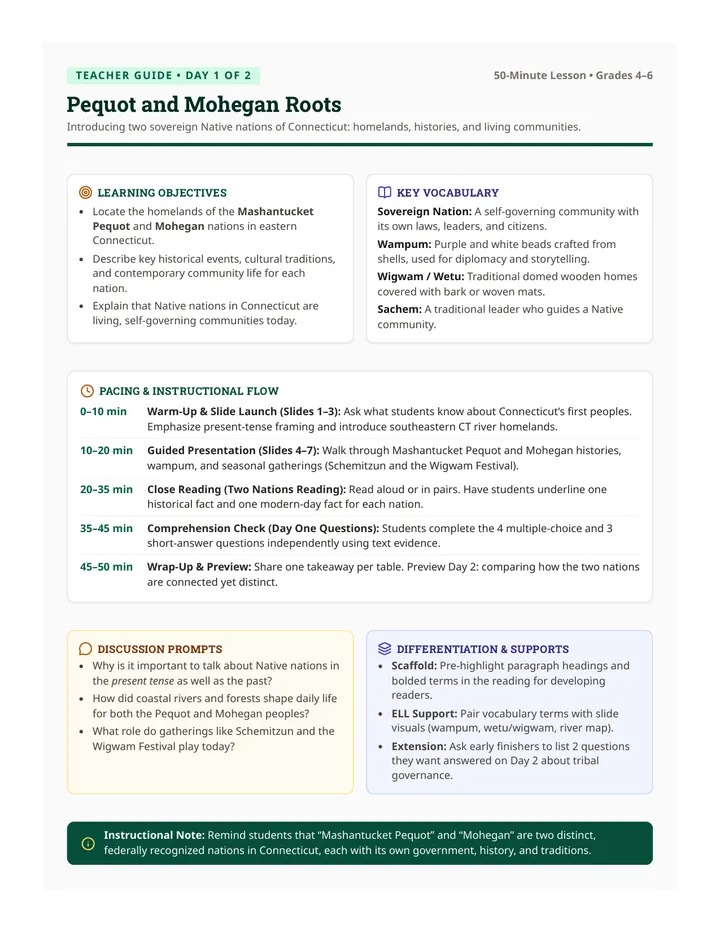
Day One Lesson Plan Teacher Guide • Day 1 of 2 50-Minute Lesson • Grades 4–6
Pequot and Mohegan Roots
Introducing two sovereign Native nations of Connecticut: homelands, histories, and living communities.
Learning Objectives
Locate the homelands of the Mashantucket Pequot and Mohegan nations in eastern Connecticut.
Describe key historical events, cultural traditions, and contemporary community life for each nation.
Explain that Native nations in Connecticut are living, self-governing communities today.
Key Vocabulary
Sovereign Nation:
A self-governing community with its own laws, leaders, and citizens.
Wampum:
Purple and white beads crafted from shells, used for diplomacy and storytelling.
Wigwam / Wetu:
Traditional domed wooden homes covered with bark or woven mats.
Sachem:
A traditional leader who guides a Native community.
Pacing & Instructional Flow
0–10 min
Warm-Up & Slide Launch (Slides 1–3): Ask what students know about Connecticut’s first peoples. Emphasize present-tense framing and introduce southeastern CT river homelands.
10–20 min
Guided Presentation (Slides 4–7): Walk through Mashantucket Pequot and Mohegan histories, wampum, and seasonal gatherings (Schemitzun and the Wigwam Festival).
20–35 min
Close Reading (Two Nations Reading): Read aloud or in pairs. Have students underline one historical fact and one modern-day fact for each nation.
35–45 min
Comprehension Check (Day One Questions): Students complete the 4 multiple-choice and 3 short-answer questions independently using text evidence.
45–50 min
Wrap-Up & Preview: Share one takeaway per table. Preview Day 2: comparing how the two nations are connected yet distinct.
Discussion Prompts
Why is it important to talk about Native nations in the present tense as well as the past?
How did coastal rivers and forests shape daily life for both the Pequot and Mohegan peoples?
What role do gatherings like Schemitzun and the Wigwam Festival play today?
Differentiation & Supports
Scaffold: Pre-highlight paragraph headings and bolded terms in the reading for developing readers.ELL Support: Pair vocabulary terms with slide visuals (wampum, wetu/wigwam, river map).Extension: Ask early finishers to list 2 questions they want answered on Day 2 about tribal governance.
Instructional Note: Remind students that “Mashantucket Pequot” and “Mohegan” are two distinct, federally recognized nations in Connecticut, each with its own government, history, and traditions.
Two Nations Slides Day 1 • Connecticut Social Studies Two Nations, One Land
Pequot and Mohegan Roots
Exploring the homelands, histories, and living communities of two sovereign Native nations in Connecticut.
Mashantucket Pequot Tribal Nation • The Mohegan Tribe
Big Idea
Living Nations, Past and Present
Deep Roots in Connecticut
Indigenous peoples have lived along Connecticut’s rivers, forests, and Long Island Sound for more than 10,000 years.
Sovereign Today
Both the Mashantucket Pequot and Mohegan are federally recognized nations with their own governments, laws, and citizens today.
Think About It: Why does using the present tense matter when learning about Native nations?
Word Bank
Key Terms for Our Reading
Sovereign Nation
A self-governing community with its own leaders, laws, and citizens.
Wampum
Purple and white beads made from shells, used for agreements and storytelling.
Wigwam / Wetu
Traditional domed wooden homes covered with tree bark or woven mats.
Sachem
A traditional leader who guides and speaks for a Native community.
Nation Focus 1
Mashantucket Pequot Tribal Nation
Homeland
Southeastern Connecticut forests and coastlands, including Mashantucket (“the much-wooded land”).
Resilience
After surviving the 1637 Pequot War, Pequot families rebuilt their community and gained federal recognition in 1983.
Culture Today
Hosts the annual Schemitzun Green Corn Festival and operates the Mashantucket Pequot Museum.
Language: Algonquian family • Traditional crafts: wampum & basketry
Nation Focus 2
The Mohegan Tribe
Homeland
Along the Thames (Pequot) River in Uncasville, Connecticut, where the Wolf is an important clan symbol.
Leadership
Led historically by Sachem Uncas in the 1600s; later preserved traditions through leaders like Gladys Tantaquidgeon.
Culture Today
Gained federal recognition in 1994; hosts the annual Wigwam Festival and runs the Tantaquidgeon Museum.
Symbol: Mohegan Trail of Life • Traditions: storytelling & herbal medicine
Woodland Life
Caring for Land, Water, and Community
Three Sisters Farming
Corn, beans, and squash planted together so each crop helps the others grow strong.
Rivers and Coast
Dugout canoes, fishing, and shellfish harvesting connected inland villages to Long Island Sound.
Passing Down Knowledge
Elders teach youth through stories, songs, language revitalization, and annual harvest festivals.
Your Turn
Read, Annotate, and Answer
1
Read Two Nations Reading carefully with your partner or class.
2
Underline one historical event and one modern tradition for each nation.
3
Complete Day One Questions Worksheet using evidence from the text.
Tomorrow: We compare the Mashantucket Pequot and Mohegan nations side by side.
Two Nations Reading Day 1 Informational Reading Page 1 of 2
Two Nations, One Land
Exploring the Mashantucket Pequot Tribal Nation and the Mohegan Tribe of Connecticut
Long before Connecticut became a state, Indigenous nations cared for its forests, rivers, and coastline. Today, two of Connecticut’s federally recognized Native nations are the Mashantucket Pequot Tribal Nation and the Mohegan Tribe . Both are sovereign nations , which means they govern their own citizens, make their own laws, and protect their own lands and traditions.
The Mashantucket Pequot Tribal Nation
The word Mashantucket means “the much-wooded land.” For centuries, Pequot families lived in southeastern Connecticut near Long Island Sound and the Mystic and Thames rivers. In spring and summer, they planted corn, beans, and squash—known as the Three Sisters —and harvested fish and shellfish along the coast. In winter, families moved inland to sheltered woodland villages of domed bark homes called wetus (or wigwams).
The Pequot were also skilled makers of wampum , purple and white beads carefully shaped from quahog and whelk shells. Wampum belts recorded important agreements, honored leaders, and carried stories from one generation to the next.
In the 1630s, conflict grew between European colonists and the Pequot over land and trade. During the Pequot War (1636–1637) , many Pequot people were killed or forced from their homes. Even after this tragedy, Pequot families stayed connected to their homeland. In 1666, the colony set aside land at Mashantucket for the tribe, though much of that land was later lost or sold without the tribe’s permission.
Through determination and legal effort, the Mashantucket Pequot Tribal Nation regained federal recognition in 1983 . Today, the nation runs its own tribal government, schools, and health services. Each year, the community welcomes visitors to Schemitzun , a vibrant Green Corn Festival featuring drumming, dancing, and traditional foods, and shares its history at the Mashantucket Pequot Museum & Research Center.
Word Check: Sovereign nation = a self-governing community • Wampum = shell beads used for agreements and storytelling • Wetu = a traditional domed woodland home.
Day 1 Informational Reading Page 2 of 2
The Mohegan Tribe
The Mohegan Tribe’s name, Mohiingan , means “People of the Wolf.” Their traditional homeland lies along the Thames River (historically called the Pequot River) in what is now Uncasville, Connecticut. Like their neighbors, Mohegan families fished the river, hunted in the woodlands, and grew Three Sisters crops.
In the early 1600s, a Mohegan leader—or sachem —named Uncas led the Mohegan people in forming their own independent community. Uncas built alliances with English colonists to protect Mohegan lands and independence during a time of great change in New England.
Over the next three centuries, Mohegan leaders worked tirelessly to keep their culture alive even as Connecticut towns grew around them. One of the most honored Mohegan leaders of the 20th century was Dr. Gladys Tantaquidgeon , a medicine woman, anthropologist, and co-founder of the Tantaquidgeon Museum in Uncasville (opened in 1931). It is the oldest Native-owned and operated museum in the United States.
In 1994 , the Mohegan Tribe officially earned federal recognition. Today, the Mohegan Tribe governs its reservation, cares for elders and youth, and teaches the Mohegan language. Every August, the tribe hosts the Wigwam Festival , celebrating harvest traditions with songs, dances, storytelling, and crafts.
Two Distinct Nations Today
Although the Mashantucket Pequot and Mohegan nations share Algonquian language roots and eastern Connecticut woodlands, they are two separate, proud nations. Each has its own history, government, and cultural centers that keep Native heritage strong for future generations.
Think & Discuss Name one museum or annual festival hosted by each nation today.
Day One Questions Worksheet Day 1 Comprehension Check Two Nations, One Land
Pequot and Mohegan Roots
Name: ____________________________________
Date: ________________
Part A: Multiple Choice. Circle the best answer for each question using evidence from Two Nations Reading .
1. What does it mean that the Mashantucket Pequot and Mohegan are “sovereign nations”?
A. They are ancient groups that no longer exist in Connecticut.
B. They govern their own citizens, make their own laws, and protect their lands.
C. They share one single government and one museum.
D. They only live in Connecticut during the summer months.
2. How did Pequot families traditionally use wampum ?
A. To build domed bark homes for winter shelter
B. To plant corn, beans, and squash together
C. To record important agreements, honor leaders, and carry stories
D. To steer dugout canoes along Long Island Sound
3. Who co-founded the Tantaquidgeon Museum in Uncasville, the oldest Native-owned museum in the United States?
A. Sachem Uncas
B. Dr. Gladys Tantaquidgeon
C. Mashantucket elders in 1666
D. European colonists in 1637
4. Which annual celebration is hosted by the Mashantucket Pequot Tribal Nation?
A. Schemitzun (Green Corn Festival)
B. The Wigwam Festival
C. The Three Sisters Harvest
D. The Thames River Boat Race
Continue to Part B on the next page →
Day 1 Comprehension Check Part B: Short Answer
Part B: Short Answer. Answer each question in complete sentences using details from the reading.
5. Describe how Connecticut’s seasons and geography (forests, rivers, and coast) shaped traditional Pequot and Mohegan daily life.
6. What happened to the Mashantucket Pequot Tribal Nation in 1983, and why was that year important?
7. Give two examples from the reading that show the Mohegan Tribe is an active, living community today.
Day One Answer Key Teacher Answer Key • Day 1 Two Nations, One Land
Day One Answer Key
Part A: Multiple Choice
1. B — They govern their own citizens, make their own laws, and protect their lands.
Rationale: Page 1 defines sovereign nations as self-governing communities with their own citizens, laws, and lands.
2. C — To record important agreements, honor leaders, and carry stories
Rationale: Wampum belts made from quahog and whelk shells served diplomatic and storytelling purposes.
3. B — Dr. Gladys Tantaquidgeon
Rationale: Page 2 notes that Dr. Gladys Tantaquidgeon co-founded the Tantaquidgeon Museum in 1931.
4. A — Schemitzun (Green Corn Festival)
Rationale: The Mashantucket Pequot Tribal Nation hosts Schemitzun; the Mohegan Tribe hosts the Wigwam Festival.
Part B: Sample Short-Answer Responses
5. How Connecticut’s seasons and geography shaped daily life:
In spring and summer, families farmed the Three Sisters (corn, beans, and squash) and fished or harvested shellfish along the rivers and Long Island Sound. In winter, they moved inland to sheltered woodland villages and lived in domed bark homes called wetus (wigwams).
6. What happened to the Mashantucket Pequot Tribal Nation in 1983:
In 1983, the Mashantucket Pequot Tribal Nation regained federal recognition through legal effort and determination. This was important because it officially affirmed their status as a sovereign nation and helped them rebuild their government, schools, and community services.
7. Two examples showing the Mohegan Tribe is an active, living community today:
Answers may include any two: (1) The Mohegan Tribe governs its reservation and cares for elders and youth; (2) they teach the Mohegan language; (3) they operate the Tantaquidgeon Museum in Uncasville; or (4) they host the annual Wigwam Festival every August.
Grading Tip: Accept any accurate student phrasing supported by text evidence from Two Nations Reading .
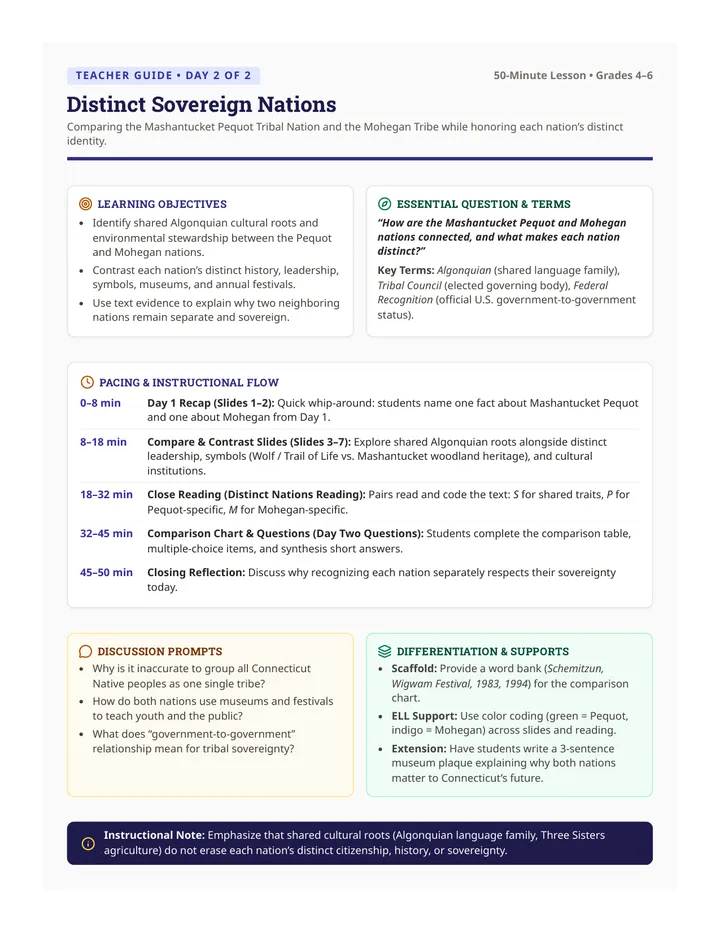
Day Two Lesson Plan Teacher Guide • Day 2 of 2 50-Minute Lesson • Grades 4–6
Distinct Sovereign Nations
Comparing the Mashantucket Pequot Tribal Nation and the Mohegan Tribe while honoring each nation’s distinct identity.
Learning Objectives
Identify shared Algonquian cultural roots and environmental stewardship between the Pequot and Mohegan nations.
Contrast each nation’s distinct history, leadership, symbols, museums, and annual festivals.
Use text evidence to explain why two neighboring nations remain separate and sovereign.
Essential Question & Terms
“How are the Mashantucket Pequot and Mohegan nations connected, and what makes each nation distinct?”
Key Terms: Algonquian (shared language family), Tribal Council (elected governing body), Federal Recognition (official U.S. government-to-government status).
Pacing & Instructional Flow
0–8 min
Day 1 Recap (Slides 1–2): Quick whip-around: students name one fact about Mashantucket Pequot and one about Mohegan from Day 1.
8–18 min
Compare & Contrast Slides (Slides 3–7): Explore shared Algonquian roots alongside distinct leadership, symbols (Wolf / Trail of Life vs. Mashantucket woodland heritage), and cultural institutions.
18–32 min
Close Reading (Distinct Nations Reading): Pairs read and code the text: S for shared traits, P for Pequot-specific, M for Mohegan-specific.
32–45 min
Comparison Chart & Questions (Day Two Questions): Students complete the comparison table, multiple-choice items, and synthesis short answers.
45–50 min
Closing Reflection: Discuss why recognizing each nation separately respects their sovereignty today.
Discussion Prompts
Why is it inaccurate to group all Connecticut Native peoples as one single tribe?
How do both nations use museums and festivals to teach youth and the public?
What does “government-to-government” relationship mean for tribal sovereignty?
Differentiation & Supports
Scaffold: Provide a word bank (Schemitzun, Wigwam Festival, 1983, 1994 ) for the comparison chart.ELL Support: Use color coding (green = Pequot, indigo = Mohegan) across slides and reading.Extension: Have students write a 3-sentence museum plaque explaining why both nations matter to Connecticut’s future.
Instructional Note: Emphasize that shared cultural roots (Algonquian language family, Three Sisters agriculture) do not erase each nation’s distinct citizenship, history, or sovereignty.
Distinct Nations Slides Day 2 • Connecticut Social Studies Two Nations, One Land
Distinct Sovereign Nations
Comparing the Mashantucket Pequot Tribal Nation and the Mohegan Tribe while recognizing each as unique.
Shared Roots • Separate Histories • Sovereign Futures
Warm-Up Review
What We Learned on Day 1
Mashantucket Pequot
“The much-wooded land”
Federal recognition: 1983
Schemitzun Green Corn Festival
Mohegan Tribe
“People of the Wolf”
Federal recognition: 1994
Wigwam Festival & Tantaquidgeon Museum
Today’s Question: How are these two nations connected, and what makes each distinct?
Connections
Shared Eastern Woodland Roots
Language Family
Both nations belong to the Algonquian language family of northeastern North America.
Land & Water
Both cared for eastern Connecticut’s forests, rivers, and coast through Three Sisters farming and fishing.
Sovereignty
Both are federally recognized nations with elected Tribal Councils and tribal citizens.
Differences
Distinct Historical Paths
Mashantucket Pequot Path
Faced the devastating 1637 Pequot War, preserved a small reservation in 1666, and fought in Congress to restore federal recognition in 1983.
Mohegan Path
Led by Sachem Uncas in the 1600s, formed an independent nation along the Thames River, and earned federal recognition in 1994.
Preserving Heritage
Two Museums, Two Stories
Mashantucket Pequot Museum
Opened in 1998 in Mashantucket; one of the largest Native American museums in the nation, featuring a recreated 16th-century village.
Tantaquidgeon Museum
Opened in 1931 in Uncasville by the Tantaquidgeon family; the oldest Native-owned and operated museum in the United States.
Today
Self-Government in Action
Separate Citizenships: A person belongs to their own nation—Pequot and Mohegan each have their own tribal rolls and leaders.
Community Services: Both nations operate police, fire, health clinics, environmental protection, and youth education programs.
Respecting Identity: Calling each nation by its true name honors its history and sovereignty.
Your Turn
Compare with Care
1
Read Distinct Nations Reading and mark S (Shared), P (Pequot), or M (Mohegan).
2
Fill in the comparison chart on Day Two Questions Worksheet .
3
Write thoughtful, text-based answers to the multiple-choice and short-answer questions.
Remember: Similar roots, distinct nations!
Distinct Nations Reading Day 2 Informational Reading Page 1 of 2
Distinct Sovereign Nations
Comparing the Mashantucket Pequot Tribal Nation and the Mohegan Tribe
Shared Algonquian Roots
When you look at a map of eastern Connecticut, the homelands of the Mashantucket Pequot Tribal Nation and the Mohegan Tribe sit only a short drive apart. Because both nations grew up in the same coastal woodland region, they share deep cultural roots.
Both Pequot and Mohegan ancestors spoke closely related languages from the Algonquian language family. Both nations practiced Three Sisters farming, fished Connecticut’s rivers and Long Island Sound, and crafted wampum from coastal shells. Today, both nations are federally recognized , meaning the United States government recognizes each tribe as an independent, self-governing nation with its own Tribal Council, laws, and citizens.
Separate Paths Through History
Even with shared roots, the Mashantucket Pequot and the Mohegan are two separate nations with distinct histories. In the 1630s, Mohegan leader Sachem Uncas guided the Mohegan people to form an independent tribe along the Thames River. During the Pequot War (1636–1637), Uncas allied with English colonists, while the Pequot suffered devastating losses and had to fight for centuries to protect their remaining Mashantucket homeland.
In modern times, each nation also followed its own path to federal recognition. The Mashantucket Pequot Tribal Nation won federal recognition through an act of Congress in 1983 . Eleven years later, in 1994 , the Mohegan Tribe achieved federal recognition through the federal review process.
Reading Tip: Notice how both nations share Connecticut’s environment, yet each has its own timeline, leadership, and story.
Day 2 Informational Reading Page 2 of 2
Unique Museums and Celebrations
Both nations teach their youth and welcome the public to learn about Native history, yet each highlights its own traditions and landmarks:
In Mashantucket, the Mashantucket Pequot Museum & Research Center (opened in 1998) features life-sized exhibits, including a recreated 16th-century Pequot village and coastal dioramas. Every late summer, the nation hosts Schemitzun , a Green Corn Festival celebrating harvest, dance, and Native music from across North America.
In Uncasville, the Mohegan Tribe cares for the Tantaquidgeon Museum , founded in 1931 by Dr. Gladys Tantaquidgeon and her family—the oldest Native-owned and operated museum in the country. Each August, the tribe hosts the Wigwam Festival , honoring the Mohegan Wolf heritage, storytelling, and traditional crafts like basketry and beadwork.
Why Recognizing Each Nation Matters
Sometimes people mistakenly talk about all Native Americans in Connecticut as if they were one group. In reality, the Mashantucket Pequot Tribal Nation and the Mohegan Tribe each have their own citizens, elected leaders, tribal courts, schools, and cultural programs.
Recognizing both what they share and what makes each nation distinct helps us respect their sovereignty and appreciate the rich Native history and living communities of Connecticut today.
Mashantucket Pequot 1983 Recognition • Schemitzun • Mashantucket Pequot Museum
Mohegan Tribe 1994 Recognition • Wigwam Festival • Tantaquidgeon Museum
Day Two Questions Worksheet Day 2 Comprehension & Comparison Two Nations, One Land
Distinct Sovereign Nations
Name: ____________________________________
Date: ________________
Part A: Compare the Two Nations. Complete the chart using details from Distinct Nations Reading .
Feature
Mashantucket Pequot
Mohegan Tribe
Location / Homeland
Year of Federal Recognition
Annual Festival
Tribal Museum
Part B: Multiple Choice. Circle the best answer for each question.
1. Which statement describes something the Mashantucket Pequot and Mohegan nations have in common?
A. Both nations belong to the Algonquian language family and practiced Three Sisters farming.
B. Both nations were founded by Sachem Uncas in 1931.
C. Both nations share the same Tribal Council and the same museum.
D. Both nations received federal recognition in the exact same year.
2. Which statement best explains how the two nations’ histories differed in the 1630s?
A. Both nations moved away from Connecticut to western states.
B. Sachem Uncas led the Mohegan as an independent tribe, while the Pequot suffered heavy losses in the Pequot War.
C. Neither nation had any contact with English colonists until 1983.
D. The Pequot built the Tantaquidgeon Museum during the 1630s.
Continue to Page 2 →
Day 2 Comprehension & Comparison Page 2 of 2
3. Why does the reading say it is inaccurate to group all Native Americans in Connecticut together as one single group?
A. Because Native peoples no longer live in Connecticut today
B. Because each nation has its own distinct history, government, citizens, and cultural traditions
C. Because only one tribe in Connecticut is federally recognized
D. Because the two nations live on opposite sides of the United States
Part C: Short Answer Synthesis. Write complete sentences using evidence from both Day 1 and Day 2 readings.
4. Explain two ways the Mashantucket Pequot Tribal Nation and the Mohegan Tribe are similar, and two ways they are distinct from one another.
5. How do tribal museums (the Mashantucket Pequot Museum and the Tantaquidgeon Museum) help keep each nation’s heritage strong today?
Day Two Answer Key Teacher Answer Key • Day 2 Two Nations, One Land
Day Two Answer Key
Part A: Comparison Chart Key
Feature
Mashantucket Pequot
Mohegan Tribe
Location / Homeland
Southeastern CT (Mashantucket / Mystic & Thames rivers)
Along the Thames River in Uncasville, CT
Federal Recognition
1983 (via act of Congress)
1994 (via federal review process)
Annual Festival
Schemitzun (Green Corn Festival)
Wigwam Festival (every August)
Tribal Museum
Mashantucket Pequot Museum & Research Center (1998)
Tantaquidgeon Museum (1931)
Part B: Multiple Choice
1. A — Both nations belong to the Algonquian language family and practiced Three Sisters farming.
2. B — Sachem Uncas led the Mohegan as an independent tribe, while the Pequot suffered heavy losses in the Pequot War.
3. B — Each nation has its own distinct history, government, citizens, and cultural traditions.
Part C: Sample Short-Answer Synthesis
4. Two similarities and two differences:
Similarities: Both nations speak languages from the Algonquian family, farmed the Three Sisters in eastern Connecticut, and are federally recognized sovereign nations today. Differences: They have different historical timelines (for example, Sachem Uncas led the Mohegan independently while the Pequot endured the 1637 Pequot War; federal recognition in 1983 vs. 1994) and host different annual festivals and museums (Schemitzun & Mashantucket Pequot Museum vs. Wigwam Festival & Tantaquidgeon Museum).
5. How tribal museums keep each nation’s heritage strong:
Tribal museums preserve artifacts, stories, and traditions so tribal youth and the public can learn accurate Native history directly from each nation. The Mashantucket Pequot Museum recreates a 16th-century Pequot village, while the Tantaquidgeon Museum (founded in 1931) preserves Mohegan heritage and crafts.
Assessment Note: Look for accurate pairing of each nation with its own museum, festival, and recognition year.