Oregon Harvest Teacher Guide Grade 4 • Standard 4.FNP.1 • Explicit Instruction
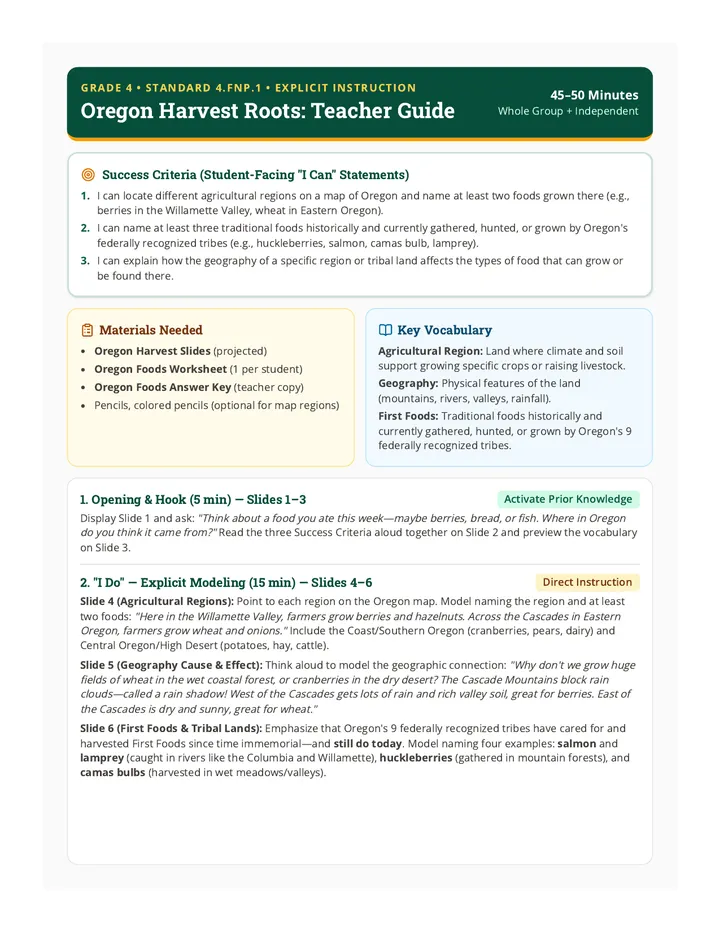
Oregon Harvest Roots: Teacher Guide
45–50 Minutes
Whole Group + Independent
Success Criteria (Student-Facing "I Can" Statements)
I can locate different agricultural regions on a map of Oregon and name at least two foods grown there (e.g., berries in the Willamette Valley, wheat in Eastern Oregon).
I can name at least three traditional foods historically and currently gathered, hunted, or grown by Oregon's federally recognized tribes (e.g., huckleberries, salmon, camas bulb, lamprey).
I can explain how the geography of a specific region or tribal land affects the types of food that can grow or be found there.
Materials Needed
Oregon Harvest Slides (projected)Oregon Foods Worksheet (1 per student)Oregon Foods Answer Key (teacher copy)Pencils, colored pencils (optional for map regions)
Key Vocabulary
Agricultural Region: An area of land where climate and soil support growing specific crops or raising livestock.Geography: Physical features of the land (mountains, rivers, valleys, rainfall).First Foods: Traditional foods historically and currently gathered, hunted, or grown by Oregon's 9 federally recognized tribes.
1. Opening & Hook (5 min) — Slides 1–3
Activate Prior Knowledge
Display Slide 1 and ask: "Think about a food you ate this week—maybe berries, bread, or fish. Where in Oregon do you think it came from?" Read the three Success Criteria aloud together on Slide 2 and preview the vocabulary on Slide 3.
2. "I Do" — Explicit Modeling (15 min) — Slides 4–6
Direct Instruction
Slide 4 (Agricultural Regions): Point to each region on the Oregon map. Model naming the region and at least two foods: "Here in the Willamette Valley, farmers grow berries and hazelnuts. Across the Cascades in Eastern Oregon, farmers grow wheat and onions." Include the Coast/Southern Oregon (cranberries, pears, dairy) and Central Oregon/High Desert (potatoes, hay, cattle).Slide 5 (Geography Cause & Effect): Think aloud to model the geographic connection: "Why don't we grow huge fields of wheat in the wet coastal forest, or cranberries in the dry desert? The Cascade Mountains block rain clouds—called a rain shadow! West of the Cascades gets lots of rain and rich valley soil, great for berries. East of the Cascades is dry and sunny, great for wheat." Slide 6 (First Foods & Tribal Lands): Emphasize that Oregon's 9 federally recognized tribes have cared for and harvested First Foods since time immemorial—and still do today . Model naming four examples: salmon and lamprey (caught in rivers like the Columbia and Willamette), huckleberries (gathered in mountain forests), and camas bulbs (harvested in wet meadows/valleys).
Oregon Harvest Roots: Teacher Guide (continued)
Standard 4.FNP.1
3. "We Do" — Guided Practice (10 min) — Slide 7
Check for Understanding
Use Slide 7 ("Map & Geography Detective"). Read each clue aloud and have students turn-and-talk with a partner for 30 seconds before cold-calling or using thumbs-up/choral response:
Clue A: "Rich river soil, mild temperatures, and plenty of rain. Which region am I, and what grows here?" → Willamette Valley (berries, hazelnuts, Christmas trees).
Clue B: "Fast-flowing rivers and waterfalls where tribal fishers gather protein-rich fish today and long ago." → Columbia/Willamette River systems (salmon, lamprey).
Clue C: "Dry, sunny plateaus east of the Cascades." → Eastern Oregon / Columbia Basin (wheat, onions, potatoes).
4. "You Do" — Independent Practice (15 min) — Slide 8
Student Worksheet
Distribute the Oregon Foods Worksheet . Review directions for all four parts: (1) Locate and label Oregon's agricultural regions and list 2+ foods per region, (2) Name 3+ traditional First Foods of Oregon's federally recognized tribes and how they are gathered/hunted/grown, (3) Explain how geography shapes food in a chosen region or tribal land, and (4) Complete the Exit Ticket self-check. Circulate to give immediate corrective feedback.
5. Closure & Debrief (5 min)
Success Criteria Review
Have 2–3 students share their Part 3 geography explanation aloud. Revisit the three "I Can" statements and ask students to rate their confidence (1–3 fingers). Collect worksheets for formative assessment using the Oregon Foods Answer Key .
Differentiation Supports
Emerging Readers / ELL: Provide a word bank on the board (Willamette Valley, Eastern Oregon, Coastal, Central Oregon, salmon, huckleberries, camas bulb, lamprey ) and sentence frames: "Because the geography has ____, ____ can grow/live there." Extension: Challenge early finishers to compare two regions' climates and explain why a crop from one region could not thrive in the other without irrigation.
Teaching Note: Tribal Sovereignty
Use present tense alongside past tense when discussing Oregon's 9 federally recognized tribes. Emphasize that First Foods (salmon, lamprey, huckleberries, camas) are not just historical—tribal nations actively harvest, steward, and celebrate these foods today.
Quick Assessment Checklist (4.FNP.1)
Success Criterion
Meets Standard (Proficient)
Needs Support
Regions & Foods
Accurately locates regions on the Oregon map and names 2+ foods per region.
Confuses regions or names fewer than 2 foods per region.
Traditional First Foods
Names 3+ traditional foods (e.g., salmon, huckleberries, camas, lamprey) and notes past/present use.
Names fewer than 3 foods or treats tribal foodways as only in the past.
Geography Connection
Clearly links physical geography (rain, soil, mountains, rivers) to why food grows/lives there.
Names a food without explaining how geography affects it.
Oregon Harvest Slides Grade 4 • Standard 4.FNP.1
Oregon Harvest Roots
Where our food grows, how geography shapes the land, and the First Foods of Oregon's tribes.
Agricultural Regions Geography & Climate Traditional First Foods
Our Goal Today
Success Criteria: "I Can..."
1
Locate different agricultural regions on a map of Oregon and name at least two foods grown there.
2
Name at least three traditional foods historically and currently gathered, hunted, or grown by Oregon's federally recognized tribes.
3
Explain how the geography of a region or tribal land affects what food can grow or be found there.
Words to Know
Key Vocabulary
Agricultural Region
An area of land where the weather, soil, and water are just right for growing certain crops or raising animals.
Geography
The natural features of the land—like mountains, valleys, rivers, coastlines, and deserts—plus its climate.
First Foods
Traditional foods that Oregon's tribes have gathered, hunted, fished, and cared for since long ago—and still do today.
Federally Recognized Tribes
Sovereign Native nations in Oregon (9 tribes today) with their own governments, lands, and living traditions.
I Do Oregon Map
Oregon's Agricultural Regions
Coast & South Willamette Valley Central Oregon Eastern Oregon
Dashed line = Cascade Mountains
Willamette Valley
Berries, hazelnuts, grass seed, nursery plants
Eastern Oregon
Wheat, onions, potatoes, cattle
Coast & Southern
Cranberries, pears, dairy cows, seafood
Central Oregon
Hay, potatoes, carrots, beef cattle
I Do Cause & Effect
How Geography Shapes What Grows
Rainy Valleys
Geography: Mild weather, lots of rain, and rich river soil in the Willamette Valley.
→ Great for berries, hazelnuts, and leafy crops!
The Rain Shadow
Geography: The tall Cascade Mountains block rain clouds, making Eastern Oregon dry and sunny.
→ Great for dryland wheat, onions, and cattle!
Rivers & Coast
Geography: Cool ocean fog on the coast and cold, fast rivers across the state.
→ Great for coastal cranberries, dairy, and river fish!
I Do Past & Present
First Foods of Oregon's Tribes
Oregon's 9 federally recognized tribes have gathered, hunted, fished, and cared for these foods for thousands of years—and still do today!
Salmon & Lamprey
Fished in cold, fast rivers and waterfalls (like the Columbia & Willamette Rivers).
Huckleberries
Gathered in cool mountain forests along the Cascade Mountains.
Camas Bulb
Dug and roasted from wet valley meadows where spring water collects.
Wapato & Acorns
Wapato grows in shallow wetlands; acorns come from oak savannas in valleys.
We Do Turn & Talk
Map & Geography Detective
Clue 1: "I have rich river soil, mild temperatures, and lots of rain."
Which Oregon region am I, and what are two foods that grow here?
Clue 2: "I am a cold, rushing river with rocky waterfalls."
Which traditional First Foods do Oregon tribes catch here today and long ago?
Clue 3: "The Cascade Mountains block rain clouds from reaching me."
Why does wheat grow well here instead of coastal cranberries?
You Do Independent Work
Your Turn: Oregon Foods Worksheet
Part 1 Label Oregon's agricultural regions on the map and list 2+ foods for each.
Part 2 Name 3+ traditional First Foods of Oregon's tribes and how they are harvested.
Part 3 Explain how geography affects what food grows or lives in a region or tribal land.
Part 4 Complete your Exit Ticket check!
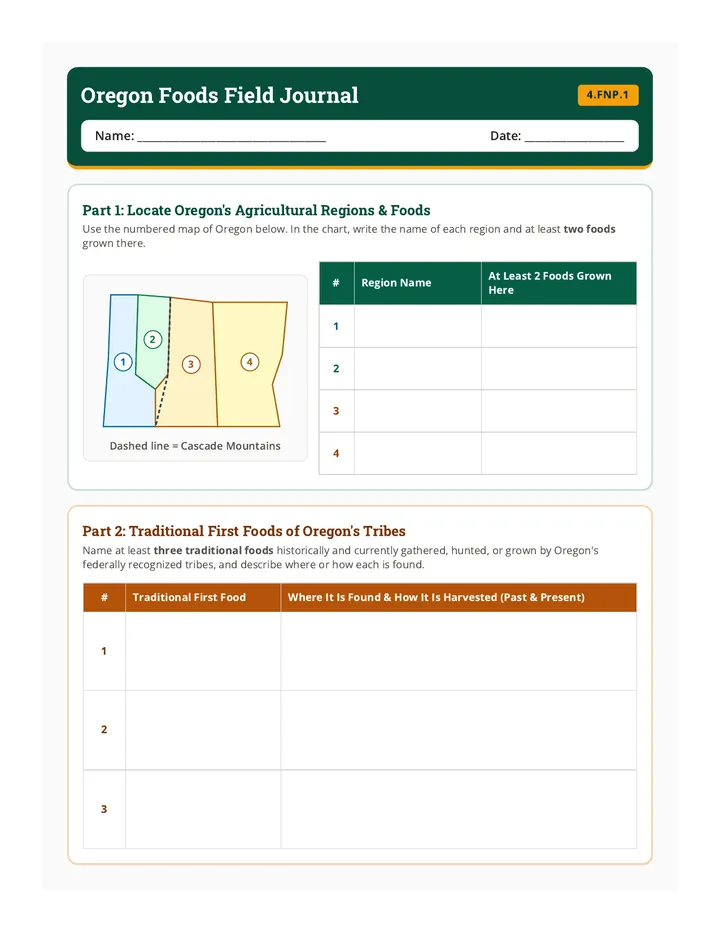
Oregon Foods Worksheet Oregon Foods Field Journal
4.FNP.1
Name: ____________________________________ Date: ___________________
Part 1: Locate Oregon's Agricultural Regions & Foods
Use the numbered map of Oregon below. In the chart, write the name of each region and at least two foods grown there.
1 2 3 4 Dashed line = Cascade Mountains
#
Region Name
At Least 2 Foods Grown Here
1
2
3
4
Part 2: Traditional First Foods of Oregon's Tribes
Name at least three traditional foods historically and currently gathered, hunted, or grown by Oregon's federally recognized tribes, and describe where or how each is found.
#
Traditional First Food
Where It Is Found & How It Is Harvested (Past & Present)
1
2
3
Oregon Foods Field Journal (continued)
Name: ________________________
Part 3: How Geography Shapes Our Food
Think about mountains, rainfall, rivers, soil, and climate. Answer both questions in complete sentences.
1. Choose one Oregon agricultural region (or tribal land). How does the geography there affect what foods can grow or be found there?
2. Why do farmers in Eastern Oregon grow wheat instead of berries, even though both are in Oregon? Use the Cascade Mountains in your answer.
Part 4: Exit Ticket — Check Your Learning
Check the box next to each "I Can" statement you feel confident about today:
I can locate different agricultural regions on a map of Oregon and name at least two foods grown there.
I can name at least three traditional foods historically and currently gathered, hunted, or grown by Oregon's federally recognized tribes.
I can explain how the geography of a specific region or tribal land affects the types of food that can grow or be found there.
One new thing I learned about Oregon foods or First Foods today:
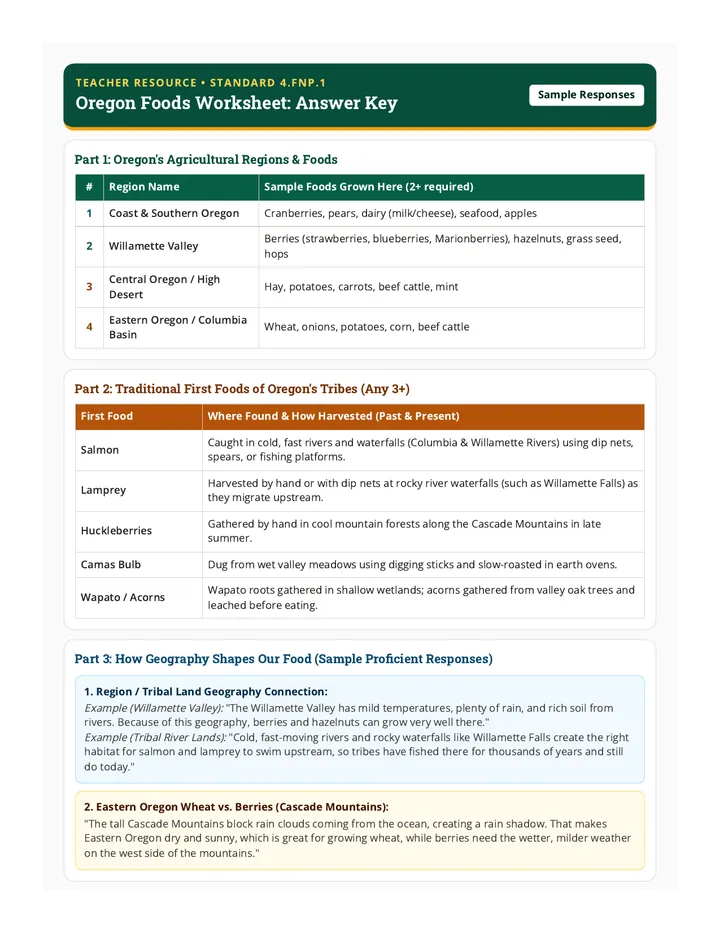
Oregon Foods Answer Key Teacher Resource • Standard 4.FNP.1
Oregon Foods Worksheet: Answer Key
Sample Responses
Part 1: Oregon's Agricultural Regions & Foods
#
Region Name
Sample Foods Grown Here (2+ required)
1
Coast & Southern Oregon
Cranberries, pears, dairy (milk/cheese), seafood, apples
2
Willamette Valley
Berries (strawberries, blueberries, Marionberries), hazelnuts, grass seed, hops
3
Central Oregon / High Desert
Hay, potatoes, carrots, beef cattle, mint
4
Eastern Oregon / Columbia Basin
Wheat, onions, potatoes, corn, beef cattle
Part 2: Traditional First Foods of Oregon's Tribes (Any 3+)
First Food
Where Found & How Harvested (Past & Present)
Salmon
Caught in cold, fast rivers and waterfalls (Columbia & Willamette Rivers) using dip nets, spears, or fishing platforms.
Lamprey
Harvested by hand or with dip nets at rocky river waterfalls (such as Willamette Falls) as they migrate upstream.
Huckleberries
Gathered by hand in cool mountain forests along the Cascade Mountains in late summer.
Camas Bulb
Dug from wet valley meadows using digging sticks and slow-roasted in earth ovens.
Wapato / Acorns
Wapato roots gathered in shallow wetlands; acorns gathered from valley oak trees and leached before eating.
Part 3: How Geography Shapes Our Food (Sample Proficient Responses)
1. Region / Tribal Land Geography Connection:
Example (Willamette Valley): "The Willamette Valley has mild temperatures, plenty of rain, and rich soil from rivers. Because of this geography, berries and hazelnuts can grow very well there."Example (Tribal River Lands): "Cold, fast-moving rivers and rocky waterfalls like Willamette Falls create the right habitat for salmon and lamprey to swim upstream, so tribes have fished there for thousands of years and still do today."
2. Eastern Oregon Wheat vs. Berries (Cascade Mountains):
"The tall Cascade Mountains block rain clouds coming from the ocean, creating a rain shadow. That makes Eastern Oregon dry and sunny, which is great for growing wheat, while berries need the wetter, milder weather on the west side of the mountains."
Oregon Harvest Teacher Guide Grade 4 • Standard 4.FNP.1 • Explicit Instruction
Oregon Harvest Roots: Teacher Guide
45–50 Minutes
Whole Group + Independent
Success Criteria (Student-Facing "I Can" Statements)
I can locate different agricultural regions on a map of Oregon and name at least two foods grown there (e.g., berries in the Willamette Valley, wheat in Eastern Oregon).
I can name at least three traditional foods historically and currently gathered, hunted, or grown by Oregon's federally recognized tribes (e.g., huckleberries, salmon, camas bulb, lamprey).
I can explain how the geography of a specific region or tribal land affects the types of food that can grow or be found there.
Materials Needed
Oregon Harvest Slides (projected)Oregon Foods Worksheet (1 per student)Oregon Foods Answer Key (teacher copy)Pencils, colored pencils (optional for map regions)
Key Vocabulary
Agricultural Region: Land where climate and soil support growing specific crops or raising livestock.Geography: Physical features of the land (mountains, rivers, valleys, rainfall).First Foods: Traditional foods historically and currently gathered, hunted, or grown by Oregon's 9 federally recognized tribes.
1. Opening & Hook (5 min) — Slides 1–3
Activate Prior Knowledge
Display Slide 1 and ask: "Think about a food you ate this week—maybe berries, bread, or fish. Where in Oregon do you think it came from?" Read the three Success Criteria aloud together on Slide 2 and preview the vocabulary on Slide 3.
2. "I Do" — Explicit Modeling (15 min) — Slides 4–6
Direct Instruction
Slide 4 (Agricultural Regions): Point to each region on the Oregon map. Model naming the region and at least two foods: "Here in the Willamette Valley, farmers grow berries and hazelnuts. Across the Cascades in Eastern Oregon, farmers grow wheat and onions." Include the Coast/Southern Oregon (cranberries, pears, dairy) and Central Oregon/High Desert (potatoes, hay, cattle).Slide 5 (Geography Cause & Effect): Think aloud to model the geographic connection: "Why don't we grow huge fields of wheat in the wet coastal forest, or cranberries in the dry desert? The Cascade Mountains block rain clouds—called a rain shadow! West of the Cascades gets lots of rain and rich valley soil, great for berries. East of the Cascades is dry and sunny, great for wheat." Slide 6 (First Foods & Tribal Lands): Emphasize that Oregon's 9 federally recognized tribes have cared for and harvested First Foods since time immemorial—and still do today . Model naming four examples: salmon and lamprey (caught in rivers like the Columbia and Willamette), huckleberries (gathered in mountain forests), and camas bulbs (harvested in wet meadows/valleys).
Oregon Harvest Roots: Teacher Guide (continued)
Standard 4.FNP.1
3. "We Do" — Guided Practice (10 min) — Slide 7
Check for Understanding
Use Slide 7 ("Map & Geography Detective"). Read each clue aloud and have students turn-and-talk with a partner before sharing out:
Clue 1: "Rich river soil, mild weather, plenty of rain." → Willamette Valley (berries, hazelnuts).
Clue 2: "Cold, rushing rivers with rocky waterfalls." → Columbia/Willamette Rivers (salmon, lamprey).
Clue 3: "Cascade Mountains block rain clouds." → Eastern Oregon is dry & sunny, great for wheat.
4. "You Do" — Independent Practice (15 min) — Slide 8
Student Worksheet
Distribute the Oregon Foods Worksheet . Review directions for all four parts: (1) locate regions & list 2+ foods each, (2) name 3+ traditional First Foods & how they are harvested, (3) explain how geography shapes food, and (4) complete the Exit Ticket. Circulate to give immediate feedback.
5. Closure & Debrief (5 min)
Success Criteria Review
Have 2–3 students share their Part 3 geography explanation aloud. Revisit the three "I Can" statements and collect worksheets for formative assessment using the Oregon Foods Answer Key .
Differentiation Supports
ELL / Emerging Readers: Post a word bank and sentence frame: "Because the geography has ____, ____ can grow or live there." Extension: Compare two regions' climates and explain why a crop from one could not thrive in the other without irrigation.
Teaching Note: Tribal Sovereignty
Use present tense alongside past tense when discussing Oregon's 9 federally recognized tribes. Emphasize that First Foods (salmon, lamprey, huckleberries, camas) are not only historical—tribal nations actively harvest and steward them today.
Quick Assessment Checklist (4.FNP.1)
Success Criterion
Meets Standard (Proficient)
Needs Support
Regions & Foods
Locates regions on Oregon map and names 2+ foods per region.
Confuses regions or names fewer than 2 foods per region.
Traditional First Foods
Names 3+ First Foods (salmon, huckleberries, camas, lamprey) past & present.
Names fewer than 3 foods or treats tribal foodways as only past.
Geography Connection
Links physical geography (rain, soil, mountains, rivers) to food grown/found.
Names a food without explaining how geography affects it.
Oregon Foods Worksheet Oregon Foods Field Journal
4.FNP.1
Name: ____________________________________ Date: ___________________
Part 1: Locate Oregon's Agricultural Regions & Foods
Use the numbered map of Oregon below. In the chart, write the name of each region and at least two foods grown there.
1 2 3 4 Dashed line = Cascade Mountains
#
Region Name
At Least 2 Foods Grown Here
1
2
3
4
Part 2: Traditional First Foods of Oregon's Tribes
Name at least three traditional foods historically and currently gathered, hunted, or grown by Oregon's federally recognized tribes, and describe where or how each is found.
#
Traditional First Food
Where It Is Found & How It Is Harvested (Past & Present)
1
2
3
Oregon Foods Field Journal (continued)
Name: ________________________
Part 3: How Geography Shapes Our Food
Think about mountains, rainfall, rivers, soil, and climate. Answer both questions in complete sentences.
1. Choose one Oregon agricultural region (or tribal land). How does the geography there affect what foods can grow or be found there?
2. Why do farmers in Eastern Oregon grow wheat instead of berries, even though both are in Oregon? Use the Cascade Mountains in your answer.
Part 4: Exit Ticket — Check Your Learning
Check the box next to each "I Can" statement you feel confident about today:
I can locate different agricultural regions on a map of Oregon and name at least two foods grown there.
I can name at least three traditional foods historically and currently gathered, hunted, or grown by Oregon's federally recognized tribes.
I can explain how the geography of a specific region or tribal land affects the types of food that can grow or be found there.
One new thing I learned about Oregon foods or First Foods today:
Oregon Foods Answer Key Teacher Resource • Standard 4.FNP.1
Oregon Foods Worksheet: Answer Key
Sample Responses
Part 1: Oregon's Agricultural Regions & Foods
#
Region Name
Sample Foods Grown Here (2+ required)
1
Coast & Southern Oregon
Cranberries, pears, dairy (milk/cheese), seafood, apples
2
Willamette Valley
Berries (strawberries, blueberries, Marionberries), hazelnuts, grass seed, hops
3
Central Oregon / High Desert
Hay, potatoes, carrots, beef cattle, mint
4
Eastern Oregon / Columbia Basin
Wheat, onions, potatoes, corn, beef cattle
Part 2: Traditional First Foods of Oregon's Tribes (Any 3+)
First Food
Where Found & How Harvested (Past & Present)
Salmon
Caught in cold, fast rivers and waterfalls (Columbia & Willamette Rivers) using dip nets, spears, or fishing platforms.
Lamprey
Harvested by hand or with dip nets at rocky river waterfalls (such as Willamette Falls) as they migrate upstream.
Huckleberries
Gathered by hand in cool mountain forests along the Cascade Mountains in late summer.
Camas Bulb
Dug from wet valley meadows using digging sticks and slow-roasted in earth ovens.
Wapato / Acorns
Wapato roots gathered in shallow wetlands; acorns gathered from valley oak trees and leached before eating.
Part 3: How Geography Shapes Our Food (Sample Proficient Responses)
1. Region / Tribal Land Geography Connection:
Example (Willamette Valley): "The Willamette Valley has mild temperatures, plenty of rain, and rich soil from rivers. Because of this geography, berries and hazelnuts can grow very well there."Example (Tribal River Lands): "Cold, fast-moving rivers and rocky waterfalls like Willamette Falls create the right habitat for salmon and lamprey to swim upstream, so tribes have fished there for thousands of years and still do today."
2. Eastern Oregon Wheat vs. Berries (Cascade Mountains):
"The tall Cascade Mountains block rain clouds coming from the ocean, creating a rain shadow. That makes Eastern Oregon dry and sunny, which is great for growing wheat, while berries need the wetter, milder weather on the west side of the mountains."