Prehistory and Sumer Exam Grade 6 World History • Ancient Civilizations CA Standards HSS 6.1 & 6.2
Prehistory & Ancient Sumer Exam
Total Points: _____ / 50
Name:
Date:
Period:
Score:
Part 1: The Stone Age • Questions 1–5
12 Points (Part 1 Total: 25 pts)
While earlier hominins may have used naturally occurring wildfires, which species is identified by archaeologists as the first to systematically create and control hearth fires using stone friction and spark technology? (2 pts)
A. Homo habilis
B. Homo erectus
C. Homo heidelbergensis
D. Homo sapiens
What is the archaeological term for chipping away flakes of stone (such as flint or obsidian) to make sharp hand tools, and which hominin species was the first recognized stone toolmaker? (2 pts)
Stone-chipping process:
First toolmaker species:
Hominin Timeline Analysis: Examine the chronological scale below. Each blue bar is drawn to scale to match the historical time period of a hominin species. Use the timeline milestones to identify each Hominin Species and its approximate Time Span : (4 pts)
Hominin Timeline Scale: 2.5 Million Years B.C.E. to Today
2.5 million years B.C.E.
2 million years B.C.E.
1.5 million years B.C.E.
1 million years B.C.E.
500,000 years B.C.E.
Today (Present)
Bar 1
Hominin:
Time Span:
Earliest Toolmaker
Bar 2
Hominin:
Time Span:
Longest Survived Hominin
Bar 3
Hominin:
Time Span:
Ice Age
Bar 4
Hominin:
(Modern humans)
Time Span:
Today
Which social arrangement best describes the daily community structure of humans during the Paleolithic Era ("Old Stone Age") ? (2 pts)
A. Rigid feudal classes ruled by emperors
B. Small, nomadic hunter-gatherer bands
C. Large urban populations in walled cities
D. Occupational guilds controlling trade
How did global climatic shifts during the last Ice Age facilitate early human migration from northeast Asia into North America? (2 pts)
A. Inland glaciers opened freshwater canals
B. Lower sea levels exposed the Beringia land bridge
C. Warmer oceans allowed navigation on reed rafts
D. Desert sandstorms pushed tribes across seas
California History-Social Science Framework • Grade 6 Standards 6.1 & 6.2 Page 1 of 3 • Continue to Page 2 →
Part 1: The Stone Age (Continued) • Questions 6–9
13 Points
The Neolithic Revolution ("New Stone Age") is considered a major turning point in human history primarily because it marked: (2 pts)
A. The transition from stone tools to cast bronze
B. The invention of mechanical steam transport
C. The shift from foraging to farming and domesticating animals
D. The first trans-oceanic migrations across open seas
What was the direct cause-and-effect relationship between agricultural surpluses and the development of specialized labor in early towns? (2 pts)
A. Surpluses forced everyone to work double farm shifts
B. Extra food freed people to become potters, weavers, and builders
C. Surplus crops made toolmaking and trade unnecessary
D. Food surpluses depleted soil and forced towns to flee
Excavations at early agricultural sites such as Jericho and Çatalhöyük demonstrate that settled Neolithic societies developed: (2 pts)
A. Permanent mud-brick homes, walls, and granaries
B. Collapsible hide shelters for seasonal moving
C. Floating papyrus dwellings across river estuaries
D. Fortified castles built exclusively of marble
Stone Age Constructed Response: Contrast how early humans acquired food before and after the Neolithic Revolution. Then, explain one major long-term effect that domesticating plants and animals had on community settlements or daily life. (7 pts)
Part 2: Ancient Sumer • Questions 10–12
6 Points (Part 2 Total: 25 pts)
The name Mesopotamia means "land between the rivers." Which two rivers surrounded Ancient Sumer and deposited fertile silt across the Fertile Crescent? (2 pts)
A. Nile and Congo Rivers
B. Tigris and Euphrates Rivers
C. Indus and Ganges Rivers
D. Huang He and Yangtze Rivers
Sumer faced unpredictable spring floods followed by dry summers. How did Sumerian farmers solve this environmental challenge to grow reliable crops? (2 pts)
A. They abandoned river valleys for mountain caves
B. They built levees, canals, and reservoirs for irrigation
C. They relied only on ocean tides to water their barley
D. They imported all grain from neighboring hunter bands
Which statement best describes the political organization of Ancient Sumer? (2 pts)
A. Independent city-states (like Ur and Uruk) with own rulers
B. A single democratic republic spanning all of Asia
C. Unwalled nomadic camps with no formal leadership
D. Small family farms with no shared laws or defense
Prehistory & Ancient Sumer Exam • Standards HSS 6.1 & 6.2 Page 2 of 3 • Continue to Page 3 →
Part 2: Ancient Sumer (Continued) • Questions 13–18
19 Points
At the center of each Sumerian city stood a massive stepped mud-brick temple called a ziggurat . What does the ziggurat reveal about Sumerian beliefs? (2 pts)
A. Sumerians practiced polytheism and honored city gods
B. Sumerians rejected all forms of organized religion
C. Ziggurats served exclusively as underground mines
D. Priests had no influence over daily city life
What is the name of the world's earliest writing system, created by Sumerian scribes who pressed wedge-shaped marks into wet clay tablets to record harvests, taxes, and trade? (2 pts)
Sumerian writing system:
How were ziggurats designed and used in Ancient Sumerian city-states? (2 pts)
A. Underground stone tombs for burying warriors
B. Stepped mud-brick temples where priests honored city gods
C. Wooden docks used for building ocean warships
D. Open-air marketplaces outside the city walls
Which group of technological and mathematical innovations was pioneered by the Sumerians to improve farming, transport, and timekeeping? (2 pts)
A. The compass, printing press, and gunpowder
B. The wheel, plow, sailboat, and base-60 number system
C. Steam engines, steel rails, and telegraph lines
D. Concrete domes, aqueducts, and paved highways
Short Constructed Response: Explain how building and maintaining irrigation systems in Mesopotamia required Sumerians to cooperate, and describe how this cooperation helped lead to organized city-states and governments. (5 pts)
Extended Historical Analysis: Identify two major achievements of Ancient Sumer (such as cuneiform writing, ziggurats, the wheel, the plow, or bronze tools). For each achievement, explain how it improved daily life or helped organize Sumerian civilization. (6 pts)
Prehistory & Ancient Sumer Exam • California History-Social Science Standards Page 3 of 3 • End of Exam
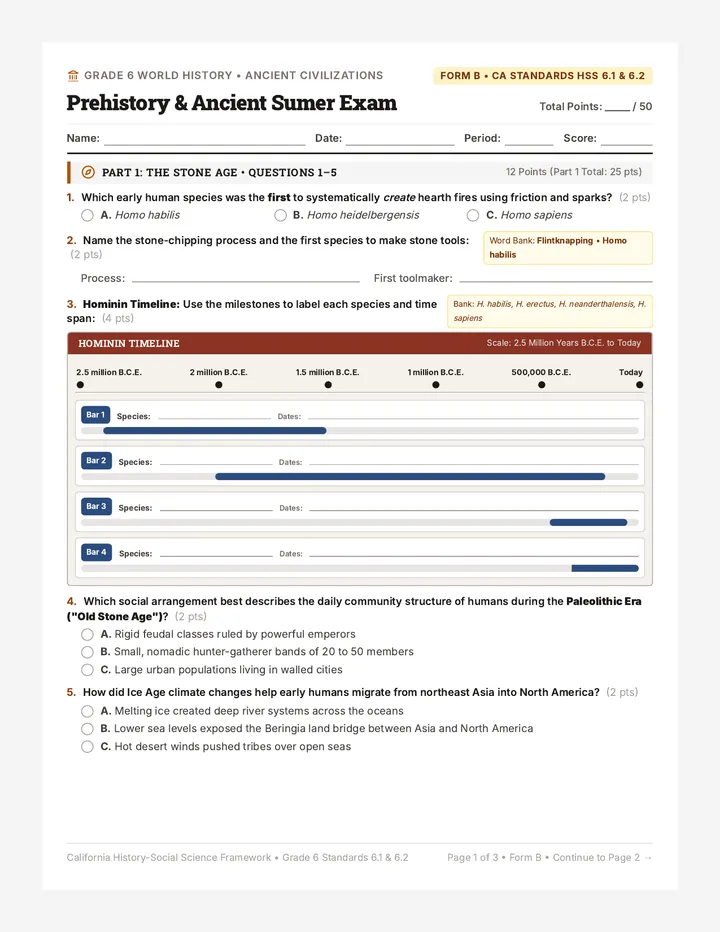
Prehistory and Sumer Adapted Exam Grade 6 World History • Ancient Civilizations Form B • CA Standards HSS 6.1 & 6.2
Prehistory & Ancient Sumer Exam
Total Points: _____ / 50
Name:
Date:
Period:
Score:
Part 1: The Stone Age • Questions 1–5
12 Points (Part 1 Total: 25 pts)
Which early human species was the first to systematically create hearth fires using friction and sparks? (2 pts)
A. Homo habilis
B. Homo heidelbergensis
C. Homo sapiens
Name the stone-chipping process and the first species to make stone tools: (2 pts)
Word Bank: Flintknapping • Homo habilis
Process:
First toolmaker:
Hominin Timeline: Use the milestones to label each species and time span: (4 pts)
Bank: H. habilis, H. erectus, H. neanderthalensis, H. sapiens
Hominin Timeline Scale: 2.5 Million Years B.C.E. to Today
2.5 million B.C.E.
2 million B.C.E.
1.5 million B.C.E.
1 million B.C.E.
500,000 B.C.E.
Today
Bar 1
Species:
Dates:
Bar 2
Species:
Dates:
Bar 3
Species:
Dates:
Bar 4
Species:
Dates:
Which social arrangement best describes the daily community structure of humans during the Paleolithic Era ("Old Stone Age") ? (2 pts)
A. Rigid feudal classes ruled by powerful emperors
B. Small, nomadic hunter-gatherer bands of 20 to 50 members
C. Large urban populations living in walled cities
How did Ice Age climate changes help early humans migrate from northeast Asia into North America? (2 pts)
A. Melting ice created deep river systems across the oceans
B. Lower sea levels exposed the Beringia land bridge between Asia and North America
C. Hot desert winds pushed tribes over open seas
California History-Social Science Framework • Grade 6 Standards 6.1 & 6.2 Page 1 of 3 • Form B • Continue to Page 2 →
Part 1: The Stone Age (Continued) • Questions 6–9
13 Points
The Neolithic Revolution was a major turning point in world history because it marked: (2 pts)
A. The shift from foraging wild food to farming and domesticating animals
B. The invention of steam-powered machines
C. The first migration across ocean waterways
How did having an agricultural food surplus lead to specialized jobs in early farming towns? (2 pts)
A. Extra food freed some people to become skilled craftworkers like weavers and potters
B. Extra food forced all citizens to farm day and night without breaks
C. Surpluses ruined food supplies and caused towns to disappear
Excavations at Jericho and Çatalhöyük demonstrate that settled Neolithic societies built: (2 pts)
A. Permanent mud-brick homes, protective walls, and grain storehouses
B. Portable animal skin tipis designed to move every week
C. Floating rafts used for traveling along coastlines
Stone Age Constructed Response: Complete the guided sentences to contrast early food gathering with farming, and explain one long-term effect on community life. (7 pts)
Before agriculture, early humans got food by:
After the Neolithic Revolution, they got food by:
One major effect of domesticating plants and animals was:
Part 2: Ancient Sumer • Questions 10–12
6 Points (Part 2 Total: 25 pts)
Mesopotamia means "land between the rivers." Which two rivers surrounded Ancient Sumer? (2 pts)
A. Nile & Congo
B. Tigris & Euphrates
C. Indus & Ganges
How did Sumerian farmers control unpredictable river floods and water their crops during dry summers? (2 pts)
A. They built levees, canals, and reservoirs for irrigation
B. They abandoned river valleys to live in mountain caves
C. They imported all grain from nomadic hunters
Which statement best describes how Ancient Sumer was governed? (2 pts)
A. Independent city-states (like Ur and Uruk) each with its own ruler and farmland
B. One single democratic country covering all of Asia
C. Unwalled nomadic camps with no shared laws
Prehistory & Ancient Sumer Exam • Standards HSS 6.1 & 6.2 Page 2 of 3 • Form B • Continue to Page 3 →
Part 2: Ancient Sumer (Continued) • Questions 13–18
19 Points
What does the giant stepped temple (ziggurat ) at the center of each Sumerian city show about Sumerian beliefs? (2 pts)
A. Sumerians practiced polytheism and honored many gods
B. Sumerians rejected all forms of organized religion
C. Ziggurats were used only as underground mines
Name the Sumerian writing system made by pressing wedge-shaped marks into wet clay tablets: (2 pts)
Bank: Cuneiform • Hieroglyphics • Alphabet
Writing system:
How were ziggurats designed and used in Ancient Sumerian city-states? (2 pts)
A. Underground stone tombs for burying warriors
B. Stepped mud-brick temples where priests honored city gods
C. Wooden docks used for building ocean warships
Which group of inventions was pioneered by the Sumerians to improve farming, transport, and timekeeping? (2 pts)
A. The compass, printing press, and gunpowder
B. The wheel, plow, sailboat, and base-60 number system
C. Steam engines, steel rails, and telegraph lines
Short Constructed Response: Complete the sentence stems below to explain how irrigation led to cooperation and organized city-states in Sumer. (5 pts)
To maintain canals and levees, Sumerian villages had to:
This cooperation helped lead to organized city-states because:
Extended Historical Analysis: Choose two Sumerian achievements from the word bank and explain how each improved or organized Sumerian life. (6 pts)
Bank: cuneiform • ziggurat • wheel • plow
First, Sumerians developed:
This helped Sumerian civilization because:
Second, Sumerians developed:
This improved daily life by:
Prehistory & Ancient Sumer Exam • California History-Social Science Standards Page 3 of 3 • Form B • End of Exam
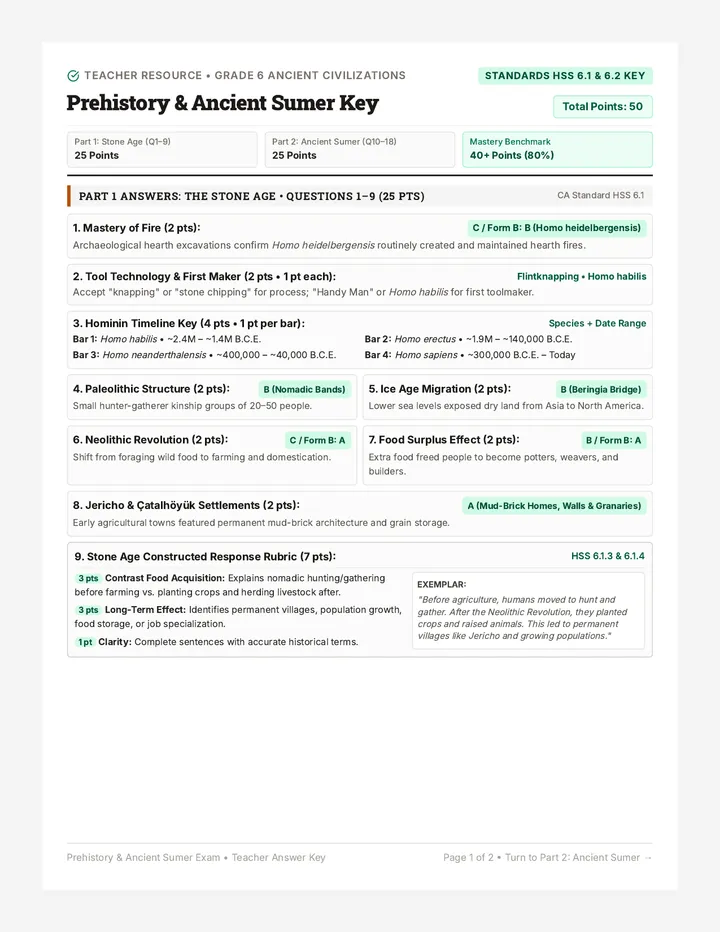
Prehistory and Sumer Key Teacher Resource • Grade 6 Ancient Civilizations Standards HSS 6.1 & 6.2 Key
Prehistory & Ancient Sumer Key
Total Points: 50
Part 1: Stone Age (Q1–9) 25 Points
Part 2: Ancient Sumer (Q10–18) 25 Points
Mastery Benchmark 40+ Points (80%)
Part 1 Answers: The Stone Age • Questions 1–9 (25 pts)
CA Standard HSS 6.1
1. Mastery of Fire (2 pts): C / Form B: B (Homo heidelbergensis)
Archaeological hearth excavations confirm Homo heidelbergensis routinely created and maintained hearth fires.
2. Tool Technology & First Maker (2 pts • 1 pt each): Flintknapping • Homo habilis
Accept "knapping" or "stone chipping" for process; "Handy Man" or Homo habilis for first toolmaker.
3. Hominin Timeline Key (4 pts • 1 pt per bar): Species + Date Range
Bar 1: Homo habilis • ~2.4M – ~1.4M B.C.E.
Bar 2: Homo erectus • ~1.9M – ~140,000 B.C.E.
Bar 3: Homo neanderthalensis • ~400,000 – ~40,000 B.C.E.
Bar 4: Homo sapiens • ~300,000 B.C.E. – Today
4. Paleolithic Structure (2 pts): B (Nomadic Bands)
Small hunter-gatherer kinship groups of 20–50 people.
5. Ice Age Migration (2 pts): B (Beringia Bridge)
Lower sea levels exposed dry land from Asia to North America.
6. Neolithic Revolution (2 pts): C / Form B: A
Shift from foraging wild food to farming and domestication.
7. Food Surplus Effect (2 pts): B / Form B: A
Extra food freed people to become potters, weavers, and builders.
8. Jericho & Çatalhöyük Settlements (2 pts): A (Mud-Brick Homes, Walls & Granaries)
Early agricultural towns featured permanent mud-brick architecture and grain storage.
9. Stone Age Constructed Response Rubric (7 pts): HSS 6.1.3 & 6.1.4
3 pts Contrast Food Acquisition: Explains nomadic hunting/gathering before farming vs. planting crops and herding livestock after.
3 pts Long-Term Effect: Identifies permanent villages, population growth, food storage, or job specialization.
1 pt Clarity: Complete sentences with accurate historical terms.
Exemplar:
"Before agriculture, humans moved to hunt and gather. After the Neolithic Revolution, they planted crops and raised animals. This led to permanent villages like Jericho and growing populations."
Prehistory & Ancient Sumer Exam • Teacher Answer Key Page 1 of 2 • Turn to Part 2: Ancient Sumer →
Part 2 Answers: Ancient Sumer • Questions 10–18 (25 pts)
CA Standard HSS 6.2
10. Mesopotamian Rivers (2 pts): B (Tigris & Euphrates)
Sumer lay between the Tigris and Euphrates rivers in the Fertile Crescent.
11. Flood & Water Control (2 pts): B / Form B: A
Sumerians built levees, canals, and reservoirs to irrigate dry fields.
12. Political Organization (2 pts): A (City-States)
Independent city-states like Ur and Uruk had their own rulers and farmland.
13. Ziggurats & Religion (2 pts): A (Polytheism)
Temples at city centers honored city gods and reflected polytheistic beliefs.
14. Sumerian Writing (2 pts): Cuneiform
Wedge-shaped marks pressed into wet clay tablets; accept phonetic spelling on Form B.
15. Ziggurat Design & Use (2 pts): B (Stepped Temples)
Stepped mud-brick temples where priests honored city gods and led rituals.
16. Sumerian Innovations (2 pts): B (The wheel, plow, sailboat, and base-60 number system)
Sumerians pioneered the wheel, plow, sailboat, bronze tools, and base-60 math/timekeeping.
17. Scoring Rubric • Irrigation, Cooperation & City-States (5 pts): Standard HSS 6.2.1 & 6.2.2
2.5 pts Cooperation on Irrigation: Explains that canals and levees crossed village boundaries and required many workers to dig, clear silt, and share water fairly.
2.5 pts Rise of City-States/Government: Explains that managing water and resolving disputes led to organized rules, leaders, and larger city-states.
Exemplar Response:
"Sumerian villages had to work together to build and clean shared canals so everyone's fields got water. Managing this system required leaders and rules, which helped towns grow into organized city-states."
18. Scoring Rubric • Sumerian Achievements (6 pts): Standard HSS 6.2.9
3 pts First Achievement & Impact: Accurately identifies a Sumerian achievement (e.g., cuneiform, wheel, plow, ziggurat, bronze) and explains how it improved or organized life.
3 pts Second Achievement & Impact: Accurately identifies a distinct second achievement and explains its impact.
Exemplar Response:
"First, Sumerians invented cuneiform, which allowed scribes to record laws, taxes, and trade deals on clay tablets. Second, they invented the wheel, which made carts faster and improved transporting crops and goods."
Accommodated Grading Note (Form B): Accept phonetic spelling for hominin/Sumerian terms and approximate timeline dates (+/- 200,000 years). Grade 6 Assessment Suite
Prehistory & Ancient Sumer Exam • Teacher Answer Key & Scoring Rubric Page 2 of 2 • End of Key