New Orleans Partner Script
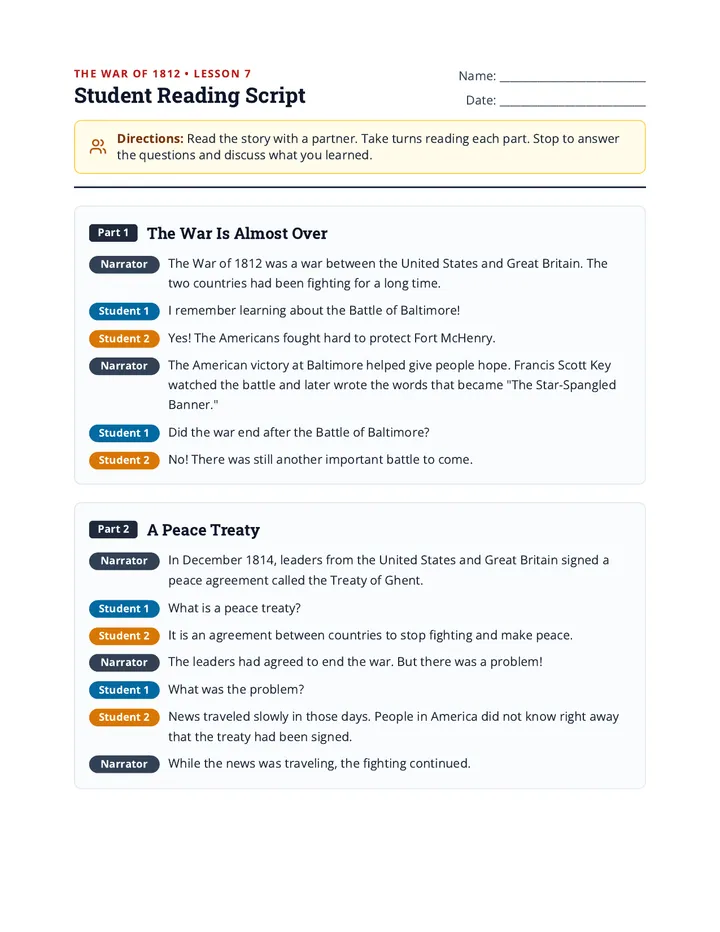
The War of 1812 • Lesson 7
Student Reading Script
Name: ___________________________
Date: ___________________________
Directions: Read the story with a partner. Take turns reading each part. Stop to answer the questions and discuss what you learned.
Part 1
The War Is Almost Over
Narrator
The War of 1812 was a war between the United States and Great Britain. The two countries had been fighting for a long time.
Student 1
I remember learning about the Battle of Baltimore!
Student 2
Yes! The Americans fought hard to protect Fort McHenry.
Narrator
The American victory at Baltimore helped give people hope. Francis Scott Key watched the battle and later wrote the words that became "The Star-Spangled Banner."
Student 1
Did the war end after the Battle of Baltimore?
Student 2
No! There was still another important battle to come.
Part 2
A Peace Treaty
Narrator
In December 1814, leaders from the United States and Great Britain signed a peace agreement called the Treaty of Ghent.
Student 1
What is a peace treaty?
Student 2
It is an agreement between countries to stop fighting and make peace.
Narrator
The leaders had agreed to end the war. But there was a problem!
Student 1
What was the problem?
Student 2
News traveled slowly in those days. People in America did not know right away that the treaty had been signed.
Narrator
While the news was traveling, the fighting continued.
Part 3
The Battle of New Orleans
Narrator
The British planned to attack the city of New Orleans. New Orleans was an important city because it was near the Mississippi River.
Student 1
Who led the American soldiers?
Student 2
General Andrew Jackson!
Narrator
Andrew Jackson gathered American soldiers and prepared to protect the city.
Student 1
Were the Americans ready to give up?
Student 2
No! They worked hard and prepared to defend New Orleans.
Narrator
On January 8, 1815, the British attacked. The American soldiers fought bravely.
Student 1
What happened?
Student 2
The Americans won the Battle of New Orleans!
Part 4
A Surprising Victory
Narrator
The Americans were astonished by how much they had accomplished. They had won an important battle!
Student 1
What does astonished mean?
Student 2
It means very surprised or amazed.
Narrator
There was something surprising about this battle. The peace treaty had already been signed before the battle took place!
Student 1
So the fighting continued because people did not know the war was supposed to be over?
Student 2
That is right! News traveled slowly, and the message had not arrived yet.
Narrator
The Battle of New Orleans became an important American victory. It helped Americans feel proud of their country.
Part 5
Where There's a Will, There's a Way
Student 1
Andrew Jackson and his soldiers worked hard to protect New Orleans.
Student 2
They did not give up when things were difficult.
Narrator
There is a saying that describes this: "Where there's a will, there's a way."
Student 1
What does that mean?
Student 2
It means that when you really want to do something and keep trying, you can often find a way to succeed.
Narrator
The Americans showed determination during the Battle of New Orleans. They worked together and did not give up!
Check Your Understanding
1. What is the main idea of the story?
A Andrew Jackson wanted to become president.
B The Battle of New Orleans was an important American victory that happened after a peace treaty was signed.
C Francis Scott Key led the American soldiers.
2. Why did the fighting continue after the peace treaty was signed?
3. Who led the American soldiers at the Battle of New Orleans?
4. Why was New Orleans an important city?
5. What does the word astonished mean?
A Very tired
B Very surprised
C Very angry
6. What happened first? Number the events from 1–4.
The Americans won the Battle of New Orleans.
The United States and Great Britain signed a peace treaty.
Andrew Jackson prepared soldiers to protect New Orleans.
The British attacked New Orleans.
Think and Respond
7. Why is the title "The Battle After the War" a good title for this lesson?
8. What does the saying "Where there's a will, there's a way" mean? Give an example of a time you kept trying even when something was difficult.
Partner Discussion: Main Idea and Key Details
Take turns completing these sentences with your partner:
The story is mostly about __________________________________________________.
One important detail I learned was __________________________________________.
Another important detail was _______________________________________________.
I think the most surprising part was ____________________ because _____________________.
Peace Pirates Partner Script
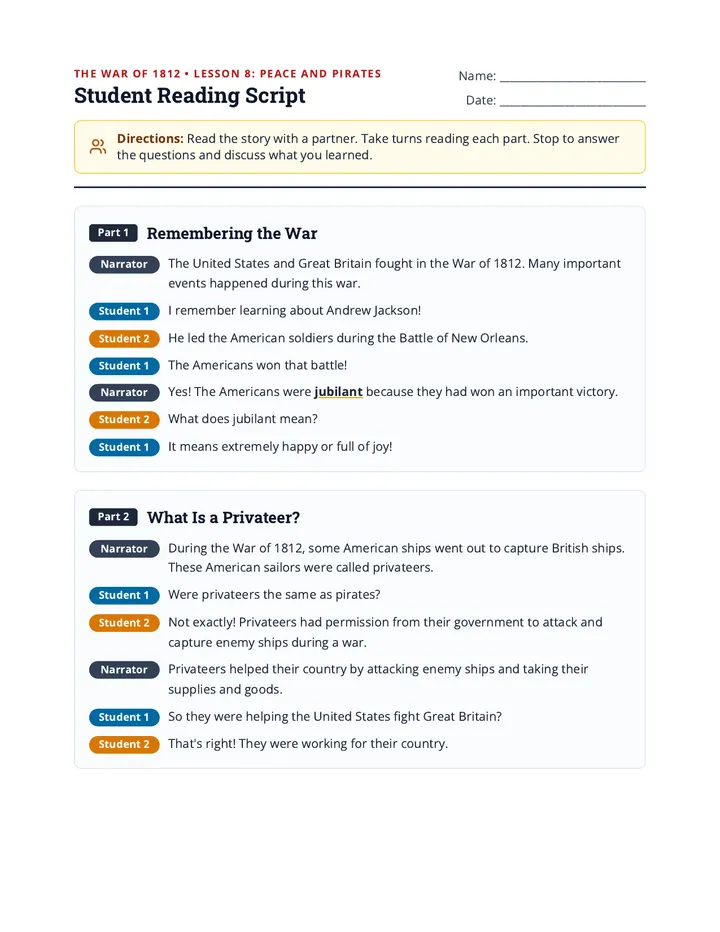
The War of 1812 • Lesson 8: Peace and Pirates
Student Reading Script
Name: ___________________________
Date: ___________________________
Directions: Read the story with a partner. Take turns reading each part. Stop to answer the questions and discuss what you learned.
Part 1
Remembering the War
Narrator
The United States and Great Britain fought in the War of 1812. Many important events happened during this war.
Student 1
I remember learning about Andrew Jackson!
Student 2
He led the American soldiers during the Battle of New Orleans.
Student 1
The Americans won that battle!
Narrator
Yes! The Americans were jubilant because they had won an important victory.
Student 2
What does jubilant mean?
Student 1
It means extremely happy or full of joy!
Part 2
What Is a Privateer?
Narrator
During the War of 1812, some American ships went out to capture British ships. These American sailors were called privateers.
Student 1
Were privateers the same as pirates?
Student 2
Not exactly! Privateers had permission from their government to attack and capture enemy ships during a war.
Narrator
Privateers helped their country by attacking enemy ships and taking their supplies and goods.
Student 1
So they were helping the United States fight Great Britain?
Student 2
That's right! They were working for their country.
Part 3
Pirates and Privateers
Narrator
Pirates and privateers both attacked ships at sea. But there was an important difference between them.
Student 1
What did pirates do?
Student 2
Pirates attacked and robbed ships for their own gain. They did not have permission from a government.
Student 1
What about privateers?
Student 2
Privateers had permission from their government to capture enemy ships during a war.
Narrator
Privateers followed orders from their country. Pirates stole for themselves.
Student 1
Now I understand! They may have done similar things, but they were not the same.
Part 4
When Peace Comes
Narrator
The War of 1812 finally came to an end. The United States and Great Britain agreed to stop fighting.
Student 1
Does that mean privateers could keep attacking British ships?
Student 2
No. Privateers were given permission to attack enemy ships during the war. When the war ended, they no longer had that permission.
Narrator
The sailors had to stop fighting because their countries were at peace.
Student 1
What a big change! The fighting was finally over.
Part 5
How People Feel
Narrator
People can have many different feelings during a war and after it ends.
Student 1
Some people might feel jubilant when their side wins a battle.
Student 2
That means they feel very happy!
Student 1
But what if someone loses something important?
Student 2
That person might feel dejected.
Narrator
Dejected means feeling sad, disappointed, or discouraged.
Student 1
So jubilant means very happy, and dejected means very sad.
Narrator
That's right! The War of 1812 brought many challenges, but it also brought important changes for the United States.
Check Your Understanding
1. What is the main idea of the story?
A Andrew Jackson became a privateer.
B Privateers helped the United States during the War of 1812, but pirates were different.
C Pirates helped the United States win the Battle of New Orleans.
2. What was a privateer?
A A sailor who had permission from the government to capture enemy ships during a war.
B A sailor who robbed ships for fun.
C A soldier who fought on land.
3. How were pirates and privateers different?
4. Why did privateers have to stop attacking enemy ships when the war ended?
5. What does the word jubilant mean?
A Very sad
B Very tired
C Extremely happy
6. What does the word dejected mean?
A Disappointed or sad
B Excited and joyful
C Angry and loud
Think and Respond
7. Imagine you are a sailor during the War of 1812. Would you rather be a privateer or a pirate? Explain why.
8. Why is the title "Peace and Pirates" a good title for this lesson?
9. Compare and Contrast: Write how pirates and privateers are different on the sides, and how they are the same in the middle.
Pirates
Both
Privateers