Country Clues Slides Grade 6 Geography • Eastern Hemisphere
Country Clues:
What Is a Place Like?
Today we will research a country using text evidence and inferences to discover its physical and human features.
Physical Features
Human Features
Double-Entry Journal
Warm-Up • Map of Japan
Also on Workbook p. 43
N Sea of Japan Pacific Ocean Shinano R. Tone R. Alps Mt. Fuji Tokyo Hokkaido Honshu Shikoku Kyushu
What Does This Map Tell Us?
1. Map Clues: List 1–2 things you can learn just by looking at this map.
2. Wonderings: List 1–2 things you still want to know that the map does not show.
▲ Mountains 〜 Rivers ● Capital
Warm-Up Debrief
Maps Don't Tell the Whole Story
What a Map Shows
• Where a country is located
• Oceans, islands, mountains, & rivers
• Major cities and capitals
What We Still Wonder
• What is daily life like there?
• How do people travel and work?
• What foods, languages, or traditions exist?
To answer these questions, we need informational texts and photos!
Key Vocabulary
Two Types of "Place" Clues
Physical Features
Made by nature (not by people)
• Islands & coastlines
• Mountains & valleys
• Rivers, lakes, & climate
Human Features
Made or shaped by people
• Cities, bridges, & roads
• Languages & religions
• Jobs, food, & traditions
Remember: Together, physical and human features answer the question: "What is it like there?"
Note-Taking Strategy
The Double-Entry Journal
1. Text Evidence
Copy or summarize a key fact directly from the article, caption, or map.
Ask: Is this a Physical or Human feature?
2. My Inference
Make a logical conclusion or smart guess about life there based on the clue.
Starter: "Because of this, people likely..."
Tip: Use headings, pictures, and captions on websites to find strong clues fast!
Model Example • Japan
Watch How It Works
Text Evidence
Feature
My Inference
"Japan is an archipelago with 4 main islands (Hokkaido, Honshu, Shikoku, Kyushu) and over 400 smaller islands."
Physical
Since Japan is made of many islands, people likely rely heavily on boats, ferries, and fishing for food and travel.
Source: National Geographic Kids — Japan ("Geography" section)
Your Turn • 15–20 Minutes
Research Checklist
Partner Practice: Find 1 more clue about Japan on your worksheet and write an inference.
Independent Research: Use 2 sources about your assigned country to fill in 3 journal rows.
Label & Cite: Circle Physical or Human for each clue and write your sources at the bottom.
Wrap-Up • 5 Minutes
Share Your Discoveries
1. Travel Pick
What is one place in your country you would most like to visit? Why?
2. Big Question
How did the country's geography shape how people live and work there?
Complete your Exit Question at the bottom of Page 2 before turning in your worksheet.
Country Clues Worksheet Country Clues Worksheet
Theme of Place: Physical & Human Characteristics
Page 1 of 2
Name: _____________________________
Date: ____________
Country: ___________________
Physical Features: Made by nature (islands, mountains, rivers, climate).
Human Features: Made by people (cities, bridges, languages, food, jobs).
Inference: A logical conclusion or smart guess based on text evidence.
Part 1: Warm-Up — Map of Japan
Look at the Map of Japan below (also on p. 43 of your workbook). List 1–2 facts it shows and 1–2 things you still want to know.
N Sea of Japan Pacific Ocean Shinano R. Tone R. Alps Mt. Fuji Tokyo Hokkaido Honshu Shikoku Kyushu
What the Map Shows Starter: "The map shows that..."
What I Still Want to Know Starter: "I still wonder..."
Part 2: Guided Practice — Japan Double-Entry Journal
Use the model row to see how a double-entry journal works. Then complete Row 2 with your partner.
Text Evidence (Fact from Source)
Feature Type
My Inference (Smart Guess)
Model Example: "Japan is an archipelago with 4 main islands and more than 400 smaller islands."
☑Physical
☐Human
Model Inference: Because Japan is made of many islands, people likely rely heavily on boats and fishing.
☐Physical
☐Human
Tip: Look at headings, photos, and captions to find strong clues! Grade 6 Social Studies
Part 3: Independent Country Research
Read 2 sources about your country. Record 3 clues, label Physical or Human, and write an inference.
Page 2 of 2
Text Evidence (Fact from Source)
Feature Type
My Inference (Smart Guess)
Starter: "According to the text, ______."
Check one
Starter: "Because of this, people likely ______."
☐Physical
☐Human
☐Physical
☐Human
☐Physical
☐Human
Sources I Used (Write the title or website):
1. _________________________________________________________________________________
2. _________________________________________________________________________________
Part 4: Wrap-Up Exit Question
What is one place in this country you would most like to visit? How does geography shape life there?
Exit Starter: "I would like to visit ______ because ______. Geography shapes life there by ______." Grade 6 Social Studies
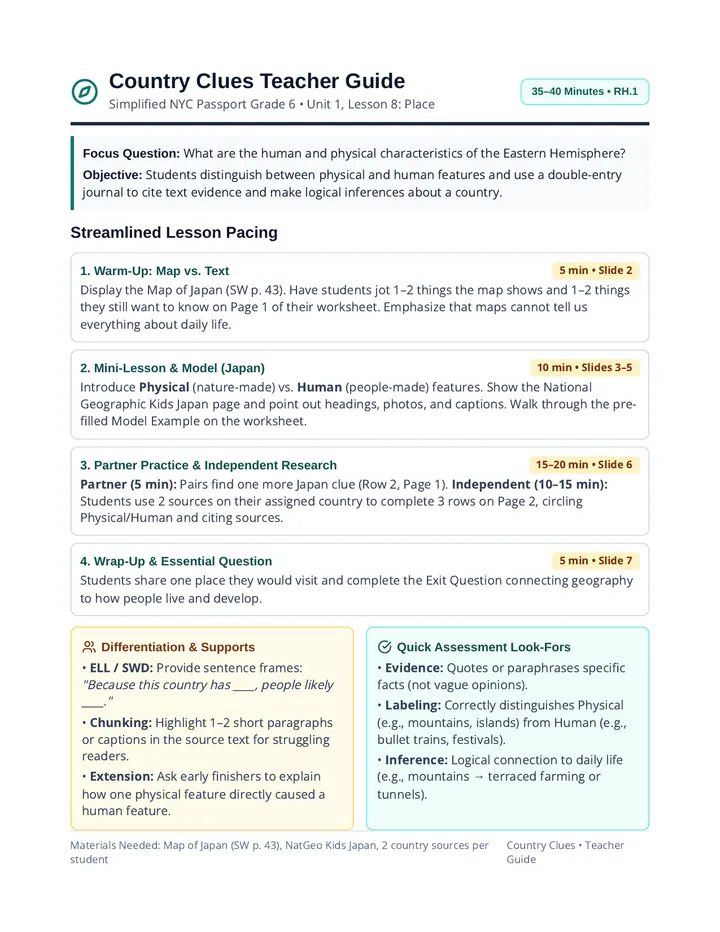
Country Clues Teacher Guide Country Clues Teacher Guide
Simplified NYC Passport Grade 6 • Unit 1, Lesson 8: Place
35–40 Minutes • RH.1
Focus Question: What are the human and physical characteristics of the Eastern Hemisphere?
Objective: Students distinguish between physical and human features and use a double-entry journal to cite text evidence and make logical inferences about a country.
Streamlined Lesson Pacing
1. Warm-Up: Map vs. Text 5 min • Slide 2
Display the Map of Japan (SW p. 43). Have students jot 1–2 things the map shows and 1–2 things they still want to know on Page 1 of their worksheet. Emphasize that maps cannot tell us everything about daily life.
2. Mini-Lesson & Model (Japan) 10 min • Slides 3–5
Introduce Physical (nature-made) vs. Human (people-made) features. Show the National Geographic Kids Japan page and point out headings, photos, and captions. Walk through the pre-filled Model Example on the worksheet.
3. Partner Practice & Independent Research 15–20 min • Slide 6
Partner (5 min): Pairs find one more Japan clue (Row 2, Page 1). Independent (10–15 min): Students use 2 sources on their assigned country to complete 3 rows on Page 2, circling Physical/Human and citing sources.
4. Wrap-Up & Essential Question 5 min • Slide 7
Students share one place they would visit and complete the Exit Question connecting geography to how people live and develop.
Differentiation & Supports
• ELL / SWD: Provide sentence frames: "Because this country has ____, people likely ____."
• Chunking: Highlight 1–2 short paragraphs or captions in the source text for struggling readers.
• Extension: Ask early finishers to explain how one physical feature directly caused a human feature.
Quick Assessment Look-Fors
• Evidence: Quotes or paraphrases specific facts (not vague opinions).
• Labeling: Correctly distinguishes Physical (e.g., mountains, islands) from Human (e.g., bullet trains, festivals).
• Inference: Logical connection to daily life (e.g., mountains → terraced farming or tunnels).
Materials Needed: Map of Japan (SW p. 43), NatGeo Kids Japan, 2 country sources per student Country Clues • Teacher Guide
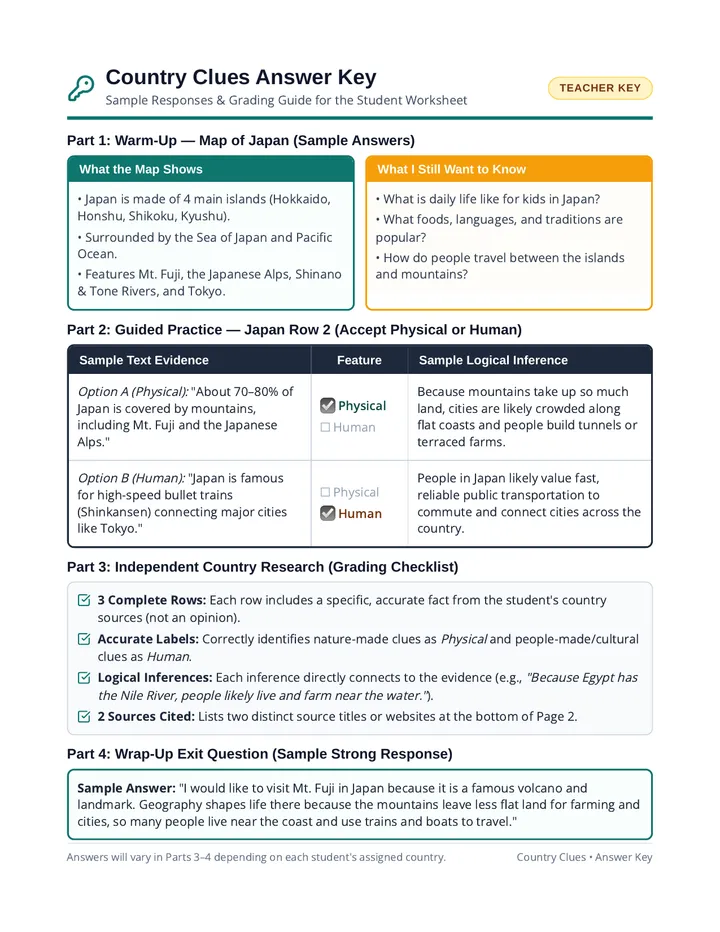
Country Clues Answer Key Country Clues Answer Key
Sample Responses & Grading Guide for the Student Worksheet
Teacher Key
Part 1: Warm-Up — Map of Japan (Sample Answers)
What the Map Shows
• Japan is made of 4 main islands (Hokkaido, Honshu, Shikoku, Kyushu).
• Surrounded by the Sea of Japan and Pacific Ocean.
• Features Mt. Fuji, the Japanese Alps, Shinano & Tone Rivers, and Tokyo.
What I Still Want to Know
• What is daily life like for kids in Japan?
• What foods, languages, and traditions are popular?
• How do people travel between the islands and mountains?
Part 2: Guided Practice — Japan Row 2 (Accept Physical or Human)
Sample Text Evidence
Feature
Sample Logical Inference
Option A (Physical): "About 70–80% of Japan is covered by mountains, including Mt. Fuji and the Japanese Alps."
☑ Physical ☐ Human
Because mountains take up so much land, cities are likely crowded along flat coasts and people build tunnels or terraced farms.
Option B (Human): "Japan is famous for high-speed bullet trains (Shinkansen) connecting major cities like Tokyo."
☐ Physical ☑ Human
People in Japan likely value fast, reliable public transportation to commute and connect cities across the country.
Part 3: Independent Country Research (Grading Checklist)
3 Complete Rows: Each row includes a specific, accurate fact from the student's country sources (not an opinion).
Accurate Labels: Correctly identifies nature-made clues as Physical and people-made/cultural clues as Human .
Logical Inferences: Each inference directly connects to the evidence (e.g., "Because Egypt has the Nile River, people likely live and farm near the water." ).
2 Sources Cited: Lists two distinct source titles or websites at the bottom of Page 2.
Part 4: Wrap-Up Exit Question (Sample Strong Response)
Sample Answer: "I would like to visit Mt. Fuji in Japan because it is a famous volcano and landmark. Geography shapes life there because the mountains leave less flat land for farming and cities, so many people live near the coast and use trains and boats to travel."
Answers will vary in Parts 3–4 depending on each student's assigned country. Country Clues • Answer Key