Civilization Comparison Slides Comparative History Workshop
The Four River Cradles
Comparing Environment, Power & Authority, and Science & Technology across Mesopotamia, Egypt, the Indus Valley, and Ancient China.
Tigris & Euphrates Nile Indus Huang He
Unit 1 • Essay Prep
Analytical Framework
Why Compare Civilizations?
1. Environment
River predictability, natural defense barriers, climate variability, and agricultural surplus.
Key Question: How did geography shape human survival and worldviews?
2. Power
Source of political rule, divine kingship, written legal codes, and state organization.
Key Question: Who held authority, and how did rulers maintain legitimacy?
3. Technology
Writing systems, architectural feats, hydraulic engineering, metallurgy, and urban planning.
Key Question: What innovations solved survival challenges?
An effective essay does not merely list facts—it contrasts causes, impacts, and societal adaptations.
Theme 1: Environment & Geography
River Systems & Survival
Mesopotamia & Egypt
Mesopotamia: Tigris & Euphrates flooded violently and unpredictably. Open flat plains invited frequent invasions; created a bleak view of the afterlife.
Egypt: The Nile flooded like clockwork every July, depositing rich silt. Surrounding deserts served as natural barriers, promoting stability and confidence.
Indus Valley & China
Indus Valley: Fed by Himalayan meltwater and monsoon winds; unpredictable seasonal flooding required advanced drainage networks.
China: Huang He (Yellow River) earned the moniker "China's Sorrow" due to catastrophic floods, but fertile loess supported intensive grain farming.
Comparative Takeaway: Predictable rivers encouraged optimism (Egypt); volatile rivers demanded heavy communal engineering (Mesopotamia, China).
Theme 2: Power & Authority
Rulers, Laws & Legitimacy
Mesopotamia
Hammurabi's Law
Independent city-states ruled by warrior-kings. Code of Hammurabi established uniform, retributive justice ("eye for an eye").
Source: Divine appointment by gods
Egypt
Divine Theocracy
Pharaoh was not just a priest; he was revered as an actual living god (Horus on Earth), maintaining universal cosmic harmony (Ma'at).
Source: Divine incarnation
Indus Valley
Civic Order
Little evidence of royal palaces, militarism, or dynastic tombs; centralized planning implies strong civic or merchant-priest leadership.
Source: Municipal / community council
China
Mandate of Heaven
Dynastic cycle governed by heavenly approval. Floods or rebellions signaled loss of mandate, justifying overthrow.
Source: Conditional heavenly approval
Contrast: Egyptian divine rulers were unquestionable; Chinese rulers held conditional power revocable by rebellion.
Theme 3: Science & Technology
Writing, Engineering & Urbanism
Writing Systems & Records
• Cuneiform (Sumer): Wedge-shaped clay tablets for trade ledgers and legal decrees.
• Hieroglyphics (Egypt): Papyrus and carved temple inscriptions for religious liturgy.
• Oracle Bones (China): Inscribed tortoise shells used for royal divination and ancestral counsel.
• Indus Seals: Stamp seals with animal pictograms (remains undeciphered).
Monumental Engineering
• Ziggurats & Pyramids: Mud-brick mountain temples (Mesopotamia) vs. limestone royal tombs (Egypt).
• Harappan Sanitation: Oven-fired standard bricks, grid street layout, and covered domestic sewer networks.
• Chinese Metallurgy & Silk: Master bronze casting, silk loom weaving, and defensive rammed-earth walls.
Comparative Takeaway: Technology directly reflected societal priorities: afterlife glory (Egypt), trade & law (Mesopotamia), civic cleanliness (Indus), statecraft (China).
Essay Preparation
Bridging Analysis to Writing
The Essay Prompt
Compare and contrast how the ancient river valley civilizations (Mesopotamia, Egypt, Indus Valley, and China) adapted to their environments , structured their power and authority , and developed science and technology .
Step 1: Evidence Matrix
Complete your matrix handout with specific facts for all 4 river cradles.
Step 2: Thesis Claim
Unite your similarities and contrasts into one strong, arguable sentence.
Step 3: 5-Paragraph Outline
Organize your 3 body paragraphs by analytical theme before drafting.
Next: Complete the Civilization Matrix Handout with your writing group. Ready to Build
Civilization Matrix Handout World History Essay Workshop • Resource Handout
River Civilizations Comparative Matrix
Name: ___________________________
Date: ____________ Period: _______
Essential Question: How did geographic environment shape political authority and technological innovation in the four foundational river valleys? Use this matrix as your primary evidence repository for your 5-paragraph comparative essay.
Mesopotamia
Ancient Egypt
Indus Valley
Shang & Zhou China
Theme 1: Environment & Geography Rivers, Flooding, & Natural Defenses
Tigris & Euphrates
Violent, unpredictable floods. Flat, open plains with no natural defenses; vulnerable to invasion. Arid climate required large irrigation canals.
Nile River
Predictable annual summer floods depositing fertile black silt. Surrounded by vast deserts (Sahara) acting as barriers against invasion.
Indus & Saraswati
Fed by Himalayan snowmelt and monsoon cycles. Seasonal flooding; dry winters. High mountains and Thar Desert offered defense.
Huang He (Yellow River)
Violent, devastating floods ("China's Sorrow") depositing rich loess silt. Geographically isolated by Gobi Desert, Pacific, and Himalayas.
Theme 2: Power & Authority Rulers, Legal Codes, & Legitimacy
City-States & Codes
Independent city-states ruled by warrior kings (lugals) claiming divine approval. Code of Hammurabi established strict written retributive justice.
Living God-King
Centralized divine monarchy. Pharaoh was revered as an actual living god (Horus) who preserved cosmic order and justice (Ma'at ).
Civic Centralization
Little sign of royal monuments or large militaries. Standardized layout suggests rule by an organized merchant council or priest-administrators.
Mandate of Heaven
Dynastic rule legitimized by heavenly favor. Rulers maintained authority only while governing justly; disasters signaled loss of the Mandate.
Theme 3: Science & Technology Writing, Architecture, & Inventions
Cuneiform & Wheel
Wedge-shaped script on clay tablets. Invented the potter's wheel, sail, base-60 math system, and monumental mud-brick ziggurats .
Hieroglyphics & Stone
Sacred carvings and cursive hieratic on papyrus. Advanced 365-day solar calendar, geometry, medicine, and monumental limestone pyramids .
Grid Cities & Sanitation
Standardized oven-baked bricks, grid urban layout, public baths (Great Bath), and covered underground domestic sewer drainage networks.
Bronze, Silk, & Oracle
Sophisticated piece-mold bronze metallurgy, sericulture (silk weaving), horse-drawn war chariots, and pictographic script on oracle bones .
Historian's Fieldwork: Spotting the Analytical Thread
Notice how physical environments influenced political rule: unpredictable rivers and lack of barriers (Mesopotamia) fueled anxieties and stern laws, while predictable waters and protective deserts (Egypt) inspired divine stability and optimistic worldviews.
Page 1 of 2 • Evidence Reference Matrix
Part II: Evidence Synthesis
Comparative Analysis & Argument Prep
Use for Essay Body Paragraphs
1 Theme 1 (Environment): Contrast Nile Predictability vs. Tigris/Euphrates Unpredictability
How did the regularity of flooding affect religious attitudes, daily life, and the need for organized irrigation in Egypt versus Mesopotamia?
2 Theme 2 (Power): Compare Egyptian Divine Rule with China's Mandate of Heaven
In what ways was the authority of an Egyptian Pharaoh permanent and god-like, while the Chinese Emperor's rule was conditional upon moral virtue and divine favor?
3 Theme 3 (Technology): Contrast Indus Valley Public Sanitation vs. Mesopotamian Monumental Ziggurats
What does Harappan city planning (sewers, grids) reveal about their societal values compared to Mesopotamian ziggurats built for elite priests and gods?
Cross-Civilization Essay Synthesis Organizer
Select at least two civilizations you will emphasize in your 5-paragraph essay and record one primary similarity and one primary difference.
Key Similarity Across Civilizations:
Key Difference Across Civilizations:
Unit 1 Writing Portfolio • River Civilizations Keep this handout inside your essay folder for thesis development and drafting. Page 2 of 2
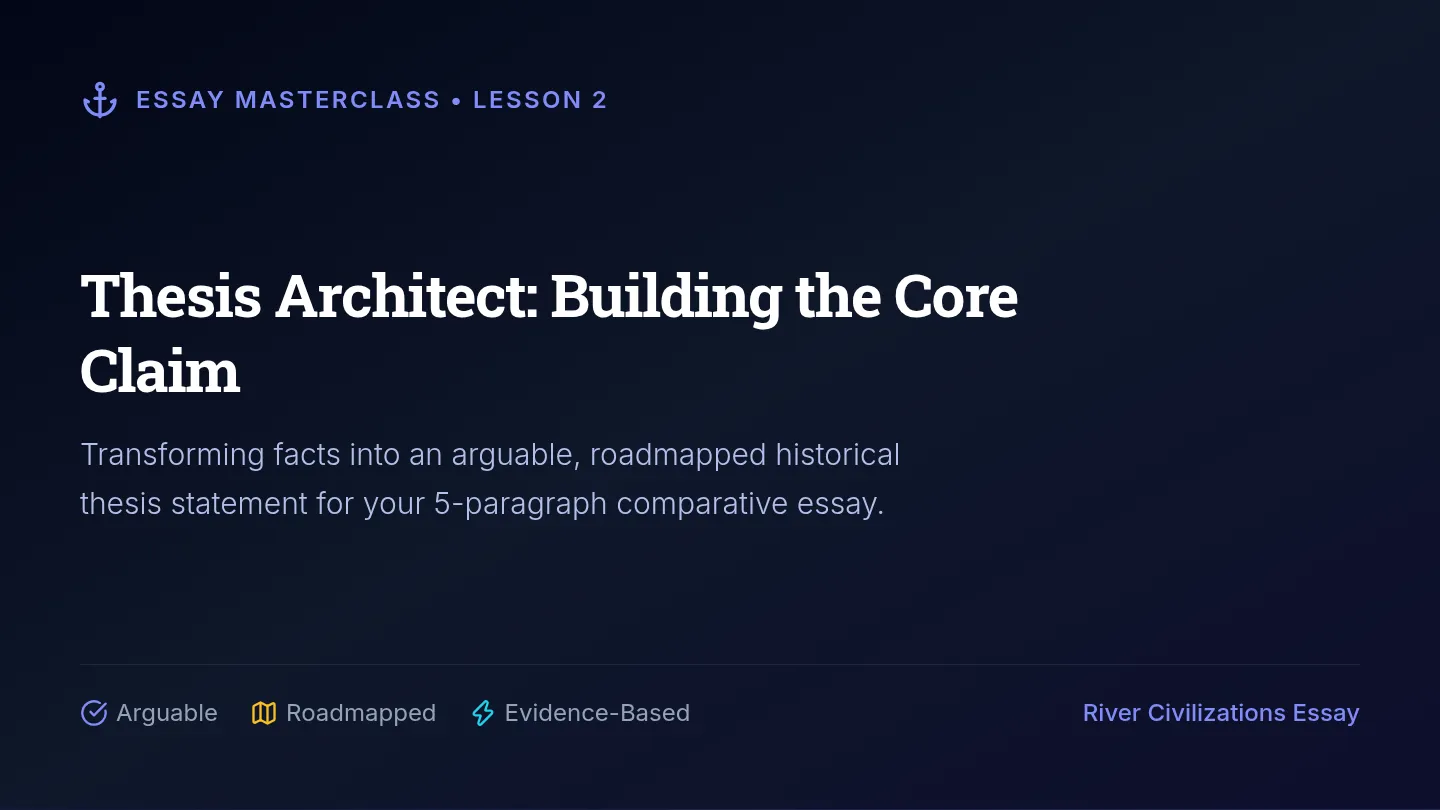
Thesis Formulation Slides Essay Masterclass • Lesson 2
Thesis Architect: Building the Core Claim
Transforming facts into an arguable, roadmapped historical thesis statement for your 5-paragraph comparative essay.
Arguable Roadmapped Evidence-Based
River Civilizations Essay
What is a Historical Thesis?
The Foundation of Your Essay
1. It Takes a Stand
A thesis is not a neutral statement of fact. It is an informed, arguable position that someone could dispute.
Not: "Egypt had the Nile."
2. It Roadmaps
It forecasts the exact 3 analytical themes your body paragraphs will prove: Environment, Power, and Science/Tech.
Guides the reader through Body 1, 2, and 3.
3. It Explains "Why"
It answers the crucial historical question: "So what?" Why did these similarities or differences matter?
Connects cause, adaptation, and legacy.
Rule: A reader who only reads your thesis statement should know exactly what you will argue and prove.
Thesis Showdown: Weak vs. Strong
Spotting the Difference
WEAK: Obvious Fact
"Mesopotamia, Egypt, China, and Indus Valley had rivers and different kings."
Problem: A statement of fact is not an argument.
STRONG: Complex Claim
"Although all four cradles relied on floodplains, geographic predictability determined whether power was centralized or fractured."
Strength: Acknowledges similarity, then asserts causal difference.
WEAK: Empty Formula
"There were many similarities and differences in environment, power, and science."
Problem: Vague placeholder; takes no real stand.
STRONG: Specific Roadmap
"While river floods spurred irrigation, natural barriers led Egypt to divine stability and Mesopotamia to strict written laws."
Strength: Directly links geography to legal & political systems.
Key Rule: Never just write "there were similarities and differences"—name them specifically!
The 3-Part Thesis Formula
Your Blueprint for Success
Part 1
Concession / Shared Baseline
Acknowledge the major commonality across the river valleys.
"Although all four cradles relied on river floods for agricultural survival..."
Part 2
Core Claim / Divergence
Assert your primary analytical stance on how they fundamentally differed.
"...they established distinct systems of political authority and urban science..."
Part 3
Historical 'Because'
State the underlying historical reason or impact that proves your claim.
"...because unique environmental security dictated whether rulers governed through fear, divine order, or civic cooperation."
Formula Equation: [Although Shared Trait], [Core Comparative Claim] + [Because of Specific Environmental & Technological Factors].
Deconstructing A Model Thesis
Color-Coded Anatomy
Although Mesopotamia, Egypt, the Indus Valley, and China all harnessed river valleys to sustain dense populations, their vulnerability to natural disasters and invasion dictated starkly different political systems and technologies, ranging from Egypt's confident divine theocracy to Mesopotamia's retributive legal codes and Harappa's civic sanitation.
1. Concession
Sets the shared historical reality (all 4 harnessed river valleys for agriculture).
2. Core Claim
Asserts causal link: vulnerability shaped government type and scientific priority.
3. The 3 Body Themes
Directly previews Body 1 (environment), Body 2 (power), and Body 3 (technology).
Notice how seamlessly this sentence acts as the steering wheel for all five paragraphs of the essay.
Testing Your Thesis: The 3 Questions
Self-Audit
01
Is it arguable?
Could a reasonable history student propose an alternative interpretation?
If everyone agrees instantly, it is a fact, not a thesis.
02
Is it roadmapped?
Does it explicitly preview environment, political authority, and technology?
Ensures the reader knows your 3 body paragraph topics.
03
Does it pass "So What?"
Does it explain why these comparative differences shaped human history?
Provides deep historical analysis, not superficial trivia.
Next Step: Complete the Thesis Builder Worksheet to craft your custom claim. Let's Construct
Thesis Builder Worksheet Lesson 2 • Student Writing Workshop
Thesis Builder Worksheet
Name: ___________________________
Date: ____________ Period: _______
The Golden Rule of Historical Theses: Your thesis is the steering wheel of your entire 5-paragraph essay. It must not state a neutral fact; it must take an arguable stance that compares river civilizations across environment, power, and technology .
PART 1 Diagnostic Clinic: Repairing Weak Theses
Weak Draft A: "Mesopotamia and Egypt had rivers and developed tools and kings." Flaw: Simple Fact
Rewrite this draft to take an arguable comparative stance on how river behavior shaped power:
Weak Draft B: "There were similarities and differences in China and Indus Valley technology." Flaw: Vague List
Rewrite this draft by naming the specific technological divergence and its historical purpose:
PART 2 Drafting Your Custom Thesis (The 3-Piece Formula)
Step A: The Concession / Shared Baseline (What broad similarity did they all share?)
Starter: "Although Mesopotamia, Egypt, the Indus Valley, and China all relied on..."
Step B: The Core Claim / Divergence (How did their environments lead to contrasting societies?)
Starter: "...their contrasting environmental security fundamentally caused them to diverge in..."
Step C: The Analytical Roadmap & 'Because' (Preview environment, power, and science)
Starter: "...because while [Civilization X] developed [Y], [Civilization A] prioritized [B] in order to..."
Page 1 of 2 • Draft Your Full Sentence on Page 2
Part III: Refinement & Approval
Thesis Polish & Peer Audit
Ready for Essay Outline
Working Draft 1: Complete Combined Thesis Sentence
Combine Steps A, B, and C from Page 1 into one cohesive, compound-complex sentence.
Thesis Litmus Test: Peer & Self-Audit Reviewer Name: _______________________
1. Arguable Claim: Does the sentence make a historical argument rather than stating an indisputable fact? (Could someone reasonably argue an alternative perspective?)
2. Three-Part Roadmap: Does the thesis clearly preview or encompass Environment/Geography, Power/Authority, and Science/Technology?
3. Pass the "So What?" Challenge: Does the thesis explain why this comparison mattered historically (e.g., impact on stability, worldviews, survival)?
4. Free of Banned Clichés: Sentence avoids phrases like "there are many similarities and differences" or "in this essay I will prove."
Peer Auditor Coaching Note: (What is one specific improvement the writer should make?)
Final Polished Thesis Statement (Transfer to Essay Outline) Final Master Copy
Teacher Thesis Approval:
(Required before starting Outline)
Page 2 of 2
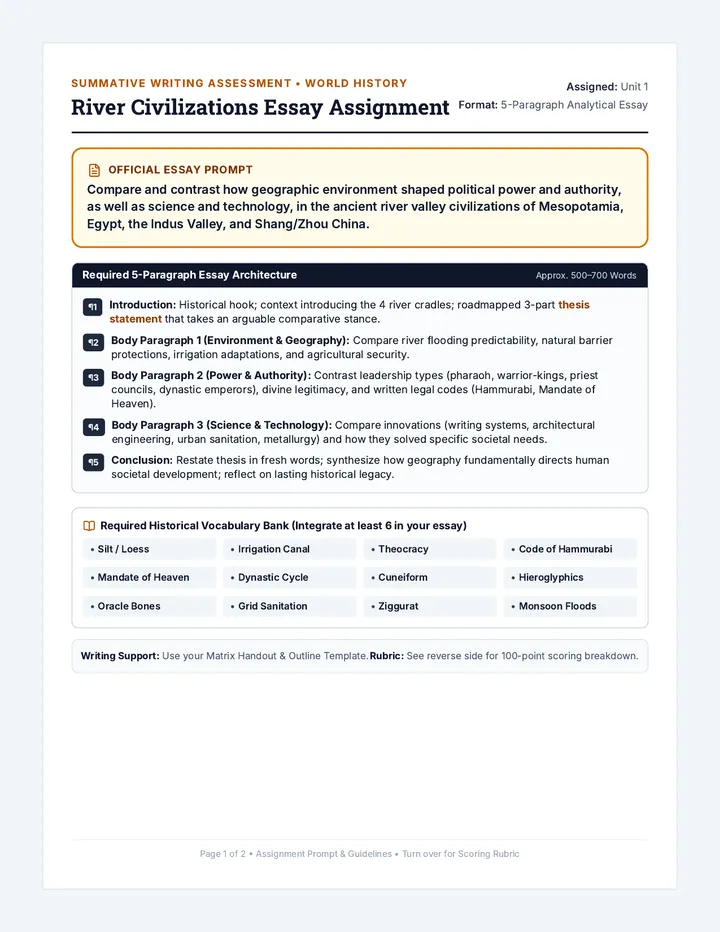
Essay Prompt Rubric Summative Writing Assessment • World History
River Civilizations Essay Assignment
Assigned: Unit 1
Format: 5-Paragraph Analytical Essay
Official Essay Prompt
Compare and contrast how geographic environment shaped political power and authority, as well as science and technology, in the ancient river valley civilizations of Mesopotamia, Egypt, the Indus Valley, and Shang/Zhou China.
Required 5-Paragraph Essay Architecture Approx. 500–700 Words
¶1
Introduction: Historical hook; context introducing the 4 river cradles; roadmapped 3-part thesis statement that takes an arguable comparative stance.
¶2
Body Paragraph 1 (Environment & Geography): Compare river flooding predictability, natural barrier protections, irrigation adaptations, and agricultural security.
¶3
Body Paragraph 2 (Power & Authority): Contrast leadership types (pharaoh, warrior-kings, priest councils, dynastic emperors), divine legitimacy, and written legal codes (Hammurabi, Mandate of Heaven).
¶4
Body Paragraph 3 (Science & Technology): Compare innovations (writing systems, architectural engineering, urban sanitation, metallurgy) and how they solved specific societal needs.
¶5
Conclusion: Restate thesis in fresh words; synthesize how geography fundamentally directs human societal development; reflect on lasting historical legacy.
Required Historical Vocabulary Bank (Integrate at least 6 in your essay)
• Silt / Loess
• Irrigation Canal
• Theocracy
• Code of Hammurabi
• Mandate of Heaven
• Dynastic Cycle
• Cuneiform
• Hieroglyphics
• Oracle Bones
• Grid Sanitation
• Ziggurat
• Monsoon Floods
Writing Support: Use your Matrix Handout & Outline Template. Rubric: See reverse side for 100-point scoring breakdown.
Page 1 of 2 • Assignment Prompt & Guidelines • Turn over for Scoring Rubric
Grading Standards • 100 Total Points
Comparative Essay Grading Rubric
Evaluation Criteria
Criterion & Weight
Exemplary (4 / 25 pts)
Proficient (3 / 21 pts)
Developing (2 / 17 pts)
Beginning (1 / 13 pts)
1. Thesis & Argument 25 Points
Sophisticated 3-part thesis; takes clear arguable stance; roadmaps environment, power, and science; answers "so what?"
Clear thesis with claim and preview of themes; arguable, but historical rationale could be deeper.
Weak claim; leans toward statement of simple fact; vague preview ("similarities and differences").
Missing or purely factual; fails to take an arguable comparative stance.
2. Historical Evidence & Accuracy 25 Points
Rich, precise historical specifics for all required civilizations; flawlessly integrates 6+ vocabulary terms with deep accuracy.
Accurate historical details across all 3 themes; includes 4-5 vocabulary terms correctly; minor generalization.
Inconsistent details; some historical inaccuracies or superficial coverage of civilizations; limited vocabulary.
Major factual errors; minimal specific evidence provided; omits key civilizations.
3. Comparative Synthesis 25 Points
Masterful cross-civilization synthesis; analyzes reasons for divergence; connects environment directly to power and innovation.
Directly compares and contrasts civilizations within paragraphs; explains causal connections with clear rationale.
Lists facts sequentially by civilization without synthesizing comparisons; lacks depth in analyzing causes.
Isolated paragraphs without comparative links; fails to contrast environmental or political impacts.
4. Structure & Conventions 25 Points
Seamless 5-paragraph flow; sophisticated transitions; strong topic sentences; formal academic register; error-free.
Organized 5-paragraph format with clear topic and concluding sentences; effective transitions; minor grammar slips.
Structure wanders; awkward or repetitive transitions; paragraphs lack unified focus; frequent mechanical errors.
Lacks basic paragraph organization; no transitions; informal slang; errors impede reader comprehension.
Scoring Summary & Teacher Comments:
Total Score: ______ / 100
Unit 1 World History • Analytical Essay Assessment Keep this rubric attached to your final printed essay draft. Page 2 of 2
Essay Outline Template Lesson 3 • Planning & Pre-Writing Blueprint
5-Paragraph Essay Outline Template
Name: ___________________________
Date: ____________ Period: _______
Strategy: Write specific facts, names, and historical concepts into these planning frames before drafting full sentences.
Paragraph 1: Introduction Opening • Context • Thesis
A. Historical Hook (Broad statement about humanity's leap from nomadic foraging to river valley civilization):
B. Historical Context (Identify the 4 river cradles: Tigris/Euphrates, Nile, Indus, Huang He and their shared agricultural reliance):
C. Thesis Statement (Insert your approved 3-part comparative thesis from Worksheet 2):
Paragraph 2: Body Paragraph 1 • Theme 1: Environment & Geography Predictability, Flooding, & Natural Barriers
A. Topic Sentence (Claim on how contrasting river behavior and geography shaped societal security):
B. Civilization 1 Evidence (e.g., Egypt):
(Note: Nile predictable floods, protective Sahara desert)
C. Civilization 2 Evidence (e.g., Mesopotamia):
(Note: Tigris/Euphrates violent floods, open invasion plains)
D. Comparative Synthesis & Transition to Power (Explain why this environmental difference forced rulers to adapt):
Page 1 of 2 • Turn over for Body Paragraphs 2 & 3 and Conclusion
Part II: Outlining Body 2, Body 3 & Conclusion
Essay Blueprint (Continued)
Themes 2 & 3 + Final Synthesis
Paragraph 3: Body 2 • Theme 2: Power & Authority Law Codes, Divine Rule, & Legitimacy
A. Topic Sentence (Claim contrasting how rulers established and justified control):
B. Contrast Evidence 1 (e.g., Code of Hammurabi):
C. Contrast Evidence 2 (e.g., Pharaoh or Mandate):
D. Comparative Synthesis (Why did one rely on strict law while another relied on divine mandate?):
Paragraph 4: Body 3 • Theme 3: Science & Technology Writing, Architecture, & Urban Sanitation
A. Topic Sentence (Claim on how technology resolved unique environmental & organizational problems):
B. Writing Systems Contrast (Cuneiform vs. Hieroglyphics vs. Oracle):
C. Engineering Contrast (Ziggurats/Pyramids vs. Harappan Sewers):
D. Synthesis (How did these innovations reflect what each society valued most?):
Paragraph 5: Conclusion Restatement • Big Picture • Enduring Legacy
A. Restated Thesis (Express your core comparative thesis using fresh, elevated vocabulary):
B. Broader Historical Synthesis (What universal lesson does this comparison reveal about human civilization and physical geography?):
C. Final Lasting Thought (Enduring legacy of written law, urbanism, or hydraulic engineering today):
Unit 1 Writing Workshop • Essay Outline Blueprint Once outline is complete, review with your teacher before starting your full rough draft. Page 2 of 2
Modified Guided Essay Modified Writing Support • Guided Essay Packet
River Civilizations Guided Essay
Name: ___________________________
Date: ____________ Period: _______
How to use this packet: Fill in the blanks and use the Word Bank below to write your complete 5-paragraph history essay. Follow the sentence starters step by step!
Helpful Word Bank:
• Nile River (Egypt) • Tigris & Euphrates • Indus River • Huang He (China) • Fertile Silt (soil) • Predictable Flood • Unpredictable Flood • Irrigation Canals • Pharaoh (Living God) • Code of Hammurabi • Mandate of Heaven • City Planning (Grids) • Cuneiform Script • Hieroglyphics • Pyramids / Tombs • Ziggurat Temples
Paragraph 1: Introduction (The Beginning) Opening • River Names • Big Claim
Sentence 1 (Hook): Thousands of years ago, the first great human civilizations all began near large, fresh water _____________________________________________________________________.
Sentence 2 (Naming Places): The four main river valley civilizations were Egypt on the __________________________ River, Mesopotamia on the Tigris and __________________________ Rivers, the Indus Valley along the Indus River, and China on the __________________________ (Yellow) River.
Sentence 3 (Similarity): All four of these civilizations needed annual river floods because the water deposited rich, fertile _________________________________ that allowed farmers to grow abundant food crops.
Sentence 4 & 5 (Your Thesis Statement - Main Argument):
Although all four civilizations depended on rivers for survival, their different geographic environments caused them to develop very different systems of (Theme 2: power / rulers) _________________________________________________ and (Theme 3: technology / inventions) _________________________________________________ because ___________________________________________________________________________________________________.
Page 1 of 3 • Introduction Complete • Turn over for Body Paragraphs 1 & 2
Part II: Guided Body Paragraphs
Body Paragraphs 1 & 2
Environment • Power & Authority
Paragraph 2: Body 1 • Theme 1: Environment & Geography Rivers, Floods, & Natural Protection
Sentence 1 (Topic): First, physical geography and river flooding patterns shaped how safe and secure each civilization felt.
Sentence 2 (Egypt): In Egypt, the Nile River flooded in a very [predictable / unpredictable] way every summer, and the surrounding hot __________________________ acted as natural barriers that protected Egypt from outside invaders.
Sentence 3 (Mesopotamia): In contrast, the Tigris and Euphrates rivers in Mesopotamia flooded [violently / gently] without warning, and the flat, open land had no natural mountains or deserts to stop enemies from ______________________________________________________________________.
Sentence 4 (Indus or China): Similarly, in China, the Huang He river had dangerous floods that caused widespread destruction, leading people to call it "______________________________________________________."
Sentence 5 (Conclusion/Transition): Because their environments were so different, their rulers had to create different ways to manage their people.
Paragraph 3: Body 2 • Theme 2: Power & Authority Kings, Laws, & Divine Rule
Sentence 1 (Topic): Second, each river civilization had a unique system of government and leadership to keep order.
Sentence 2 (Egypt): In Ancient Egypt, the ruler was called a ____________________________, who was worshipped not just as a human king, but as an actual living ____________________________ who controlled the universe.
Sentence 3 (Mesopotamia): In Mesopotamia, however, King Hammurabi united his city-states by carving a strict written legal code called the ______________________________________________________, famous for the rule "an eye for an ______________________."
Sentence 4 (China): In Ancient China, rulers claimed authority through the ________________________________________, meaning the gods gave them permission to rule as long as they governed fairly.
Sentence 5 (Synthesis): While Egyptian pharaohs were viewed as immortal gods, Mesopotamian and Chinese kings had to prove their authority through strict ____________________________ and successful leadership.
Page 2 of 3 • Body 1 & 2 Complete • Turn over for Technology, Conclusion & Checklist
Part III: Final Paragraphs & Self-Check
Body Paragraph 3 & Conclusion
Science & Technology • Final Reflection
Paragraph 4: Body 3 • Theme 3: Science & Technology Writing, Buildings, & Inventions
Sentence 1 (Topic): Furthermore, river civilizations invented new scientific tools and technologies to solve daily survival problems.
Sentence 2 (Writing): For record-keeping, Mesopotamians invented wedge-shaped writing on clay tablets called ________________________________, while Egyptians used sacred picture writing called ________________________________.
Sentence 3 (Architecture): For monumental building, Egyptians constructed giant stone ____________________________ as royal tombs, while Mesopotamians built mud-brick temples called ____________________________.
Sentence 4 (Indus Valley Innovation): The Indus Valley civilization showed remarkable technology by building clean, planned cities on a grid with underground ________________________________ to remove wastewater.
Sentence 5 (Conclusion): These technological inventions prove that each society used its intelligence to adapt to its unique river valley home.
Paragraph 5: Conclusion (The Wrap-Up) Restate • Big Idea • Legacy
Sentence 1 (Restated Thesis): In conclusion, although the river valleys of Mesopotamia, Egypt, the Indus Valley, and China all provided fresh water and rich soil, their different geographies created different types of ________________________________ and ________________________________.
Sentence 2 (Summary of Contrast): Where rivers were predictable, like Egypt, societies had stability and divine kings; where rivers were dangerous and borders were open, like Mesopotamia, leaders relied on written ____________________________.
Sentence 3 (Enduring Legacy): Today, modern societies still rely on the inventions of these river cradles, including written laws, organized cities, and advanced ________________________________ systems.
Student Essay Self-Checklist:
I completed all 5 paragraphs. I compared all 3 themes (water, kings, tech). I capitalized civilization and river names. I included at least 6 words from the Word Bank.
Unit 1 World History • Guided Writing Scaffolding Great job! Turn this completed guided essay in with your portfolio. Page 3 of 3