Cold Trail Reading Handout Grade 9 • ELA Reading Block Target Time: 15 Minutes
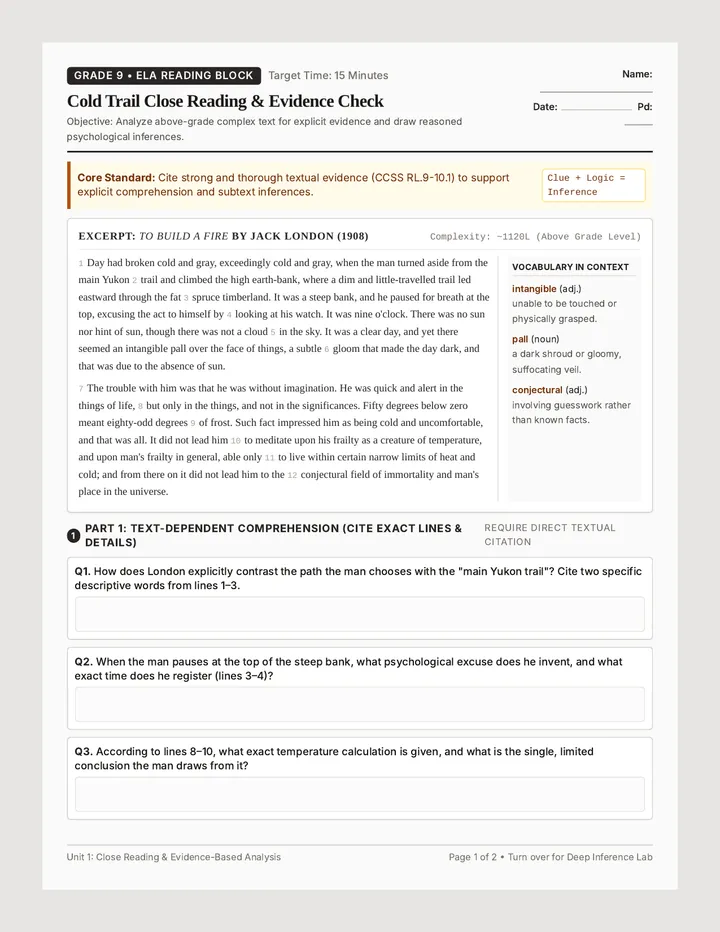
Cold Trail Close Reading & Evidence Check
Objective: Analyze above-grade complex text for explicit evidence and draw reasoned psychological inferences.
Name:
Date: Pd:
Core Standard: Cite strong and thorough textual evidence (CCSS RL.9-10.1) to support explicit comprehension and subtext inferences.
Clue + Logic = Inference
Excerpt: To Build a Fire by Jack London (1908)
Complexity: ~1120L (Above Grade Level)
1Day had broken cold and gray, exceedingly cold and gray, when the man turned aside from the main Yukon 2trail and climbed the high earth-bank, where a dim and little-travelled trail led eastward through the fat 3spruce timberland. It was a steep bank, and he paused for breath at the top, excusing the act to himself by 4looking at his watch. It was nine o'clock. There was no sun nor hint of sun, though there was not a cloud 5in the sky. It was a clear day, and yet there seemed an intangible pall over the face of things, a subtle 6gloom that made the day dark, and that was due to the absence of sun.
7The trouble with him was that he was without imagination. He was quick and alert in the things of life, 8but only in the things, and not in the significances. Fifty degrees below zero meant eighty-odd degrees 9of frost. Such fact impressed him as being cold and uncomfortable, and that was all. It did not lead him 10to meditate upon his frailty as a creature of temperature, and upon man's frailty in general, able only 11to live within certain narrow limits of heat and cold; and from there on it did not lead him to the 12conjectural field of immortality and man's place in the universe.
Vocabulary in Context
intangible (adj.)
pall (noun)
conjectural (adj.)
1 Part 1: Text-Dependent Comprehension (Cite Exact Lines & Details) Require direct textual citation
Q1. How does London explicitly contrast the path the man chooses with the "main Yukon trail"? Cite two specific descriptive words from lines 1–3.
Q2. When the man pauses at the top of the steep bank, what psychological excuse does he invent, and what exact time does he register (lines 3–4)?
Q3. According to lines 8–10, what exact temperature calculation is given, and what is the single, limited conclusion the man draws from it?
Unit 1: Close Reading & Evidence-Based Analysis Page 1 of 2 • Turn over for Deep Inference Lab
Analytical Depth
Inference Lab: Decoding Subtext & Mindset
CCSS.ELA-LITERACY.RL.9-10.1
2 Inference Architecture: The Analytical Equation
Text Clue (Explicit Evidence)
+ Logical Reasoning (Subtext)
= Evidence-Based Inference
"He paused for breath at the top, excusing the act to himself by looking at his watch." (lines 3–4)
People who check their watch to justify resting are prideful and uncomfortable admitting physical strain or vulnerability.
The protagonist has deep hubris; he suppresses his body's natural warnings to preserve an illusion of complete mastery.
3 Part 2: Evidence-Based Inference Practice (3 Focus Areas) Claim + Quoted Evidence Required
Inference 1 (Atmosphere & Peril): In lines 4–6, London writes that despite a clear sky, there is "no sun nor hint of sun" and an "intangible pall over the face of things." What does this atmospheric detail infer about nature's disposition toward the traveler?
Direct Quoted Evidence (with line #):
My Inference & Psychological Reasoning:
Inference 2 (Character Psychology): What does the narrator's distinction between "the things of life" and "the significances" (lines 7–8) infer about the man's mental preparation for wilderness survival?
Direct Quoted Evidence (with line #):
My Inference & Psychological Reasoning:
Inference 3 (Thematic Subtext): London notes that the cold does not lead the man to meditate upon "man's frailty in general, able only to live within certain narrow limits" (lines 10–11). What can we infer about how London views human beings in comparison to the natural universe?
Direct Quoted Evidence (with line #):
My Inference & Psychological Reasoning:
CRAFT BRIDGE Mentor Takeaway for Narrative Writing Connects Reading directly to Writing Planning
London builds suspense by showing character flaws through sensory setting details and varied sentence pacing (e.g., contrasting dense descriptions with the stark four-word sentence, "It was nine o'clock."). Use these exact strategies in your story blueprint!
Cold Trail Close Reading & Inference Handout Page 2 of 2 • Transition to Story Blueprint Planning
Story Blueprint Planning Worksheet Day 1 • Narrative Planning Target Time: 15 Minutes
Narrative Story Blueprint & Architecture
Focus: Brainstorm an original premise, establish vivid sensory setting, and structure narrative pacing.
Name:
Date: Period:
1 Step 1: Student Choice Topic & Premise Launch
Pick any topic, memory, or fictional scenario that captivates you
Personal Milestone Survival / High Stakes Sports / Competition Mystery / Discovery Sci-Fi / Speculative
My Chosen Topic & Core Conflict (1-2 sentences):
Point of View (POV):
1st Person (I, we) 3rd Person Limited (he, she)
2 Step 2: Narrative Arc Progression (Multi-Paragraph Map)
1. Exposition & Hook
Introduce protagonist, immediate setting atmosphere, and baseline world.
2. Inciting Obstacle
The event that disrupts normal life and triggers tension.
3. Climax Peak
The decisive turning point or highest moment of pressure.
4. Resolution & Shift
The aftermath, internal realization, or lasting consequence.
3 Step 3: Setting Atmosphere & 5-Sense Palette
Like Jack London's Arctic Yukon, your setting should feel alive. List precise sensory descriptors:
👁 Sight & Light Colors, shadows, weather
👂 Sound & Silence Echoes, pitch, volume
✋ Touch & Temp Textures, heat, numbness
👃 Smell & Air Aroma, dampness, fumes
⚡ Internal / Gut Heartbeat, adrenaline, dread
Unit 1: Multi-Paragraph Narrative Architecture Page 1 of 2 • Turn over for Transitions & Drafting
Craft Arsenal
Transitions, Sentence Variety & Drafting Launch
Target: Multi-Paragraph Narrative
Sequencing Transitions Bank Choose & star 3 to use
Chronological:
At dawn, moments before, concurrently, as seconds ticked away, eventually
Sudden Shifts / Tension:
Without warning, in an instant, abruptly, mid-stride, out of the periphery
Spatial Movement:
Across the threshold, beneath the canopy, flanking the path, beyond the ridge
Varied Sentence Structures Alternate lengths
1. Short & Punchy (Simple):
"The engine sputtered. Silence followed."
2. Compound (Coordination):
"The wind whipped the canvas, but he refused to let go."
3. Complex (Subordinating Starter):
"Although the shadows lengthened, she kept running."
✓ Master Narrative Writer's Checklist (Self-Monitoring) Verify before & during drafting
Clear, engaging narrative hook that anchors character & situation Setting atmosphere developed with at least 2 distinct senses Logical temporal sequence with transitional phrases Deliberate sentence variety (short punchy + complex clauses) Central conflict or internal obstacle introduced clearly Consistent narrative point of view (1st or 3rd person)
If Time Extension
Start Drafting: Paragraph 1 (Exposition & Hook)
Goal: 4–6 strong sentences
Apply your blueprint: Hook the reader immediately, establish your setting's sensory atmosphere, and test at least one transition word and varied sentence length.
Story Blueprint Planning Worksheet & Checklist Page 2 of 2 • Ready for Writing Workshop
Narrative Launch Teacher Guide Teacher Facilitation Guide Grade 9 • ELA Reading & Writing
Narrative Launch: Reading & Planning
Dual-Focus Session: 15-Min Analytical Reading & Inference + 15-Min Narrative Architecture Planning.
Total Duration: 30–40 Mins
Model: Gradual Release (I/We/You)
Part 1: Reading Goal (15 Mins)
Given an above-grade-level complex text (~1120L), students read closely, cite explicit textual evidence, and synthesize textual clues with logical reasoning to generate grounded inferences.
Part 2: Writing Goal (15 Mins)
Students plan an original multi-paragraph narrative (student choice) focusing on sensory setting, sequencing transitions, and varied sentence structure; extends to drafting paragraph 1.
⏱ Instructional Pacing Roadmap
Time
Phase & Focus
Teacher & Student Actions
0:00–5:00
Close Read & Detail
Teacher frames vocabulary and models annotation of Jack London excerpt. Students cite lines for 3 explicit comprehension questions.
5:00–12:00
Inference Lab
Direct instruction on Inference Formula (Text Clue + Logic = Claim). Students complete 3 structured evidence-based inference prompts.
12:00–15:00
Mentor Craft Bridge
Analyze London's sensory setting and sentence rhythm (short vs. complex) as structural inspiration for student writing.
15:00–22:00
Gradual Release (I / We)
Teacher models choice premise & 5-sense setting palette. Class co-constructs transitions for a shared scenario.
22:00–30:00+
Independent (You Do)
Students plan choice topic on blueprint. Early finishers launch into Paragraph 1 and audit against Writer's Checklist.
🗣 Gradual Release Facilitation Scripts (Teacher Talk)
I DO (Teacher Modeling) Demonstrating Sensory Atmosphere & Choice
"Watch how I choose my topic: I'm picking an intense personal memory—getting caught in a sudden thunderstorm on an open lake. Instead of just writing 'it rained,' I build my sensory palette first: ozone smell, freezing spray, and violent violet skies. Then, I alternate sentence lengths to inject urgency."
WE DO (Guided Practice) Connecting Action with Sequence Transitions
"Let's look at our transitions bank together. If our character enters an abandoned hallway, which transition creates suspense: 'Next,' or 'Without warning'? Turn to your partner: give me one sound detail and one transition phrase to link paragraph one to paragraph two."
YOU DO (Independent Blueprinting) Student Ownership & 'If Time' Extension
"Your turn. Choose any topic that genuinely excites you—real or fictional. Complete your 4-stage narrative arc, populate your 5-sense setting box, and select three transitions. Once your blueprint is complete, don't wait: launch immediately into Paragraph 1 and run your work against the Writer's Checklist."
Narrative Launch Teacher Facilitation Guide Page 1 of 2 • Turn over for Answer Key & Rubrics
Teacher Reference
Expanded Answer Key & Analysis Exemplars
Formative Evaluation Guide
1 Part 1: Text-Dependent Comprehension Answer Key
Q1 Key (Trail Contrast): London describes the side path as "a dim and little-travelled trail" leading through "fat spruce timberland" (lines 2–3), explicitly contrasting it with the established "main Yukon trail."
Q2 Key (Excuse & Exact Time): The man catches his breath on the steep bank by "excusing the act to himself by looking at his watch" (lines 3–4); he registers that it is exactly "nine o'clock."
Q3 Key (Temperature Calculation & Conclusion): The calculation is "Fifty degrees below zero meant eighty-odd degrees of frost" (lines 8–9). His only conclusion is that it is "cold and uncomfortable, and that was all."
2 Part 2: Evidence-Based Inference Lab Exemplars
Inference 1 Exemplar (Atmosphere & Peril):
Evidence: "no sun nor hint of sun... an intangible pall over the face of things, a subtle gloom" (lines 4–6).
Inference 2 Exemplar (Things vs. Significances):
Evidence: "quick and alert in the things of life, but only in the things, and not in the significances" (lines 7–8).
Inference 3 Exemplar (Thematic Subtext & Human Frailty):
Evidence: "his frailty as a creature of temperature... able only to live within certain narrow limits" (lines 10–11).
3 Exemplar: 'If Time' Paragraph 1 Draft (Annotated for Checklist)
"The iron rungs of the fire escape were so cold they burned through my leather gloves. Beneath me, Chicago breathed in icy gusts of exhaust and salt, but up on the fourth-floor landing, the world was frozen still. Without warning, the latch groaned. I froze. If the heavy steel door slammed shut now, my only way back into the warm corridor was lost forever."
Hook: Sensory shock of iron.
Sensory: Burning cold & groaning latch.
Transition: "Without warning."
Syntax: 2-word sentence + complex clause.
Scaffolds for Striving Learners
Provide sentence stem: "London's phrase '___' implies that nature is ___ because..." Pair with partner to verify exact line numbers.
Extensions for Advanced Writers
Ask students to explain how London's diction (e.g., pall, conjectural) creates dramatic irony where the reader understands the peril before the character does.
Teacher Guide: Narrative Foundations Page 2 of 2 • ELA Curriculum Ready
Narrative Launch Slides Grade 9 ELA Day 1 Workshop
30–40 Minutes Total
Narrative Architecture & Evidence-Based Inference
Reading complex literature for subtext, then building the blueprint for your own student-choice narrative.
Part 1: 15-Min Reading Goal
Demonstrate comprehension of complex text; synthesize explicit details into reasoned inferences.
Part 2: 15-Min Writing Goal
Plan a multi-paragraph narrative with sensory setting, sequencing transitions, and sentence variety.
Unit 1: The Narrative Architect Slide 1 of 7
Part 1 • Reading Strategy CCSS.ELA-LITERACY.RL.9-10.1
The Inference Formula
An inference is not a wild guess. It is a logical claim built on cold, hard textual evidence.
Step 1
Text Clue
What does the author explicitly state? (Facts, quotes, line numbers)
Step 2
Logical Reason
What does common sense or human psychology tell us about this fact?
Step 3
Valid Inference
What deeper reality or character trait is revealed underneath?
Rule of Thumb: If your partner asks "Where does it say that?", you must be able to point your finger to the exact line number!
Inference Lab Slide 2 of 7
Mentor Text Analysis To Build a Fire by Jack London
"Day had broken cold and gray, exceedingly cold and gray... It was nine o'clock. There was no sun nor hint of sun... an intangible pall over the face of things, a subtle gloom that made the day dark..."
3 Craft Moves to Steal for Your Story:
1. Tangible Senses
London doesn't just say "it was winter." He uses temperature, light quality, and atmosphere to make the cold a living adversary.
2. Sentence Rhythm
Notice the punchy 4-word sentence: "It was nine o'clock." Sandwiched between complex clauses, it hits like a gavel.
3. Psychological Hook
The protagonist's fatal flaw (lack of imagination) is established right against the setting in paragraph 1.
From Reader to Writer Slide 3 of 7
Part 2 • Writing Architecture I DO • Teacher Modeling
Step 1: Choose Your Story Seed
You have complete student choice today! Select any premise that genuinely interests you:
🏃♂️
Personal Memory
A real turning point or challenge you faced.
⚡
High Stakes
Survival, extreme weather, race against clock.
🏆
Competition
Championship game, audition, final test.
🔍
Mystery
Uncovering a secret, an abandoned place.
🚀
Speculative
Dystopian escape, sci-fi anomaly, myth.
Teacher's Model Choice:
Premise: Trapped on an icy Chicago fire escape during a sudden polar vortex while locked out of an apartment.
Gradual Release: I Do Slide 4 of 7
Gradual Release WE DO • Guided Practice
Setting Palette & Sequencing Transitions
Don't tell us what happened—make us feel the physical atmosphere.
5-Sense Palette Anchor
👁 Sight: Blue exhaust fumes, peeling black enamel
👂 Sound: Groaning steel latch, wind whistling in hollow rungs
✋ Touch: Sub-zero iron burning through wet leather gloves
👃 Smell: Salt, diesel smoke, bitter frozen air
⚡ Internal: Violent thump of adrenaline behind the ribs
Sequencing Transitions Bank
Chronological:
Moments before, as seconds ticked away, eventually
Tension & Surprise:
Without warning, in an instant, abruptly, mid-stride
Spatial / Movement:
Across the threshold, beneath the canopy, flanking the path
Turn & Talk: Star 3 Transitions on Page 2 Slide 5 of 7
Independent Blueprinting YOU DO • 15 Minutes
The Master Narrative Writer's Checklist
As you build your multi-paragraph blueprint, hold your writing to this standard:
✓
Compelling Hook & Exposition
Introduce protagonist and core situation immediately.
✓
Sensory Setting Atmosphere
Engage at least 2 distinct physical senses on page 1.
✓
Sequencing Transitions
Link scenes and shifts in time with deliberate transition words.
✓
Varied Sentence Structures
Mix punchy short sentences with complex subordinating clauses.
Self-Assessment & Peer Verification Slide 6 of 7
Fast Finisher Launch Day 1 Writing Extension
IF TIME: Start Paragraph 1!
Finished your blueprint early? Do not wait. Launch your opening paragraph in the lined drafting zone on Page 2.
Paragraph 1 Target (4–6 Sentences):
Sentence 1–2: Hook with immediate sensory impact (temperature, sound, or sight).
Sentence 3–4: Anchor the character's internal stakes or initial obstacle.
Sentence 5–6: Insert a transition of sudden shift and alternate sentence length.
Check off items on your Writer's Checklist as you write!
Ready, Set, Draft! Slide 7 of 7
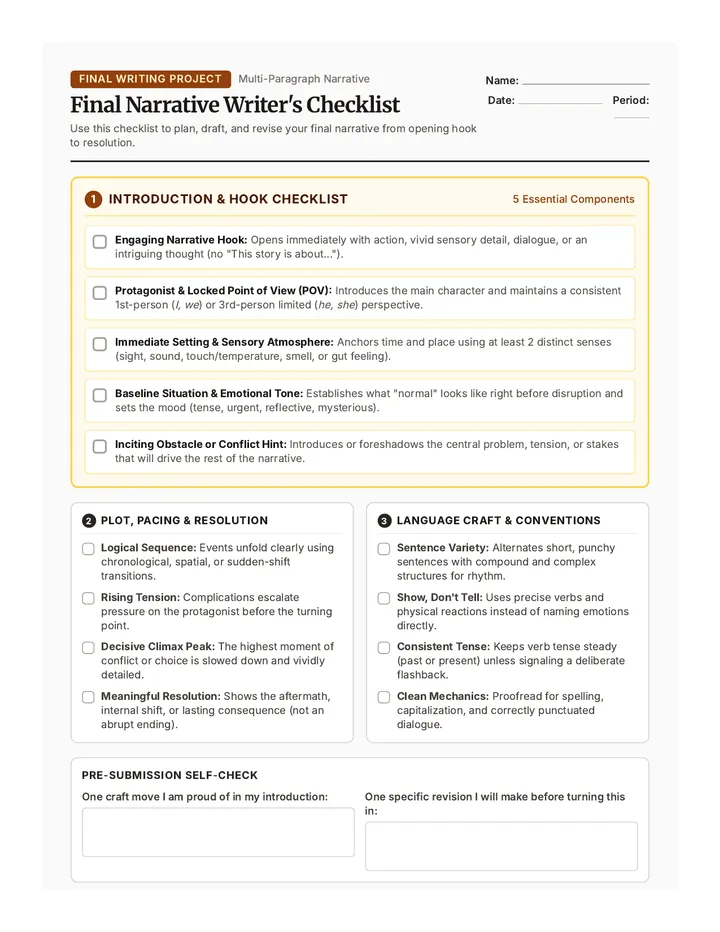
Final Project Writer Checklist Final Writing Project Multi-Paragraph Narrative
Final Narrative Writer's Checklist
Use this checklist to plan, draft, and revise your final narrative from opening hook to resolution.
Name:
Date: Period:
1 Introduction & Hook Checklist
5 Essential Components
Engaging Narrative Hook: Opens immediately with action, vivid sensory detail, dialogue, or an intriguing thought (no "This story is about...").
Protagonist & Locked Point of View (POV): Introduces the main character and maintains a consistent 1st-person (I, we ) or 3rd-person limited (he, she ) perspective.
Immediate Setting & Sensory Atmosphere: Anchors time and place using at least 2 distinct senses (sight, sound, touch/temperature, smell, or gut feeling).
Baseline Situation & Emotional Tone: Establishes what "normal" looks like right before disruption and sets the mood (tense, urgent, reflective, mysterious).
Inciting Obstacle or Conflict Hint: Introduces or foreshadows the central problem, tension, or stakes that will drive the rest of the narrative.
2 Plot, Pacing & Resolution
Logical Sequence: Events unfold clearly using chronological, spatial, or sudden-shift transitions.
Rising Tension: Complications escalate pressure on the protagonist before the turning point.
Decisive Climax Peak: The highest moment of conflict or choice is slowed down and vividly detailed.
Meaningful Resolution: Shows the aftermath, internal shift, or lasting consequence (not an abrupt ending).
3 Language Craft & Conventions
Sentence Variety: Alternates short, punchy sentences with compound and complex structures for rhythm.
Show, Don't Tell: Uses precise verbs and physical reactions instead of naming emotions directly.
Consistent Tense: Keeps verb tense steady (past or present) unless signaling a deliberate flashback.
Clean Mechanics: Proofread for spelling, capitalization, and correctly punctuated dialogue.
Pre-Submission Self-Check
One craft move I am proud of in my introduction:
One specific revision I will make before turning this in:
Final Project Extension
Opening Scene Launch & Introduction Draft
Goal: 5–7 Polished Sentences
Hook Starters
• Action: Start mid-movement
• Sensory: Spotlight cold, sound, or light
• Internal: Drop into an urgent thought
Transition Bank
• Time: Moments before, at dawn
• Shift: Without warning, abruptly
• Space: Across the threshold, beyond
Sentence Mix Goal
• 1 short, punchy sentence
• 1 compound sentence (and / but )
• 1 complex starter (Although / As )
Part A: Draft Your Final Project Introduction (Exposition & Hook)
Apply all 5 Introduction Checklist items
Use your Story Blueprint to write the opening paragraph of your final narrative. Anchor your POV, build atmosphere with at least two senses, and hint at the coming obstacle.
Part B: Bridge to Paragraph 2 (Inciting Obstacle Launch)
1–2 transitional sentences
Draft the exact transition sentence(s) that shift your scene from baseline normal into the first complication.
Quick Introduction Self-Audit
Clear Hook
Locked POV
2+ Senses
Tone Set
Conflict Hint