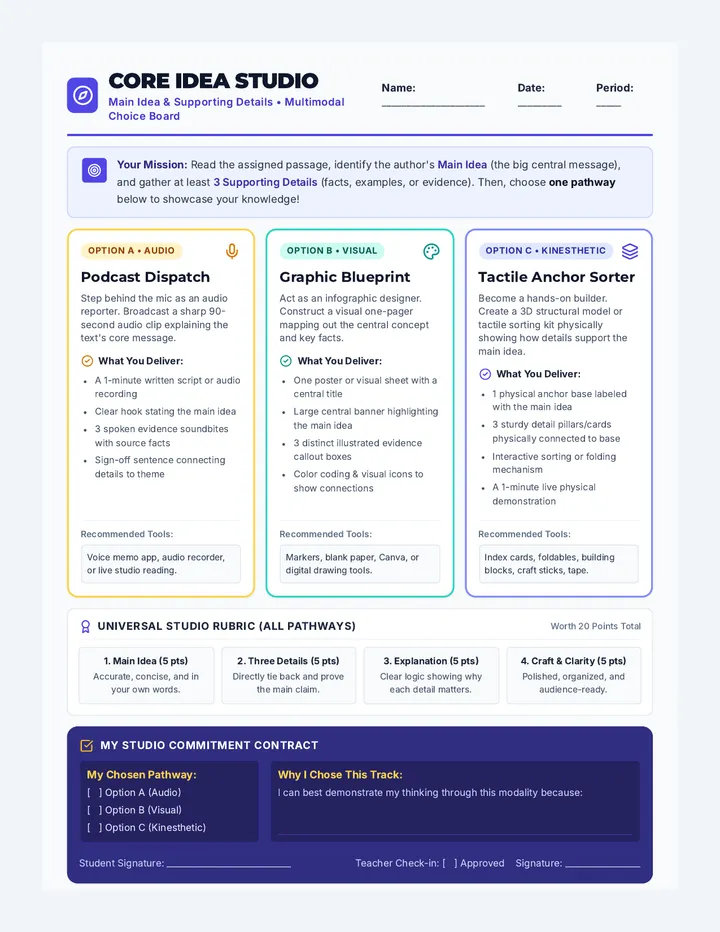
Core Ideas Choice Board Core Idea Studio
Main Idea & Supporting Details • Multimodal Choice Board
Name: _____________________
Date: _________
Period: _____
Your Mission: Read the assigned passage, identify the author's Main Idea (the big central message), and gather at least 3 Supporting Details (facts, examples, or evidence). Then, choose one pathway below to showcase your knowledge!
Option A • Audio
Podcast Dispatch
Step behind the mic as an audio reporter. Broadcast a sharp 90-second audio clip explaining the text's core message.
What You Deliver:
A 1-minute written script or audio recording
Clear hook stating the main idea
3 spoken evidence soundbites with source facts
Sign-off sentence connecting details to theme
Recommended Tools:
Voice memo app, audio recorder, or live studio reading.
Option B • Visual
Graphic Blueprint
Act as an infographic designer. Construct a visual one-pager mapping out the central concept and key facts.
What You Deliver:
One poster or visual sheet with a central title
Large central banner highlighting the main idea
3 distinct illustrated evidence callout boxes
Color coding & visual icons to show connections
Recommended Tools:
Markers, blank paper, Canva, or digital drawing tools.
Option C • Kinesthetic
Tactile Anchor Sorter
Become a hands-on builder. Create a 3D structural model or tactile sorting kit physically showing how details support the main idea.
What You Deliver:
1 physical anchor base labeled with the main idea
3 sturdy detail pillars/cards physically connected to base
Interactive sorting or folding mechanism
A 1-minute live physical demonstration
Recommended Tools:
Index cards, foldables, building blocks, craft sticks, tape.
Universal Studio Rubric (All Pathways)
Worth 20 Points Total
1. Main Idea (5 pts)
Accurate, concise, and in your own words.
2. Three Details (5 pts)
Directly tie back and prove the main claim.
3. Explanation (5 pts)
Clear logic showing why each detail matters.
4. Craft & Clarity (5 pts)
Polished, organized, and audience-ready.
My Studio Commitment Contract
My Chosen Pathway:
[ ] Option A (Audio)
[ ] Option B (Visual)
[ ] Option C (Kinesthetic)
Why I Chose This Track:
I can best demonstrate my thinking through this modality because:
Student Signature: ____________________________
Teacher Check-in: [ ] Approved Signature: _________________
Studio Mission Task Cards Studio Mission Task Cards
Keep this card at your workstation or cut along the dashed lines for your chosen pathway.
Page 1 of 2
Task Card 1 • Audio
The 90-Second Podcast Dispatch
Your role: Investigative Audio Reporter explaining the text's core message to your audience.
1 The Headline Hook
Open with high energy. State the Main Idea within the first 15 seconds.
"Welcome back! Today we're breaking down how [Main Idea]..."
2 3 Evidence Soundbites
Share three facts from the reading. Explain what each fact actually proves.
"First up, the text states... This is huge because..."
3 The Big Sign-Off
Wrap up by tying all 3 facts back to the main idea with a punchy conclusion sentence.
"And that's why [Main Idea] matters for all of us. Signing out!"
Audio Checklist: [ ] Clear volume & steady pace [ ] Main Idea stated clearly [ ] 3 distinct facts quoted or paraphrased
Time: 60–90 Seconds
Cut line
Task Card 2 • Visual
The Graphic Blueprint One-Pager
Your role: Infographic Designer creating a visual showcase of the article's big ideas.
1 Centerpiece Banner
Draw a bold, prominent center header or banner stating the Main Idea.
Make it the biggest text element so the eye sees it first!
2 3 Evidence Modules
Create 3 distinct callout blocks or panels around the main idea with specific text facts.
Include 1 drawing, symbol, or icon for every detail block.
3 Visual Connectors
Use arrows, colored lines, or numbered badges connecting each detail to the center header.
Color-code your details (e.g., all facts outlined in teal).
Visual Checklist: [ ] Main Idea prominent in center [ ] 3 illustrated detail modules [ ] Neat text with clear captions
Format: 1 Poster Page
Studio Mission Task Cards
Kinesthetic response guide and universal sentence stems toolkit.
Page 2 of 2
Task Card 3 • Kinesthetic
The Tactile Anchor Sorter & 3D Model
Your role: Structural Builder demonstrating physically how details hold up the main idea.
1 The Anchor Platform
Construct an Anchor Base (card tent, folded hub, or platform). Label it boldly with the Main Idea.
This is the roof or core that rests upon the supporting pillars.
2 3 Support Pillars
Build 3 physical cards or blocks. On each, write one specific supporting fact from the text.
Slot, tape, or arrange them under/around the main idea anchor.
3 Live Demonstration
Give a 60-second interactive walk-through: explain the model, move the cards, and show how the facts hold the claim up.
Demonstrate: "If I remove this detail, the claim becomes weak!"
Kinesthetic Checklist: [ ] Physical anchor base labeled [ ] 3 movable or structural detail cards [ ] 60-second live explanation
Model + 1-Min Demo
Universal Scaffolding
Universal Sentence Stems Toolkit (Use in Any Pathway)
Confidence Boosters
Stating the Main Idea:
• "The author's central argument is that _____."
• "The most important takeaway of this text is _____."
• "Overall, this passage reveals how _____."
Citing Supporting Details:
• "One specific fact from the text is _____."
• "In paragraph __, the author points out that _____."
• "Another key piece of evidence is when _____."
Connecting Fact to Idea:
• "This proves the central claim because _____."
• "Without this evidence, the reader would not realize that _____."
• "This detail supports the big picture by showing _____."
💡 Tip: Whether speaking, drawing, or building, use these sentence stems to anchor your reasoning. CCSS.ELA-LITERACY.RI.6-8.2
Evidence Builder Worksheet Evidence Builder Worksheet
Part 1: Text Dissection & Core Idea Discovery
Name: ___________________
Date: _________
Period: _____
My Selected Modality Track:
Audio (Podcast) Visual (One-Pager) Kinesthetic (3D Sorter)
Reading Prompt
Sole Tech: How Nature Inspires Modern Sneakers
Lexile ~850L (6th Grade Level)
[1] Today's high-tech athletic sneakers are not just fashion statements; they are marvels of modern engineering. In recent years, shoe designers have stopped looking only at machines and started turning to the natural world for inspiration. This practice is called biomimicry—copying nature's best biological designs to solve human problems. By observing how animals run, climb, and survive, engineers create footwear that makes athletes faster, safer, and more agile.
[2] One major breakthrough came from the humble gecko lizard. Geckos can dash up vertical glass walls without slipping because their toes are covered in millions of microscopic hairs that grip microscopic bumps. Shoe developers copied this structure to invent rubber outsoles with microscopic suction patterns, giving basketball players incredible stopping power on slippery hardwood courts.
[3] Designers also studied marine life like mako sharks. A shark's skin feels rough because it is lined with tiny tooth-like scales called dermal denticles. These scales smooth out water turbulence and reduce drag. Track sprint spikes now feature grooved, sharkskin-textured fabric across the upper shoe, allowing runners to slice through wind resistance.
[4] Finally, shoe scientists looked at kangaroos to master energy return. Kangaroos bounce across deserts using spring-like tendons that store elastic energy when landing and snap forward on takeoff. Modern running shoes now embed carbon-fiber plates inside ultra-springy foam that compresses and bounces back like a kangaroo tendon, reducing runner fatigue. Nature has spent millions of years testing solutions, and today's sneaker designers are turning those natural gifts into athletic triumph.
Step 1: The Core Main Idea (1-2 Complete Sentences) What is the author's primary message?
Prompt: In your own words, state the central claim of the entire article. (Avoid minor details here!)
Step 2: Three Anchored Supporting Details (Evidence from Text) Cite facts or paraphrased quotes
Detail #1: Gecko Grip
From Para [2]: How does this detail prove the main idea?
Detail #2: Sharkskin Texture
From Para [3]: How does this detail prove the main idea?
Detail #3: Kangaroo Tendon
From Para [4]: How does this detail prove the main idea?
Modality Action Planner
Part 2: Planning Your Audio, Visual, or Kinesthetic Creation
Page 2 of 2
Directions: Complete the planning section below for your one chosen pathway (Option A, B, or C). Use your Page 1 findings
A
Audio Track: 90-Second Podcast Script Outline
Record or Read Live
Podcast Hook & Main Idea Opening:
3 Evidence Soundbites & Sign-Off:
B
Visual Track: Graphic Blueprint Thumbnail Wireframe
Draft Your Layout
Rough Sketch / Box Layout (Center Banner + 3 Surrounding Panels):
3 Visual Icons & Color Plan:
C
Kinesthetic Track: 3D Model & Sorter Architecture Plan
Physical Construction
Anchor Base Construction (Materials & Label):
3 Pillar Connections & Demo Plan:
2-Minute Peer Studio Check-In
Trade planners with a partner before final build!
Partner Reviewer Name:
Main Idea Check:
[ ] Clear & central
[ ] Needs refinement
3 Details Check:
[ ] 3 distinct facts cited
[ ] Needs more proof
Studio Stamp:
[ ] Ready to Create!
[ ] Revise Plan First
Core Idea Showcase Slides High School Literacy Studio
Core Idea Studio
Showcase your understanding of Main Idea and Supporting Details through Audio, Visual, or Kinesthetic creation.
Audio
•
Visual
•
Kinesthetic
Concept Breakdown
The Keystone & The Pillars
The Keystone
Main Idea
The single central claim or overarching message. It answers: "What is the big point the author wants me to know?"
Every strong reading response starts with one clear keystone idea.
The Pillars
Supporting Details
Specific facts, statistics, and examples from the text. They answer: "What evidence proves the main idea is true?"
Without at least three strong pillars, the central claim collapses!
Your goal today: Pick the medium that lets you explain both best.
Option A • Audio Track
The Podcast Dispatch
1. The Hook
State Main Idea
Open with energy. State the author's primary takeaway within the first 15 seconds.
"Today on the mic..."
2. The Proof
3 Soundbites
Share 3 specific facts or quotes from the reading and explain what each one proves.
"Here is the proof..."
3. The Outro
Power Sign-Off
Connect the 3 facts back to the big picture with a memorable concluding line.
"Signing off!"
Deliverable: 60 to 90 second voice memo recording or live studio reading. Best for Spoken Storytellers
Exemplar Walk-Through
Audio Model: "The Sole Tech Breakdown"
20/20 Full Credit
0:00 - 0:15
Hook & Main Idea: "Shoe engineers use biomimicry—copying animal survival traits—to make athletic shoes faster, safer, and lighter!"
0:15 - 1:00
3 Evidence Soundbites: (1) Gecko toe hairs copied into non-slip basketball outsoles. (2) Shark scales copied to slice wind drag for sprinters. (3) Kangaroo tendons copied into springy foam soles!
1:00 - 1:18
Power Sign-Off: "Millions of years of nature's testing is now right on your feet. Stay fast, and see you next drop!"
💡 Why it works: Clear vocal energy, exact paragraph citations, and strong causal reasoning. Time: 78 Seconds
Option B • Visual Track
The Graphic Blueprint
1. Centerpiece
Main Idea Banner
Create a bold central headline stating the core idea. Make it the dominant focal point.
Center Focal Point
2. Callouts
3 Evidence Panels
Draw 3 distinct panels containing written text facts paired with icons or mini sketches.
Facts + Visual Icons
3. Hierarchy
Color & Flow
Use connecting arrows and consistent color coding to guide the viewer's eyes through evidence.
Visual Pathways
Deliverable: One polished 8.5x11 infographic poster or digital one-pager. Best for Visual Designers
Exemplar Walk-Through
Visual Model: Graphic Blueprint Poster
20/20 Full Credit
Central Main Idea Header Shoe developers copy animal survival traits to engineer high-performance sneakers.
1. Gecko Grip
Microscopic toe hairs copied into non-slip basketball court soles.
2. Sharkskin
Tooth-like scales copied onto track spike fabric to reduce air drag.
3. Kangaroo
Springy tendons copied into carbon foam soles for energy return.
💡 Why it works: Dominant center headline, clear icons for each fact, and high-contrast color scheme. Format: One-Pager
Option C • Kinesthetic Track
The Tactile Anchor Model
1. Anchor Base
Physical Platform
Fold or construct a sturdy base or roof clearly labeled with the passage's main idea.
The Physical Hub
2. Pillars
3 Evidence Struts
Create 3 movable index cards or struts that physically attach to and support the anchor base.
Structural Support
3. Live Demo
Hands-on Test
Give a 60-second live demonstration proving how each detail holds up the main claim.
Interactive Motion
Deliverable: 3D paper foldable/sorter kit + 1-minute hands-on demonstration. Best for Hands-on Builders
Exemplar Walk-Through
Kinesthetic Model: Tactile Anchor Sorter
20/20 Full Credit
Physical Roof / Platform "Main Idea: Animal biomimicry enables revolutionary athletic shoe design."
Pillar #1 Card
Gecko toe hairs grip glass → basketball soles
Pillar #2 Card
Mako shark scales → track sprint wind drag
Pillar #3 Card
Kangaroo tendons → elastic carbon-plate bounce
Live Demonstration Test: The student physically removes Pillar #2 during their demo to show how the roof wobbles when evidence is missing!
💡 Why it works: Interactive physical metaphor proving facts are the structural pillars of arguments. Demo: 65 Seconds
Studio Mission
Your 4-Step Studio Workflow
1
Read
Read "Sole Tech" on Page 1 of your worksheet.
10 Minutes
2
Choose
Pick Option A, B, or C on your Choice Board.
5 Minutes
3
Plan
Draft your script, sketch, or model blueprint.
15 Minutes
4
Showcase
Record, illustrate, or assemble and demo!
20 Minutes
Grab your Evidence Builder Worksheet to begin! Ready, Set, Create 🚀
Studio Exemplars Guide Studio Exemplars Guide
Real Student Models for "Sole Tech: How Nature Inspires Modern Sneakers"
Page 1 of 2
Mentor Texts: Study these student examples to see how each modality proves the same Main Idea and 3 Details. Scored 20/20 (Full Points)
Option A • Audio Model
Podcast Script: "The Sole Tech Breakdown" (Recorded Time: 78s)
20/20 Exemplar
[SFX: Fast electronic beat, fades out]
HOST: "Check out these three wild facts from the reading. First, in paragraph 2, scientists copied gecko lizards! Geckos have microscopic toe hairs that stick to glass; designers turned that into rubber outsoles with suction patterns so hoopers don't slip on hardwood."
HOST: "Second, paragraph 3 reveals that sprint spikes mimic mako shark scales called dermal denticles to slice through wind resistance. Third, paragraph 4 shows how running shoes copy kangaroo tendons by packing carbon-fiber plates into springy foam to bounce runners forward."
HOST: "In short, nature spent millions of years perfecting speed, and your favorite kicks are proof of it. Catch you on the next drop!" [SFX: Beat fades]
Why It Earns Full Credit:
Clear Hook: Main idea stated in the first 15 seconds.3 Verified Facts: Gecko toe hairs, shark denticles, and kangaroo tendons all cited.Causal Logic: Explains how each animal feature helps human athletes.Vocal Polish: Conversational tone, clear transitions, sound cue.
Meets CCSS.ELA-LITERACY.RI.6-8.2
Option B • Visual Model
Graphic Blueprint: "Biomimicry in Footwear Design"
20/20 Exemplar
Central Main Idea Engineers copy animal survival traits to design faster, safer athletic shoes.
1. Gecko Grip
Microscopic toe hairs grip tiny bumps. Copied into rubber outsoles for non-slip court traction (Para 2).
Proof: Traction
2. Sharkskin
Dermal denticles smooth turbulence. Copied onto track spike fabrics to slice wind drag (Para 3).
Proof: Aerodynamics
3. Kangaroo Tendon
Spring-loaded tendons store energy. Copied into carbon plates & bouncy foam to propel runners (Para 4).
Proof: Energy Return
Why It Earns Full Credit:
Focal Hierarchy: Main idea banner commands immediate attention.Visual Icons: Distinct symbols paired with factual text captions.Connecting Arrows: Shows direct relationship from details to claim.Neat Organization: High visual polish and easy legibility.
Meets CCSS.ELA-LITERACY.RI.6-8.2
Studio Exemplars Guide
Kinesthetic Structural Model & Cross-Modality Comparison
Page 2 of 2
Hands-On Architecture: Kinesthetic learners demonstrate mastery through physical structure and live action. Scored 20/20 (Full Points)
Option C • Kinesthetic Model
Tactile Anchor Sorter & Live Walk-Through (Demonstration Time: 65s)
20/20 Exemplar
Physical Artifact Architecture:
ROOF ANCHOR: "Main Idea: Shoe developers copy animal biomimicry to create superior athletic footwear."
▲ Supported By ▲ Supported By ▲ Supported By
Pillar 1: Gecko Grip
Toe hair suction outsoles (Para 2)
Pillar 2: Shark Skin
Tooth scale drag reduction (Para 3)
Pillar 3: Kangaroo
Spring tendon carbon foam (Para 4)
STUDENT DEMO TRANSCRIPT:[Lifts folded model] "This top platform is my Main Idea: modern sneaker engineering relies on copying animal adaptations. Notice how the roof cannot stand by itself—it relies on these three physical pillars. [Taps Pillar 1] Pillar 1 is the gecko's microscopic hairs for basketball grip. [Taps Pillar 2] Pillar 2 is shark scales for track speed. [Taps Pillar 3] Pillar 3 is kangaroo tendons for energy return. [Slides out Pillar 2] Look: if I remove sharkskin, the roof wobbles and weakens! That physically proves how every detail is required to hold up the author's argument."
Why It Earns Full Credit:
Tactile Metaphor: Accurately portrays details as structural load-bearers.Clear Labeling: Main idea and 3 details explicitly written on cards.Active Test: Removing a strut demonstrates why evidence matters.Live Delivery: Confident 60-second explanation of the reading.
Meets CCSS.ELA-LITERACY.RI.6-8.2
How All 3 Modalities Meet the Same Standards
Differentiated Medium • Identical Rigor
Rubric Element
What the teacher evaluates
Audio Track
Spoken opening sentence Hook
Visual Track
Dominant Center Headline Banner
Kinesthetic Track
Top Structural Roof Anchor
3 Supporting Details
Text evidence proof
3 audio soundbites citing text facts
3 illustrated panels with icons & facts
3 physical support struts bearing load
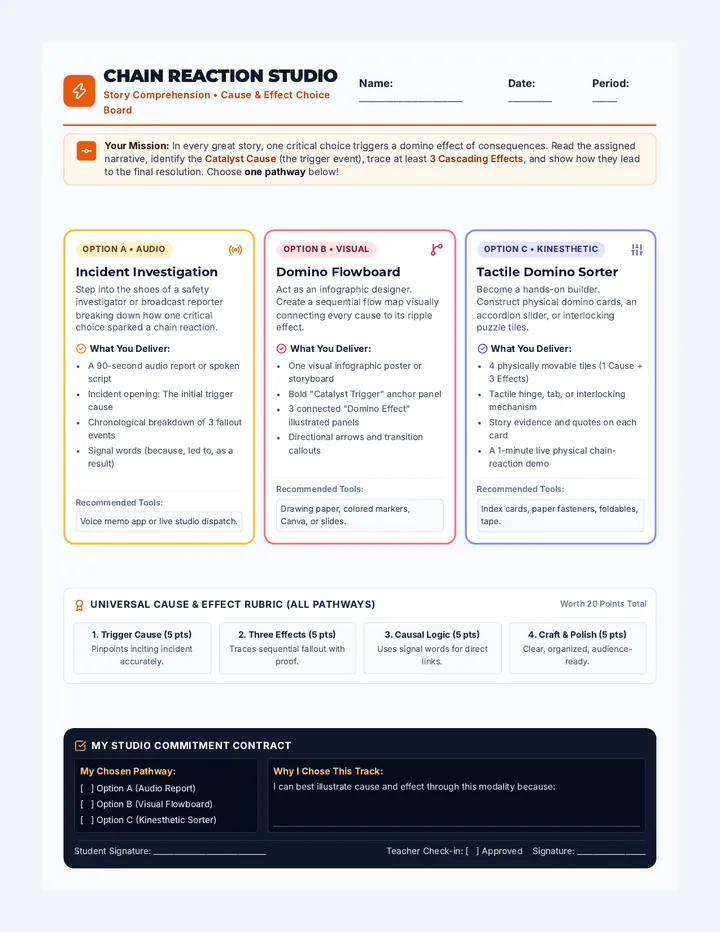
Chain Reaction Choice Board Chain Reaction Studio
Story Comprehension • Cause & Effect Choice Board
Name: _____________________
Date: _________
Period: _____
Your Mission: In every great story, one critical choice triggers a domino effect of consequences. Read the assigned narrative, identify the Catalyst Cause (the trigger event), trace at least 3 Cascading Effects, and show how they lead to the final resolution. Choose one pathway below!
Option A • Audio
Incident Investigation
Step into the shoes of a safety investigator or broadcast reporter breaking down how one critical choice sparked a chain reaction.
What You Deliver:
A 90-second audio report or spoken script
Incident opening: The initial trigger cause
Chronological breakdown of 3 fallout events
Signal words (because, led to, as a result)
Recommended Tools:
Voice memo app or live studio dispatch.
Option B • Visual
Domino Flowboard
Act as an infographic designer. Create a sequential flow map visually connecting every cause to its ripple effect.
What You Deliver:
One visual infographic poster or storyboard
Bold "Catalyst Trigger" anchor panel
3 connected "Domino Effect" illustrated panels
Directional arrows and transition callouts
Recommended Tools:
Drawing paper, colored markers, Canva, or slides.
Option C • Kinesthetic
Tactile Domino Sorter
Become a hands-on builder. Construct physical domino cards, an accordion slider, or interlocking puzzle tiles.
What You Deliver:
4 physically movable tiles (1 Cause + 3 Effects)
Tactile hinge, tab, or interlocking mechanism
Story evidence and quotes on each card
A 1-minute live physical chain-reaction demo
Recommended Tools:
Index cards, paper fasteners, foldables, tape.
Universal Cause & Effect Rubric (All Pathways)
Worth 20 Points Total
1. Trigger Cause (5 pts)
Pinpoints inciting incident accurately.
2. Three Effects (5 pts)
Traces sequential fallout with proof.
3. Causal Logic (5 pts)
Uses signal words for direct links.
4. Craft & Polish (5 pts)
Clear, organized, audience-ready.
My Studio Commitment Contract
My Chosen Pathway:
[ ] Option A (Audio Report)
[ ] Option B (Visual Flowboard)
[ ] Option C (Kinesthetic Sorter)
Why I Chose This Track:
I can best illustrate cause and effect through this modality because:
Student Signature: ____________________________
Teacher Check-in: [ ] Approved Signature: _________________
Chain Reaction Task Cards Chain Reaction Task Cards
Keep at your desk or cut along dashed lines for your chosen pathway.
Page 1 of 2
Task Card 1 • Audio
The Incident Investigation Dispatch
Your role: Special Investigative Reporter analyzing how one critical decision sparked a story's chain reaction.
1 The Catalyst Trigger
Open your broadcast. Identify the Catalyst Cause that set all plot events in motion.
"Breaking dispatch: It all started when Marcus chose to..."
2 3 Domino Fallout Steps
Explain the 3 cascading effects in chronological order using strong transition words.
"Because of this, Effect 1 occurred, which subsequently led to..."
3 Final Impact Sign-Off
Conclude by summarizing the ultimate outcome and what the character learned from the fallout.
"As a final result, the crisis forced him to realize that..."
Audio Checklist: [ ] Clear trigger cause stated [ ] 3 distinct sequential effects [ ] Uses 3+ cause/effect transition words
Time: 60–90 Seconds
Cut line
Task Card 2 • Visual & Vocab Map
Domino Flowboard & Vocabulary Map
Your role: Graphic Storyboard Artist creating a visual chain-reaction map or cause-and-effect vocabulary organizer.
1 Catalyst Word Hub
Anchor your map with the Trigger Cause or target concept word (e.g., Catalyst , Thermal Overload ).
Center banner: What action sparked the reaction?
2 3 Domino / Map Quadrants
Create 3 connected panels: (1) Battery smoke, (2) Gate collision, (3) Emergency sandpit dive.
Pair each step with a definition, sketch, and quote.
3 Directional Connectors
Draw bold arrows linking each quadrant labeled with signal words: "BECAUSE" → "LED TO" → "AS A RESULT".
Visual arrows show exact cause-to-effect momentum.
Vocab Map Checklist: [ ] Target word / Catalyst in center [ ] Meaning in own words [ ] 3 Story fallout examples [ ] Visual icon + Signal words
Visual Organizer
Chain Reaction Task Cards
Kinesthetic response directions and cause-and-effect signal words toolkit.
Page 2 of 2
Task Card 3 • Kinesthetic
The Tactile Domino Sorter & Slider
Your role: Mechanical Prototype Builder showing physically how one event directly topples the next.
1 The Catalyst Domino
Construct Tile #1 (the Trigger Cause). Write the inciting character decision and tape or prop it up.
This first tile is the spark that starts the physical sequence.
2 3 Connected Fallout Tiles
Build 3 interlocking or sequential tiles. Write each cascading story effect with evidence quotes.
Connect with paper tabs, fold creases, or physical spacing.
3 Live Chain-Reaction Demo
Give a 60-second interactive walk-through: tip Tile #1 or slide the chain to show how each consequence knocked down the next!
Narrate: "When Tile 1 fell, it inevitably forced Tile 2..."
Kinesthetic Checklist: [ ] 4 physical tiles/cards created [ ] Story facts written on each tile [ ] 60-second live physical chain-reaction demo
Model + 1-Min Demo
Cause & Effect Language Toolkit
Cause & Effect Transition Word Bank (Use in Any Pathway)
Signal Vocabulary
Stating the Cause:
• "Because the character decided to _____..."
• "Due to the fact that _____..."
• "The crisis was triggered when _____."
Connecting to Effects:
• "As a direct result, _____ happened."
• "Consequently, this led to _____."
• "This caused an immediate chain reaction of _____."
Tracing Final Impact:
• "Ultimately, this domino effect forced them to _____."
• "The final outcome revealed that _____."
• "Without this initial choice, they would not have _____."
💡 Tip: High-scoring responses connect every single effect back to the cause that created it. CCSS.ELA-LITERACY.RL.6-8.3
Ripple Effect Worksheet Ripple Effect Worksheet
Part 1: Story Dissection & Domino Chain Discovery
Name: ___________________
Date: _________
Period: _____
My Selected Modality Track:
Audio (Report) Visual (Flowboard) Kinesthetic (Domino Sorter)
Narrative Prompt
Ghost Drone: The Midnight Circuit
Lexile ~820L (6th Grade Level)
[1] Seventeen-year-old Marcus stood in the arena pit, adjusting his virtual-reality flight goggles. It was the final qualifying heat of the Metro Drone Racing League, and he was trailing his rival by three seconds. Desperate for raw burst speed, Marcus made a reckless decision: he used his laptop to bypass the drone's built-in battery thermal limiter, ignoring the software's flashing red overheat warnings.
[2] When the green starting horn blared, the modified drone shot into the air like a rocket. For two laps, Marcus tore through the neon tunnel gates at record speed. But on Lap 3, the uncooled lithium battery reached extreme temperatures. Scorching heat melted the plastic camera casing, flooding Marcus's video goggles with a blizzard of static and black smoke.
[3] Flying blind at eighty miles per hour, Marcus panicked. He jerked his steering joystick hard to the left, which caused the drone to clip a steel obstacle hoop. The brutal collision snapped his right carbon-fiber propeller and threw the aircraft into an uncontrollable downward spiral.
[4] Through the flickering goggle display, Marcus saw the spinning drone heading straight toward the crowded spectator bleachers. In a fraction of a second, he slammed the emergency motor kill switch. The drone dropped instantly, burying itself deep in the safety sandpit. His championship dream was over and his drone was totaled, but nobody was hurt. Marcus pulled off his goggles, staring at the smoking wreckage—fully understanding how one shortcut had triggered a catastrophic chain of events.
Step 1: The Catalyst Cause (The Inciting Action) What specific choice triggered the chain reaction?
From Para [1]: Identify Marcus's initial decision that set the crisis in motion.
Step 2: The 3 Cascading Domino Effects (Sequential Fallout) Trace each step in the chain
Effect #1 (Para [2])
What happened to the battery and camera?
Effect #2 (Para [3])
Because of the smoke, what did Marcus do?
Effect #3 & Result (Para [4])
What was the final crash and lesson?
Modality Action Planner
Part 2: Planning Your Cause & Effect Creation
Page 2 of 2
Directions: Complete the planning space below for your one chosen pathway (A, B, or C). Use your Page 1 chain facts
A
Audio Track: Incident Report Script Beats
Record or Read Live
Broadcast Alert & Catalyst Trigger Opening:
3 Fallout Beats & Sign-Off with Transition Words:
B
Visual Track: Domino Flowboard Thumbnail Sketch
Draft Sequential Map
Flow Sketch (Trigger Panel → 3 Sequential Consequence Panels):
Arrow Labels (Signal Words):
C
Kinesthetic Track: Tactile Domino Tiles & Slider Plan
Physical Construction
Tile #1 Trigger Setup (Label & Weight):
Tiles #2–4 Fallout Hinges & Live Demo Script:
2-Minute Peer Studio Check-In
Trade planners with a partner before final build!
Peer Reviewer:
Catalyst Cause:
[ ] Accurate trigger
[ ] Needs refinement
3 Domino Effects:
[ ] Sequential & proven
[ ] Check story order
Studio Stamp:
[ ] Approved to Build!
[ ] Revise Plan First
Chain Reaction Slides High School Literacy Studio
Chain Reaction Studio
Trace how One Critical Cause sparks a cascade of Story Effects through Audio, Visual, or Kinesthetic creation.
Audio Dispatch
•
Visual Flowboard
•
Kinesthetic Domino
Concept Breakdown
The Catalyst Trigger & The Domino Chain
The Trigger
The Cause (Why)
The inciting choice, action, or event that sets everything in motion. It answers: "Why did the crisis begin?"
Every story conflict starts with one pivotal character decision.
The Ripple
The Effect (What)
The sequential consequence or fallout. It answers: "What happened as a direct result?"
In gripping plots, one effect instantly becomes the cause of the next!
Your mission: Trace Marcus's chain of consequences in "Ghost Drone."
Language Scaffolding
Signal Words: The Connective Tissue
1. Stating Causes
The Origin
"Because Marcus bypassed the thermal switch..."
"Due to his desperation for speed..."
Origins & Triggers
2. Linking Fallout
The Consequence
"As a direct result, smoke filled his goggles..."
"Consequently, he clipped the steel gate..."
Ripple Transitions
3. Final Outcome
The Resolution
"Ultimately, Marcus sacrificed his race..."
"This chain reaction revealed that..."
Final Impacts
💡 Use at least three of these signal transitions in your chosen project. CCSS.RL.6-8.3
Option A • Audio Track
Incident Investigation Dispatch
1. Incident Alert
State the Trigger
Open like a crash investigator. Pinpoint Marcus's decision to disable the thermal limiter.
"Breaking report..."
2. The Fallout
3 Domino Beats
Report the 3 consequences in order: battery smoke → clipped gate → emergency sandpit crash.
"This caused..."
3. Final Finding
Moral of Crisis
Wrap up with what Marcus realized about how reckless shortcuts create uncontrollable fallout.
"Final debrief..."
Deliverable: 60 to 90 second voice memo audio report or live reading. Best for Story Broadcasters
Option B • Visual Track
The Domino Flowboard
1. Catalyst Box
Inciting Cause
Draw an anchor box highlighting Marcus overriding the safety limiter on his laptop.
Anchor Origin Box
2. Domino Panels
3 Sequential Steps
Illustrate 3 connected panels: (1) battery smoke, (2) prop snap, (3) safety sandpit dive.
Sequential Artwork
3. Signal Arrows
Flow Connectors
Label arrows with signal transitions: "LED TO" → "AS A RESULT" → "ULTIMATELY."
Cause-to-Effect Flow
Deliverable: One polished graphic flowboard poster or comic storyboard. Best for Visual Artists
Option C • Kinesthetic Track
The Tactile Domino Sorter
1. Trigger Tile
The Lead Domino
Construct Tile #1 representing Marcus's initial decision to ignore red warning lights.
The Physical Spark
2. Fallout Tiles
3 Falling Cards
Build 3 connected cards spaced so tipping Tile #1 physically knocks down Tiles #2, #3, and #4!
Hinged Movement
3. Live Demo
Chain-Reaction
Tip Tile #1 during your 60-second talk to physically prove how the plot collapsed.
Physical Simulation
Deliverable: 4-tile physical domino mechanism + 1-minute live demo. Best for Hands-on Builders
Studio Mission
Your 4-Step Studio Workflow
1
Read
Read "Ghost Drone" on Page 1 of your worksheet.
10 Minutes
2
Choose
Pick Option A, B, or C on your Choice Board.
5 Minutes
3
Plan
Draft your script beats, flow map, or tiles.
15 Minutes
4
Showcase
Record, illustrate, or demonstrate the chain!
20 Minutes
Grab your Ripple Effect Worksheet to start tracing causes! Start The Reaction ⚡
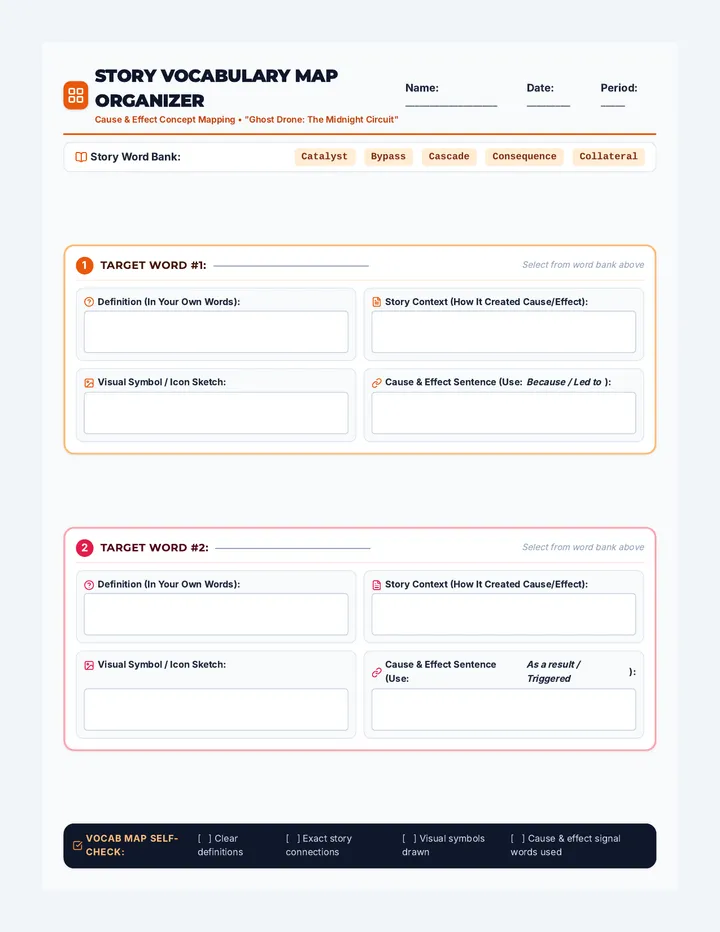
Story Vocabulary Map Organizer Story Vocabulary Map Organizer
Cause & Effect Concept Mapping • "Ghost Drone: The Midnight Circuit"
Name: ___________________
Date: _________
Period: _____
Story Word Bank:
Catalyst Bypass Cascade Consequence Collateral
1 Target Word #1:
Select from word bank above
Definition (In Your Own Words):
Story Context (How It Created Cause/Effect):
Visual Symbol / Icon Sketch:
Cause & Effect Sentence (Use: Because / Led to ):
2 Target Word #2:
Select from word bank above
Definition (In Your Own Words):
Story Context (How It Created Cause/Effect):
Visual Symbol / Icon Sketch:
Cause & Effect Sentence (Use: As a result / Triggered ):
Vocab Map Self-Check:
[ ] Clear definitions [ ] Exact story connections [ ] Visual symbols drawn [ ] Cause & effect signal words used