Neighborhood Bridges Slides Boston Community Centers Network
Half-Day Leadership & Staff Workshop
Connecting Neighborhoods Across Greater Boston
Neighborhood Bridges
Building lasting partnerships, sharing resources, and co-designing programs across Boston's community centers.
Relationships • Resource Sharing • Joint Programs • Action Plan 3-Hour Collaborative Session
Workshop Roadmap
What We Will Accomplish Today
1. Build Relationships (45 min)
Connect across neighborhoods, learn each center's strengths, and uncover shared priorities.
2. Share Resources (45 min)
Map spaces, staff expertise, supplies, and wraparound services we can coordinate.
3. Plan Joint Programs (45 min)
Co-design realistic, high-impact events or series serving residents together.
4. Create an Action Plan (30 min)
Lock in 30-60-90 day next steps, owners, and a regular check-in rhythm.
Includes a 15-minute midpoint break Use your Participant Workbook at each step
The Boston Context
Stronger Together Across Neighborhoods
Residents Cross Borders
Families live in Dorchester, work in Back Bay, and attend school in Roxbury. Coordinated centers meet people where they are.
Stretch Limited Budgets
Sharing commercial kitchens, vans, bilingual staff, and AV gear prevents duplication and stretches every grant dollar.
Amplify Cultural Reach
Every center holds deep trust with specific communities. Partnering expands welcoming access to all Bostonians.
Guiding Principle: Collaboration isn't extra work—it's how we make existing work more sustainable and equitable.
Part 1 • 45 Minutes
Build Relationships: Speed-Connecting
How It Works
1 Take 8 minutes to fill out your Center Snapshot in your workbook.
2 Complete 3 rounds (8 min each) with leaders from other neighborhoods.
3 Log shared interests and follow-up sparks in your Connection Map.
4 Questions for Every Pairing
1. Who do you serve? Age groups, languages, and neighborhood roots.
2. What is your center's superpower? Signature program, space, or team strength.
3. What's a current stretch or gap? Where could a partner help right now?
4. Where do our missions overlap? One shared resident need we both care about.
Part 2 • 45 Minutes
Share Resources: 4 Pillars of Coordination
Spaces
• Gyms & fields
• Commercial kitchens
• Quiet classrooms
• Off-peak hours
Staff Expertise
• Bilingual navigators
• Youth counselors
• Grant writers
• Tech & ESOL coaches
Supplies & Gear
• 15-passenger vans
• Sound & AV kits
• Folding tables/tents
• Bulk art/sport gear
Services
• Food pantries
• Tax & legal clinics
• Senior wellness
• Warm referrals
Think Beyond Money: Underused Tuesday mornings or a shared van schedule can unlock brand-new programming at zero added cost.
Part 2 Activity • Resource Swap
Give, Need & Match
1. What We Can Offer
List 2–3 spaces, skills, or supplies your center has in abundance or during off-peak times.
2. What We Need
Name 2–3 resources that would immediately help you serve residents better or ease staff strain.
3. Make a Match
In small groups, trade lists and circle at least two real swaps —plus note any MOUs or insurance checks needed.
Record matches in your Workbook: Resource Swap Matrix 10 min solo • 20 min group matching
Part 3 • 45 Minutes
Plan Joint Programs: Design Principles
Resident-Centered Value
Start with a real resident need neither center can fully solve alone—not just an event that looks good on paper.
Balanced Ownership
Each partner contributes clearly defined roles (hosting, outreach, staffing, or supplies) so no single center carries the load.
Transit & Language Access
Pick sites near MBTA lines or rotate locations across neighborhoods, with multilingual flyers and interpretation built in.
Start Small, Pilot Fast
Design a 1-day pop-up or 4-week pilot you can launch within 60 days, learn from residents, and grow from there.
Part 3 Activity • Co-Design Sprint
Spark Ideas: What Could We Build Together?
Youth & Teens
Cross-Neighborhood Arts & STEM Showcase
Teens from two centers co-create projects using one center's makerspace and another's auditorium.
Shared: Van + Tech Lab + Stage
Families
Multilingual Resource & Benefits Fair
Centers pool Spanish, Haitian Creole, Cantonese, and Vietnamese staff for a one-stop Saturday clinic.
Shared: Interpreters + Childcare
Older Adults
Rotating Senior Wellness & Lunch Club
Monthly healthy cooking + movement mornings rotating between two centers along the Orange/Red Line.
Shared: Kitchen + Fitness Lead
Your Turn: Form a trio of 2–3 centers and complete the Joint Program Canvas . 30 min build • 10 min share-out
Part 4 • 30 Minutes
Create an Action Plan: 30-60-90 Days
Next 30 Days
Confirm & Align
• Brief your Executive Director / team
• Tour partner center's space
• Confirm dates, contacts & insurance
Days 31–60
Prepare & Promote
• Finalize shared roles & budget
• Launch co-branded bilingual outreach
• Run a logistics walk-through
Days 61–90
Pilot & Debrief
• Host your first joint swap or program
• Gather quick resident feedback
• Hold a 30-min partner debrief
No Action Without an Owner: Every commitment in your workbook needs a specific name, email, and target date.
Keeping the Bridges Open
Before You Leave Today
3 Quick Commitments
Add your center to the shared Boston Contact & Asset Sheet .
Schedule your first 15-minute partner check-in before walking out.
Share one concrete takeaway in our closing circle.
"When Boston's community centers share their doors, skills, and trust, every neighborhood becomes stronger."
Thank you for building together today!
Neighborhood Bridges Workshop 30-Day Network Check-In: Mark Your Calendar
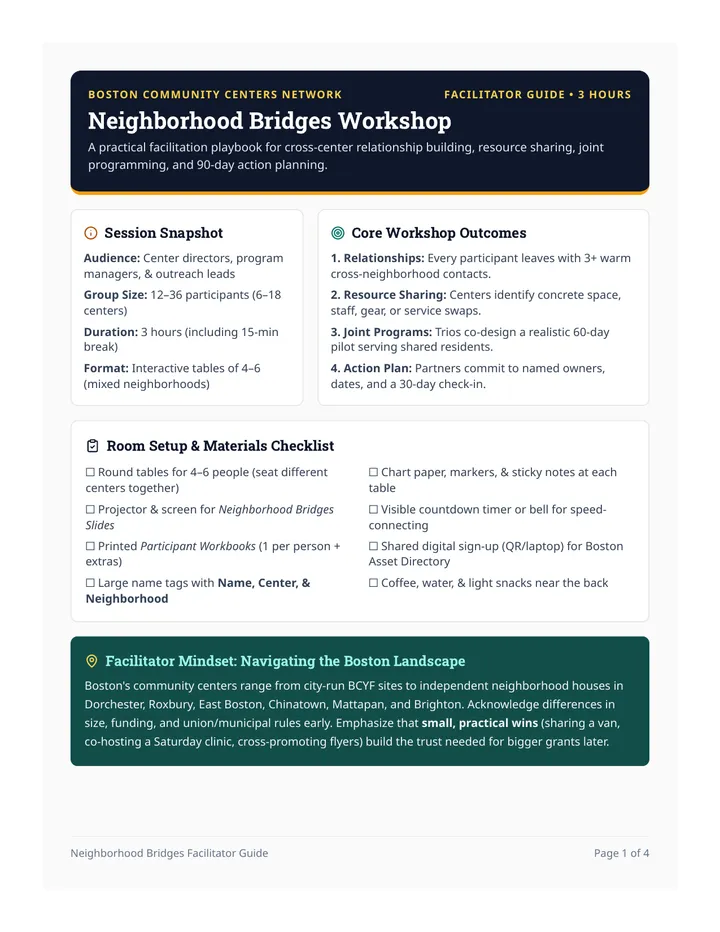
Neighborhood Bridges Facilitator Guide Boston Community Centers Network Facilitator Guide • 3 Hours
Neighborhood Bridges Workshop
A practical facilitation playbook for cross-center relationship building, resource sharing, joint programming, and 90-day action planning.
Session Snapshot
Audience: Center directors, program managers, & outreach leadsGroup Size: 12–36 participants (6–18 centers)Duration: 3 hours (including 15-min break)Format: Interactive tables of 4–6 (mixed neighborhoods)
Core Workshop Outcomes
1. Relationships: Every participant leaves with 3+ warm cross-neighborhood contacts.2. Resource Sharing: Centers identify concrete space, staff, gear, or service swaps.3. Joint Programs: Trios co-design a realistic 60-day pilot serving shared residents.4. Action Plan: Partners commit to named owners, dates, and a 30-day check-in.
Room Setup & Materials Checklist
☐ Round tables for 4–6 people (seat different centers together)
☐ Projector & screen for Neighborhood Bridges Slides
☐ Printed Participant Workbooks (1 per person + extras)
☐ Large name tags with Name, Center, & Neighborhood
☐ Chart paper, markers, & sticky notes at each table
☐ Visible countdown timer or bell for speed-connecting
☐ Shared digital sign-up (QR/laptop) for Boston Asset Directory
☐ Coffee, water, & light snacks near the back
Facilitator Mindset: Navigating the Boston Landscape
Boston's community centers range from city-run BCYF sites to independent neighborhood houses in Dorchester, Roxbury, East Boston, Chinatown, Mattapan, and Brighton. Acknowledge differences in size, funding, and union/municipal rules early. Emphasize that small, practical wins (sharing a van, co-hosting a Saturday clinic, cross-promoting flyers) build the trust needed for bigger grants later.
Neighborhood Bridges Facilitator Guide Page 1 of 4
Part 1: Welcome & Relationship Building
0:00 – 1:00 (60 min)
Welcome, Framing & Boston Context
15 min • Slides 1–3
Open by naming the energy in the room: everyone is busy serving residents, yet no single center has every language, space, or specialty. Walk through the 4 workshop goals on Slide 2 and set norms: listen with curiosity, speak candidly about capacity, and focus on what's doable.
Quick Room Warm-Up (3 min): Ask participants to stand if their center serves youth, seniors, immigrant families, or runs food/wellness programs—showing visually how much overlap already exists.
Activity: Center Speed-Connecting
45 min • Slide 4 • Workbook pp. 1–2
Solo Prep (8 min): Have everyone complete their Center Snapshot on Page 1 of the Workbook (populations served, signature strength, current stretch, and languages spoken).3 Pairing Rounds (3 × 8 min = 24 min): Pair participants with someone from a different neighborhood. Ring a bell at 4 minutes so both partners get equal airtime using the 4 prompts on Slide 4.Connection Map & Debrief (13 min): Give 3 minutes to jot follow-up sparks in the Connection Map (Workbook p. 2), then invite 3–4 volunteers to share one surprising overlap they discovered.
Facilitator Prompts for Debrief:
"What did you learn about another neighborhood center that surprised you?"
"Where did you notice two centers trying to solve the exact same challenge?"
Facilitation Tip: If multiple staff from the same center attend, ask them to split up for Speed-Connecting so they maximize new relationships across Boston.
Neighborhood Bridges Facilitator Guide Page 2 of 4
☕ Midpoint Break (15 min) — 1:00 – 1:15 Encourage informal mingling & coffee
Part 2: Share Resources (Give, Need & Match)
1:15 – 2:00 (45 min)
4 Pillars & Resource Swap Matrix
Slides 5–6 • Workbook p. 3
Walk through Slide 5 (Spaces, Staff Expertise, Supplies & Gear, Services). Emphasize off-peak hours (e.g., weekday mornings when youth spaces sit empty) and non-cash assets.
Solo Inventory (10 min): Participants fill out "What We Can Offer" and "What We Need" in their Workbook.Table Matching (20 min): In groups of 4–6, go around the table reading Needs aloud. Others raise a hand if they can offer a match. Circle at least 2 real swaps per table.Reality Check (10 min): Ask tables to flag any logistics (keys, CORI checks, van insurance, union hours) that need a quick follow-up.
Part 3: Plan Joint Programs (Co-Design Sprint)
2:00 – 2:45 (45 min)
Design Principles & Trio Sprint
Slides 7–8 • Workbook p. 4
Present Slide 7 (Resident-Centered, Balanced Ownership, Transit/Language Access, Start Small) and spark ideas with Slide 8. Then form partner trios or pairs (2–3 centers with a shared interest or nearby MBTA line).
Co-Design Build (30 min): Teams complete the Joint Program Canvas (Workbook p. 4): target residents, program concept, each partner's role, and transit/language plan.Rapid Share-Out (10 min): Each group gives a 60-second pitch: "Who is it for, what are we doing, and what resource are we sharing?"
Troubleshooting Pitfall: If a group designs a massive festival requiring $50k, nudge them to shrink it to a 60-day pilot (e.g., one Saturday pop-up or a 3-week workshop) they can launch with existing staff.
Neighborhood Bridges Facilitator Guide Page 3 of 4
Part 4: Create an Action Plan & Close
2:45 – 3:30 (45 min)
30-60-90 Day Commitments (30 min)
Slide 9 • Workbook p. 5
Keep partner groups together. Direct them to the Action Plan & Commitment Charter (Workbook p. 5). Walk the room to make sure every row has a specific person's name and a calendar date —not "TBD" or "our centers."
Crucial Step (Last 5 min): Have partners pull out their phones/calendars right now and book their first 15-minute follow-up call or site visit within the next 14 days.
Closing Circle & Shared Directory (15 min)
Slide 10
Invite everyone to scan or sign the shared Boston Contact & Asset Sheet . Close with a rapid whip-around where each person shares one word or one next step they are excited about.
Facilitator Post-Workshop Follow-Up Plan
Within 48 Hours: Email the compiled Boston Community Center Contact & Asset Directory, photos of chart paper notes, and a reminder of 30-day check-in dates.
Day 14 Nudge: Send a brief 3-bullet check-in email asking partners: "Have you had your first tour or call yet? Any roadblocks we can help clear?"
Day 30 Virtual Huddle (45 min): Host a Zoom check-in for all participating centers to celebrate early resource swaps, troubleshoot logistics, and preview upcoming joint pilots.
Neighborhood Bridges Facilitator Guide Page 4 of 4
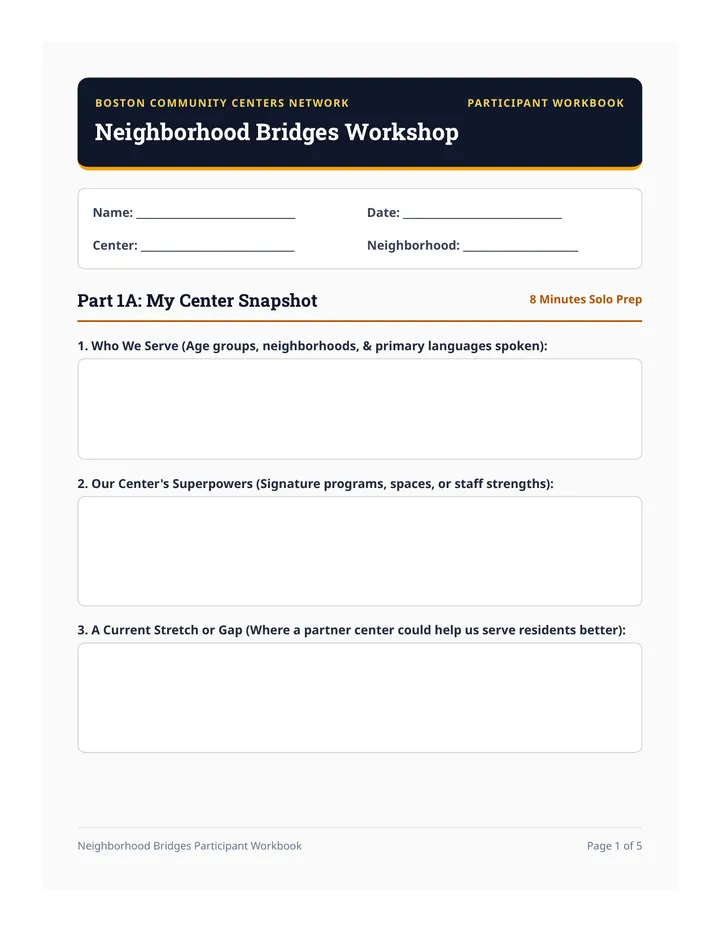
Neighborhood Bridges Participant Workbook Boston Community Centers Network Participant Workbook
Neighborhood Bridges Workshop
Name: _____________________________
Date: _____________________________
Center: ____________________________
Neighborhood: _____________________
Part 1A: My Center Snapshot
8 Minutes Solo Prep
1. Who We Serve (Age groups, neighborhoods, & primary languages spoken):
2. Our Center's Superpowers (Signature programs, spaces, or staff strengths):
3. A Current Stretch or Gap (Where a partner center could help us serve residents better):
Neighborhood Bridges Participant Workbook Page 1 of 5
Part 1B: Speed-Connecting & Connection Map
3 Rounds × 8 Minutes
Pair with someone from a different Boston neighborhood. Use the 4 questions on the slide and capture key details below.
Round 1 Partner: _______________________
Center / Neighborhood: __________________
Shared interests, resident overlaps, & follow-up spark:
Round 2 Partner: _______________________
Center / Neighborhood: __________________
Shared interests, resident overlaps, & follow-up spark:
Round 3 Partner: _______________________
Center / Neighborhood: __________________
Shared interests, resident overlaps, & follow-up spark:
Quick Reflection: One surprising connection or common challenge I noticed:
Neighborhood Bridges Participant Workbook Page 2 of 5
Part 2: Resource Swap Matrix (Give, Need & Match)
10 min solo • 20 min table match
Consider all 4 pillars: Spaces (off-peak rooms/kitchens/gyms), Staff Expertise (bilingual/tech/grant), Supplies & Gear (vans/AV/tents), and Services (pantries/clinics).
1. What We Can Offer (2–3 items + when available):
2. What We Need (2–3 items that would help most):
3. Our Table's Best Matches & Logistics to Verify (keys, insurance, CORI, hours):
Partner Center
Resource Shared (Give / Get)
Logistics / Policy Check
Neighborhood Bridges Participant Workbook Page 3 of 5
Part 3: Joint Program Canvas (60-Day Pilot)
30 min Co-Design Sprint
Working Program Title:
Partner Centers Involved:
Target Residents & Shared Need (Who is this for, and why partner to deliver it?):
Pilot Format & Location (1-day pop-up, 4-week series, rotating sites, MBTA access):
Balanced Roles (What each center contributes: hosting, staffing, outreach, supplies):
Language Access & Outreach Plan (Languages needed, co-branded flyers, warm referrals):
Neighborhood Bridges Participant Workbook Page 4 of 5
Part 4: 30-60-90 Day Action Plan & Charter
30 Minutes
Every action needs a specific person's name and a target date . Lock in your first check-in before leaving!
Window
Concrete Next Step
Lead Owner
By Date
Days 1–30
Confirm & Align
Days 31–60
Prep & Promote
Days 61–90
Pilot & Debrief
Our First 15-Minute Partner Check-In (Schedule before leaving the room):
Date & Time: _________________________
Format (Call / Zoom / Visit): _____________
Partner Contacts & Emails: _______________________________________________________
My #1 Takeaway or Commitment from Today:
Neighborhood Bridges Participant Workbook Page 5 of 5