Two Chinas Lesson Plan Lesson 1 of 3 • Teacher Guide • CA HSS 10.9.4
Two Chinas Collide
Grade 10 World History
Pacing: 55 Minutes
Learning Objectives
Compare the leadership, support bases, and goals of the Kuomintang (KMT) and Chinese Communist Party (CCP).
Analyze primary-source evidence to explain why the CCP won the Chinese Civil War in 1949.
Evaluate the domestic and Cold War consequences of the founding of the People's Republic of China.
Key Vocabulary
Kuomintang (KMT): Nationalist Party led by Chiang Kai-shek.
CCP: Chinese Communist Party led by Mao Zedong.
PRC (1949): People's Republic of China on the mainland.
Taiwan (ROC): Island where the defeated KMT retreated.
Instructional Pacing & Flow
Time
Phase
Teacher Moves & Student Activity
0–8 min
Hook & Context
Slides 1–2
Introduce the 1945 power vacuum after Japan's surrender. Ask students: Why do wartime alliances often collapse once a common enemy is defeated? Connect to the fragile KMT–CCP truce.
8–22 min
Direct Instruction
Slides 3–5
Walk through the two rival factions, peasant land reform vs. KMT hyperinflation, and the 1949 outcome. Students complete Part 1 of the Civil War Evidence Worksheet during pauses.
22–40 min
Evidence Analysis
Worksheet Part 2
In pairs, students read the 1949 excerpts from Mao Zedong and the U.S. State Department White Paper. Prompt them to corroborate how both sources explain the KMT's collapse.
40–50 min
Synthesis & Debrief
Slide 6 & Part 3
Students map causes and consequences in Part 3 . Lead a quick whole-class share-out on how Mao's victory shifted the global Cold War balance.
50–55 min
Exit Ticket
Worksheet Part 4
Independent written response evaluating the most decisive factor in the Communist victory and its international impact.
Materials Needed: Two Chinas Slides, Civil War Evidence Worksheet (1 per student), Civil War Answer Key (teacher reference).
Facilitation Notes & Differentiation
Two Chinas Collide
Common Misconceptions to Address
1. "The Soviet Union conquered China for Mao."
Clarify that while the USSR provided limited diplomatic and logistical support in Manchuria, the CCP's victory was primarily driven by domestic peasant mobilization, guerrilla strategy, and KMT internal collapse.
2. "Taiwan was just an empty island before 1949."
Explain that Taiwan had been under Japanese colonial rule (1895–1945) before KMT forces arrived, creating lasting political tensions between local Taiwanese residents and incoming mainlanders.
3. "The U.S. didn't care about China until 1949."
Note that the U.S. sent billions in aid to the KMT during and after WWII, which made the 1949 "loss of China" a fierce domestic political controversy in the United States.
Scaffolds (ELL / IEP)
Pre-teach key terms: hyperinflation, guerrilla warfare, coalition, sovereignty .
Provide a sentence starter for Part 2: "Both sources suggest the KMT lost support because..."
Allow students to complete Part 3 using bulleted phrases rather than full sentences.
Extension (Honors / Fast Finishers)
Ask students to evaluate U.S. Secretary of State Dean Acheson's claim that the civil war outcome was "beyond the control of the United States."
Connect October 1949 to the outbreak of the Korean War in June 1950.
Formative Assessment Criteria
Look for three elements in students' Exit Tickets (Part 4) before moving to Day 2:
Identifies a specific cause of CCP victory (e.g., peasant land reform, KMT corruption/inflation) backed by worksheet evidence.
Explains the immediate political outcome (PRC founded on mainland; KMT retreats to Taiwan).
Connects 1949 to the broader Cold War (Sino-Soviet alignment and U.S. containment fears in Asia).
Red China Upheavals Sequence Next Lesson: Great Leap and Chaos
Two Chinas Slides CA HSS 10.9.4 • Lesson 1
Two Chinas Collide
The Chinese Civil War, the Rise of Mao Zedong, and the 1949 Turning Point
1945–1949 Nationalists vs. Communists Cold War Shockwave
Historical Context
1945: Japan Surrenders, China Fractures
A Fragile Truce Ends
During WWII, the Nationalists (KMT) and Communists (CCP) paused their civil war to fight Japan. When Japan surrendered in August 1945, both sides raced to control former Japanese territory.
Failed Peace Talks
U.S. diplomats tried to broker a coalition government, but neither side trusted the other. By 1946, full-scale civil war erupted across China.
Two Visions for China
Who Fought the Civil War?
Kuomintang (KMT)
Leader: Chiang Kai-shek
Base: Urban elites, landlords, business owners
Advantage: Larger army & U.S. financial/military aid
Communist Party (CCP)
Leader: Mao Zedong
Base: Rural peasants & villagers
Advantage: High morale, guerrilla tactics, land reform
Turning the Tide (1946–1949)
Why Did Mao's Forces Win?
1. Land Reform
The CCP redistributed landlords' fields to poor peasants, winning millions of loyal recruits and food supplies.
2. KMT Collapse
Runaway hyperinflation, corruption, and forced conscription destroyed public trust in Chiang's government.
3. Discipline
Mao's People's Liberation Army avoided looting and captured abandoned KMT and Japanese weapons.
Outcomes & Consequences
October 1, 1949: A Divided China
Mainland: People's Republic of China (PRC)
Mao Zedong proclaimed a Communist state in Beijing, aligning with the Soviet Union and reshaping Asia's balance of power.
Island: Republic of China (Taiwan)
Chiang Kai-shek and 2 million Nationalists fled to Taiwan, backed by the United States. Both governments claimed to be China's sole legitimate ruler.
Think • Pair • Share
Connecting Causes to the Cold War
Why did the Communist victory in China alarm U.S. leaders in 1949, even though the U.S. had focused mostly on Europe?
Use evidence from your worksheet sources to support your answer.
Civil War Evidence Worksheet Name: _______________________________ Date: _______________ Period: ______
Civil War Evidence Worksheet
Analyzing the Causes and Outcomes of the Chinese Civil War (1945–1949)
Part 1: Comparing the Rival Factions
Complete the chart as we review the two sides of the Chinese Civil War.
Category
Kuomintang (Nationalists)
Chinese Communist Party (CCP)
Key Leader
Main Support Base
Key Strengths
Major Weaknesses
Part 2: Primary Source Evidence
Source A: Mao Zedong (June 1949)
"Twenty-four years have passed since the Chinese Communist Party was founded... We have had to rely on the broad masses of the peasantry. Without their support, our revolution could not have succeeded against domestic reactionaries and foreign imperialism."
Source B: U.S. China White Paper (Aug 1949)
"The Nationalist armies did not have to be defeated; they disintegrated. History has proved again and again that a regime without the confidence of its own people cannot be saved by foreign aid alone."
1. According to Source A, who was essential to the CCP's victory, and why?
2. How does Source B explain the KMT's defeat, despite receiving billions in U.S. aid?
Civil War Evidence Worksheet (Page 2)
Causes & Outcomes
Part 3: Cause-and-Outcome Map
Summarize three causes of the 1949 Communist victory and two major consequences for China and the world.
Cause 1: Rural Support
Cause 2: KMT Weaknesses
Cause 3: Military Strategy
Turning Point: October 1, 1949 — Mao Proclaims the People's Republic of China
Domestic Consequence (Mainland & Taiwan)
International Consequence (Cold War)
Part 4: Exit Ticket
Which factor was most decisive in the Communist victory, and how did the 1949 outcome reshape Cold War politics? Support your claim with at least one piece of evidence from today's lesson.
Civil War Answer Key Teacher Reference • Lesson 1
Civil War Answer Key
Exemplar Responses
Part 1: Comparing the Rival Factions
Category
Kuomintang (Nationalists)
Chinese Communist Party (CCP)
Key Leader
Chiang Kai-shek
Mao Zedong
Support Base
Urban elites, landlords, business owners
Rural peasants and villagers
Strengths
Larger initial army, control of major cities, U.S. aid
Land reform popularity, high morale, disciplined army
Weaknesses
Hyperinflation, corruption, forced conscription
Fewer heavy weapons early on, lacked U.S. funding
Part 2: Primary Source Evidence
1. Mao's Source: The rural peasantry was essential because their mass support allowed the CCP to survive and defeat both domestic rivals (KMT) and foreign powers.
2. U.S. White Paper: The KMT lost because its armies disintegrated and the government lost the confidence of the Chinese people; foreign aid alone could not save an unpopular, corrupt regime.
Part 3: Cause-and-Outcome Map
Cause 1 (Rural Support): CCP promised and carried out land redistribution, winning millions of peasant recruits.
Cause 2 (KMT Weaknesses): Hyperinflation, corruption, and harsh taxes alienated urban and rural citizens alike.
Cause 3 (Military Strategy): Disciplined People's Liberation Army used guerrilla tactics and captured KMT weapons.
Domestic Consequence: Mainland became the Communist PRC under Mao; Chiang's KMT fled to Taiwan, creating "two Chinas."
International Consequence: The world's most populous nation turned Communist, alarming the U.S. and expanding the Cold War into East Asia.
Part 4: Exit Ticket Exemplar
Sample Response: Popular peasant support combined with KMT corruption was the most decisive factor in the Communist victory. As the U.S. China White Paper noted, KMT armies disintegrated because they lost public confidence, while Mao gained loyal recruits through land reform. The 1949 founding of the PRC reshaped the Cold War by aligning mainland China with the Soviet bloc and convincing the U.S. to pursue strict containment in Asia.
Mao Campaigns Lesson Plan Lesson 2 of 3 • Teacher Guide • CA HSS 10.9.4
Great Leap and Chaos
Grade 10 World History
Pacing: 55 Minutes
Learning Objectives
Analyze quantitative data and eyewitness accounts to explain why the Great Leap Forward caused a catastrophic famine.
Examine primary-source documents from the Cultural Revolution to evaluate the role of youth, propaganda, and political purges.
Compare how Mao Zedong used mass mobilization in both campaigns and assess the human cost.
Key Vocabulary
Great Leap Forward: 1958–1962 push for rapid collectivization and steel output.
People's Communes: Massive collective farms replacing private plots.
Cultural Revolution: 1966–1976 purge to renew revolutionary zeal.
Red Guards: Radicalized students mobilized to attack the "Four Olds."
Instructional Pacing & Flow
Time
Phase
Teacher Moves & Student Activity
0–7 min
Hook & Framing
Slides 1–2
Ask students: What happens when a government sets impossible economic targets and punishes officials who report bad news? Introduce Mao's 1958 goal to surpass Britain's steel output.
7–18 min
Mini-Lecture
Slides 2–5
Contrast the Great Leap Forward's communes and backyard furnaces with the resulting famine. Transition to 1966, explaining how Mao launched the Cultural Revolution to reclaim political authority.
18–35 min
Dossier Part 1
Sources A & B
Students work in pairs on Page 1 of the Mao Policies Dossier Activity, comparing grain production data (Source A) with commune testimony (Source B).
35–48 min
Dossier Part 2
Sources C & D
Students analyze the Red Guard Manifesto (Source C) and a student/teacher account (Source D) on Page 2, identifying how ideology reshaped daily life.
48–55 min
Synthesis & Debrief
Slide 6 & Synthesis
Students complete the Comparative Synthesis box. Lead a brief closing discussion on why Deng Xiaoping later abandoned Mao's radical campaigns.
Materials Needed: Mao Campaigns Slides, Mao Policies Dossier Activity (1 per student), Mao Policies Answer Key (teacher reference).
Facilitation Notes & Differentiation
Great Leap and Chaos
Common Misconceptions to Address
1. "The Great Leap famine was caused only by bad weather."
Emphasize that while drought occurred in some regions, the catastrophe was overwhelmingly man-made: local officials falsified harvest numbers, the state seized grain based on inflated quotas, and farmers were pulled away from fields to tend backyard furnaces.
2. "The Cultural Revolution was just a spontaneous youth riot."
Clarify that Mao deliberately mobilized students via state media and closed schools to purge his political rivals inside the CCP, before later sending millions of Red Guards to the countryside once chaos threatened order.
3. "Both campaigns were identical."
Help students distinguish the primary targets: the Great Leap Forward targeted rapid economic/agricultural transformation, whereas the Cultural Revolution targeted culture, education, and political loyalty.
Scaffolds (ELL / IEP)
Highlight key numbers in Source A (1958 vs. 1960 grain output) before students answer Question 1.
Provide a graphic cue for "Four Olds" (old ideas, culture, customs, habits).
Offer a sentence frame for the synthesis: "Both campaigns relied on _____, which led to..."
Extension (Honors / Fast Finishers)
Ask students to evaluate how propaganda in Source B masked the crisis shown in Source A.
Have students predict what kind of leadership China might seek after Mao's death in 1976.
Formative Assessment Criteria
Check students' Dossier responses for:
Accurate citation of data from Source A (sharp grain drop from 200M to 143M tons) alongside qualitative testimony in Source B.
Clear explanation of how Red Guards enforced ideological conformity in Sources C and D.
A coherent comparison in the final synthesis box linking mass mobilization to human and economic costs.
Red China Upheavals Sequence Next Lesson: Reform and Reckoning
Mao Campaigns Slides CA HSS 10.9.4 • Lesson 2
Great Leap and Chaos
Evaluating Mao Zedong's Great Leap Forward and Cultural Revolution Through Evidence
1958–1976 People's Communes Red Guards & Ideology
1958–1962 • Economic Mobilization
The Great Leap Forward
People's Communes
Private farms were abolished. Up to 25,000 people were grouped into giant communes with shared kitchens, nurseries, and state-controlled grain quotas.
Backyard Furnaces
To overtake Britain in steel output, peasants melted pots, tools, and farm equipment in makeshift clay furnaces—producing mostly unusable scrap metal.
Propaganda vs. Reality
The Great Chinese Famine (1959–1961)
Inflated Quotas
Officials feared punishment, so they reported fake record harvests. The state seized grain based on those lies.
Labor Diverted
Millions of farmers were pulled from harvests to make steel and dig dams, leaving crops rotting in fields.
Human Cost
An estimated 15 to 45 million people died of starvation—the deadliest famine in human history.
1966–1976 • Political Purge
The Cultural Revolution
Mao Reclaims Power
After the Great Leap disaster weakened his standing, Mao called on China's youth to expose "capitalist roaders" inside the Communist Party.
Red Guards & the "Four Olds"
Armed with Mao's Little Red Book , student Red Guards attacked old ideas, old culture, old customs, and old habits—burning books and smashing temples.
Impact on Society
A Lost Generation
Education Halted
Universities and high schools shut down for years. Teachers, scientists, and writers were publicly humiliated, imprisoned, or beaten.
Sent to the Countryside
To restore order after Red Guard clashes turned violent, Mao sent 17 million urban youth to do hard farm labor in rural villages.
Dossier Debrief
Evaluating Mao's Campaigns
Both the Great Leap Forward and the Cultural Revolution relied on mass enthusiasm and ideological loyalty. Why did both campaigns end in crisis?
Cite at least one piece of quantitative data and one eyewitness account from your dossier.
Mao Policies Dossier Activity Name: _______________________________ Date: _______________ Period: ______
Mao Policies Dossier Activity
Examining the Great Leap Forward (1958–1962) and Cultural Revolution (1966–1976) Through Evidence
Part 1: Great Leap Forward Evidence
Source A: Chinese Grain Production & Steel Output (1957–1961)
Year
Grain Output (Million Tons)
State Grain Procurement (Million Tons)
Reported Steel Output (Million Tons)
1957
195.0
48.0
5.3
1958
200.0
58.8
10.7
1959
170.0
67.4
13.9
1960
143.5
51.0
18.7
1961
147.5
40.5
8.7
Source B: Rural Villager Account of 1958–1960 (Oral History)
"Every family had to hand over iron woks, door hinges, and farming tools for the backyard furnaces. We cut down all the fruit trees for firewood. Meanwhile, cadres boasted that our fields produced ten times the normal rice, so the government trucks took almost everything away. By winter, people were eating tree bark."
1. Using Source A, describe what happened to grain output vs. state grain procurement between 1958 and 1959. Why was this deadly for rural villagers?
2. How does Source B help explain the drop in grain output and the rise in steel output shown in Source A?
Mao Policies Dossier Activity (Page 2)
Cultural Revolution & Synthesis
Part 2: Cultural Revolution Evidence
Source C: Red Guard Leaflet (August 1966)
"We are critics of the old world! Using Mao Zedong Thought as our weapon, we will smash old ideas, old culture, old customs, and old habits. Any book, temple, or teacher that spreads feudal or bourgeois poison must be swept away!"
Source D: Beijing Student Memoir (1966–1968)
"Classes stopped completely. Students wrote big-character posters accusing our principal of being a 'counter-revolutionary.' At first, I felt proud to defend Chairman Mao—until my own father, an engineer, was arrested for owning foreign books."
3. According to Source C, what were the goals of the Red Guards, and what justified their actions?
4. How does Source D reveal the personal and educational impact of the Cultural Revolution on ordinary families?
Part 3: Comparative Evidence Synthesis
Compare the Great Leap Forward and the Cultural Revolution. How did Mao use mass mobilization and ideological loyalty in both campaigns, and what were the human costs? Cite evidence from at least two sources above.
Mao Policies Answer Key Teacher Reference • Lesson 2
Mao Policies Answer Key
Exemplar Responses
Part 1: Great Leap Forward Evidence (Sources A & B)
1. Grain Output vs. Procurement: Between 1958 and 1959, total grain output fell sharply from 200.0 million tons to 170.0 million tons (a 15% drop), yet the state increased grain procurement from 58.8 to 67.4 million tons. Taking more grain out of a shrinking harvest left rural villagers without enough food to survive, triggering mass starvation.
2. Explaining the Data with Source B: Source B shows that farmers were forced to melt down their own farming tools for backyard steel furnaces (explaining why reported steel output spiked to 18.7 million tons by 1960), while local cadres lied about rice yields, causing government trucks to seize almost all available food.
Part 2: Cultural Revolution Evidence (Sources C & D)
3. Red Guard Goals & Justification: Their goal was to destroy the "Four Olds" (old ideas, culture, customs, and habits) and purge books, temples, and teachers accused of "feudal or bourgeois poison." They justified these attacks by claiming they were defending "Mao Zedong Thought."
4. Impact on Education & Families: Source D reveals that schools shut down, students turned against principals and teachers, and even loyal families were torn apart when professionals (like the narrator's engineer father) were arrested for harmless possessions such as foreign books.
Part 3: Comparative Synthesis Exemplar
Sample Response: In both the Great Leap Forward and the Cultural Revolution, Mao mobilized millions of ordinary citizens to prove ideological loyalty rather than relying on practical expertise. During the Great Leap Forward, fear and revolutionary zeal led officials to falsify harvest numbers and seize grain even as output fell from 200 to 143.5 million tons (Source A), causing a devastating famine where villagers ate tree bark (Source B). During the Cultural Revolution, Mao mobilized student Red Guards to smash the "Four Olds" (Source C), shutting down schools and leading to the persecution of educated professionals like engineers and principals (Source D). In both cases, unchecked ideological campaigns produced severe human suffering and social disruption.
Red China Upheavals Sequence Lesson 2 Teacher Key
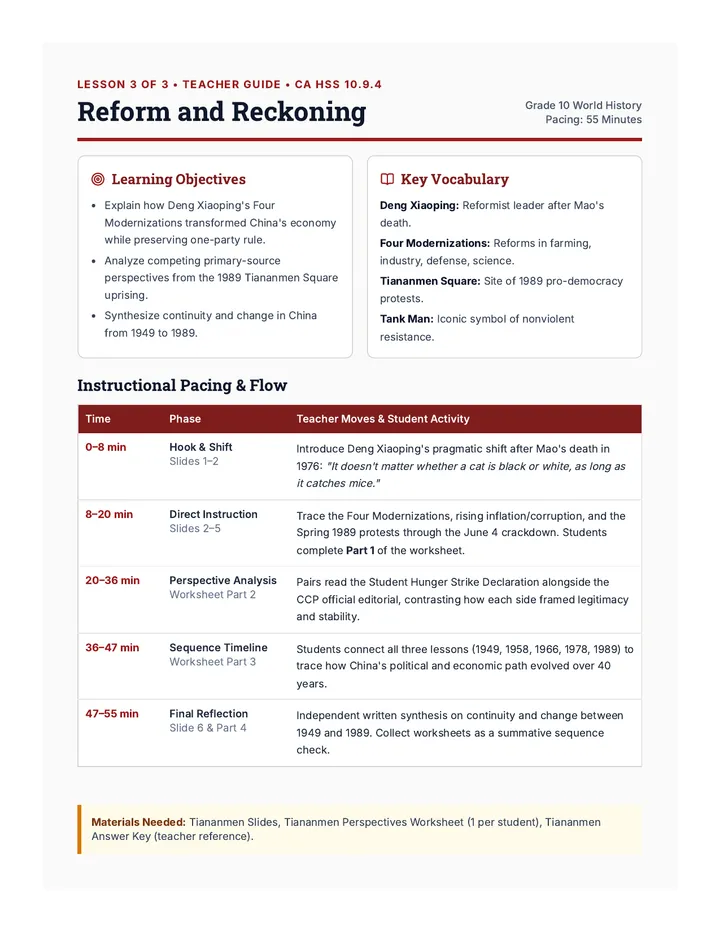
Tiananmen Lesson Plan Lesson 3 of 3 • Teacher Guide • CA HSS 10.9.4
Reform and Reckoning
Grade 10 World History
Pacing: 55 Minutes
Learning Objectives
Explain how Deng Xiaoping's Four Modernizations transformed China's economy while preserving one-party rule.
Analyze competing primary-source perspectives from the 1989 Tiananmen Square uprising.
Synthesize continuity and change in China from 1949 to 1989.
Key Vocabulary
Deng Xiaoping: Reformist leader after Mao's death.
Four Modernizations: Reforms in farming, industry, defense, science.
Tiananmen Square: Site of 1989 pro-democracy protests.
Tank Man: Iconic symbol of nonviolent resistance.
Instructional Pacing & Flow
Time
Phase
Teacher Moves & Student Activity
0–8 min
Hook & Shift
Slides 1–2
Introduce Deng Xiaoping's pragmatic shift after Mao's death in 1976: "It doesn't matter whether a cat is black or white, as long as it catches mice."
8–20 min
Direct Instruction
Slides 2–5
Trace the Four Modernizations, rising inflation/corruption, and the Spring 1989 protests through the June 4 crackdown. Students complete Part 1 of the worksheet.
20–36 min
Perspective Analysis
Worksheet Part 2
Pairs read the Student Hunger Strike Declaration alongside the CCP official editorial, contrasting how each side framed legitimacy and stability.
36–47 min
Sequence Timeline
Worksheet Part 3
Students connect all three lessons (1949, 1958, 1966, 1978, 1989) to trace how China's political and economic path evolved over 40 years.
47–55 min
Final Reflection
Slide 6 & Part 4
Independent written synthesis on continuity and change between 1949 and 1989. Collect worksheets as a summative sequence check.
Materials Needed: Tiananmen Slides, Tiananmen Perspectives Worksheet (1 per student), Tiananmen Answer Key (teacher reference).
Facilitation Notes & Differentiation
Reform and Reckoning
Common Misconceptions to Address
1. "Deng Xiaoping turned China into a democracy."
Clarify that Deng introduced market-oriented economic reforms (private farming, foreign investment) while firmly maintaining the Communist Party's monopoly on political power.
2. "Tiananmen Square protesters wanted to overthrow socialism immediately."
Note that protesters had diverse goals—many initially demanded an end to party corruption, inflation relief, press freedom, and dialogue with leaders rather than violent revolution.
3. "1989 ended China's economic rise."
Explain that after brief international sanctions, Deng doubled down on economic opening in 1992, creating modern China's blend of state capitalism and strict political censorship.
Scaffolds (ELL / IEP)
Provide a word bank for Part 1: communes, private enterprise, isolated, global trade .
Pre-annotate Source B's phrase "turmoil" to help students see how state media framed the protests.
Allow students to reference their Day 1 and Day 2 worksheets when completing the Part 3 timeline.
Extension (Honors / Fast Finishers)
Compare the 1989 Tiananmen Square outcome in China with the fall of the Berlin Wall in Europe later that same year.
Analyze why the Chinese government still censors references to June 4, 1989 today.
Sequence Summative Check (Part 4)
A strong final reflection should:
Identify a major change from 1949 to 1989 (e.g., shift from Mao's communes to Deng's market reforms).
Identify a major continuity (e.g., authoritarian one-party rule by the CCP).
Support both claims with specific historical events from the three-lesson sequence.
Red China Upheavals Sequence End of 3-Lesson Sequence
Tiananmen Slides CA HSS 10.9.4 • Lesson 3
Reform and Reckoning
Deng Xiaoping's Economic Opening and the 1989 Tiananmen Square Uprising
1976–1989 Four Modernizations Pro-Democracy Movement
1978 • A New Economic Direction
Deng Xiaoping & the Four Modernizations
Market Reforms
After Mao's death in 1976, Deng dismantled communes, allowed private businesses, and opened Special Economic Zones to foreign trade and investment.
Four Sectors
Deng prioritized Agriculture, Industry, Defense, and Science/Technology —lifting hundreds of millions out of poverty.
The 1980s Dilemma
Economic Freedom Without Political Reform
Growing Gap
Rapid growth brought high inflation and widening inequality, fueling anger at corrupt officials.
New Ideas
Students studying abroad and reading Western ideas began calling for a "Fifth Modernization": democracy.
Party Control
The CCP refused to allow opposition parties, free press, or independent labor unions.
April–May 1989
The Tiananmen Square Uprising
1 Million Citizens Gather
Triggered by the death of reformist leader Hu Yaobang, Beijing students launched hunger strikes in Tiananmen Square—joined by workers, journalists, and ordinary citizens.
Demands & Symbols
Protesters erected the 33-foot Goddess of Democracy statue and demanded anti-corruption reforms, press freedom, and official dialogue.
June 3–4, 1989
Crackdown and Global Shockwave
Martial Law
China's leadership declared martial law and sent People's Liberation Army troops and tanks into Beijing, killing hundreds to thousands of civilians.
"Tank Man" & Legacy
Images of a lone protester blocking a column of tanks became a global symbol of resistance. Inside China, the event remains heavily censored.
Sequence Synthesis (1949–1989)
Continuity and Change in Modern China
How did China change between Mao's 1949 revolution and the 1989 Tiananmen Square uprising—and what stayed the same?
Use your sequence timeline and primary sources to build your final written argument.
Tiananmen Perspectives Worksheet Name: _______________________________ Date: _______________ Period: ______
Tiananmen Perspectives Worksheet
Deng Xiaoping's Reforms and the 1989 Tiananmen Square Uprising
Part 1: Economic vs. Political Change
Dimension
Mao Zedong's Era (1949–1976)
Deng Xiaoping's Era (1978–1989)
Economic System
Global Trade
Political Control
Part 2: Competing Perspectives on May 1989
Source A: Student Hunger Strike Declaration (May 13, 1989)
"We are in the spring of our lives, yet we must leave this world behind. Our country is plagued by corruption and officials who silence the truth. We strike not for chaos, but to ask our government to speak honestly with its people and grant freedom of the press."
Source B: CCP People's Daily Editorial (April 26, 1989)
"A small handful of people with ulterior motives are using students to create turmoil. If we tolerate this disorder, the hard-won achievements of economic reform and national stability will be destroyed. The whole nation must unite to oppose unrest."
1. According to Source A, what specific grievances motivated the students, and how did they justify their protest?
2. How does Source B portray the protesters, and what danger does the government claim they pose?
Tiananmen Perspectives Worksheet (Page 2)
Sequence Synthesis (1949–1989)
Part 3: 40 Years of Upheaval (1949–1989)
Briefly summarize what happened at each turning point and its impact on China.
1949 PRC Founded
1958–1962 Great Leap
1966–1976 Cultural Rev.
1978 Deng's Reforms
1989 Tiananmen
Part 4: Final Sequence Reflection
How did China change—and how did it stay the same—between Mao's 1949 revolution and the 1989 Tiananmen Square uprising? Cite at least two specific historical developments from our three lessons.
Tiananmen Answer Key Teacher Reference • Lesson 3
Tiananmen Answer Key
Exemplar Responses
Part 1: Economic vs. Political Change
Dimension
Mao's Era (1949–1976)
Deng's Era (1978–1989)
Economic System
State-owned industry, collective communes
Private farming/business, Four Modernizations
Global Trade
Largely isolated from Western markets
Open to foreign investment (SEZs) and trade
Political Control
Strict one-party CCP rule, mass purges
Strict one-party CCP rule, no opposition allowed
Part 2: Competing Perspectives on May 1989
1. Student Declaration: Students protested official corruption and censorship ("silence the truth"). They insisted they did not want chaos, only honest dialogue and freedom of the press.
2. CCP Editorial: The government portrayed protesters as a "small handful" causing "turmoil" and "disorder" that threatened economic reform and national stability.
Part 3: 40 Years of Upheaval (1949–1989)
1949: CCP won the civil war, founded the PRC on the mainland; KMT fled to Taiwan.
1958–1962: Great Leap Forward communes & backyard steel caused a catastrophic famine.
1966–1976: Cultural Revolution mobilized Red Guards, closed schools, and purged intellectuals.
1978: Deng Xiaoping launched the Four Modernizations, introducing market-style reforms.
1989: Pro-democracy protests in Tiananmen Square were crushed by the military on June 4.
Part 4: Final Reflection Exemplar
Sample Response: Between 1949 and 1989, China's economy changed dramatically—moving from Mao's isolated, state-run communes during the Great Leap Forward to Deng Xiaoping's Four Modernizations, which welcomed private enterprise and foreign trade. However, China's political system stayed remarkably consistent: the Chinese Communist Party maintained a strict monopoly on power, crushing dissent during both the Cultural Revolution and the 1989 Tiananmen Square uprising.