Lenny.com
Explore
Create
ActivitiesNewMathEnglish Language ArtsScience & EngineeringSocial StudiesGlobal LanguagesHealth & Physical EducationSpecial EducationCounseling & Life SkillsArts & CreativityESL
Lenny.com
Lenny.com
Explore
Create
ActivitiesNewMathEnglish Language ArtsScience & EngineeringSocial StudiesGlobal LanguagesHealth & Physical EducationSpecial EducationCounseling & Life SkillsArts & CreativityESL
Lenny.com
Lenny.com

Solutions

Lenny for EducatorsLenny for SchoolsLenny for Districts

Product

ExploreSign inCreateSupportAbout

Resources

Getting startedMTSS Acceleration Program

Newsletters

School Funding Newsletter

© 2026 Lenny Learning Inc.

TermsPrivacyAccessibility
LinkedInInstagramX
Lenny
Social StudiesSocial Studies PracticesLocation WordsMapsOrder EventsChronology and CausationEvaluating SourcesHistorical ThinkingGeography, Humans, & the EnvironmentAmerican Symbols and LandmarksCitiesStatesState CapitalsRegions of the United StatesGeographic SkillsPhysical GeographyHuman GeographyRegional GeographyGeography of AfricaGeography of AsiaGeography of EuropeGeography of OceaniaGeography of the AmericasSociety and Environment of EuropeSociety and Environment of AsiaSociety and Environment of The AmericasSociety and Environment of the Middle EastSociety and Environment of AfricaHistoryPrehistoryComparing Ancient River CivilizationsAncient MesopotamiaAncient Egypt and KushAncient South AsiaEarly ChinaGreeceRome and the Byzantine EmpireAncient World HistoryNative Peoples of North AmericaNative Peoples of Mesoamerica and South AmericaAfrican EmpiresMedieval AsiaMedieval EuropeThe Silk RoadMedieval HistoryIslamic EmpiresWorld ReligionsRenaissance PeriodAge of ExplorationThe Thirteen ColoniesThe American RevolutionUS History Early RepublicFounding of the United StatesUS History AntebellumUS Civil WarReconstruction PeriodThe Gilded AgeUS ImperialismWorld ImperialismWorld War IUS History 1920sGreat DepressionWorld War IIThe Cold WarUS History 1950-60sUS History 1960s-70sWorld History 20th CenturyContemporary US HistoryContemporary World HistoryHolidaysCivics and GovernmentCitizenshipGovernment FoundationsThe ConstitutionUS ConstitutionExecutive BranchLegislative BranchJudicial BranchState and LocalPolitical ParticipationPublic PolicyPolitical SystemsPower and AuthoritySocial MovementsDefining DevianceTheories of DevianceCrime and Criminal JusticeEconomicsBasic Economic PrinciplesSupply and DemandWhat is MoneyEconomic FundamentalsMicroeconomicsMacroeconomicsBanking and FinanceEconomic SystemsGlobal EconomicsCorporations and PowerThe Changing WorkplaceUnemployment and LaborClass and InequalitySocial MobilityGlobal InequalityPsychologyHistory of PsychologyPsychology as a ScienceBrain and Nervous SystemNeuroscience and BehaviorGenetics and BehaviorSleep and ConsciousnessSensory ProcessesPerceptual OrganizationClassical ConditioningOperant ConditioningObservational LearningCognitive LearningMemory ProcessesThinking and Problem SolvingLanguage and CognitionTheories of MotivationStress and CopingPrenatal and Infant DevelopmentChildhood DevelopmentAdolescent DevelopmentAdulthood and AgingSelf and IdentitySocial CognitionSocial InfluenceAttraction and RelationshipsGroup BehaviorPrejudice and DiscriminationAnxiety and Mood DisordersClinical PsychologyForensic PsychologyPhilosophy & EthicsIntroduction to PhilosophyMajor Philosophers & IdeasMind and Body ProblemFree Will vs DeterminismEthics & MoralityReligion & PhilosophyPolitical Philosophy

Product to Market

A comprehensive review unit covering product research, manufacturing, branding, economic utility, distribution channels, and logistics for business and marketing essentials.

LLandry.Stahl

Product to Market

A comprehensive review unit covering product research, manufacturing, branding, economic utility, distribution channels, and logistics for business and marketing essentials.

LLandry.Stahl
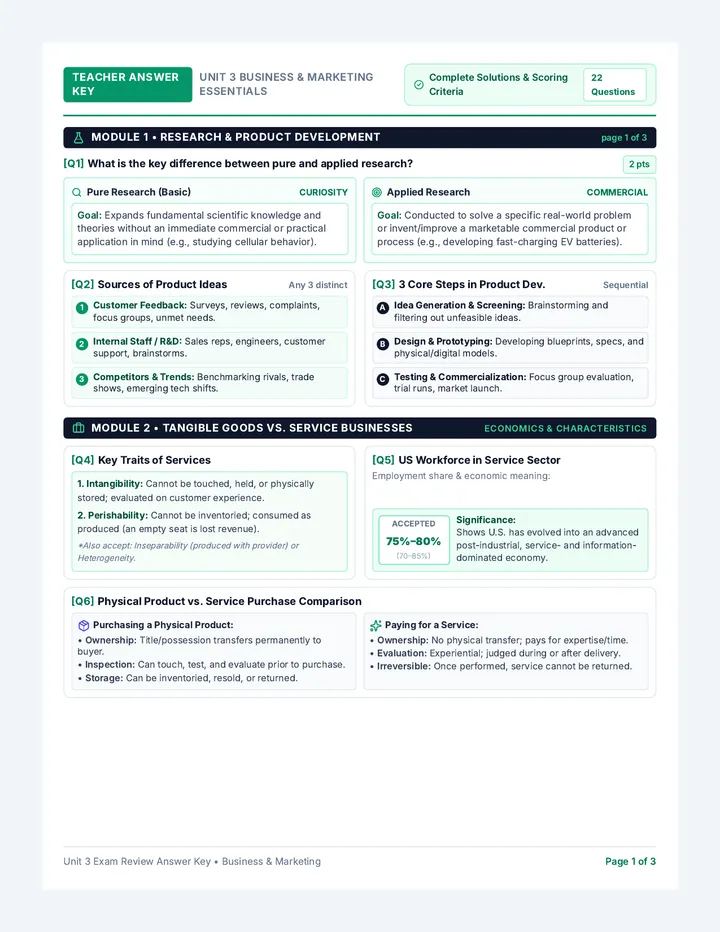
  • • Irreversible: Once performed, service cannot be returned.
  • Unit 3 Exam Review Answer Key • Business & Marketing Page 1 of 3

    Teacher Key Modules 3 & 4: Manufacturing, Facility, Branding & Utility

    Page 2 of 3

    Module 3 • Manufacturing Methods & Facility Location

    [Q7 & Q8]

    [Q7]Manufacturing vs. Mass Production vs. Custom Manufacturing 3 pts (1 each)

    Manufacturing (General)

    The overall process of converting raw materials into finished marketable goods using labor, machinery, and tools.

    Mass Production

    High-volume assembly-line output of standardized, identical items with specialized automation to lower per-unit cost.

    Custom Manufacturing

    Designing and fabricating unique, one-of-a-kind goods tailored to individual customer specifications (e.g., custom cabinetry).

    [Q8]Facility Location Variables (4 Factors)

    1. Customer Proximity: Reduces shipping times/costs; critical for retail and perishables.

    2. Labor Supply & Wages: Access to skilled talent, prevailing regional wage rates, and regulations.

    3. Raw Material & Supplier Access: Minimizes inbound shipping expense and prevents supply disruptions.

    4. Transportation & Utilities: Access to highways, ports, rail, reliable power/water/web, and tax zoning.

    Module 4 • Product Strategy, Branding & Packaging

    [Q9–Q13]

    [Q10] Product Line: A group of closely related products manufactured or sold by a business that serve similar functions, target similar customers, or share price ranges (e.g., Apple iPhone models, Nike running shoes).

    [Q9]Basic vs. Enhanced vs. Extended Product Levels

    Basic Product:

    Simplest version delivering core utility/primary benefit (e.g., standard car with engine and wheels).

    Enhanced Product:

    Upgraded features, premium styling, options, and comfort (e.g., leather seating, GPS, sunroof).

    Extended Product:

    Intangible support services: warranties, free maintenance, financing, and customer support.

    [Q11]4 Elements of Brand Identity

    1. Brand Name: Spoken words/letters (e.g., Nike).

    2. Brand Mark / Logo: Visual symbol (e.g., Swoosh).

    3. Slogan / Tagline: Catchy phrase ("Just Do It").

    4. Trade Character: Mascot (e.g., Tony the Tiger).

    [Q12]Economic Utility & Its Forms

    Definition: Capacity of a good/service to satisfy consumer wants; value added to an item.

    • Form: Physical production & assembly of parts.

    • Place: Offering product in accessible, convenient spots.

    • Time: Having item available exactly when wanted.

    • Possession: Ease of purchasing/legal transfer (credit/cash).

    [Q13]4 Main Purposes of Product Packaging

    1. Protection

    Prevents physical damage, spoilage, tampering, contamination.

    2. Identification

    Displays brand, barcode, ingredients, dosage, and legal warning labels.

    3. Convenience

    Facilitates easy opening, dispensing, handling, pouring, resealing.

    4. Promotion

    Attracts shelf attention with vibrant colors, claims, and branding imagery.

    Unit 3 Exam Review Answer Key • Business & Marketing Page 2 of 3

    Teacher Key Modules 5 & 6: Distribution Channels, Pricing & Logistics

    Page 3 of 3

    Module 5 • Distribution Channels & Intermediaries

    [Q14–Q18]

    [Q14]Definition: Channel Members

    Answer: The businesses, intermediaries, and individuals who participate in moving a product from producer to final consumer (producers, wholesalers, agents/brokers, retailers, buyers).

    [Q15]Channel Discrepancies

    Quantity: Mass production vs. small consumer purchases (intermediaries break bulk).
    Assortment: Single producer variety vs. consumer desire for one-stop shopping multi-brand selections.

    [Q16 & Q17]Retailers vs. Wholesalers & Market Advantages B2B vs. B2C

    Wholesaler (B2B Intermediary) Bulk Distributor

    Buys massive volumes directly from manufacturers, stores inventory, absorbs market risk, and resells smaller bulk lots to retail stores.

    Retailer (B2C Intermediary) End-Consumer Outlet

    Sells directly to the ultimate consumer for personal use; provides convenient store locations, displays, customer service, and immediate possession.

    Q18 Shortest Distribution Channel:

    Direct Channel (Channel Level 0): Producer \(\rightarrow\) Final Consumer

    Module 6 • Channel Strategy, Logistics & Inventory

    [Q19–Q22]

    [Q19]Channel Selection Factors (Any 3)

    1. Product Characteristics: Perishability, unit value, fragility, complexity, bulkiness.

    2. Target Market: Geographic density, buying habits, order volume, and shopping location preferences.

    3. Business Resources: Financial capital, internal sales team size, and desire for brand control.

    [Q20]Channel Length vs. Price Impact

    Key Relationship: A longer distribution channel increases the final consumer price.

    Why? Every intermediary (wholesaler, distributor, retailer) incurs freight, storage, and labor costs and must add a profit markup/margin to remain profitable.

    [Q21]Distribution Center vs. Warehouse

    Warehouse:

    Focuses on long-term holding & storage of bulk seasonal or buffer inventory until needed.

    Dist. Center:

    Focuses on rapid movement & throughput; goods are received, sorted, and cross-docked immediately to stores.

    [Q22]Purpose & Value of Bar Codes (Any 2)

    Inventory Management: Enables real-time automated tracking of stock levels and automated reordering.

    POS Accuracy & Speed: Eliminates manual human pricing mistakes at checkout and accelerates transactions.

    Unit 3 Exam Review Answer Key • Business & Marketing Page 3 of 3
    You might also like

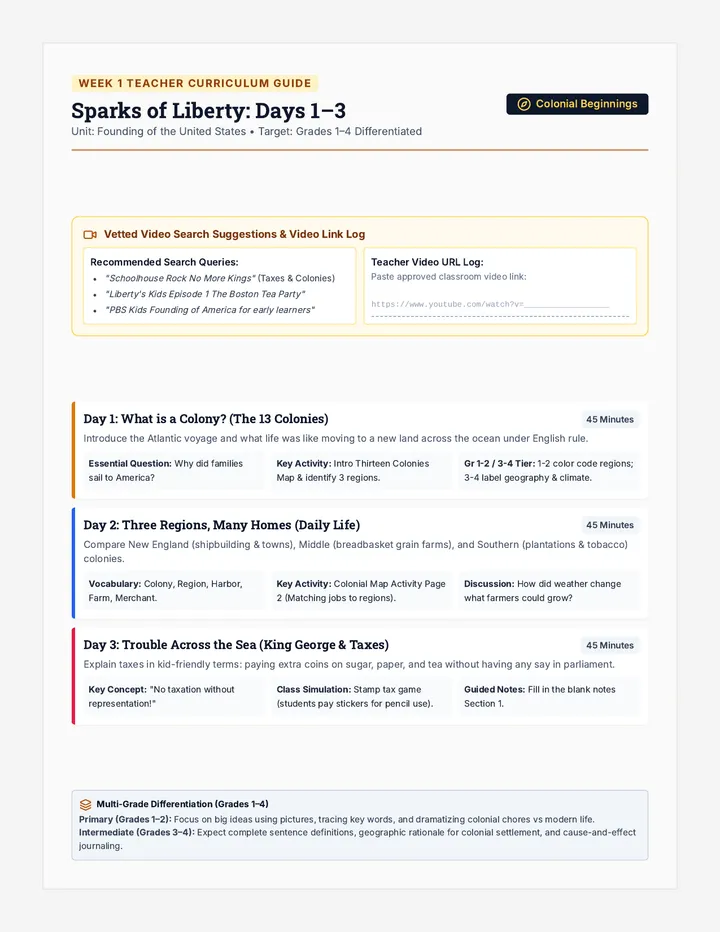
    Sparks Pacing Guide

    Founding Freedom

    A two-week, comprehensive elementary history unit exploring the birth of the United States for 1st through 4th grade learners. Students discover the thirteen colonies, the causes of the revolution, the Declaration of Independence, the Constitution, and enduring American symbols through interactive maps, guided notes, vocabulary cards, and vetted media guides.

    Lenny Avatar
    Lenny
    8
    Mill Voices Investigation Slides

    Voices of the Loom

    A 40-minute interactive 8th-grade history lesson exploring child labor in England during the Industrial Revolution through primary sources, UDL scaffolds, and collaborative source analysis.

    C

    ccofone

    4
    Unit 3 Review Answer Key

    Unit 3 Review Answer Key

    A comprehensive 3-page teacher answer key and grading guide mirroring the Unit 3 Exam Review Worksheet with detailed correct responses, scoring rubrics, and pedagogical notes.

    L

    Landry.Stahl

    Provenance Sleuths Slides

    Curator Studio

    A comprehensive project sequence guiding high school students through professional museum curation, artifact evaluation, historical storytelling, and polished exhibit design.

    Lenny Avatar
    Lenny
    6
    Marketing in Action Worksheet

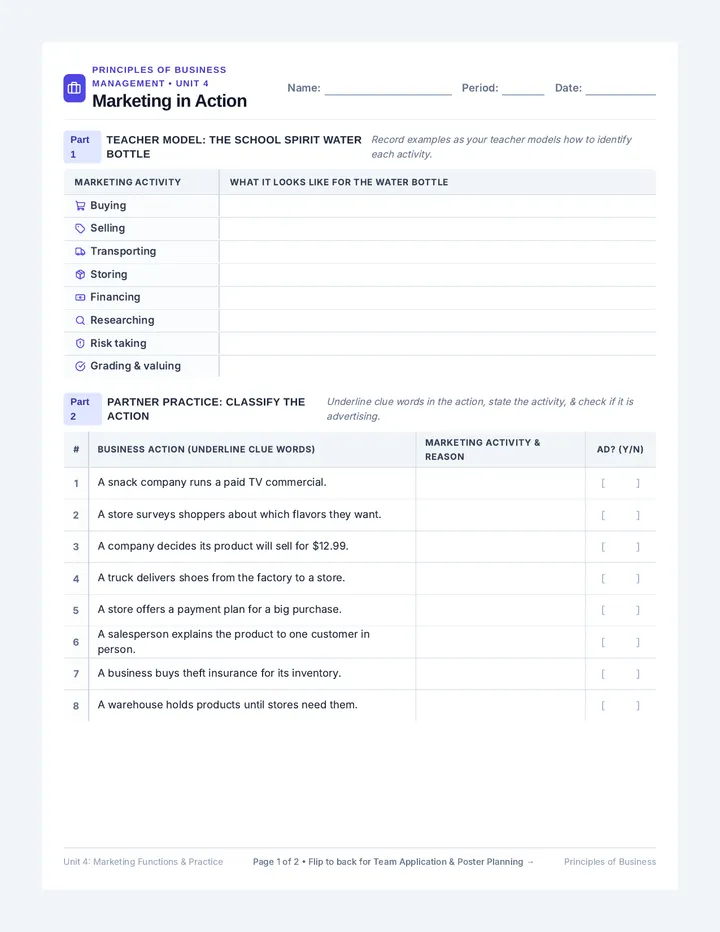
    Marketing in Action

    A comprehensive business lesson introducing students to the eight core marketing activities through direct modeling, partner classification, applied product planning, and advertising poster design.

    L

    Landry.Stahl

    2
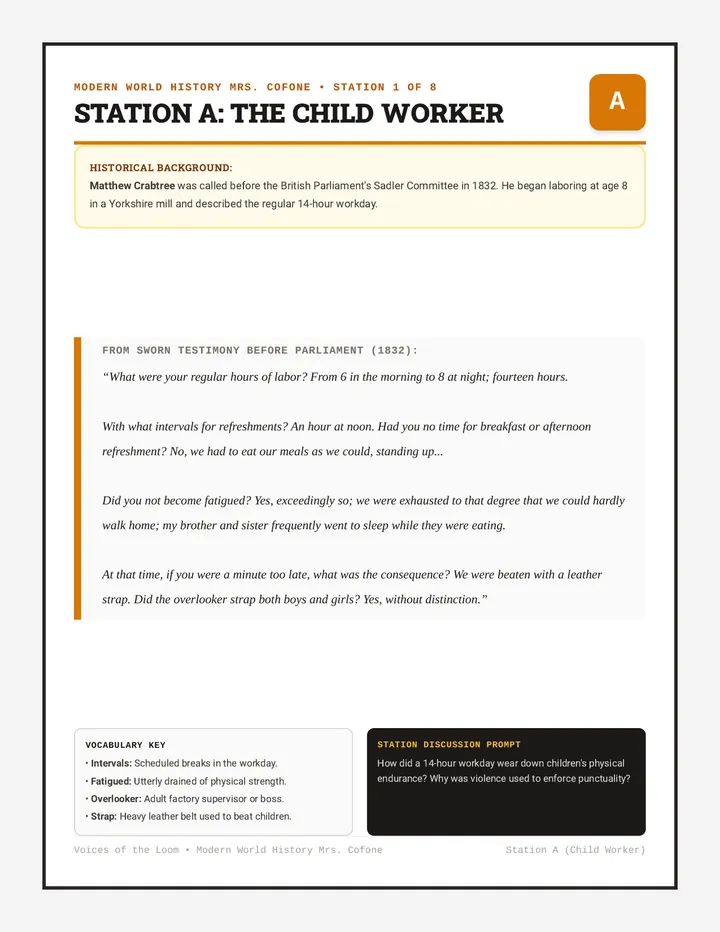
    Source Station Placards

    Source Station Placards

    Printable set of 8 primary source station placards (Stations A through H) for classroom stations or gallery walks in Mrs. Cofone's Modern World History class.

    C

    ccofone

    Business Blueprint Slides

    Market Makers

    A hands-on introductory curriculum that equips students with foundational business acumen and marketing savvy through practical entrepreneurial challenges, financial basics, and campaign design.

    D

    despinoza

    9
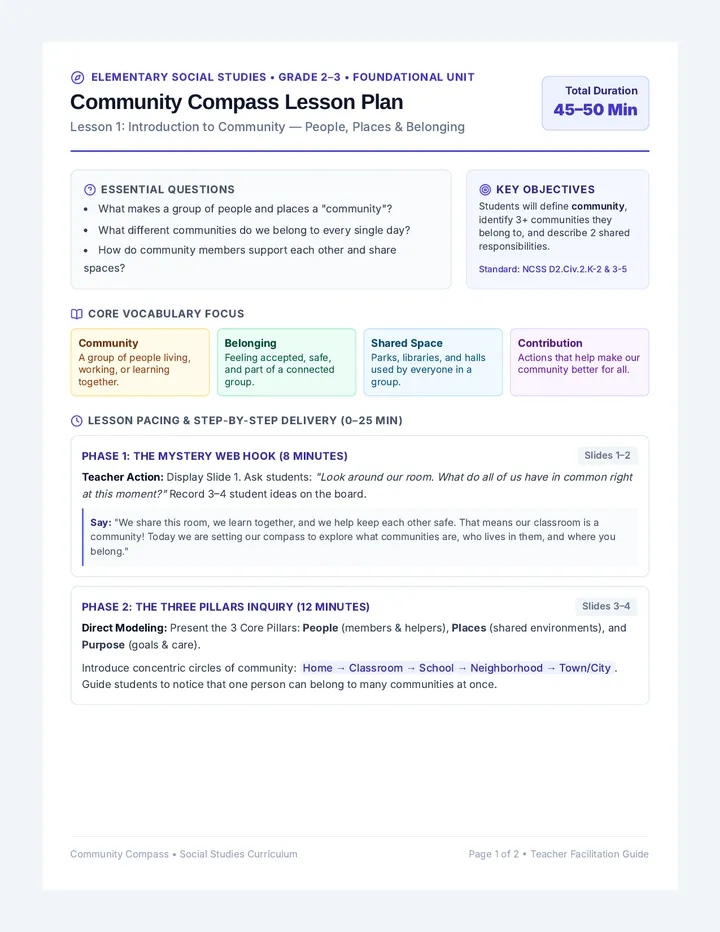
    Community Compass Lesson Plan

    Community Compass

    A foundational social studies lesson introducing students to what a community is, how members help each other, and the different communities we belong to. Students explore shared places, roles, and responsibilities through guided inquiry, visual mapping, and collaborative discussion.

    Lenny Avatar
    Lenny
    4
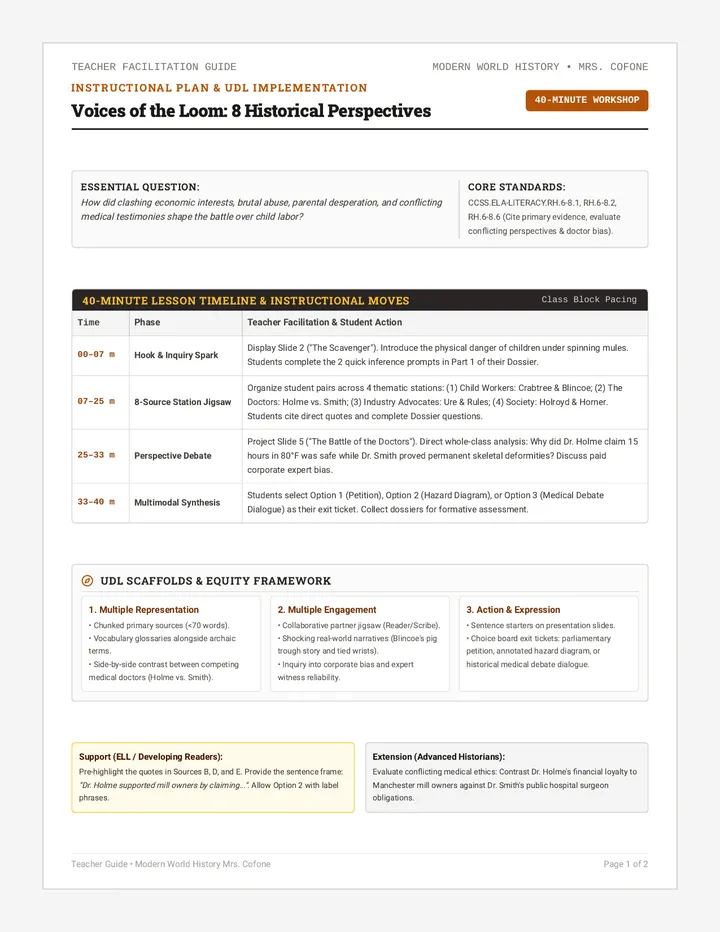
    Voices of the Loom Teacher Guide

    Voices of the Loom Teacher Guide

    A comprehensive 2-page teacher facilitation guide updated for Mrs. Cofone's class featuring all 8 primary source perspectives, 40-minute jigsaw pacing, full answer key, and UDL rubric.

    C

    ccofone

    Hemisphere Hunt Slides

    Continent Quest

    A 4th-grade geography sequence introducing students to North America through map navigation, regional comparisons, and landform exploration. Students investigate hemisphere locations, the three major nations, and iconic geographic features across the continent.

    E

    ehdunn

    9
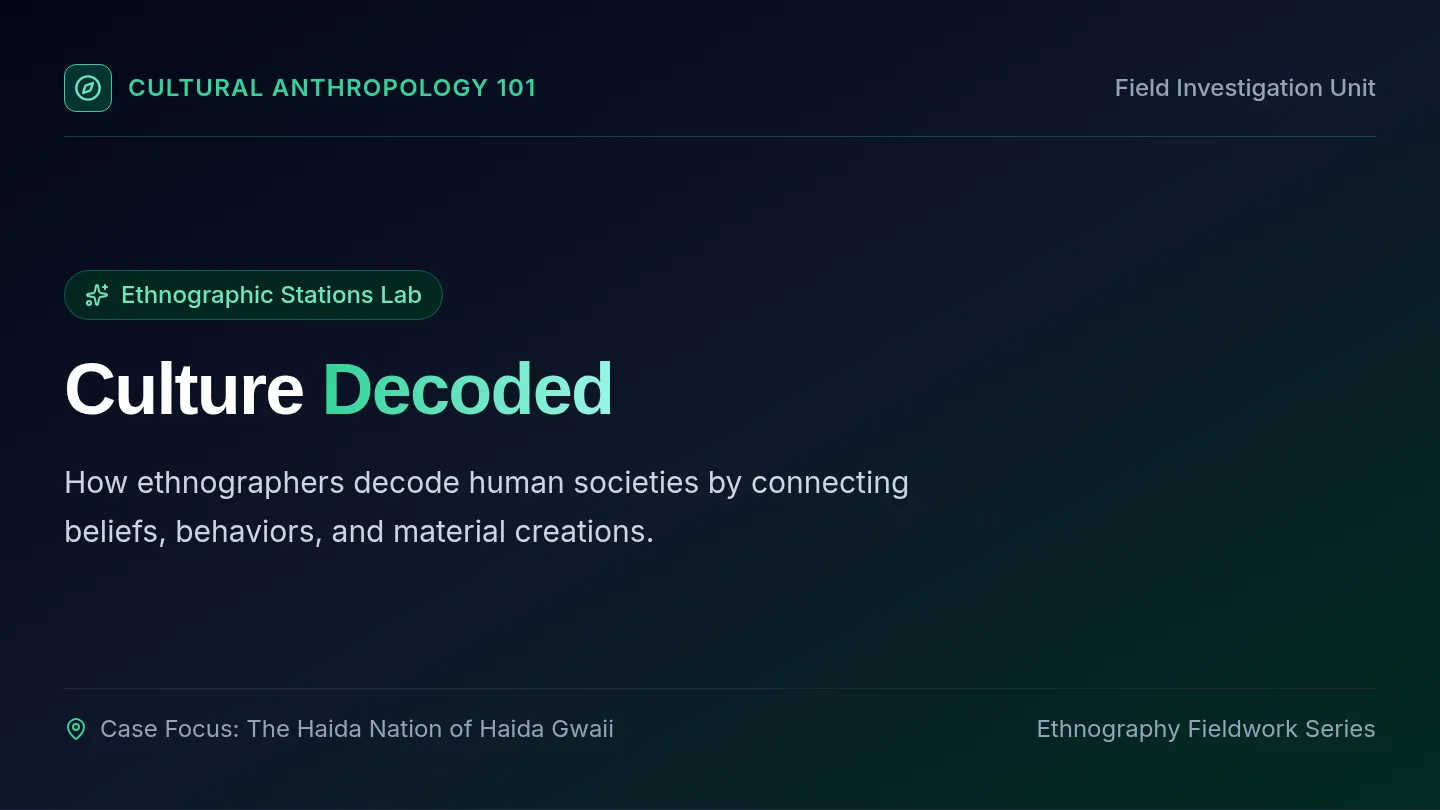
    Culture Decoded Slides

    Culture Decoded

    A 9th grade cultural anthropology lesson introducing ethnography and the three components of culture through an immersive Haida case study. Students examine field notes across cognitive values, behavioral rituals, and material artifacts to discover how all aspects of culture interconnect.

    KT

    Kyle Trocolla

    4
    Child Labor Investigation Worksheet

    Child Labor Investigation Worksheet

    A print-ready 4-page primary source dossier for 8th graders featuring 8 historical perspectives, including competing doctors and brutal child worker testimonies, with UDL supports and class details for Mrs. Cofone.

    C

    ccofone