Wampanoag Seasons Slides
Grade 3 Social Studies
People of the First Light
How the Wampanoag Lived with the Changing Seasons
Use arrow keys to navigate
Who are the Wampanoag?
1 / 6
The Wampanoag (Wôpanâak) have lived in what is now coastal Massachusetts and Rhode Island for over 12,000 years.
Their name means "People of the First Light" because they live in the east, where the sun rises first each day.
Key Concept: Interconnectedness
They traditionally viewed themselves as part of the natural world, rather than owners of it. Every season brought new gifts and responsibilities.
Our Homeland
Location: Woodlands and coastal shores of southern New England.
Resources: Rich soil, deep forests, rivers, and salt oceans.
Harmony: Moving dwellings to fit the natural seasons.
Traditional Wampanoag Seasonal Way of Life
Grade 3 Social Studies
Spring & Summer: Coastal Living
2 / 6
Spring: Planting & Moving
As the snow melted, families packed up their belongings and moved toward the shorelines to establish seasonal farming villages.
- • Planted "Three Sisters" (Corn, Beans, Squash) together.
- • Herring fish used in soil as fertilizer for sprouted seeds.
"The crops grew together, supporting one another."
Summer: Abundance
Summer was spent near beaches and estuaries. The weather was warm, and natural food resources were incredibly plentiful.
- • Gathered clams, oysters, lobsters, and caught fish.
- • Lived in dome-shaped homes called Wetus.
- • Wetus were cool, breezy, and covered in woven grass mats.
"Coastal breezes and rich waters sustained the community."
Summer homes (Wetus) could be easily packed or left behind.
Grade 3 Social Studies
Autumn: Harvest & Preparation
3 / 6
A Time of Great Cooperation
Autumn was the busiest season. The Wampanoag worked hard to harvest crops and preserve food so they would survive the long, cold winter.
Gathering Wild Food
Picked wild cranberries, acorns, walnuts, and seasonal berries.
Preserving & Drying
Smoked meats and dried corn, squash, and fish for storage.
Harvest Highlights
Cranberries (Sasumuneash)
Used for food, beautiful dye, and medicine.
Animal Skins
Deer skins prepared, scraped, and softened for warm winter clothing.
🍂 Gratitude was given to nature for every harvest.
The Wampanoag modern Thanksgiving continues to celebrate this harvest spirit.
Grade 3 Social Studies
Winter: Forest Sanctuaries
4 / 6
When winter winds began to blow, the Wampanoag moved inland into dense valleys and forests.
The tall trees and hills shielded their homes from severe, freezing winter winds blowing off the Atlantic ocean.
Winter Homes
Lived in larger, winter wetus or longhouses insulated with heavy tree bark.
Winter Foods
Ate dried summer crops, hunted turkey and deer, and ice fished.
Inside the Wetu
A small fire was kept burning in the center of the wetu. Smoke escaped through a central roof hole covered by a adjustable bark flap.
Families sat on warm deer and bear furs around the fire, telling stories and making tools.
Winter was the season for passing down history through storytelling.
Moving inland saved families from severe coastal freezing storms.
Grade 3 Social Studies
Clothing & Natural Resources
5 / 6
Clever Craftsmanship
Wampanoag clothing was made entirely from local resources, designed for warmth, flexibility, and protection from the weather.
1
Deerskin (Ahteep)
The primary material for breechcloths, leggings, dresses, and soft-soled shoes called moccasins.
2
Fur & Feathers
Bear, deer, and beaver furs lined winter cloaks. Turkey feather cloaks provided wind and rain protection.
Wampum: Shell Artistry
Wampum are precious purple and white beads hand-carved from the shells of hard-shell clams (quahog) and whelk sea snails.
- • Woven into belts to record histories, treaties, and stories.
- • Worn as jewelry to show a person's role in the tribe.
- • Highly valued, but not used as "money" until Europeans arrived.
Shells connect the land, ocean, and the community.
Nothing was wasted. Every part of an animal was treated with deep respect.
Grade 3 Social Studies
Think & Share!
6 / 6
Let's Discuss
Think about how the seasons changed where the Wampanoag lived, what they ate, and what they wore.
Why was moving inland during the winter a survival necessity?
What are the "Three Sisters" crops and why did they grow well together?
🏆 Team Challenge
Name 3 items crafted from forest animals.
Our Seasonal Cycle
Can you sort these activities into the correct seasons?
Gathering Shellfish
Shoreline
Heavy Bark Wetu
Inland Valley
Harvesting Corn
Farming Plots
Planting Herring
Spring Fertilizer
Let's complete our worksheets!
Thank you for learning about the Wampanoag seasonal way of life!
Grade 3 Social Studies
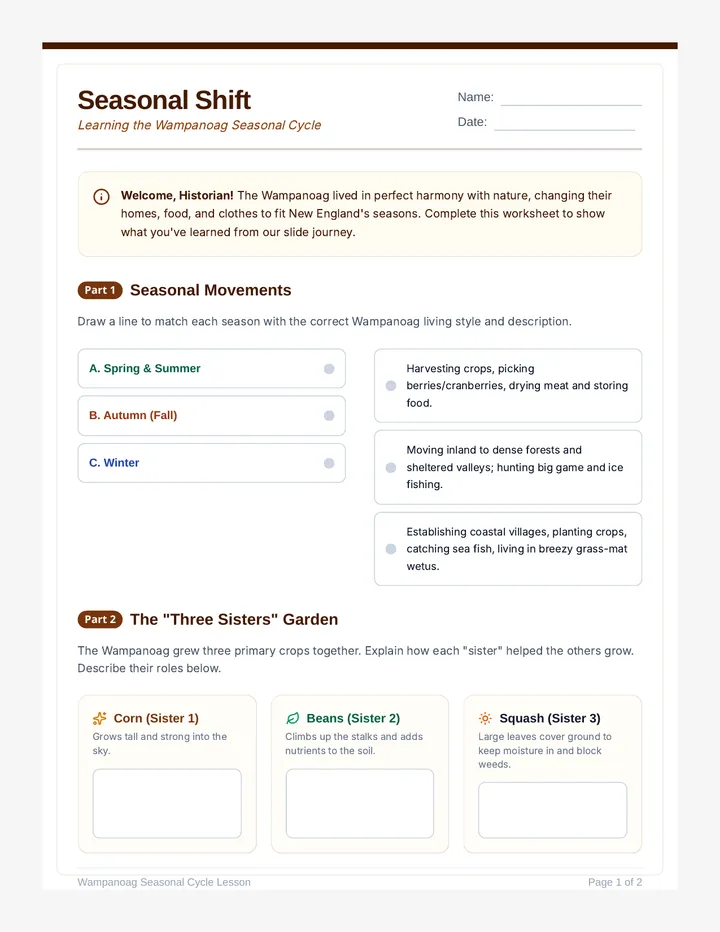
Seasonal Shift Worksheet
Seasonal Shift
Learning the Wampanoag Seasonal Cycle
Name:
Date:
Welcome, Historian! The Wampanoag lived in perfect harmony with nature, changing their homes, food, and clothes to fit New England's seasons. Complete this worksheet to show what you've learned from our slide journey.
Part 1 Seasonal Movements
Draw a line to match each season with the correct Wampanoag living style and description.
A. Spring & Summer
B. Autumn (Fall)
C. Winter
Harvesting crops, picking berries/cranberries, drying meat and storing food.
Moving inland to dense forests and sheltered valleys; hunting big game and ice fishing.
Establishing coastal villages, planting crops, catching sea fish, living in breezy grass-mat wetus.
Part 2 The "Three Sisters" Garden
The Wampanoag grew three primary crops together. Explain how each "sister" helped the others grow. Describe their roles below.
Corn (Sister 1)
Grows tall and strong into the sky.
Beans (Sister 2)
Climbs up the stalks and adds nutrients to the soil.
Squash (Sister 3)
Large leaves cover ground to keep moisture in and block weeds.
Wampanoag Seasonal Cycle Lesson Page 1 of 2
Resource Treasure
Understanding Natural Resources & Crafting
Grade 3 Social Studies
Part 3 Gifts of the Land & Sea
Write how the Wampanoag traditionally used each resource from their local New England environment.
| Natural Resource | How It Was Used (Provide 1-2 examples) |
|---|
| 🦌 Deer Hide & Fur | |
| |
| 🐚 Quahog Clam Shells | |
|
| 🪵 Thick Tree Bark & Grass |
|
| 🐟 Herring Fish |
|
Part 4 A Day in the Wetu
Imagine you are a Wampanoag child living 400 years ago. Choose one season (Summer or Winter). Write a short description describing your home, what you are wearing, and what work you are helping your family do today.
Wampanoag Seasonal Cycle Lesson Page 2 of 2
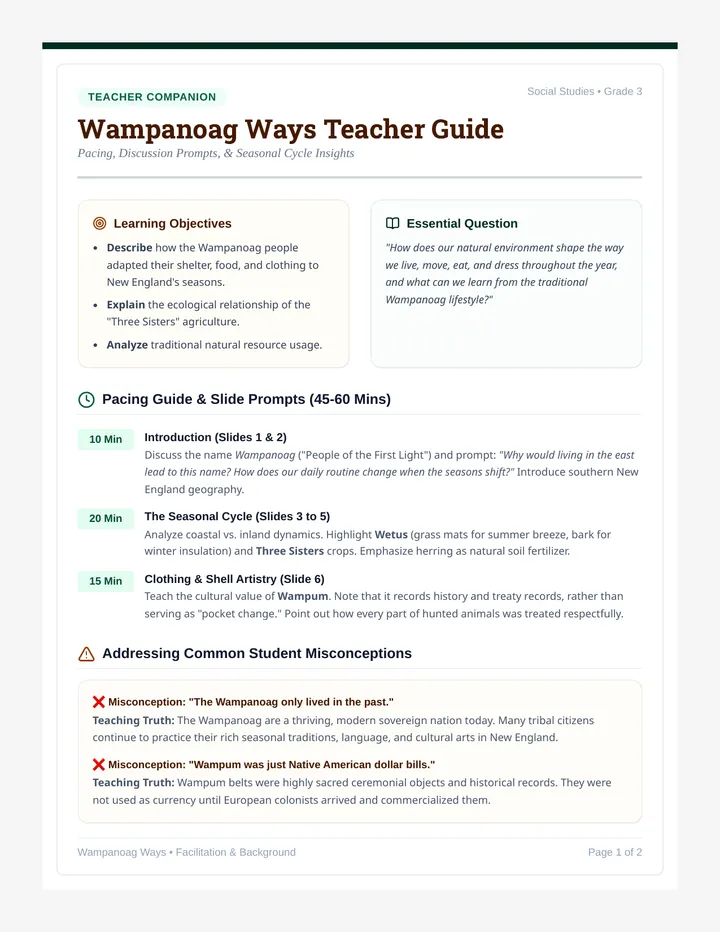
Wampanoag Ways Teacher Guide
Teacher Companion
Wampanoag Ways Teacher Guide
Pacing, Discussion Prompts, & Seasonal Cycle Insights
Social Studies • Grade 3
Learning Objectives
- Describe how the Wampanoag people adapted their shelter, food, and clothing to New England's seasons.
- Explain the ecological relationship of the "Three Sisters" agriculture.
- Analyze traditional natural resource usage.
Essential Question
"How does our natural environment shape the way we live, move, eat, and dress throughout the year, and what can we learn from the traditional Wampanoag lifestyle?"
Pacing Guide & Slide Prompts (45-60 Mins)
10 Min
Introduction (Slides 1 & 2)
Discuss the name Wampanoag ("People of the First Light") and prompt: "Why would living in the east lead to this name? How does our daily routine change when the seasons shift?" Introduce southern New England geography.
20 Min
The Seasonal Cycle (Slides 3 to 5)
Analyze coastal vs. inland dynamics. Highlight Wetus (grass mats for summer breeze, bark for winter insulation) and Three Sisters crops. Emphasize herring as natural soil fertilizer.
15 Min
Clothing & Shell Artistry (Slide 6)
Teach the cultural value of Wampum. Note that it records history and treaty records, rather than serving as "pocket change." Point out how every part of hunted animals was treated respectfully.
Addressing Common Student Misconceptions
❌ Misconception: "The Wampanoag only lived in the past."
Teaching Truth: The Wampanoag are a thriving, modern sovereign nation today. Many tribal citizens continue to practice their rich seasonal traditions, language, and cultural arts in New England.
❌ Misconception: "Wampum was just Native American dollar bills."
Teaching Truth: Wampum belts were highly sacred ceremonial objects and historical records. They were not used as currency until European colonists arrived and commercialized them.
Wampanoag Ways • Facilitation & Background Page 1 of 2
Teacher Companion
Worksheet Answer Key
Grading Guide, Criteria, & Differentiation Strategies
Social Studies • Grade 3
Student Worksheet Answers
Part 1: Matching Key