Violent Earth Reading Guide
VIOLENT EARTH
01. Human-Environmental Interaction
NAME:
DATE:
STUDENT COMPANION HANDOUT
Humans & The Environment
Humans live in a constant relationship with the physical environment. The environment dictates what clothes we wear, what food we can grow, and how we build our shelters. However, the Earth is also dynamic and violent. Natural disasters are extreme, sudden environmental events that cause massive damage and threaten lives.
Forces from Inside: Tectonic Disasters
Caused by the shifting and collision of massive tectonic plates deep beneath Earth's crust.
1. Mount Vesuvius Volcano (79 AD)
In ancient Italy, Mount Vesuvius erupted violently. It sent a massive cloud of toxic gas, rocks, and scorching volcanic ash into the air. The city of Pompeii was completely buried, freezing daily Roman life in time. The eruption was so powerful that it altered the local coastline and redirected the Sarno River.
2. San Francisco Earthquake (1906)
A massive slippage along the San Andreas Fault shook the city of San Francisco. The violent tremors ruptured gas lines, sparking uncontrollable fires that destroyed most of the city and killed over 3,000 people. This disaster proved to scientists that urban centers built near fault lines must prepare for unavoidable future shakes.
BILINGUAL KEYWORDS
Environment El medio ambiente
The physical world around us.
Natural Disaster El desastre natural
An extreme, sudden earth event.
Earthquake El terremoto
Violent shaking of the ground.
STOP & JOT 1
How does the physical environment affect your daily lifestyle choices?
Start writing with this stem:
The physical environment affects my life because...
STOP & JOT 2
Why must cities near plate boundaries change how they build structures?
Start writing with this stem:
Cities near plate boundaries must build differently so...
Resumen en Español: La Tierra Violenta (Parte 1)
El medio ambiente físico influye en la comida, ropa y casas de los seres humanos. Los desastres naturales son eventos repentinos y destructivos. Los volcanes (como el Vesubio, que enterró la ciudad de Pompeya bajo ceniza) y los terremotos (como el de San Francisco en 1906, que destruyó la ciudad con temblores e incendios) son causados por la energía del interior de la Tierra y cambian drásticamente la geografía y la vida humana.
VIOLENT EARTH
02. Weather Disasters & Preparing for the Future
PAGE 2 / STUDENT COMPANION
Forces from Above: Weather & Water
Caused by heat energy, warm oceans, and atmospheric conditions surrounding our globe.
3. The Indonesian Ocean Tsunami (2004)
A massive earthquake cracked the ocean floor under the Indian Ocean. This suddenly displaced millions of gallons of water, creating a giant wall of waves called a tsunami. These waves raced across the ocean at hundreds of miles per hour, destroying coastlines and instantly killing over 200,000 people.
4. The Galveston Hurricane (1900)
One of the deadliest storms in United States history hit Galveston, Texas. This Category 4 hurricane brought wind speeds over 135 mph and a massive storm surge (ocean flooding). It destroyed most of the island city. To protect the city, engineers rebuilt the ground 17 feet higher and built a massive concrete seawall.
Mitigation: Predict, Prepare, Adapt
Humans cannot prevent natural disasters. However, we can use science to reduce their impact. In 1989, an earthquake hit San Francisco, but far fewer people died compared to older earthquakes. Why? Because the city had built modern structures designed to bend with tectonic tremors, rather than collapse. Today, global communities collaborate, sending food, medicine, and rescue workers when disaster strikes.
BILINGUAL KEYWORDS
Tsunami El tsunami
A giant wave caused by ocean floor earthquakes.
Hurricane El huracán
A massive storm with high wind and heavy rain.
Mitigation La mitigación
Action taken to reduce disaster damage.
STOP & JOT 3
Why are concrete seawalls and raised grounds built near hurricane-prone oceans?
Start writing with this stem:
Engineers build seawalls to protect cities from...
STOP & JOT 4
What is one way countries can cooperate after a severe earthquake strikes?
Start writing with this stem:
After a disaster, different nations can help by...
Resumen en Español: La Tierra Violenta (Parte 2)
Los tsunamis (olas gigantes por sismos submarinos) y los huracanes (tormentas masivas de viento y lluvia como el de Galveston) causan inundaciones severas. Aunque no podemos evitar que ocurran estas fuerzas, la ciencia ayuda a mitigar el impacto mediante el diseño de edificios que se mueven sin caerse y muros de protección. Además, las naciones del mundo cooperan compartiendo suministros médicos y alimentos para salvar vidas.
Violent Earth Instruction Slides
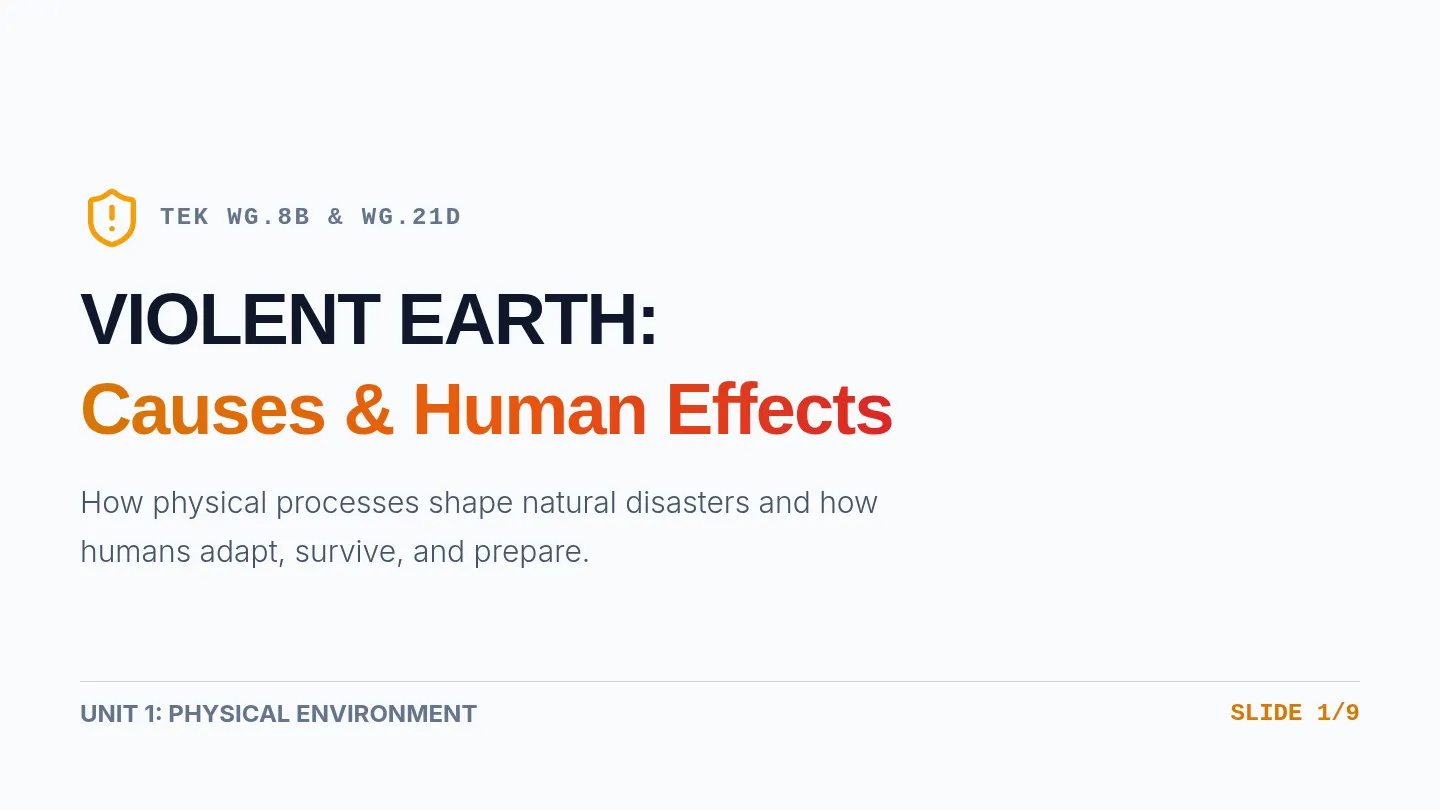
TEK WG.8B & WG.21D
VIOLENT EARTH:
Causes & Human Effects
How physical processes shape natural disasters and how humans adapt, survive, and prepare.
UNIT 1: PHYSICAL ENVIRONMENT
SLIDE 1/9
LEARNING TARGETS
OBJETIVOS DE APRENDIZAJE
English
"I can explain how physical processes cause natural disasters and analyze their effects on human activity."
Standard: TEK WG.8B
Español
"Puedo explicar las causas de los desastres naturales y sus efectos en las poblaciones humanas."
Estándar de Apoyo
Guiding Question: How does a changing Earth force humans to change how they live?
Violent Earth: Introduction
SLIDE 2/9
TECTONIC PROCESSES
PROCESOS TECTÓNICOS
How Tectonic Plate Disasters Occur:
- Plate Movement: The crust is split into giant pieces that slowly drift, slide, and collide.
- Earthquakes: Plates lock together; when they suddenly slip, violent waves of energy shake the surface.
- Volcanoes: Magma erupts through weakness points in boundaries, dumping toxic gas and ash.
BILINGUAL SUPPORT
Tectonic Plates / Placas tectónicas
Huge pieces of Earth's crust that move.
Earthquake / El terremoto
Ground shaking caused by plates slipping.
TEK WG.8B: Tectonic Forces
SLIDE 3/9
CASE 1: MOUNT VESUVIUS (79 AD)
CASO 1: MONTE VESUBIO
THE PHYSICAL PROCESS
- ✔ Extreme volcanic pressure built up over centuries inside Mount Vesuvius.
- ✔ It exploded, launching gas and tons of blistering hot ash into the sky.
- ✔ The ash fell like snow, completely burying the city of Pompeii.
HUMAN IMPACT
- ⚠ The entire population of Pompeii was trapped and buried under feet of ash.
- ⚠ The eruption was so heavy it changed the coastline and blocked rivers.
- ⚠ This taught historians how dangerous active volcanoes are to human settlements.
👉 Review prompt: In what ways did Vesuvius permanently change the landscape?
TEK WG.8B: Volcano Case Study
SLIDE 4/9
CASE 2: SAN FRANCISCO (1906)
CASO 2: SAN FRANCISCO
Violent Earth Teacher Guide
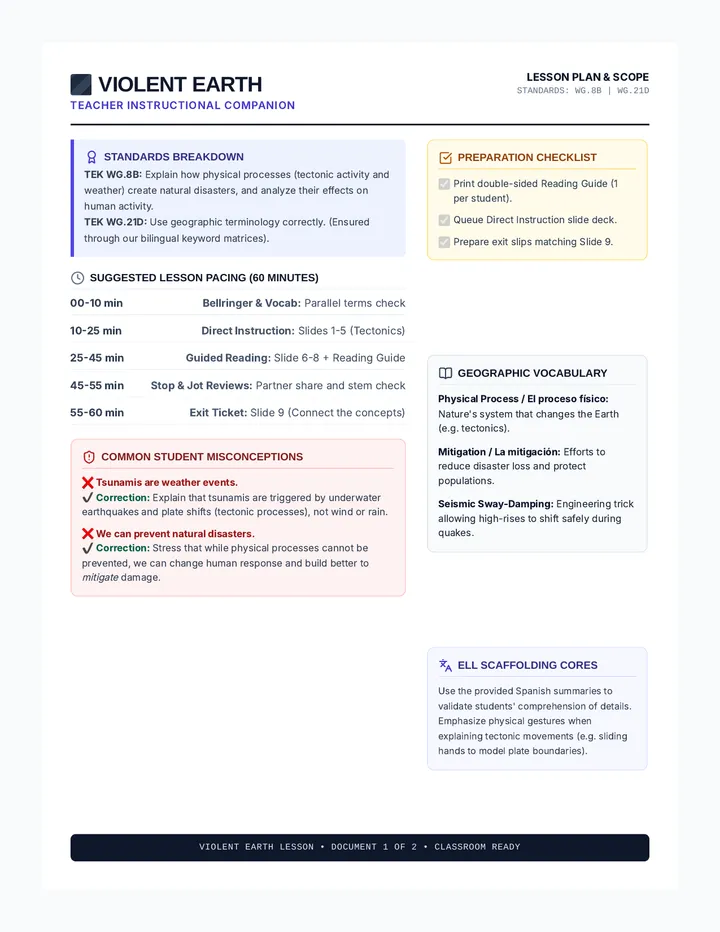
VIOLENT EARTH
TEACHER INSTRUCTIONAL COMPANION
LESSON PLAN & SCOPE
STANDARDS: WG.8B | WG.21D
Standards Breakdown
TEK WG.8B: Explain how physical processes (tectonic activity and weather) create natural disasters, and analyze their effects on human activity.
TEK WG.21D: Use geographic terminology correctly. (Ensured through our bilingual keyword matrices).
Suggested Lesson Pacing (60 Minutes)
00-10 min Bellringer & Vocab: Parallel terms check
10-25 min Direct Instruction: Slides 1-5 (Tectonics)
25-45 min Guided Reading: Slide 6-8 + Reading Guide
45-55 min Stop & Jot Reviews: Partner share and stem check
55-60 min Exit Ticket: Slide 9 (Connect the concepts)
Common Student Misconceptions
❌ Tsunamis are weather events.
✔ Correction: Explain that tsunamis are triggered by underwater earthquakes and plate shifts (tectonic processes), not wind or rain.
❌ We can prevent natural disasters.
✔ Correction: Stress that while physical processes cannot be prevented, we can change human response and build better to mitigate damage.
PREPARATION CHECKLIST
GEOGRAPHIC VOCABULARY
Physical Process / El proceso físico: Nature's system that changes the Earth (e.g. tectonics).
Mitigation / La mitigación: Efforts to reduce disaster loss and protect populations.
Seismic Sway-Damping: Engineering trick allowing high-rises to shift safely during quakes.
ELL SCAFFOLDING CORES
Use the provided Spanish summaries to validate students' comprehension of details. Emphasize physical gestures when explaining tectonic movements (e.g. sliding hands to model plate boundaries).
VIOLENT EARTH LESSON • DOCUMENT 1 OF 2 • CLASSROOM READY
VIOLENT EARTH
TEACHER INSTRUCTIONAL COMPANION