STATION NO. 03
COORD: 54.5260° N, 15.2551° E
3
EURASIAN LANDMASS
Warm, damp western coastlines feature a Temperate Marine climate, while sub-freezing Polar zones exist in Scandinavia.
The majestic snowy peak of the Alps spans across south-central Europe. The Ural Mountains separate Europe from Asia.
Europe is unique: it is the only inhabited continent with no major dry desert climates! Most regions have ample water.
Bordering Oceans & Seas Bounded by the icy Arctic Ocean to the north, the stormy Atlantic Ocean to the west, and the enclosed Mediterranean Sea to the south.
STATION NO. 04
COORD: 1.2921° N, 36.8219° E
4
CROSSES EQUATOR
Mirrored climate patterns: wet equatorial Tropical rain forests, bordered by dry grasslands (Savannas) and immense arid deserts.
The rocky, folded Atlas Mountains rise sharply in the northwest coast. Mt. Kilimanjaro stands tall in East Africa.
The northern third is covered by the legendary Sahara Desert, the largest hot desert on Earth. The Kalahari lies in the south.
Bordering Oceans Bordered to the west by the stormy Atlantic Ocean, and to the east by the warm waters of the Indian Ocean.
STATION NO. 05
COORD: 34.0479° N, 100.6197° E
5
LARGEST CONTINENT
Extreme weather! Strong, wet Monsoon Tropical climates in the south, dry central plateaus, and sub-zero arctic tundra in northern Siberia.
Home to the Himalayas—the world's highest mountain range. This massive range hosts Mt. Everest, soaring 29,029 feet high!
Features the cold Gobi Desert along the China/Mongolia border, known for freezing winter winds and unique fossil beds.
Bordering Oceans Bordered by the freezing Arctic Ocean to the north, the vast Pacific Ocean to the east, and the warm Indian Ocean to the south.
STATION NO. 06
COORD: 25.2744° S, 133.7751° E
6
ISLAND CONTINENT
A heavy tropical savanna climate dominates the northern tip, fading into a dry Arid Outback interior, and temperate forests south.
The Great Dividing Range hugs the east coast, catching rain clouds and allowing fertile green valleys to form.
The red interior features the Great Victoria Desert and the Outback, spanning more than two-thirds of the entire continent!
Bordering Oceans Fringed by the warm Indian Ocean to the west/south, the Pacific Ocean to the east, and the cold Southern Ocean to the far south.
STATION NO. 07
COORD: 82.8628° S, 135.0000° E
7
SOUTH POLE
A permanent Polar Ice Cap climate. It is the coldest, windiest, and absolute highest-average elevation continent on the globe.
The massive Transantarctic Mountains slice directly across the continent, largely buried beneath thousands of feet of ice.
Surprise! Because it receives less than 2 inches of liquid precipitation yearly, Antarctica is classified as a giant Cold Desert.
Surrounding Ocean Encircled entirely by the freezing, stormy waters of the Southern Ocean (also known as the Antarctic Ocean).
| Bordering / Encircling Ocean(s) |
| Southern Ocean (encircling the entire sub-zero continent) |
Analyze how different mountain ranges, wind patterns, and climates interact by answering the two synthesis questions below. Write in complete, professional geographic terms:
1. Rain Shadows & Mountains: In South America, the Andes block rain clouds from reaching the western coast, forming the Atacama Desert. In Australia, how does the Great Dividing Range affect moisture and land use in the Outback?
2. The Double Desert Enigma: Explain why both Antarctica and Africa have massive deserts (the Polar Ice Sheet and the Sahara), but their temperature profiles, water sources, and ecosystems are completely polar opposites.
SERIES: GLOBE TROTTERS GEOGRAPHY FIELD STATION COMPANION PAGE 2 OF 2
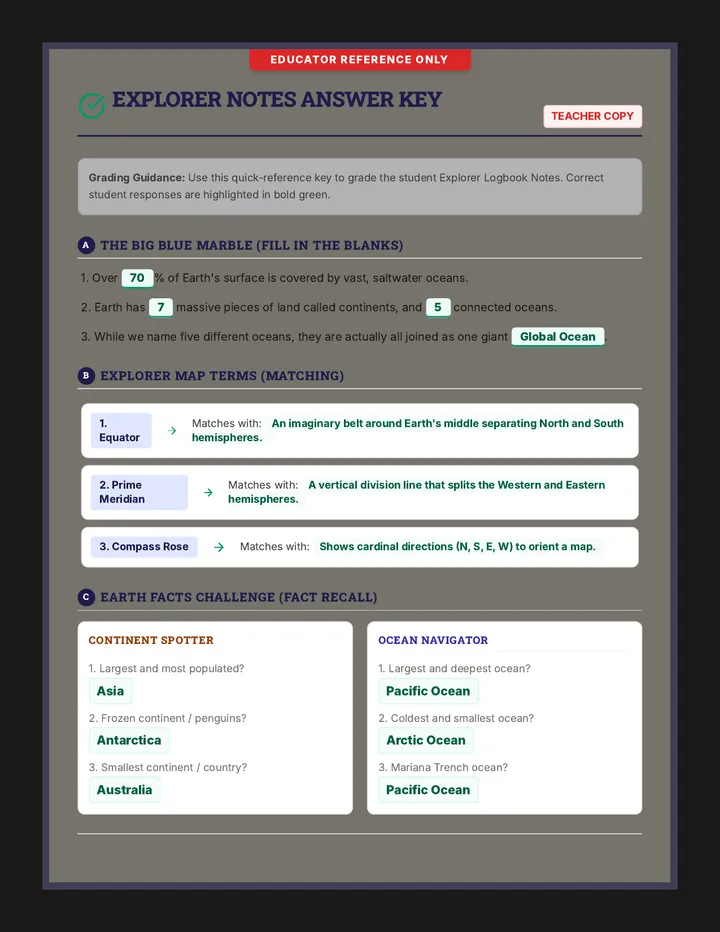
Continent Boxes:
Ocean Survey Marks:
Hemisphere Divider: The Equator (0° Latitude)
| Feature | Africa Solutions | Antarctica Solutions |
|---|---|---|
| Desert Category | Hot desert (Sahara) | Cold / Polar Desert (Permanent ice cover) |
| Mountains | Atlas Mountains (Northwest coast) | Transantarctic Mountains (Ice buried) |
| Climate Zones | Tropical, Savanna, Dry Desert | Polar Ice Cap / Ice Sheet climate |
| Oceans | Atlantic Ocean, Indian Ocean | Southern Ocean |
Question 1: Rain Shadows in Australia (Great Dividing Range)
Answer Criteria: Students must state that the Great Dividing Range block rain clouds from moving west into the interior. This causes moisture to drop on the narrow eastern coast, creating the extremely dry Outback desert climate to the west.
Question 2: Double Desert Comparison (Sahara vs Polar Desert)
Answer Criteria: Students must clarify that deserts are defined by low yearly precipitation (less than 10 in / 25 cm), NOT heat. Antarctica is dry because cold air cannot hold moisture. The Sahara is dry due to rising air belts blocking clouds.
CURRICULUM MODULE: GLOBE TROTTERS CONFIDENTIAL SURVEY TEAM ACCESS ONLY PAGE 2 OF 2