Indiana Heritage Study Guide
Indiana Social Studies • Unit 1 Textbook Review & Assess (pp. 38–39)
Indiana Heritage Study Guide
Geography, History, and Statewide Test Practice
Name:
Date:
Part 1
Vocabulary Review
Questions 1–4
Word Bank:
glacier limestone culture climate
A very large sheet of moving ice is known as a .
A pattern of weather in a certain place is called the .
is the way of life of a people.
Coal and are natural resources that benefit the economy of Indiana.
Part 2
Comprehension & Critical Thinking
Questions 5–8 • Write in complete sentences
-
Why is agriculture important to Indiana's economy?
-
Reading Skill
Name and give details about the three regions of Indiana.
- Reading Skill
What was the main reason that many Amish left Europe?
- Critical Thinking
Why do you think most mines and quarries in Indiana are located in the southern part of the state?
Unit 1 Review & Assess • Page 1 of 2 Turn page for Map Skills & Test Practice →
Indiana Unit 1 Review (Continued)
Geography Skills & Statewide Test Practice
Student Name:
Part 3
Skill: Understand Latitude and Longitude
Questions 9–10
Use the latitude and longitude map from your textbook below to find each address. Identify which city is located nearest to those coordinates.
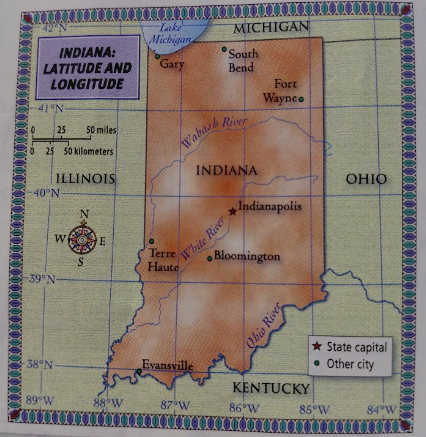
- 40° N, 86° W
Which major city is located closest to this coordinate address?
City:
- 38° N, 88° W
Which major city is located closest to this coordinate address?
City:
Part 4
Indiana Statewide Test Practice
Read passage & answer questions 1–3
Reading Passage: Lake Effect Snow in Indiana
Indiana can be very cold in the winter. Blizzards, or winter storms with strong, cold winds and snow, can form in states in the Midwest. Cold winters in areas by the Great Lakes are partly due to a weather condition called the lake effect. Lake effect snow occurs when cold, dry air from Canada meets warmer, damp air over the Great Lakes. Moisture in the air cools over the lake water and becomes snow. Lake Michigan coastal cities, such as Michigan City and Gary, usually receive larger amounts of snowfall than southern Indiana cities like Evansville and Terre Haute.
- The main idea of this passage is that ____________.
A the weather in Canada causes mild winters in Indiana
B Indiana experiences lake effect snow
C the Midwest gets little snow
D the Great Lakes have no effect on Indiana's climate
- What is one reason Michigan City receives more snow than Terre Haute?
A Michigan City experiences lake effect snow.
B The warm air from Canada brings more snow.
C Terre Haute gets warm air from the Great Lakes.
D Terre Haute is farther north than Michigan City.
- Suppose that you live in Evansville and are thinking of moving to Gary. How might the weather in Gary affect your decision?
Unit 1 Review & Assess Complete • Page 2 of 2 Check over your work before submitting!
Indiana Heritage Answer Key
Indiana Social Studies • Unit 1 Teacher Answer Key & Scoring Guide
Indiana Heritage Review Key
Unit 1 Review & Assess (pp. 38–39) • Standard Social Studies Grade 4
Total Score
/ 26 Points
Part 1 Key
Vocabulary Review
4 Points (1 pt each)
- glacier
Large sheet of moving ice that formed northern lakes and plains.
- climate
Pattern of weather over a long period in a specific area.
- Culture
The way of life, customs, traditions, and beliefs of a people.
- limestone
Mined rock resource in southern Indiana crucial to state building and economy.
Part 2 Key
Comprehension & Critical Thinking
12 Points (3 pts each)
5. Why is agriculture important to Indiana's economy? 3 pts
Exemplar Response: Agriculture is essential because Indiana's rich soil and favorable climate produce valuable cash crops (corn and soybeans) and livestock (hogs and poultry). Farming brings billions of dollars into the state economy and creates thousands of jobs in farming, food processing, transport, and equipment manufacturing.
✔ Scoring: Financial contribution (1 pt) • Specific crops/livestock (1 pt) • Jobs and food production (1 pt).
- Reading Skill Name and give details about the three regions of Indiana.
3 pts
Exemplar Response (1 pt per region with detail):
1. Great Lakes Plain: Northern area shaped by glaciers; features sand dunes, Lake Michigan shoreline, and flat fertile ground.
2. Tipton Till Plain: Central agricultural heartland; very flat with rich glacial soil; home to state capital Indianapolis.
3. Southern Hills: Unglaciated hilly terrain; steep knobs, deep river valleys, caves, coal deposits, and limestone quarries.
- Reading Skill What was the main reason that many Amish left Europe?
3 pts
Exemplar Response: Many Amish left Europe to seek religious freedom and escape religious persecution and mandatory military draft (conscription). They moved to North America to practice their faith in peace and preserve their simple agricultural way of life.
✔ Scoring: Religious freedom/escape persecution (2 pts) • Preserving peaceful farming lifestyle (1 pt).