Veterans Valor Fourth Worksheet Informational Reading • Grade 4 Level Text A • Lexile ~740L
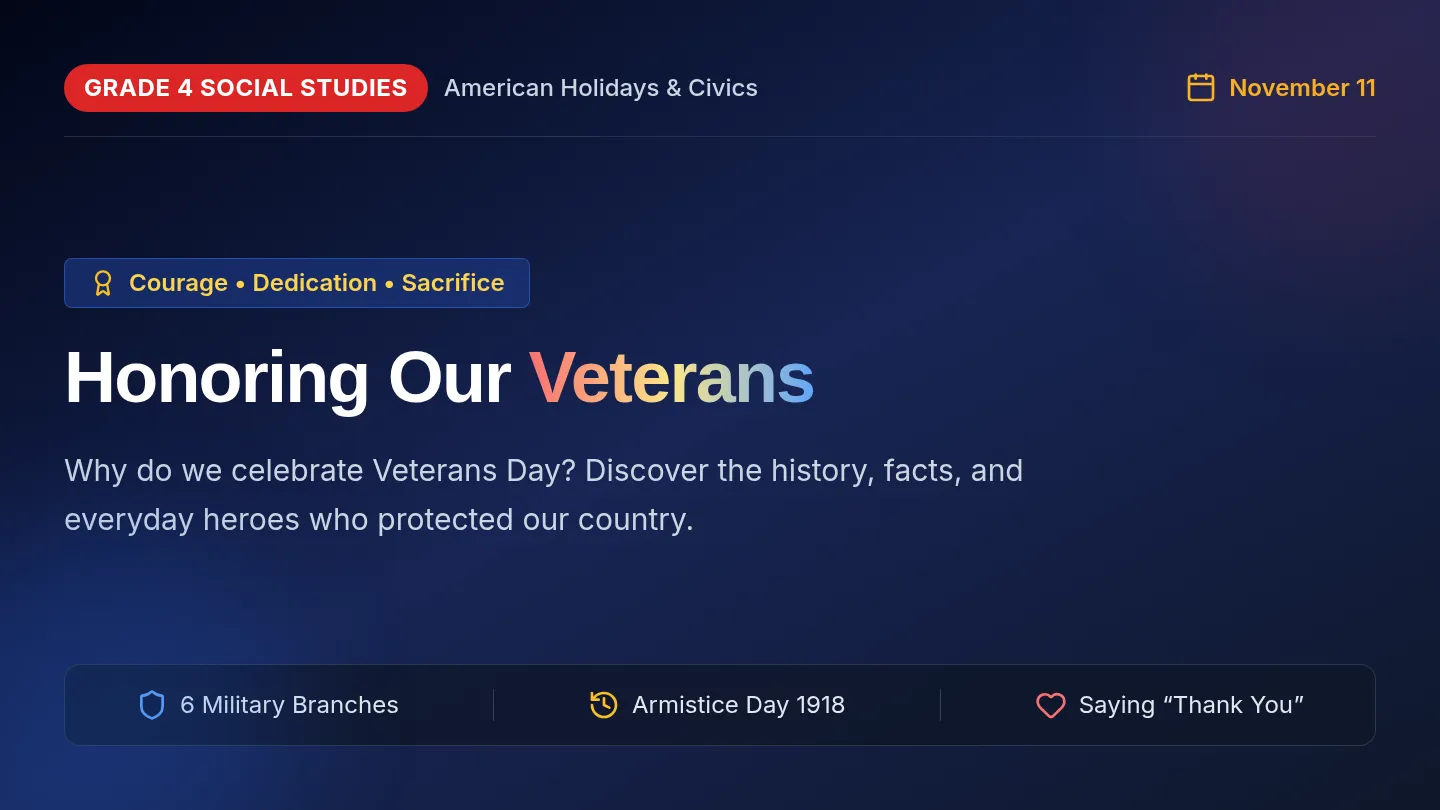
Veterans Day: Honoring Those Who Served
Learn about the history, purpose, and traditions of this important national holiday.
Name:
Date:
Reading Focus Question
Why is November 11 a special day in America, and how does Veterans Day differ from Memorial Day?
1 A Nation Pauses to Give Thanks
Every year on November 11, communities across the United States gather for parades, speeches, and special ceremonies. Schools and government offices often close so families can take time to reflect. This special holiday is called Veterans Day . A veteran is any person who has served honorably in the United States military during times of war or times of peace. Veterans Day is our country's chance to say a heartfelt "thank you" to these men and women for their bravery, dedication, and sacrifice.
2 The Eleventh Hour of the Eleventh Day
Veterans Day was not always known by that name. More than one hundred years ago, during World War I, a major war ended when both sides signed an agreement to stop fighting. This agreement was called an armistice . The fighting officially stopped at the eleventh hour of the eleventh day of the eleventh month in 1918 (November 11 at 11:00 a.m.). One year later, President Woodrow Wilson proclaimed November 11 as Armistice Day to remember the brave soldiers of that war. In 1954, President Dwight D. Eisenhower signed a law changing the name to Veterans Day so that heroes of all American wars would be honored.
3 The Six Branches of Service
American veterans have served in six main branches of the Armed Forces: the Army (land defense), the Navy (seas and oceans), the Marine Corps (special combat operations), the Air Force (air and sky), the Coast Guard (coasts and maritime safety), and the newest branch, the Space Force (space defense). Whether someone served as a pilot, a mechanic, a doctor, an engineer, or an infantry soldier, every role helped keep our country secure.
4 Veterans Day vs. Memorial Day
People sometimes confuse Veterans Day with Memorial Day , which takes place in late May. While both holidays honor military service, they have different purposes. Memorial Day is a solemn occasion to remember and mourn service members who died in battle or from injuries received in combat. In contrast, Veterans Day is an occasion to honor all who served, with a special focus on giving thanks to living veterans who are still with us today.
Word Watch • Key Vocabulary
Veteran (noun):
A person who has served in the military forces.
Armistice (noun):
A formal agreement between two sides to stop fighting a war.
Tribute (noun):
An act, statement, or gift showing deep respect and gratitude.
Comprehension & Vocabulary Check
Demonstrate your understanding using facts and details from the text.
Grade 4 Reading Worksheet
Total Score: _____ / 10 pts
Part A: Key Ideas & Details 1 pt each • Select one answer
1. Why was November 11 originally selected as the date for this holiday?
A It was the birthday of President Woodrow Wilson.
B An armistice stopped World War I on that date in 1918.
C The United States military was founded on November 11.
D President Eisenhower returned from war on that day.
2. What is the key difference between Veterans Day and Memorial Day?
A Veterans Day honors living veterans; Memorial Day mourns those who died in service.
B Memorial Day honors the Army, while Veterans Day only honors the Navy.
C Veterans Day happens in the spring; Memorial Day happens in the autumn.
D Veterans Day is celebrated only by military officers, not the general public.
3. According to the text, why did President Eisenhower change the holiday's name in 1954?
A People had forgotten what happened during World War I.
B To ensure that veterans of all American wars were honored, not just World War I.
C Congress wanted to move the celebration to a three-day weekend.
D The word "Armistice" was too difficult for young students to pronounce.
4. Which of the following is the newest branch of the United States Armed Forces mentioned in paragraph 3?
A Coast Guard
B Air Force
C Space Force
D Marine Corps
Part B: Vocabulary in Context 1 pt each
5. In paragraph 2, what does the word armistice mean?
A A grand celebration with music and parades.
B An official agreement to cease combat and fighting.
C A medal awarded for supreme acts of bravery.
D A special uniform worn during peace conferences.
6. In paragraph 1, the author states that veterans served honorably . This word means they served with:
A Integrity, honesty, and moral courage.
B Wealth, fame, and personal power.
C Doubt, fear, and hesitation.
D Speed, impatience, and loud cheering.
Part C: Written Response & Text Evidence 2 pts each • Write in complete sentences
7. Explain one way a citizen or student can show meaningful gratitude to a veteran in their community. Support your answer with ideas from the text or your own reflections.
8. Why is it important that Veterans Day recognizes service members who served during times of peace as well as times of war?
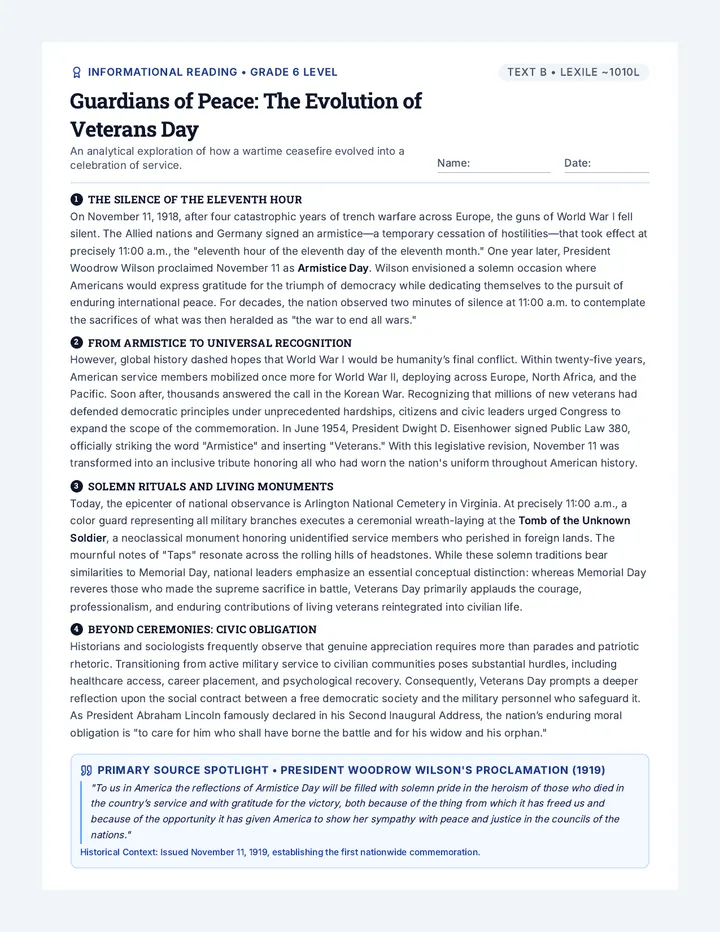
Veterans Legacy Sixth Worksheet Informational Reading • Grade 6 Level Text B • Lexile ~1010L
Guardians of Peace: The Evolution of Veterans Day
An analytical exploration of how a wartime ceasefire evolved into a celebration of service.
Name:
Date:
1 The Silence of the Eleventh Hour
On November 11, 1918, after four catastrophic years of trench warfare across Europe, the guns of World War I fell silent. The Allied nations and Germany signed an armistice—a temporary cessation of hostilities—that took effect at precisely 11:00 a.m., the "eleventh hour of the eleventh day of the eleventh month." One year later, President Woodrow Wilson proclaimed November 11 as Armistice Day . Wilson envisioned a solemn occasion where Americans would express gratitude for the triumph of democracy while dedicating themselves to the pursuit of enduring international peace. For decades, the nation observed two minutes of silence at 11:00 a.m. to contemplate the sacrifices of what was then heralded as "the war to end all wars."
2 From Armistice to Universal Recognition
However, global history dashed hopes that World War I would be humanity’s final conflict. Within twenty-five years, American service members mobilized once more for World War II, deploying across Europe, North Africa, and the Pacific. Soon after, thousands answered the call in the Korean War. Recognizing that millions of new veterans had defended democratic principles under unprecedented hardships, citizens and civic leaders urged Congress to expand the scope of the commemoration. In June 1954, President Dwight D. Eisenhower signed Public Law 380, officially striking the word "Armistice" and inserting "Veterans." With this legislative revision, November 11 was transformed into an inclusive tribute honoring all who had worn the nation's uniform throughout American history.
3 Solemn Rituals and Living Monuments
Today, the epicenter of national observance is Arlington National Cemetery in Virginia. At precisely 11:00 a.m., a color guard representing all military branches executes a ceremonial wreath-laying at the Tomb of the Unknown Soldier , a neoclassical monument honoring unidentified service members who perished in foreign lands. The mournful notes of "Taps" resonate across the rolling hills of headstones. While these solemn traditions bear similarities to Memorial Day, national leaders emphasize an essential conceptual distinction: whereas Memorial Day reveres those who made the supreme sacrifice in battle, Veterans Day primarily applauds the courage, professionalism, and enduring contributions of living veterans reintegrated into civilian life.
4 Beyond Ceremonies: Civic Obligation
Historians and sociologists frequently observe that genuine appreciation requires more than parades and patriotic rhetoric. Transitioning from active military service to civilian communities poses substantial hurdles, including healthcare access, career placement, and psychological recovery. Consequently, Veterans Day prompts a deeper reflection upon the social contract between a free democratic society and the military personnel who safeguard it. As President Abraham Lincoln famously declared in his Second Inaugural Address, the nation’s enduring moral obligation is "to care for him who shall have borne the battle and for his widow and his orphan."
Primary Source Spotlight • President Woodrow Wilson's Proclamation (1919)
"To us in America the reflections of Armistice Day will be filled with solemn pride in the heroism of those who died in the country’s service and with gratitude for the victory, both because of the thing from which it has freed us and because of the opportunity it has given America to show her sympathy with peace and justice in the councils of the nations."
Historical Context: Issued November 11, 1919, establishing the first nationwide commemoration.
Text-Dependent Analysis & Evaluation
Analyze central ideas, historical rhetoric, and author's craft using textual evidence.
Grade 6 Reading Worksheet
Total Score: _____ / 12 pts
Part A: Textual Analysis & Synthesis 1 pt each • Select the best response
1. Which statement best summarizes the central idea of paragraph 2?
A World War II completely overshadowed all memories of World War I.
B Subsequent wars prompted lawmakers to honor service members from all conflicts.
C President Eisenhower believed Armistice Day should only honor European allies.
D Public Law 380 was passed solely to combine Veterans Day with Memorial Day.
2. How does the author structure the historical progression of the passage?
A By contrasting ancient military ceremonies with modern holiday parades.
B By chronologically tracing its origin in 1918 to its broader civic implications today.
C By presenting problems with military recruitment and offering policy solutions.
D By listing individual biographies of famous decorated generals throughout history.
3. In paragraph 4, what is the author’s primary purpose in citing Abraham Lincoln’s Second Inaugural Address?
A To argue that gratitude must be manifested in concrete social and economic care.
B To prove that Abraham Lincoln was the original founder of Veterans Day.
C To suggest that only combat casualties deserve governmental assistance.
D To show that speeches delivered in wartime are more effective than peacetime laws.
4. Based on paragraph 3, what symbolic message does the Tomb of the Unknown Soldier convey?
A It represents all unidentified service members who gave their lives in duty.
B It marks the exact location where the Armistice treaty was signed in Europe.
C It celebrates the founding of Arlington National Cemetery during the Civil War.
D It honors only the high-ranking commanding officers of modern naval forces.
Part B: Vocabulary & Rhetorical Analysis 1 pt each
5. In paragraph 1, the word cessation most nearly means:
A An aggressive intensification of military strikes.
B A temporary or permanent halting of activity.
C A public parade displaying captured artillery.
D A formal election to choose civilian governors.
6. In the primary source box, President Wilson highlights America's "sympathy with peace and justice." In this context, sympathy reflects:
A Feeling pity for nations that lost battlefield engagements.
B An active, shared alignment with moral and diplomatic principles.
C Regret over participating in foreign alliances and treaties.
D A polite refusal to negotiate with opposing military delegates.
Part C: Constructed Textual Analysis 3 pts each • Cite specific text evidence
7. Explain why the author asserts that observing Veterans Day requires "more than parades and patriotic rhetoric." What civic duties does the passage suggest society owes to returning veterans?
8. Contrast the historical tone and original purpose of Armistice Day in 1919 with the modern focus of Veterans Day established by President Eisenhower in 1954. Use evidence from paragraphs 1 and 2.
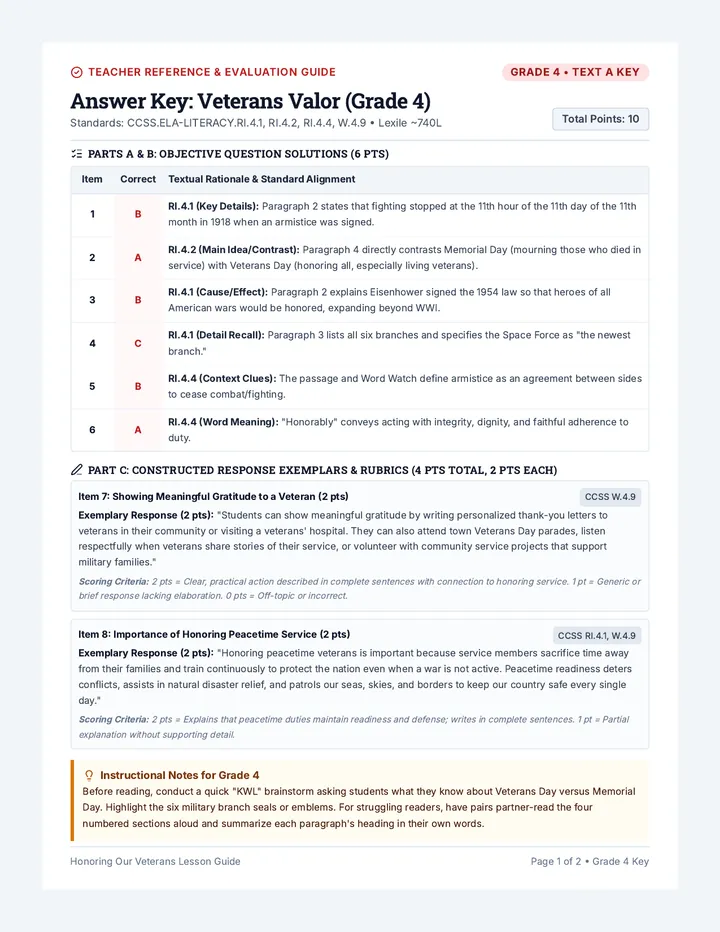
Veterans Day Answer Key Teacher Reference & Evaluation Guide Grade 4 • Text A Key
Answer Key: Veterans Valor (Grade 4)
Standards: CCSS.ELA-LITERACY.RI.4.1, RI.4.2, RI.4.4, W.4.9 • Lexile ~740L
Total Points: 10
Parts A & B: Objective Question Solutions (6 pts)
Item
Correct
Textual Rationale & Standard Alignment
1
B
RI.4.1 (Key Details): Paragraph 2 states that fighting stopped at the 11th hour of the 11th day of the 11th month in 1918 when an armistice was signed.
2
A
RI.4.2 (Main Idea/Contrast): Paragraph 4 directly contrasts Memorial Day (mourning those who died in service) with Veterans Day (honoring all, especially living veterans).
3
B
RI.4.1 (Cause/Effect): Paragraph 2 explains Eisenhower signed the 1954 law so that heroes of all American wars would be honored, expanding beyond WWI.
4
C
RI.4.1 (Detail Recall): Paragraph 3 lists all six branches and specifies the Space Force as "the newest branch."
5
B
RI.4.4 (Context Clues): The passage and Word Watch define armistice as an agreement between sides to cease combat/fighting.
6
A
RI.4.4 (Word Meaning): "Honorably" conveys acting with integrity, dignity, and faithful adherence to duty.
Part C: Constructed Response Exemplars & Rubrics (4 pts total, 2 pts each)
Item 7: Showing Meaningful Gratitude to a Veteran (2 pts) CCSS W.4.9
Exemplary Response (2 pts): "Students can show meaningful gratitude by writing personalized thank-you letters to veterans in their community or visiting a veterans' hospital. They can also attend town Veterans Day parades, listen respectfully when veterans share stories of their service, or volunteer with community service projects that support military families."
Scoring Criteria: 2 pts = Clear, practical action described in complete sentences with connection to honoring service. 1 pt = Generic or brief response lacking elaboration. 0 pts = Off-topic or incorrect.
Item 8: Importance of Honoring Peacetime Service (2 pts) CCSS RI.4.1, W.4.9
Exemplary Response (2 pts): "Honoring peacetime veterans is important because service members sacrifice time away from their families and train continuously to protect the nation even when a war is not active. Peacetime readiness deters conflicts, assists in natural disaster relief, and patrols our seas, skies, and borders to keep our country safe every single day."
Scoring Criteria: 2 pts = Explains that peacetime duties maintain readiness and defense; writes in complete sentences. 1 pt = Partial explanation without supporting detail.
Instructional Notes for Grade 4
Before reading, conduct a quick "KWL" brainstorm asking students what they know about Veterans Day versus Memorial Day. Highlight the six military branch seals or emblems. For struggling readers, have pairs partner-read the four numbered sections aloud and summarize each paragraph's heading in their own words.
Honoring Our Veterans Lesson Guide Page 1 of 2 • Grade 4 Key
Teacher Reference & Evaluation Guide Grade 6 • Text B Key
Answer Key: Veterans Legacy (Grade 6)
Standards: CCSS.ELA-LITERACY.RI.6.1, RI.6.2, RI.6.4, RI.6.6, W.6.9 • Lexile ~1010L
Total Points: 12
Parts A & B: Analytical Solutions & Rationales (6 pts)
Item
Correct
Textual Rationale & Standard Alignment
1
B
RI.6.2 (Central Idea): Paragraph 2 demonstrates that fighting in WWII and Korea proved WWI wasn't the final war, leading to Public Law 380 honoring all veterans.
2
B
RI.6.5 (Text Structure): The text chronologically traces the holiday from the 1918 ceasefire and 1919 proclamation to its 1954 expansion and modern civic obligations.
3
A
RI.6.6 (Author's Purpose): Lincoln's quote emphasizes actionable civic care ("care for him who shall have borne the battle"), supporting the argument that gratitude demands real aid.
4
A
RI.6.1 (Inference/Detail): Paragraph 3 states the Tomb honors unidentified personnel who gave their lives, symbolizing collective sacrifice.
5
B
RI.6.4 (Domain Vocabulary): "Cessation" derives from cease, meaning an intentional stopping or halting of armed conflict.
6
B
RI.6.4 (Rhetorical Tone): In Wilson's diplomatic prose, "sympathy" denotes an active mutual alliance and harmony with international ideals of justice.
Part C: Constructed Textual Analysis Rubrics (6 pts total, 3 pts each)
Item 7: Beyond Ceremonies & Civic Responsibility (3 pts) CCSS RI.6.1, W.6.9
Exemplary Response (3 pts): "The author asserts that genuine appreciation requires more than parades because returning service members face tangible hardships when reintegrating into civilian life, such as 'healthcare access, career placement, and psychological recovery' (paragraph 4). As supported by Abraham Lincoln’s principle to 'care for him who shall have borne the battle,' society owes veterans active civic support: ensuring quality medical facilities, mental health assistance, fair employment opportunities, and ongoing community inclusion."
Scoring Criteria: 3 pts = Fully explains author's argument, cites specific hurdles from paragraph 4, and quotes/paraphrases Lincoln's mandate. 2 pts = Explains concept but lacks textual evidence. 1 pt = Vague opinion.
Item 8: Contrasting Armistice Day (1919) and Veterans Day (1954) (3 pts) CCSS RI.6.1, RI.6.2
Exemplary Response (3 pts): "In 1919, Armistice Day had a solemn, singular focus: reflecting on the end of World War I, remembering fallen soldiers, and celebrating hopes for lasting world peace through moments of silence. In contrast, by 1954, President Eisenhower recognized that World War II and the Korean War involved millions of new service members. Public Law 380 shifted the holiday into an inclusive national tribute celebrating all living and past American veterans across every conflict."
Scoring Criteria: 3 pts = Accurately contrasts both dates, names, historical contexts, and ideological shifts using details from paragraphs 1 and 2. 2 pts = Partial comparison. 1 pt = Incomplete contrast.
Paired Text Discussion Prompt (Extension)
Compare & Contrast: Have students compare Text A (4th Grade) and Text B (6th Grade). Ask: "How does the author of Text B deepen the reader’s understanding of Veterans Day compared to Text A? What historical documents and moral questions does Text B introduce that go beyond basic facts?"
Honoring Our Veterans Lesson Guide Page 2 of 2 • Grade 6 Key & Standards