Borderline Economies Student Packet Independent Study Module • 90 Minutes
The US & Canada: Economic Activities
Name: ______________________
Date: __________
Period: _____
90-Min Roadmap:
Part 1: US Economy (20m) → Part 2: Canada & Compare (20m) → Part 3: Trade & Tariffs (25m) → Part 4: Synthesis (25m)
Part 1: The United States (Reading Passage)
Text Evidence Focus
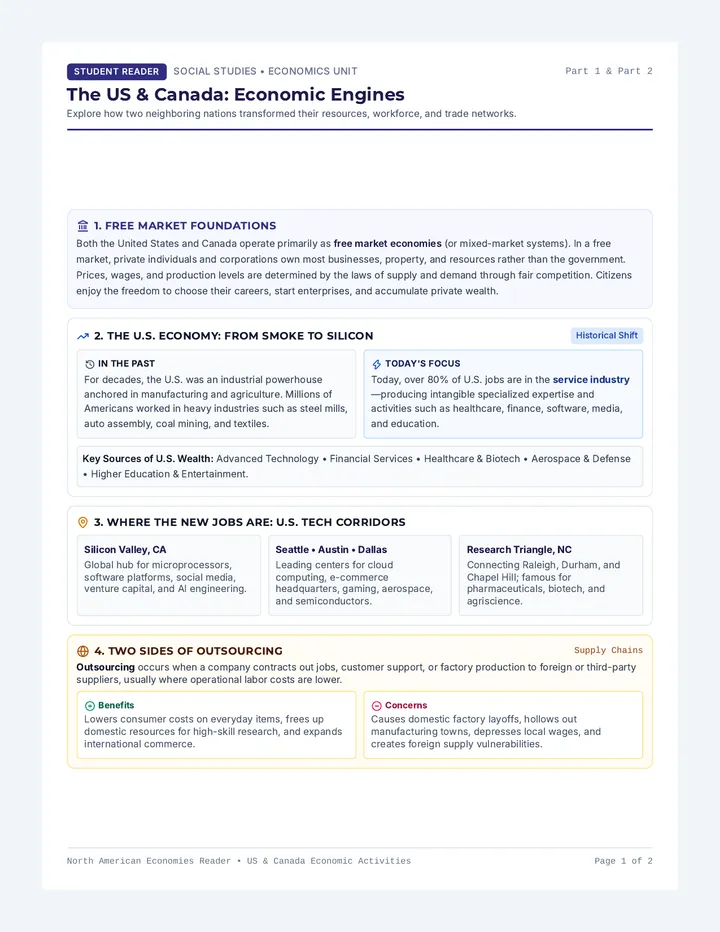
Today, the U.S. has a free market economy , which means people can own their own businesses and earn money from them. This freedom, along with laws that protect workers and private property, has helped the U.S. become an economic leader. The country’s wealth comes from strong education, technology, natural resources, farming, and industry. The U.S. also has large supplies of natural gas, oil, and coal, which are important sources of energy.
In the past, most Americans worked in farming or manufacturing. Today, the economy is more focused on technology and services like health care, education, and business. Areas such as Silicon Valley in California and cities like Seattle, Austin, and Dallas are known for software and technology jobs. In North Carolina, the cities of Raleigh, Durham, and Chapel Hill form the Research Triangle, a place that attracts many biotechnology companies.
Some companies have started outsourcing , which means they set up businesses in other countries to make products or parts. This can create jobs in one country but take them away from another. While outsourcing helps lower the cost of goods, some people worry it reduces job opportunities for American workers.
1 How have technology and services changed the U.S. economy compared to the past? Use details from the passage to explain your answer.
Evaluating the Outsourcing Trade-Off
Critical Analysis
The passage states that outsourcing "can create jobs in one country but take them away from another." Complete both perspectives below:
Benefit of Outsourcing:
Concern About Outsourcing:
In your opinion, does outsourcing help or hurt American workers overall? Explain:
Part 1: U.S. Economic Sectors & Labor Shifts Page 1 of 4
Part 2 • 20 Minutes
Canada's Economy & Cross-Border Comparison
Source Reading & Matrix
Reading Passage 2: Canada
Text Evidence Focus
Like the United States, Canada also has a market economy . Much of Canada’s money comes from its natural resources, such as oil, natural gas, forests, and minerals. Canada has one of the largest oil reserves in the world and exports a lot of energy to other countries. It is also a world leader in producing hydroelectric power, coal, uranium, copper, and silver.
Even though natural resources are important, most Canadians work in the service industry , which includes jobs like transportation, health care, retail, and tourism. About 70% of Canada’s workers are employed in services. Canada trades with many countries and is part of trade agreements such as NAFTA. Tourism is also a growing industry because of Canada’s beautiful national parks, cities, and historic sites.
2 How is the economy of the United States different from Canada’s economy? Cite specific evidence for both nations.
Activity A: Comparative Economic Matrix (Use details from Pages 1 & 2)
Economic Feature
United States
Canada
Type of Economic System
|
| Primary Energy & Natural Resources |
|
|
| Dominant Worker Employment |
|
|
| Major Industry Hubs or Exports |
|
|
Activity B: Identifying North American Economic Centers
Silicon Valley (CA): Industry: _______________
Research Triangle (NC): Industry: _______________
Seattle, Austin, Dallas: Industry: _______________
Canadian National Parks: Industry: _______________
Part 2: Canadian Economic Wealth & Cross-Border Matrix Page 2 of 4
Part 3 • 25 Minutes
World Trade & North American Pacts
Source Reading & Analysis
Reading Passage 3: World Trade
World trade is when countries buy and sell goods and services with each other. Most countries trade because they do not have all the resources they need. A country might export (sell) products it has a lot of and import (buy) things it needs from others. For example, one country might sell oil but buy food. This exchange helps countries become trading partners.
Trading between countries can cost more than trading within a country. This is because there can be tariffs (taxes on imports), delays at borders, and differences in language or laws that make trade more complicated.
3 The passage explains that countries export products they have in large supply and import products they need. How does this idea help countries become trading partners?
Tariffs
Define in your own words:
Border Delays
Why do these increase costs?
Differing Laws
How do laws complicate trade?
Reading Passage 4: NAFTA and USMCA
The North American Free Trade Agreement (NAFTA) was an agreement made in 1992 between the United States, Canada, and Mexico. It removed many taxes and trade barriers, allowing goods and services to move more freely between the three countries. This helped increase trade in North America.
In 2018, the three countries created a new trade deal called the United States–Mexico–Canada Agreement (USMCA) . It kept many parts of NAFTA but also made new rules. The USMCA became official in 2020 and continues to support trade among the three countries.
4 Why did the U.S., Canada, and Mexico create NAFTA and later update it to the USMCA? What primary barrier did these deals aim to remove?
Part 3: Trade Dynamics, Tariffs & Trade Pacts Page 3 of 4
Part 4 & 5 • 25 Minutes
Scenario Lab & Independent Exit Ticket
Application & Assessment
Applied Scenario Lab: Classify & Explain
Scenario 1: Energy & Power Grid Resource Flow
Canada produces abundant hydroelectric power in Quebec and oil in Alberta, which it sells to cities in the northern United States.
For Canada, this electricity is an:
Export Import
For the U.S., this electricity is an:
Export Import
Scenario 2: Cross-Border Tariff Impact Trade Barrier
If the United States places a 15% tariff on imported Canadian lumber, what happens to the price of building homes in the U.S.? Explain:
Scenario 3: Technological Specialization Service Economy
Why might a Canadian biotechnology startup partner with companies in North Carolina's Research Triangle?
Final Synthesis: North American Interdependence (CER)
Independent Exit Task
Prompt: How do trade agreements like NAFTA and USMCA help the United States and Canada overcome economic differences and act as interdependent trading partners?
Claim:
Evidence (Cite 2 facts from the reading):
Reasoning (Connect evidence to economic cooperation):
Part 4 & 5: Applied Scenarios & Final Synthesis Page 4 of 4
Borderline Economies Slide Deck Independent Module Secondary World Geography
90-Minute Self-Paced Guide
North American Economies & World Trade
Investigating the economic engines of the United States and Canada, the mechanics of imports and exports, and the trade agreements that connect them.
00–20 Min U.S. Economy & Outsourcing
20–40 Min Canada & Comparative Matrix
40–65 Min World Trade & Tariff Barriers
65–90 Min NAFTA/USMCA & Synthesis
Part 1 Focus • 20 Minutes
The United States: Economic Engine
Packet Page 1
From Farms to High Tech
Past economy was driven by farming and manufacturing. Today's wealth centers on technology, education, healthcare, and finance.
Core Hubs: Silicon Valley (CA), Seattle, Austin, Dallas (Software); Research Triangle (NC - Biotech).
Free Market & Outsourcing
Private ownership and profit incentives drive growth, alongside vast energy reserves (oil, natural gas, coal).
The Outsourcing Debate: Companies set up overseas to lower production costs, creating debate over domestic job loss.
Student Action: Complete Reading Passage 1 and Question 1 on Page 1 of your packet. Timer: ~20 Mins
Part 2 Focus • 20 Minutes
Canada: Resource Wealth & Services
Packet Page 2
Resource Giant
Massive oil reserves, vast timber forests, and global leadership in hydroelectricity, uranium, copper, and silver.
70% Service Jobs
While resources provide huge wealth, about 7 out of 10 Canadian workers are employed in healthcare, retail, transit, and business.
Tourism & Trade
World-renowned national parks, historic cities, and active participation in international trade pacts like NAFTA/USMCA.
Student Action: Complete Reading Passage 2, Question 2, and the Comparative Matrix on Page 2. Timer: ~20 Mins
Part 3 Focus • 25 Minutes
The Mechanics of World Trade
Packet Page 3
EXPORTS
Sell Surplus
Products and services a nation produces in large supply and sells to other countries for economic revenue.
Example: Canada exports surplus oil, natural gas, and hydroelectricity to U.S. markets.
IMPORTS
Buy Deficit
Goods and services a country buys from foreign producers because it lacks sufficient domestic resources.
Example: A nation sells mineral fuels but imports agricultural crops or specialized consumer goods.
Mutual Interdependence: No country produces every required resource. By exchanging surplus for necessity, nations form enduring trading partnerships.
Trade Friction • Concept Spotlight
Why International Trade Costs More
Packet Page 3
Tariffs (Import Taxes)
Special taxes added to imported foreign goods, making them more expensive for consumers to buy.
Raises consumer prices
Border Delays
Physical customs inspections, cargo checks, and paperwork that hold up freight shipments at national borders.
Increases logistics costs
Differing Laws
Contrasting safety codes, language labeling standards, and business regulations across sovereign nations.
Adds compliance friction
Student Action: Define these 3 barriers in the activity table on Page 3 of your packet. Checkpoint
North American Integration
From NAFTA (1992) to USMCA (2020)
Packet Page 3 & 4
Created 1992 Foundational Deal
NAFTA
Eliminated tariffs and trade barriers between the United States, Canada, and Mexico.
Impact: Massively increased the volume of cross-border goods and services across North America.
Official 2020 Modern Update
USMCA
Negotiated in 2018; updated NAFTA with modernized rules for digital trade, auto production, and labor.
Impact: Preserved free trade while setting new standards for the 21st-century continental economy.
Core Objective: Make cross-border commerce as seamless and barrier-free as possible. Key Standard
Final 25 Minutes • Synthesis Lab
Application & Independent Exit Ticket
Packet Page 4
Scenario Lab (15m)
Complete the 3 applied scenarios on Page 4:
Classify Canadian hydroelectric power exports
Analyze how a lumber tariff affects U.S. home prices
Explain biotech collaboration in the Research Triangle
CER Exit Ticket (10m)
Synthesize continental trade in 3 structured parts:
Claim: Clear statement answering the prompt.Evidence: Cite 2 specific facts from the reading.Reasoning: Explain how trade pacts enable mutual wealth.
Turn in your completed 4-page packet to your teacher or class collection box. Mission Complete • 90 Mins
Borderline Economies Teacher Guide Teacher Facilitation & Answer Key
Borderline Economies: Facilitator Guide
Format: 90-Min Independent Lesson
Learning Objective
Students analyze economic systems of the US & Canada, compare service and resource sectors, and evaluate how NAFTA/USMCA and tariffs impact continental trade.
Standards Alignment
SSWG Unit 3: North American Economic Geography; Free market systems; Labor sector transitions; Interdependence, imports, exports, and trade pacts.
Student Deliverable
4-page completed student packet with annotated reading passages, comparative matrices, trade barrier definitions, scenario lab, and synthesis CER.
Suggested 90-Minute Independent Pacing & Checkpoints
Time
Segment
Student Tasks & Teacher Checkpoint
00–20 Min
Part 1: U.S. Economy & Outsourcing
Read Passage 1; answer Question 1 (tech/services shift); complete outsourcing pros/cons analysis. Teacher Check: Check definition of free market.
20–40 Min
Part 2: Canada & Comparative Matrix
Read Passage 2; answer Question 2 (differences); fill out 4-part comparative table; match regional economic hubs. Teacher Check: Verify 70% service sector noted.
40–65 Min
Part 3: Trade Dynamics & Tariffs
Read Passages 3 & 4; answer Question 3 (trading partners); define 3 trade friction factors; answer Question 4 (NAFTA/USMCA evolution).
65–90 Min
Part 4: Scenario Lab & CER Exit Ticket
Complete 3 applied economic scenarios; draft Claim-Evidence-Reasoning response evaluating continental interdependence; packet submission.
Differentiation Supports
Striving Readers: Provide highlighter to code US text in yellow and Canada in green; allow paired reading for Passages 1-2.ELL / Multilingual: Clarify cognates: exportar/importar , mercado libre , servicios . Use visual icons in slides.Advanced Learners: Ask students to analyze how exchange rates or supply chain disruptions influence USMCA auto manufacturing rules.
Common Misconceptions
Misconception: Canada's workforce is mostly loggers and miners. Clarification: 70% of Canadians work in services (healthcare, retail, transit, tourism).Misconception: Foreign countries pay tariffs. Clarification: Tariffs are import taxes paid by domestic importing businesses and passed to consumers.Misconception: Outsourcing is identical to importing. Clarification: Outsourcing moves entire business operations or production facilities abroad.
Borderline Economies Facilitator Guide Page 1 of 2
Exemplar Key & Assessment
Complete Student Packet Answer Key
Official Key
PART 1: U.S. ECONOMY & OUTSOURCING (Page 1)
Question 1 (Tech & Services Shift): Past: Most Americans worked in agriculture or industrial manufacturing. Today: Economy is focused on technology and services (health care, education, business). Text evidence: Areas like Silicon Valley (software) and Research Triangle (biotechnology) now lead growth.
Outsourcing Trade-Off: Benefit: Lowers the cost of goods for consumers; creates jobs abroad. Concern: Reduces job opportunities for domestic American workers.
PART 2: CANADA'S ECONOMY & COMPARATIVE MATRIX (Page 2)
Question 2 (Differences): Both have market economies, but Canada's wealth relies heavily on vast natural resource reserves (oil, natural gas, timber, minerals, hydroelectric power, uranium, copper, silver) which it exports. Both have large service sectors (70% in Canada).
Matrix: System: Both = Free market/Market. Energy: US = Coal, oil, gas; Canada = Oil reserves, hydro, gas, uranium. Workers: US = Tech/services; Canada = 70% in services. Hubs: US = Silicon Valley, Research Triangle; Canada = National parks, mining belts.
Activity B Matching: Silicon Valley = Software/Tech; Research Triangle = Biotechnology; Seattle/Austin/Dallas = Software/Tech; Canadian Parks = Tourism.
PART 3: WORLD TRADE, TARIFFS & PACTS (Page 3)
Question 3 (Exports/Imports): Countries lack all needed resources. Exporting surplus products and importing needed items allows nations to satisfy domestic needs and form mutual trade partnerships.
Trade Barriers: Tariffs: Taxes on foreign imports that raise consumer prices. Border Delays: Physical inspections that increase shipping time and costs. Differing Laws: Divergent rules and standards that complicate trade.
Question 4 (NAFTA/USMCA): Created in 1992 and updated in 2018/2020 to remove taxes and trade barriers so goods and services move freely between the US, Canada, and Mexico.
PART 4 & 5: SCENARIOS & CER EXIT TICKET (Page 4)
Scenario 1: Canada = Export ; United States = Import . | Scenario 2: Homebuilding costs in the U.S. will rise due to taxed Canadian timber. | Scenario 3: Partnering provides access to specialized research universities, talent, and biotech firms in the Triangle.
CER Exemplar: Claim: Trade agreements like NAFTA and USMCA connect the US and Canada as interdependent partners by eliminating taxes on complementary resources. Evidence: Canada exports energy from huge oil and hydro reserves, while 70% of its workforce is in services; the US specializes in high-tech and biotech services. Reasoning: By eliminating tariffs, both countries trade their surplus goods for needed imports at lower costs, strengthening both economies.
4-Point Quick Evaluation Rubric:
4 (Advanced): All 4 text questions accurate with citations; matrix complete; CER has clear claim, 2 citations, and strong reasoning.
3 (Proficient): All sections completed; questions accurately answered; CER has claim and at least 1-2 accurate citations.
2 (Developing): 1-2 sections incomplete; answers lack textual evidence; CER lacks either clear claim or reasoning.
1 (Beginning): Multiple sections blank; basic definitions missing; minimal effort on synthesis prompt.
Borderline Economies Facilitator Guide Page 2 of 2