North American Economies Reader
Student Reader Social Studies • Economics Unit
Part 1 & Part 2
The US & Canada: Economic Engines
Explore how two neighboring nations transformed their resources, workforce, and trade networks.
1. Free Market Foundations
Both the United States and Canada operate primarily as free market economies (or mixed-market systems). In a free market, private individuals and corporations own most businesses, property, and resources rather than the government. Prices, wages, and production levels are determined by the laws of supply and demand through fair competition. Citizens enjoy the freedom to choose their careers, start enterprises, and accumulate private wealth.
2. The U.S. Economy: From Smoke to Silicon
Historical Shift
In the Past
For decades, the U.S. was an industrial powerhouse anchored in manufacturing and agriculture. Millions of Americans worked in heavy industries such as steel mills, auto assembly, coal mining, and textiles.
Today's Focus
Today, over 80% of U.S. jobs are in the service industry—producing intangible specialized expertise and activities such as healthcare, finance, software, media, and education.
Key Sources of U.S. Wealth: Advanced Technology • Financial Services • Healthcare & Biotech • Aerospace & Defense • Higher Education & Entertainment.
3. Where the New Jobs Are: U.S. Tech Corridors
Silicon Valley, CA
Global hub for microprocessors, software platforms, social media, venture capital, and AI engineering.
Seattle • Austin • Dallas
Leading centers for cloud computing, e-commerce headquarters, gaming, aerospace, and semiconductors.
Research Triangle, NC
Connecting Raleigh, Durham, and Chapel Hill; famous for pharmaceuticals, biotech, and agriscience.
4. Two Sides of Outsourcing
Supply Chains
Outsourcing occurs when a company contracts out jobs, customer support, or factory production to foreign or third-party suppliers, usually where operational labor costs are lower.
Benefits
Lowers consumer costs on everyday items, frees up domestic resources for high-skill research, and expands international commerce.
Concerns
Causes domestic factory layoffs, hollows out manufacturing towns, depresses local wages, and creates foreign supply vulnerabilities.
North American Economies Reader • US & Canada Economic Activities Page 1 of 2
Student Reader Social Studies • Economics Unit
Part 3 & Part 4
Canada's Economy & Continental Trade
Examining natural resource powerhouses, the service sector paradox, and reciprocal trade agreements.
5. Canada's Economy: Resources & Services
Dual Economy
Canada possesses one of the richest resource reserves on Earth. It is a world leader in producing crude petroleum (Alberta oil sands), potash, timber and paper products, nickel, gold, uranium, and hydroelectric power.
Service Jobs (~75% of Workers)
Around 75% of Canadian workers are employed in services: commercial banking, healthcare, engineering, telecommunications, and digital media.
Trade & Booming Tourism
Tourism is growing fast as visitors flock to Banff & Jasper national parks, Niagara Falls, Whistler ski resorts, and cities like Vancouver and Montreal.
Think Deeper Paradox: While natural resources generate immense export revenue, extraction requires heavy technology and automation, meaning high financial output with relatively few on-site laborers. Most citizens thus work in urban service fields.
6. Global Trade & Why Borders Cost Money
Nations specialize in what they produce efficiently, becoming trading partners. An export is a good sold to another country; an import is a good brought in from abroad. For instance, Canada exports surplus crude oil and lumber to the U.S. while importing warm-weather citrus and advanced machinery.
Three Barriers That Increase Trade Costs:
1. Tariffs Taxes charged directly on foreign imported goods to shield local domestic producers.
2. Import Quotas Specific physical caps placed on the total quantity of a foreign product allowed into a nation.
3. Regulatory Standards Costly border inspections, custom delays, and conflicting health, safety, or environmental laws.
7. Continental Pacts: From NAFTA to USMCA
Trade Policy
A trade agreement is a formal treaty between nations reducing taxes and quotas. The U.S., Canada, and Mexico created a trilateral continental trading zone.
1992 (Signed) / 1994
NAFTA Created: North American Free Trade Agreement eliminated tariffs on thousands of goods across all 3 countries.
2018 (Renegotiated)
USMCA Drafted: Leaders renegotiated terms to modernize digital trade rules and address domestic manufacturing job losses.
2020 (Enacted)
USMCA Enacted: Officially replaced NAFTA with higher auto wage standards, digital commerce rights, and dairy access.
Comparison: Both pacts connect the same three member nations (U.S., Canada, Mexico) to eliminate cross-border tariffs, but USMCA added digital trade protections, stricter environmental rules, and higher auto wage requirements.
North American Economies Reader • US & Canada Economic Activities Page 2 of 2
Economic Crossroads Activity Packet
Independent Student Packet Pacing: 90 Minutes Total
Page 1 of 3
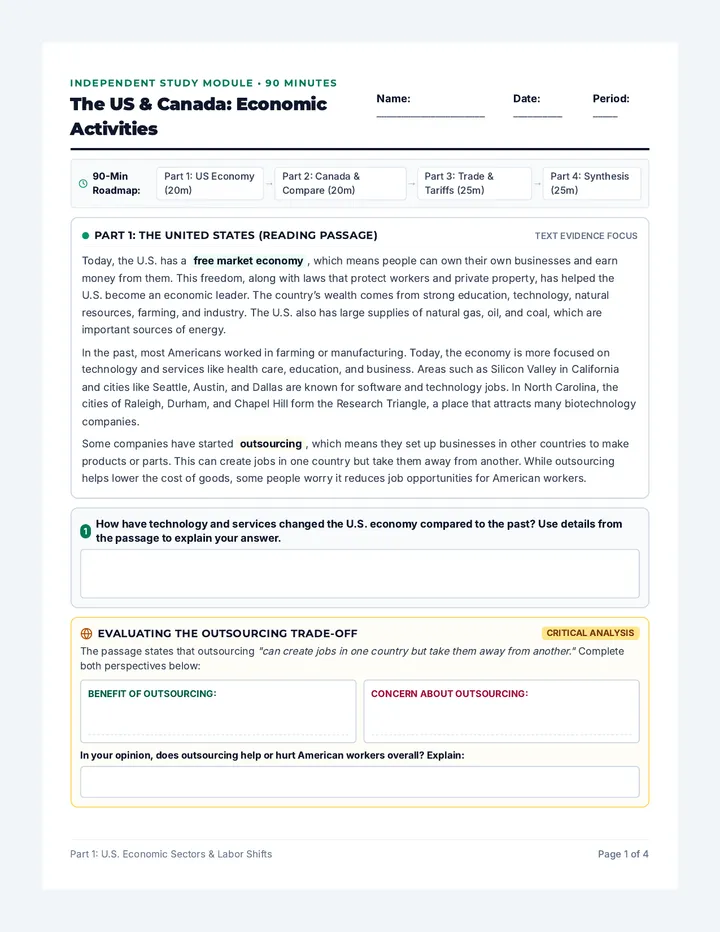
The US & Canada: Economic Activities
Part 1: Core Vocabulary • Part 2: U.S. Economic Transformation (30 Minutes)
Name:
Date:
1
Key Vocabulary
Find each term in your reader and define it in your own words.
Free market economy
Service industry
Outsourcing
Natural resources
Export
Import
Tariff
Trade agreement
2
The U.S. Economy: Then and Now
In the Past: Most Americans worked in...
Today: The economy focuses on...
Sources of U.S. Wealth (List 5 major industries):
3
Where the New Jobs Are
What is each place known for?
Silicon Valley, California
Seattle • Austin • Dallas
Research Triangle, N.C.
4
Two Sides of Outsourcing
Outsourcing means:
+ Benefit (Economic Upside)
– Concern (Economic Risk)
Part 1 & 2 Complete • Check answers with Reader Section 1–4 Page 1 of 3
Independent Student Packet Pacing: 30 Minutes
Page 2 of 3
Canada & Comparing Economies
Part 3: Canada's Economy Web • Part 4: Comparative Synthesis
Name:
5
Canada's Economy Web
Natural resources that bring in money:
World leader in producing...
Service jobs: about % of workers
Examples:
Trade & Tourism: Why is tourism growing?
Canada's Economy market economy
Think Deeper:
Much of Canada's wealth comes from natural resources, yet most Canadians work in service industries. How can both facts be true?
6
Compare: U.S. vs. Canada
Write at least 3 distinct facts in each section.
United States Only
Both Nations
Canada Only
Claim: The biggest difference between the U.S. and Canadian economies is...
Part 3 & 4 Complete • Check answers with Reader Section 5 Page 2 of 3
Independent Student Packet Pacing: 30 Minutes
Page 3 of 3
World Trade, NAFTA & USMCA
Part 5: Trade Dynamics • Part 6: Pacts & 3-2-1 Synthesis
Name:
7
How Trading Partners Work
Use the passage example: one country sells oil but buys food.
Country A (e.g., Canada)
Has a lot of:
Needs:
EXPORTS →
(sells)
← IMPORTS
(buys)
Country B (e.g., U.S. / Mexico)
Has a lot of:
Needs:
Why does this make them trading partners?
8
Why Trade Between Countries Costs More
Barrier 1: Tariffs
Barrier 2: Import Quotas
Barrier 3: Regulatory Inspections
9
From NAFTA to USMCA: Timeline
1992 What happened?
2018 What happened?
2020 What happened?
Member countries:
How USMCA is like NAFTA, and how it is different:
10
3 – 2 – 1 Wrap-Up
3 facts I learned
•
•
•
2 ways U.S. & Canada differ
1 question I still have
Unit Activity Complete • Review all 10 tasks before submission Page 3 of 3
Economic Crossroads Answer Key
Teacher Resource Complete Solutions • 90-Min Activity
Page 1 of 3
Economic Crossroads • Teacher Answer Key
Part 1: Key Vocabulary & Part 2: U.S. Economy Then and Now
1
Key Vocabulary (Exemplar Student Definitions)
Free market economy
An economic system where private citizens and firms own property and set prices via supply and demand.
Service industry
Businesses that produce intangible activities or expertise (healthcare, finance, tech) rather than tangible goods.
Outsourcing
Contracting out business operations, manufacturing, or customer support to third parties or foreign nations.
Natural resources
Raw materials supplied by nature that humans extract for economic gain (oil, timber, fresh water, minerals).
Export
A domestic good or service produced at home and sold across national borders to another country.
Import
A foreign good or commodity brought into a country from abroad for domestic sale or consumption.
Tariff
A government tax or duty charged on imported foreign goods to protect local industries.
Trade agreement
A formal treaty between nations that reduces or eliminates trade barriers like tariffs and import quotas.
2
The U.S. Economy: Then and Now
In the Past (Model Answer)
Most Americans worked in agriculture and heavy manufacturing: steel mills, automotive factories, coal mining, railroad transport, and textile mills.
Today (Model Answer)
Over 80% of workers are in service industries: software, healthcare, financial banking, corporate law, higher education, media, and biotechnology.
Sources of U.S. Wealth (Any 5 accepted):
High Tech / Software
Finance & Banking
Biotech / Health
Aerospace / Defense
Entertainment / Media
3
Where the New Jobs Are (Innovation Hubs)
Silicon Valley, California
Global leader in microchips, AI software, internet platforms, venture capital, and tech startups.
Seattle • Austin • Dallas
Cloud computing data centers, aerospace engineering, telecommunications, e-commerce, and gaming.
Research Triangle, N.C.
Raleigh-Durham-Chapel Hill research corridor specializing in pharmaceuticals, biotechnology, and agricultural science.
4
Two Sides of Outsourcing
Outsourcing means: Moving operations or hiring outside contractors/foreign workers where labor and production costs are lower.
+ Benefit:
Lowers consumer retail prices on electronics and clothing; enables corporations to invest in domestic high-skill research and design.
– Concern:
Causes domestic industrial job losses, economically hurts factory towns, lowers manufacturing wages, and risks supply chain interruptions.
Teacher Answer Key • Part 1 & 2 Solutions Page 1 of 3
Teacher Resource Complete Solutions • 90-Min Activity
Page 2 of 3
Canada's Economy & Comparative Analysis
Part 3: Economy Web & Part 4: U.S. vs. Canada Venn Diagram
5
Canada's Economy Web (Model Responses)
Natural resources that bring in money:
Crude oil (Alberta tar sands), timber/pulp, wheat/grains, potash, fresh water, gold, nickel, uranium, and natural gas.
World leader in producing:
Potash fertilizer, crude petroleum, newsprint/softwood lumber, nickel, uranium, and hydroelectric power generation.
Service jobs: about 75% of workers
Examples: Commercial banking (Toronto), healthcare, civil engineering, telecommunications, education, and digital software.
Trade & Tourism: Why is tourism growing?
Pristine outdoor wilderness (Banff, Jasper), Whistler ski resorts, Niagara Falls, and vibrant multicultural cities (Vancouver, Montreal, Toronto).
Think Deeper Solution: How can resource wealth and service workforce both be true?
Modern natural resource extraction relies heavily on capital, automation, heavy machinery, and robotic technology rather than mass physical labor. As a result, huge resource value is extracted by relatively few workers, allowing the vast majority of citizens to work in urban service professions.
6
Compare: U.S. vs. Canada Venn Diagram Key
U.S. Only (3 Facts)
- 1. 80%+ service workforce; largest global economy.
- 2. Dominates global tech (Silicon Valley, Seattle, Austin).
- 3. Major net importer of crude energy; heavy global outsourcing.
Both Nations (3 Facts)
- 1. Both operate free market (mixed) economies.
- 2. Service sector employs the majority of citizens.
- 3. Key founding member nations of NAFTA & USMCA.
Canada Only (3 Facts)
- 1. World leader in potash, uranium, timber, and hydro.
- 2. Large net exporter of energy/oil to the United States.
- 3. Economy highly reliant on primary natural resources for GDP.
Exemplar Claim:
"The biggest difference between the U.S. and Canadian economies is that while both are advanced market economies dominated by service jobs, Canada’s national export earnings rely heavily on extracting raw natural resources (petroleum, timber, potash), whereas the U.S. economy is driven primarily by specialized technological innovation, financial services, and intellectual property."
Teacher Answer Key • Part 3 & 4 Solutions Page 2 of 3
Teacher Resource Complete Solutions • 90-Min Activity
Page 3 of 3
Trade Dynamics & USMCA Evaluation
Part 5: Trade Dynamics & Part 6: Pacts & 3-2-1 Synthesis
7
How Trading Partners Work (Model Analysis)
Country A (Canada): Has a lot of: crude petroleum, timber, hydro. Needs: warm-climate produce, advanced consumer tech.
Country B (United States): Has a lot of: tech hardware, citrus/crops, machinery. Needs: imported crude oil, paper/lumber.
Why does this make them trading partners?
Each country produces a surplus of what it has naturally and trades for goods it lacks, creating reciprocal economic interdependence that benefits both populations.
8
Trade Barriers Analysis Key
Barrier 1: Tariffs
Direct taxes added to foreign goods, raising retail prices to make domestic goods more appealing.
Barrier 2: Import Quotas
Legal volume caps that restrict the physical quantity of an import, limiting supply and raising consumer prices.
Barrier 3: Regulatory Inspections
Administrative compliance paperwork, border customs checks, and differing environmental or safety rules.
9
NAFTA to USMCA Timeline Key
1992: NAFTA Signed
U.S., Canada, and Mexico signed treaty to eliminate tariffs and spur trilateral trade.
2018: Renegotiation
Leaders renegotiated terms to address domestic job flight and modernize digital commerce.
2020: USMCA Enacted
New pact took legal effect with auto manufacturing wage mandates and digital data rules.
Member Countries: United States, Canada, Mexico
How USMCA is like NAFTA, and how it is different:
Both treaties eliminate cross-border tariffs between the same three North American allies. However, USMCA introduced strict auto labor wage requirements, stronger digital data protections, and opened Canadian dairy markets.
10
3 – 2 – 1 Wrap-Up Scoring Rubric
3 Facts (Exemplar):
• Over 80% of U.S. jobs are in services.
• Canada leads in potash & oil sands.
• USMCA enacted in 2020 replaced NAFTA.
2 Differences (Exemplar):
1. Canada exports raw energy; U.S. imports energy.
2. U.S. tech hubs drive software; Canada's wealth is heavily resource-based.
1 Question (Check for):
Award full credit for any thoughtful question connecting tariffs, automation, climate change, or trade renegotiations.
Teacher Answer Key • Part 5 & 6 Solutions • Lesson Complete Page 3 of 3