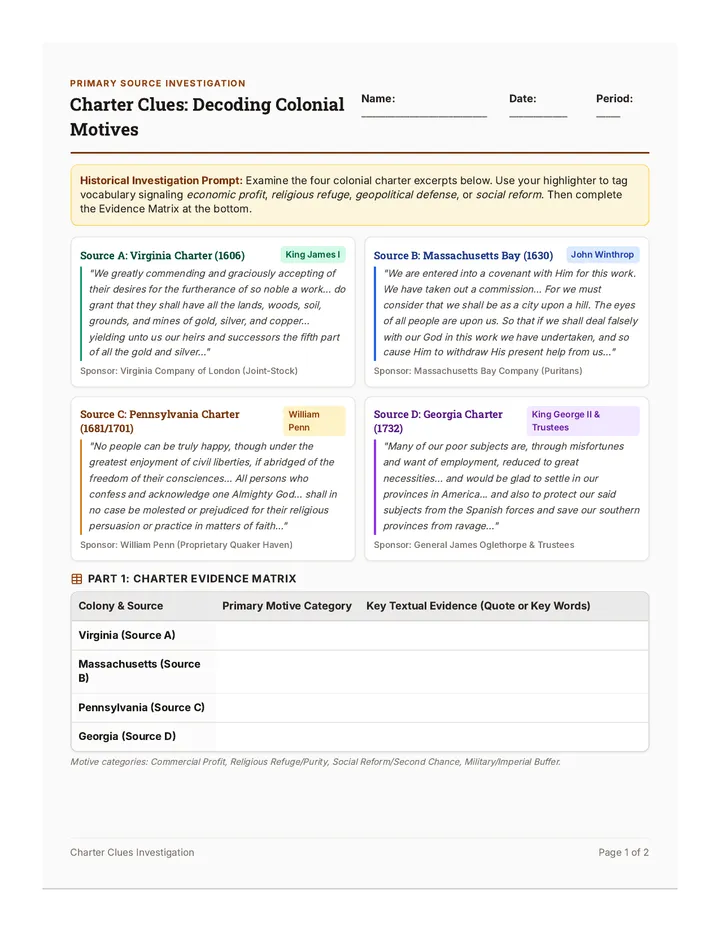
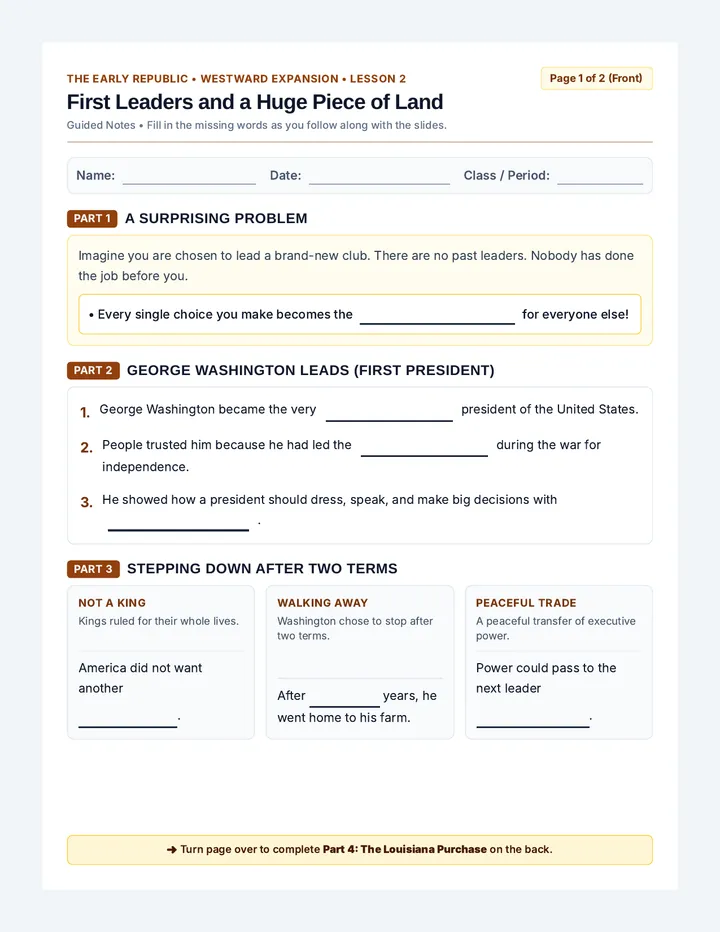
A comprehensive middle-to-high school history lesson investigating the diverse motives behind the founding of the thirteen British North American colonies. Students analyze primary charter excerpts and contrast economic profit, religious refuge, social reform, and geopolitical defense across the New England, Middle, and Southern regions.
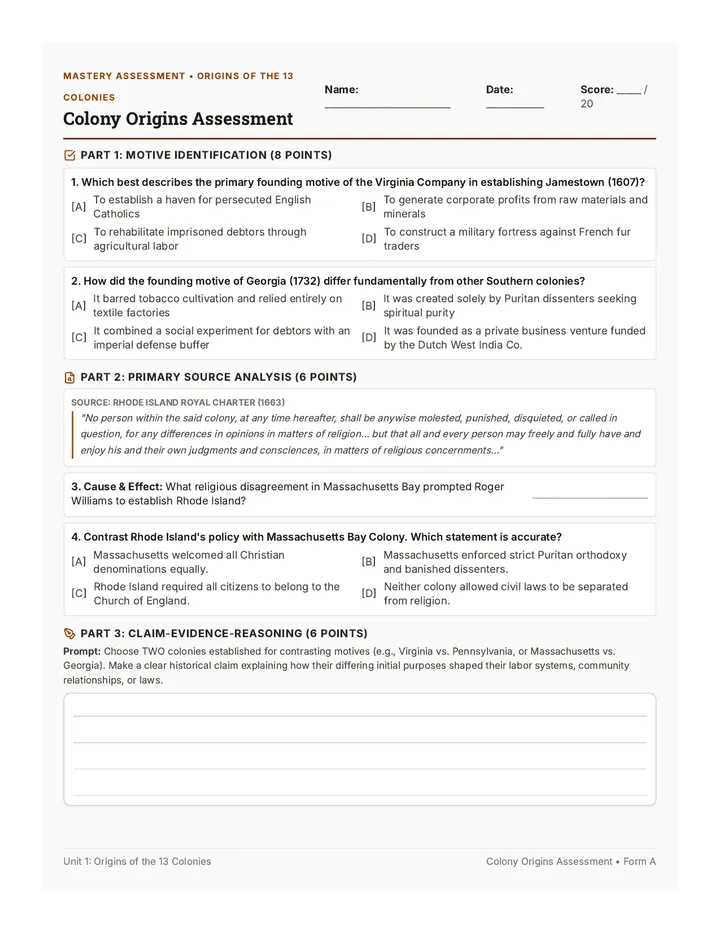
Whole-Class Synthesis & Exit Assessment: Facilitate a rapid-fire debrief: "Which colony's motive proved most durable over time?" Distribute the 1-page Colony Origins Assessment as an individual exit check for immediate mastery verification.
Lesson 1: Origins of the 13 Colonies Founding Ambitions Teacher Guide • Page 1 of 2
Pedagogical Framework & Content Mastery
Charter Analysis & Teaching Notes
Teacher Reference
Critical Historical Misconceptions to Address
Misconception 1: "All early colonists came to America seeking religious freedom."
Reality: Virginia, New York, the Carolinas, and Delaware were predominantly commercial enterprises focused on trade, agricultural land, and returns for European financial backers. Religious motives were concentrated in New England and Pennsylvania/Maryland.
Misconception 2: "Puritans championed universal religious freedom and tolerance."
Reality: Puritans sought religious freedom strictly for themselves. Dissenters like Roger Williams and Anne Hutchinson were banished under pain of heresy for challenging Puritan theological and civil authority.
Misconception 3: "Colonists acted independently without crown or corporate control."
Reality: Every colony operated under royal charters, proprietary grants (e.g., William Penn, Lord Baltimore), or joint-stock charters requiring legal recognition and royal approval.
Primary Source Charter Reading Tips
Virginia Charter (1606): Guide students to look past King James’s standard pious rhetoric about "Christian religion" and note where the legal rights focus: mining 20% shares of gold/silver and organizing corporate trade monopolies.
Model of Christian Charity (1630): Direct students to John Winthrop’s use of "covenant" and "Citty upon a Hill." Emphasize that their success was framed not as personal profit, but as public accountability before God.
Pennsylvania Charter (1681): Highlight William Penn’s Quaker principles: pacifism, freedom of conscience for theists, and deliberate recruitment of diverse European artisans to create a balanced, peaceful society.
Georgia Charter (1732): Point out the dual motives explicitly stated by James Oglethorpe: humanitarian relief for worthy poor/debtors AND a vital physical barrier shielding South Carolina from Spanish military forces in St. Augustine.
Differentiation Pathways
Support / ELL: Provide pre-highlighted charter excerpts focusing on key motive keywords; allow paired partner reading with defined roles (Reader vs. Evidence Recorder).
Extension / Advanced: Have students analyze why Georgia's utopian restrictions (banning slavery and hard liquor) collapsed within 20 years under economic pressure.
Discussion & Debrief Prompts
"How did the founding motives of Virginia versus Massachusetts influence the types of people who immigrated to each?"
"Why did Pennsylvania develop the most diverse and ethnically tolerant society among the early colonies?"
Founding Ambitions: Origins of the 13 Colonies Founding Ambitions Teacher Guide • Page 2 of 2
Motive categories: Commercial Profit, Religious Refuge/Purity, Social Reform/Second Chance, Military/Imperial Buffer.
Charter Clues Investigation Page 1 of 2
Part 2: Settler Motive Matching & Regional Synthesis
Connecting Motives to Destinations
Section A: Match the Colonist to Their Colony
Write the letter of the colony best suited for each prospective settler's personal goals.
[A] Virginia
[B] Massachusetts
[C] Pennsylvania
[D] Georgia
1. Thomas, a London tailor imprisoned for unpaid merchant debts, offered a clean slate to farm small acreage: _____
2. Reverend Nathaniel, seeking a strict moral commonwealth governed strictly by Calvinist biblical law: _____
3. Bartholomew, a second son of English gentry seeking cash-crop fortunes through tobacco cultivation: _____
4. Hannah, a pacifist Quaker seeking a community where people of varied faiths could trade without persecution: _____
Section B: Regional Synthesis Matrix
Colonial Region
Dominant Motive for Founding
Effect on Settlement & Society
New England Colonies
Middle Colonies
Southern Colonies
Section C: Historical Claim & Evidence Writing
Question: How did the original founding motives of Virginia and Massachusetts lead to completely different types of societies (social structure, laws, and daily priorities)? Support your claim with specific evidence from the charters.
Charter Clues Investigation Page 2 of 2
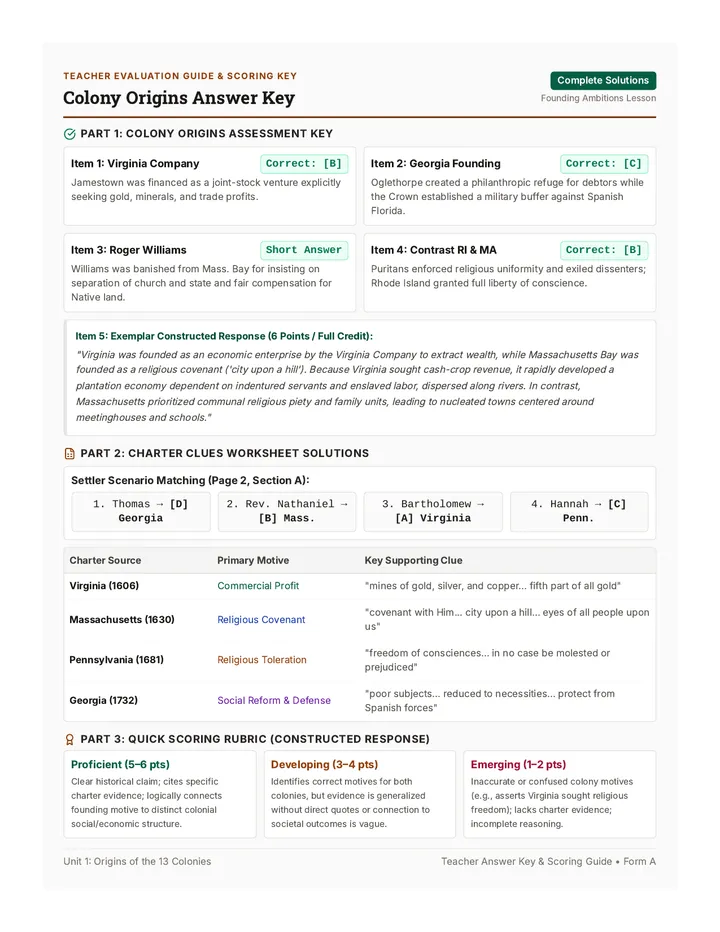
Clear historical claim; cites specific charter evidence; logically connects founding motive to distinct colonial social/economic structure.
Developing (3–4 pts)
Identifies correct motives for both colonies, but evidence is generalized without direct quotes or connection to societal outcomes is vague.
Emerging (1–2 pts)
Inaccurate or confused colony motives (e.g., asserts Virginia sought religious freedom); lacks charter evidence; incomplete reasoning.
Unit 1: Origins of the 13 Colonies Teacher Answer Key & Scoring Guide • Form A