City Planners Teacher Guide Facilitator Guide
Desert City Planners: Geography & HEI
8th Grade Geography
Duration: 50 Minutes
Learning Objective
Students will evaluate Human-Environment Interaction (HEI) by proposing sustainable solutions to environmental challenges (water, heat, habitat) in the American Southwest.
Materials Needed
"Planner Logbook" Worksheets
"Challenge Brief" Cards
Poster Paper (1 per group)
Markers & Sketching Tools
Vocabulary
Adaptation
Changing human behavior to fit the environment (e.g., wearing a coat).
Modification
Changing the environment to fit human needs (e.g., building a dam).
Sustainability
Meeting current needs without compromising future generations.
Pacing & Instructional Moves
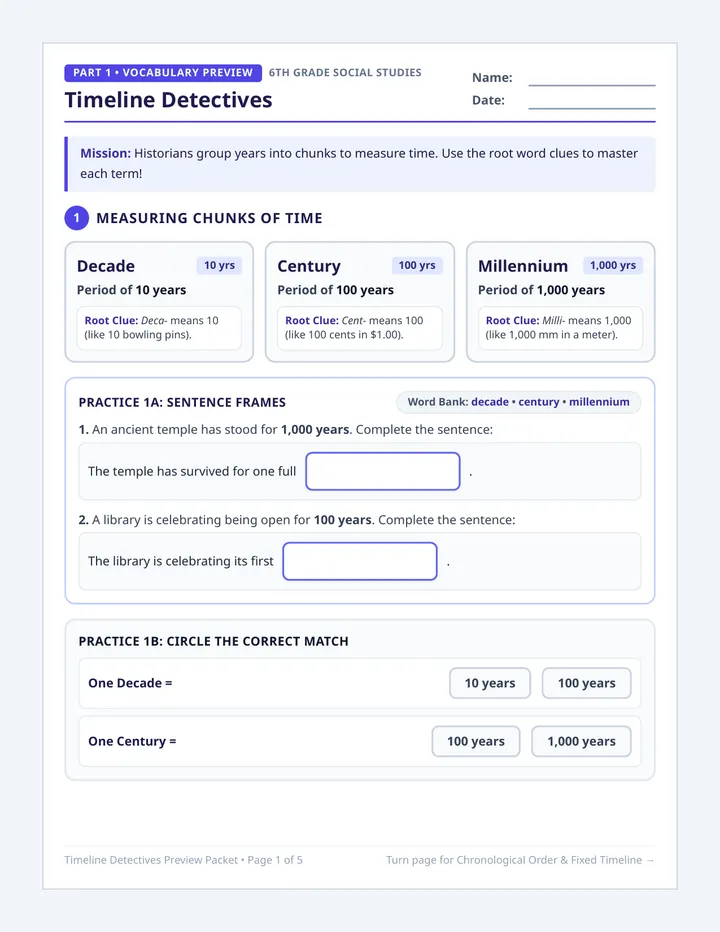
0:00-0:05
Warm-up: The 100-Year Shift
"How did people stay cool in Phoenix in 1924 vs. 2024?"
Focus on the transition from purely adapting (porches, shade) to heavily modifying (AC, massive irrigation).
0:05-0:15
Video Viewing: Interaction
Watch segment 8:16-10:02 . Students complete the "Video Reflection" section in their logbooks. Ask: "What are the hidden costs of modifying the desert?"
0:15-0:40
Main Activity: Desert City Planners
Divide students into groups of 3-4 (The "Planning Committee").
Distribute 1 Challenge Brief per group.
Task: Design a solution on poster paper. They must identify if their solution is an Adaptation or a Modification .
Criteria: Must balance human growth with environmental health.
0:40-0:50
Pitch & Reflection
Each group gives a 60-second "Elevator Pitch" of their solution. Class votes on the most "Sustainable Vision."
Facilitator Discussion Prompts
On Adaptation vs Modification
"If we stop modifying the environment (like turning off AC), could humans still live in Phoenix in the numbers they do today? Why or why not?"
On Consequences
"Every modification has a side effect. If we build a massive dam for water, what happens to the ecosystems downstream?"
Common Misconceptions
"Modification is always bad."
Clarify that modifications allow for human civilization, healthcare, and safety. The goal isn't to stop modification, but to make it sustainable.
"We can just bring in more water."
Encourage students to think about the source of resources. Water in the Southwest often comes from the Colorado River, which is shared by 7 states and Mexico.
Planning Slideshow Presentation Desert City
Planners
Human-Environment Interaction in the Southwest
Warm-up
5 Minutes
Think about a Heat Wave in the desert...
How did people stay cool in...
1926?
2026?
"Humans have always lived in harsh places. The difference is how we interact with them."
Theme: Interaction
Adaptation
Humans change their behavior to fit the environment.
Example: Wearing a hat in the sun.
Modification
Humans change the environment to fit their needs.
Example: Building an air conditioner.
Watch & Reflect
Section: Human-Environment Interaction (HEI)
8:16 - 10:02
Embedded media
Questions
• What made the Southwest "uninviting" before?
• What are the consequences of rapid growth?
Mission Brief
Project: Phoenix 2050
1
Analyze Your Brief
Read your specific environmental challenge card.
2
Design the Solution
Sketch your city plan on the poster. Will you adapt or modify ?
3
Pitch Your Plan
Explain how you balanced human needs with nature.
The Pitch
You have 60 Seconds to convince the City Council that your solution is sustainable.
BE BOLD • BE CREATIVE • PROTECT THE PLANET
Planner Logbook Worksheet Dept. of Urban Sustainability
Planner Logbook
Lead Planner Name
Date
Part 01
The 100-Year Shift
Compare how humans interact with extreme desert heat. List 2 ways people stayed cool in 1926 versus how we do it today in 2026.
Past (1926)
Modern (2026)
Part 02
HEI Video Briefing
According to the video, what made the American Southwest "uninviting" before modernization?
What were 3 technologies mentioned that allowed people to modify the desert environment?
Project Brief
The Desert City Challenge
Assigned Challenge
City Name
Planning District
1. Problem Analysis
How does your assigned challenge impact both humans AND the natural environment?
2. Proposed Solution
Describe your main idea for solving the challenge.
3. Classification
Is your solution mostly an adaptation or a modification?
Adaptation
Modification
4. Trade-Offs
What is one potential "consequence" (negative side effect) of your solution?
The 60-Second Pitch Script
"Honorable City Council, our city is facing the challenge of..."
"Our plan to address this while protecting the environment is to..."
"This is sustainable because..."
Challenge Briefs Cards Priority Brief: Water
The Thirsty Metropolis
Status: Critical
The Colorado River is at record lows. Your city’s population is growing by 10% every year, but your water supply is shrinking.
Challenge Details:
Local reservoirs are at 25% capacity.
Lawns and golf courses use 60% of city water.
New residents need water for drinking and sanitation.
*Design a solution to reduce water use or find a new source without destroying local ecosystems.
Priority Brief: Heat
The Sizzling Streetscape
Status: Warning
The "Urban Heat Island" effect is making the city 15 degrees hotter than the surrounding desert. Concrete is soaking up all the heat.
Challenge Details:
Air conditioning use is causing power blackouts.
Surface temperatures on asphalt reach 180°F.
Vulnerable residents are at risk of heat stroke.
*Design a cooling strategy for the city that doesn't rely purely on electricity.
Priority Brief: Habitat
The Vanishing Valley
Status: Ecological Risk
New housing developments are sprawling into the desert, destroying the homes of Gila monsters, tortoises, and bobcats.
Challenge Details:
Fragmented habitats make it hard for animals to migrate.
Invasive species from suburban gardens are taking over.
Loss of desert plants leads to flash flooding.
*Design a housing plan that allows for city growth while protecting wildlife.
Priority Brief: Atmosphere
The Dust Storm Dilemma
Status: Respiratory Alert
As the city expands and clears desert soil, "Haboobs" (giant dust storms) are becoming more frequent and dangerous.
Challenge Details:
Dust causes major highway accidents and health issues.
Developers leave soil bare after clearing land.
Lack of groundcover lets the wind whip up debris.
*Design a solution to keep the soil in place and improve city air quality.
[ Teacher Instructions: Cut along the center lines to distribute cards to groups ]