Lenny.com
Explore
Create
ActivitiesNewMathEnglish Language ArtsScience & EngineeringSocial StudiesGlobal LanguagesHealth & Physical EducationSpecial EducationCounseling & Life SkillsArts & CreativityESL
Lenny.com
Lenny.com
Explore
Create
ActivitiesNewMathEnglish Language ArtsScience & EngineeringSocial StudiesGlobal LanguagesHealth & Physical EducationSpecial EducationCounseling & Life SkillsArts & CreativityESL
Lenny.com
Social StudiesSocial Studies PracticesLocation WordsMapsOrder EventsChronology and CausationEvaluating SourcesHistorical ThinkingGeography, Humans, & the EnvironmentAmerican Symbols and LandmarksCitiesStatesState CapitalsRegions of the United StatesGeographic SkillsPhysical GeographyHuman GeographyRegional GeographyGeography of AfricaGeography of AsiaGeography of EuropeGeography of OceaniaGeography of the AmericasSociety and Environment of EuropeSociety and Environment of AsiaSociety and Environment of The AmericasSociety and Environment of the Middle EastSociety and Environment of AfricaHistoryPrehistoryComparing Ancient River CivilizationsAncient MesopotamiaAncient Egypt and KushAncient South AsiaEarly ChinaGreeceRome and the Byzantine EmpireAncient World HistoryNative Peoples of North AmericaNative Peoples of Mesoamerica and South AmericaAfrican EmpiresMedieval AsiaMedieval EuropeThe Silk RoadMedieval HistoryIslamic EmpiresWorld ReligionsRenaissance PeriodAge of ExplorationThe Thirteen ColoniesThe American RevolutionUS History Early RepublicFounding of the United StatesUS History AntebellumUS Civil WarReconstruction PeriodThe Gilded AgeUS ImperialismWorld ImperialismWorld War IUS History 1920sGreat DepressionWorld War IIThe Cold WarUS History 1950-60sUS History 1960s-70sWorld History 20th CenturyContemporary US HistoryContemporary World HistoryHolidaysCivics and GovernmentCitizenshipGovernment FoundationsThe ConstitutionUS ConstitutionExecutive BranchLegislative BranchJudicial BranchState and LocalPolitical ParticipationPublic PolicyPolitical SystemsPower and AuthoritySocial MovementsDefining DevianceTheories of DevianceCrime and Criminal JusticeEconomicsBasic Economic PrinciplesSupply and DemandWhat is MoneyEconomic FundamentalsMicroeconomicsMacroeconomicsBanking and FinanceEconomic SystemsGlobal EconomicsCorporations and PowerThe Changing WorkplaceUnemployment and LaborClass and InequalitySocial MobilityGlobal InequalityPsychologyHistory of PsychologyPsychology as a ScienceBrain and Nervous SystemNeuroscience and BehaviorGenetics and BehaviorSleep and ConsciousnessSensory ProcessesPerceptual OrganizationClassical ConditioningOperant ConditioningObservational LearningCognitive LearningMemory ProcessesThinking and Problem SolvingLanguage and CognitionTheories of MotivationStress and CopingPrenatal and Infant DevelopmentChildhood DevelopmentAdolescent DevelopmentAdulthood and AgingSelf and IdentitySocial CognitionSocial InfluenceAttraction and RelationshipsGroup BehaviorPrejudice and DiscriminationAnxiety and Mood DisordersClinical PsychologyForensic PsychologyPhilosophy & EthicsIntroduction to PhilosophyMajor Philosophers & IdeasMind and Body ProblemFree Will vs DeterminismEthics & MoralityReligion & PhilosophyPolitical Philosophy

Microeconomics

Individual and firm-level decision-making processes, supply and demand dynamics, and market structures. Examines resource allocation, price determination, and elasticity within specific economic environments.

Lenny.com

Solutions

Lenny for EducatorsLenny for SchoolsLenny for Districts

Product

ExploreSign inCreateSupportAbout

Resources

Getting startedMTSS Acceleration Program

Newsletters

School Funding Newsletter

© 2026 Lenny Learning Inc.

TermsPrivacyAccessibility
LinkedInInstagramX
Lenny

Videos

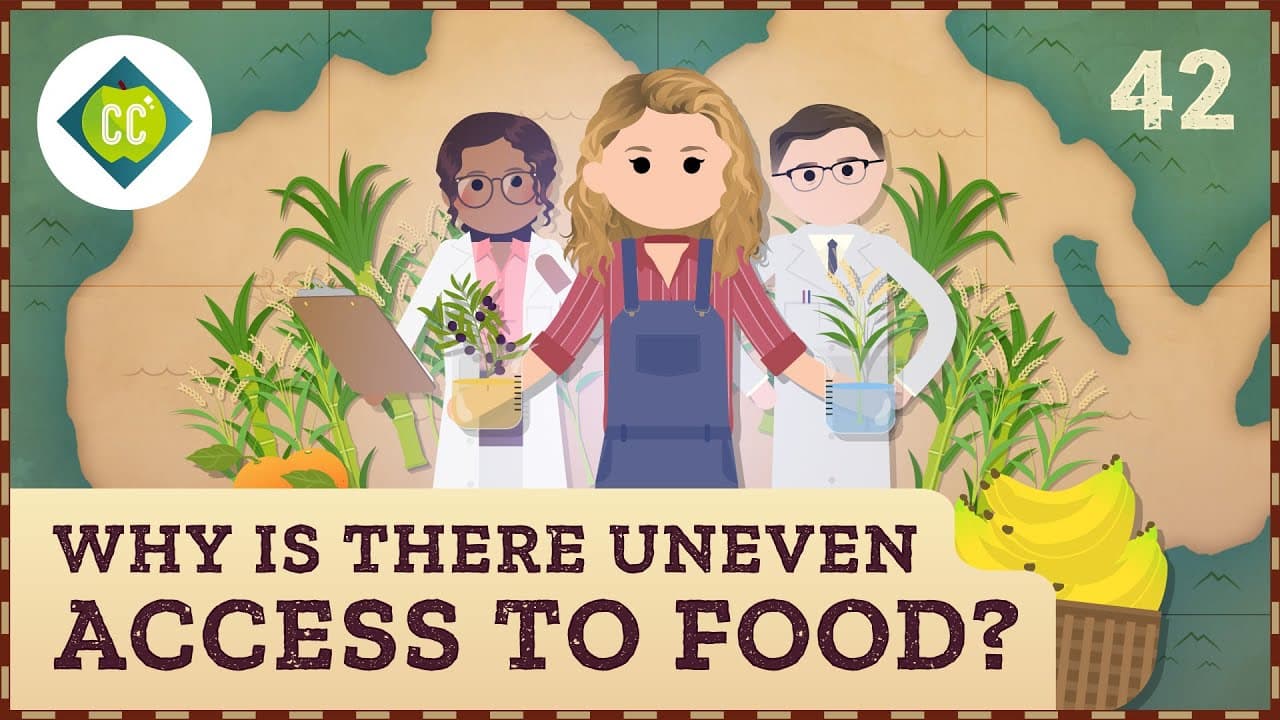
How Geography Shapes Global Food Security

How Geography Shapes Global Food Security

This educational video explores the complex field of agricultural geography, examining why food insecurity persists in a world that produces enough calories to feed everyone. Host Alizé Carrère guides viewers through the intricate web of historical, political, economic, and environmental factors that determine who has access to food. The narrative moves from local examples of farming to global systems, explaining how colonialism, the Columbian Exchange, and various agricultural revolutions have shaped our modern food landscape. The video covers critical themes including the distinction between subsistence and commercial farming, the shift from polyculture to monoculture, and the impact of the Green Revolution. It delves into the geography of hunger, explaining concepts like food deserts and the difference between food availability and food access. Significant attention is paid to how historical events, such as the triangular trade and colonization, disrupted indigenous food systems and established export-oriented economies that still influence global food distribution today. For educators, this resource serves as a powerful tool to connect geography, history, and economics. It moves beyond simple definitions to show students the systems thinking required to understand global challenges. The video provides excellent opportunities for classroom discussions on food justice, the environmental impacts of industrial agriculture, and the importance of biodiversity. It is particularly useful for units on human geography, economic development, and sustainability.

CrashCourseCrashCourse

11mins 32s

Introduction to Economics: Scarcity, Choices, and Incentives

Introduction to Economics: Scarcity, Choices, and Incentives

This fast-paced, engaging video serves as the introductory episode to the Crash Course Economics series, hosted by Jacob Clifford and Adriene Hill. It dispels common myths about economics—clarifying that it isn't just about the stock market or getting rich—and defines the subject as the study of people and choices. Through the core concepts of scarcity and opportunity cost, the hosts explain how individuals, businesses, and governments make decisions when resources are limited. The video uses humor, including a cameo by The Muppets, and historical examples to make abstract concepts concrete. The video covers several foundational economic topics: the definition of economics, the principle of scarcity, opportunity cost, cost-benefit analysis, and the role of incentives. It explores the "Guns or Butter" trade-off using military spending as an example and discusses how incentives can sometimes lead to unintended consequences (perverse incentives), illustrated by a historical rat bounty program in Vietnam. Finally, it clearly distinguishes between Microeconomics (individual and business decisions) and Macroeconomics (national economy, inflation, unemployment). For educators, this video is an excellent hook for a high school economics unit. It provides a high-energy overview that humanizes the subject and connects it to students' daily lives (like the choice to watch the video versus sleeping). It offers multiple entry points for classroom discussion, from the ethics of government spending to the analysis of personal decision-making, making it a versatile tool for introducing the economic way of thinking.
CrashCourseCrashCourse

12mins 9s

How Banks Use Loans to Grow the Economy

How Banks Use Loans to Grow the Economy

This video provides a clear and accessible introduction to the role of banks, loans, and money in the economy. Using the relatable example of a friend starting a mobile dog grooming business, the narrator explains how banks operate as businesses that generate profit through interest on loans. It breaks down key banking concepts including principal, interest, reserve requirements, and the flow of money between savers, the bank, and borrowers.

Miacademy & MiaPrep Learning ChannelMiacademy & MiaPrep Learning Channel

9mins 29s

Using Economic Indicators to Guide Business Decisions

Using Economic Indicators to Guide Business Decisions

This engaging educational video uses a relatable narrative about a robot named Mia and her lemonade stand to explain complex macroeconomic concepts. The host helps Mia decide whether to expand her successful stand into a brick-and-mortar store by analyzing key economic indicators. By grounding abstract concepts in a concrete business scenario, the video demonstrates how the broader economy directly influences individual business success and consumer behavior. Key themes include the relationship between macroeconomic health and microeconomic decisions, specific economic indicators like Gross Domestic Product (GDP), unemployment rates, wages, inflation (CPI), and consumer confidence. The video also covers business cycles (expansion and contraction) and emphasizes the importance of using data rather than intuition to make strategic business moves. For educators, this video serves as an excellent bridge between theoretical economics and practical application. It transforms dry statistics into decision-making tools, showing students why unemployment numbers or inflation rates actually matter to everyday people and business owners. It is ideal for lessons on financial literacy, entrepreneurship, and introduction to economics, providing clear definitions and visual examples of how to interpret economic data.

Miacademy & MiaPrep Learning ChannelMiacademy & MiaPrep Learning Channel

9mins 35s

How World War II Transformed the American Home Front

How World War II Transformed the American Home Front

In this installment of Crash Course US History, John Green explores how World War II transformed the United States domestically, shifting the focus from the battlefields abroad to the dramatic social and economic changes occurring on the home front. The video details how the war acted as a catalyst for ending the Great Depression, vastly expanding the size and scope of the federal government, and fundamentally altering the American economy through massive spending, rationing, and industrial mobilization.

CrashCourseCrashCourse

14mins 23s

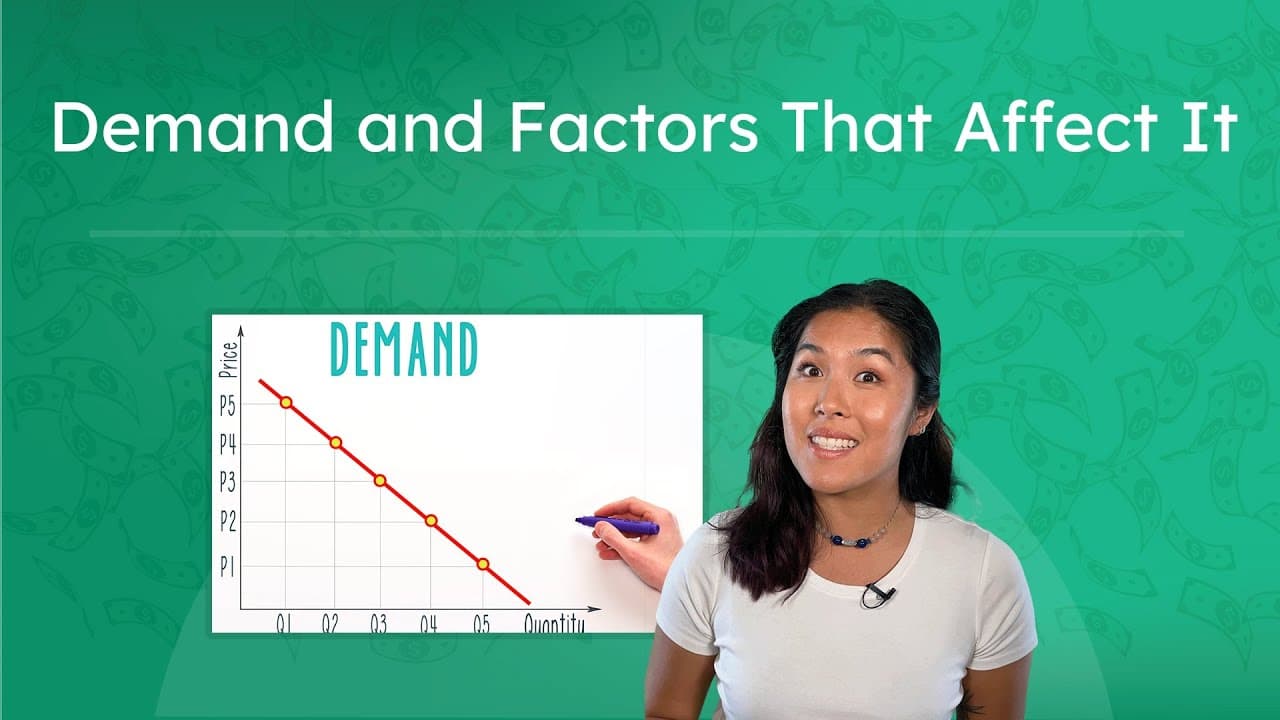
How Market Demand Shifts in Economics

How Market Demand Shifts in Economics

This educational video provides a comprehensive overview of market demand in economics, distinguishing between changes in "quantity demanded" caused by price fluctuations and changes in "demand" caused by non-price factors. The narrator uses relatable examples like fidget spinners, pizza, and video game consoles to explain complex economic concepts, making them accessible to students. The lesson visualizes these concepts through demand curves, demonstrating the difference between movement along a curve versus shifting the entire curve to the left or right. The video breaks down the five key "shifters of demand" (non-price factors): Income, Consumer Preference, Demographic Characteristics, Expectations of Future Prices, and Price of Related Goods. Each factor is defined and illustrated with specific scenarios, such as how a holiday bonus changes buying power or how the Baby Boom impacted the toy industry. The video also covers the Law of Demand, noting the inverse relationship between price and demand. Ideally suited for high school economics or social studies curriculums, this resource helps teachers explain the mechanics of market economies. It offers clear definitions, visual graphing examples, and pause points for student reflection. The content bridges the gap between theoretical graphs and real-world consumer behavior, allowing students to analyze how their own purchasing decisions are influenced by various market forces.

Miacademy & MiaPrep Learning ChannelMiacademy & MiaPrep Learning Channel

10mins 11s

Materials

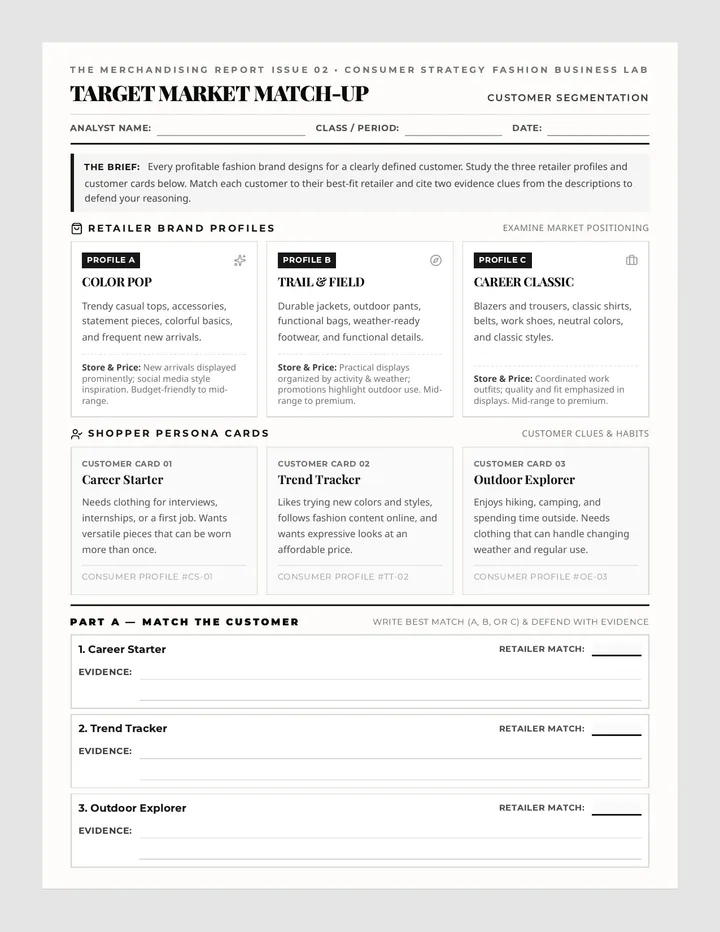
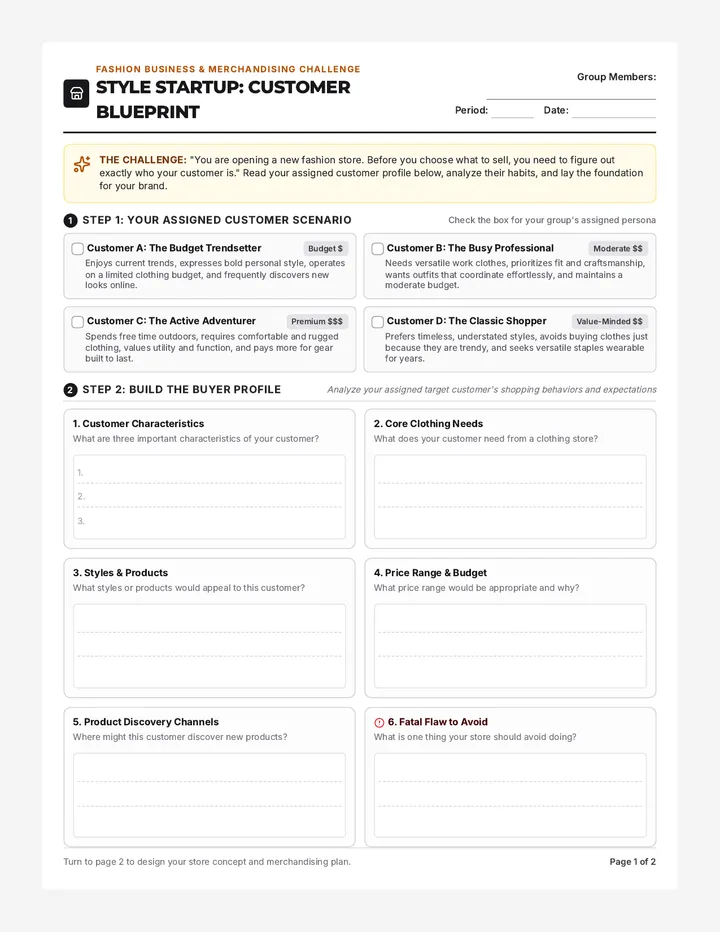
Target Market Match Worksheet

Target Market Match Worksheet

A two-page fashion merchandising student worksheet in an editorial magazine aesthetic. Retailer brand profiles and customer persona cards have been shuffled, and answer giveaways and category spoilers have been removed for an authentic deduction activity.

J

Jennifer.Leber

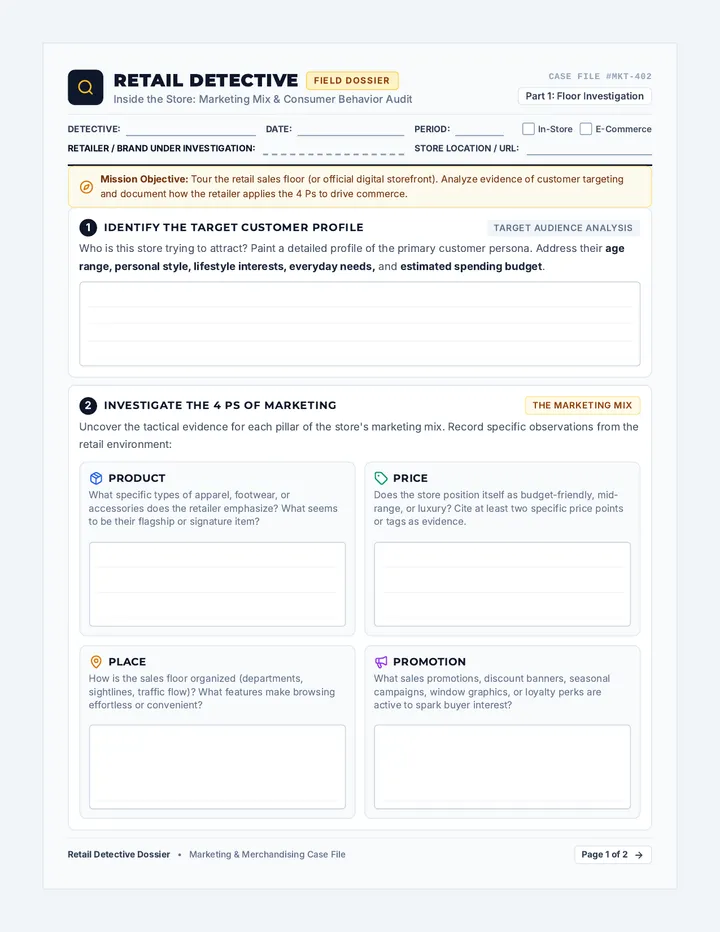
Retail Detective Worksheet

Retail Detective Worksheet

A comprehensive two-page marketing investigation worksheet with expanded writing areas for students to profile target customers, audit the 4 Ps, analyze retail psychology, and develop strategic manager recommendations.

J

Jennifer.Leber

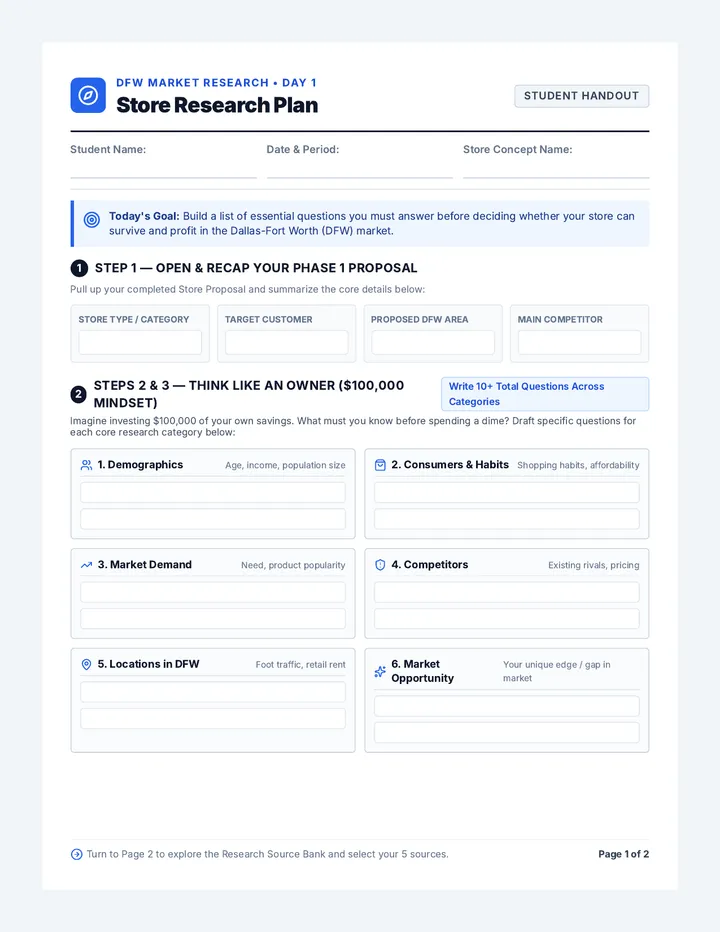
Market Research Plan Handout

Market Research Plan Handout

A clear two-page guided notes handout for students to map out their DFW store research questions, comprehensive credible source bank, and Phase 2 project milestones.

SB

Shanna Brady

Style Startup Worksheet

Style Startup Worksheet

A comprehensive 2-page group worksheet guiding students through market research, customer persona profiling, fashion merchandising decisions, and peer evaluation.

J

Jennifer.Leber

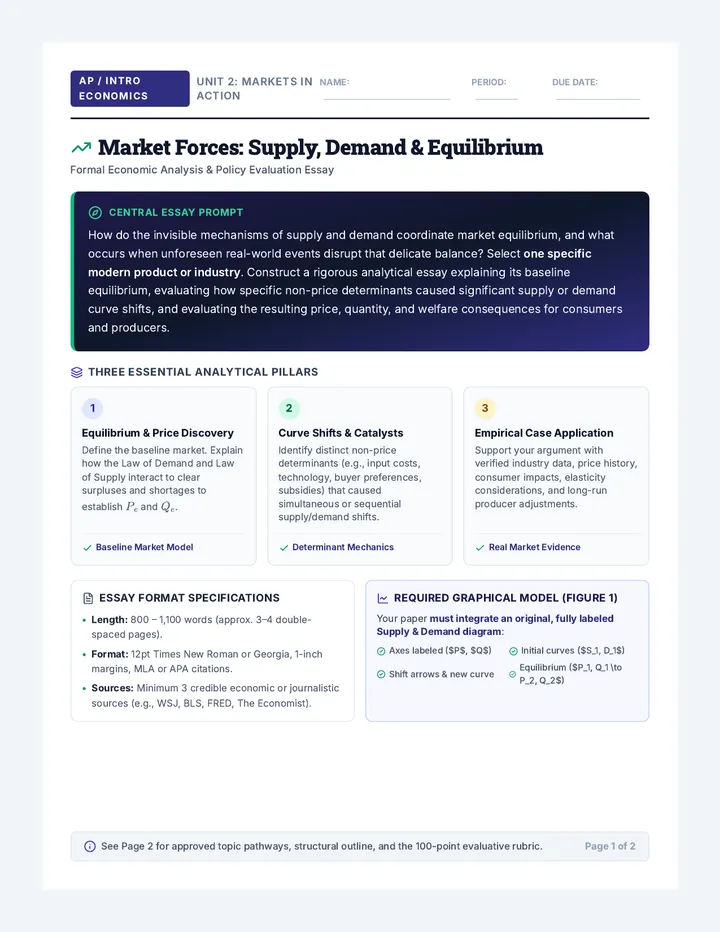
Market Forces Essay Assignment

Market Forces Essay Assignment

A comprehensive economics essay assignment guide challenging students to analyze market equilibrium, supply and demand shifts, and real-world market shocks, complete with structural guidelines and a detailed 100-point rubric.

LS

LeVar St Germain

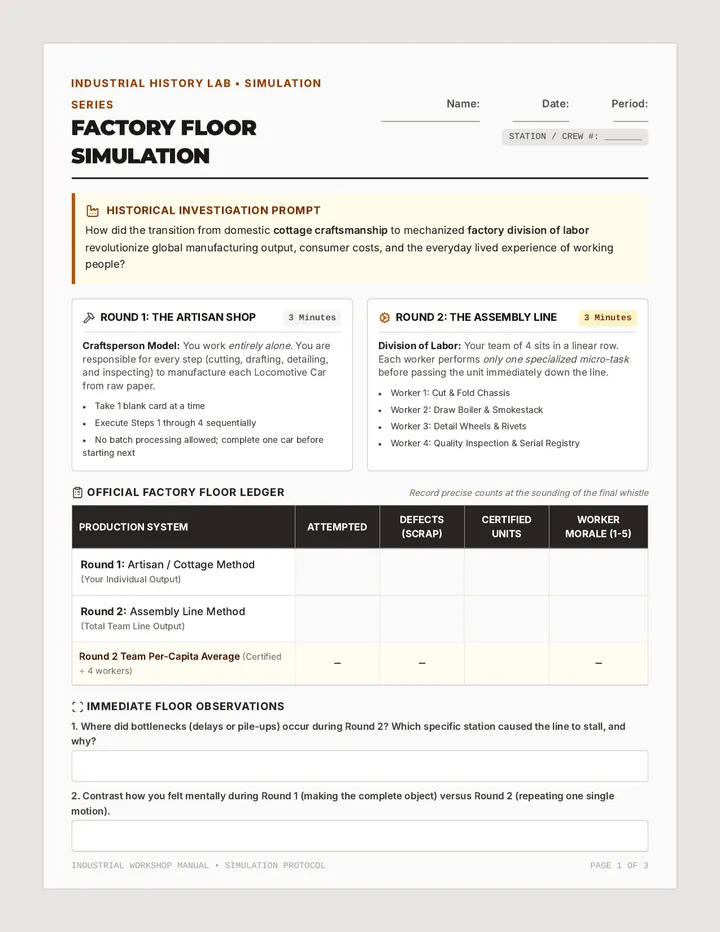
Factory Floor Simulation Activity

Factory Floor Simulation Activity

A comprehensive Industrial Revolution assembly line simulation featuring comparative production ledgers, standardized blueprint manufacturing specs, station role protocols, and historical debrief analysis.

TL

Tricia Lucie

Sequences

Economics Essentials Facilitation Guide

Economics Essentials Packet

A 7-day remediation packet for 12th-grade economics focusing on fundamental concepts like scarcity, supply and demand, economic systems, and international trade, scaffolded for accessibility.

CE

Chelsea Elliott

29
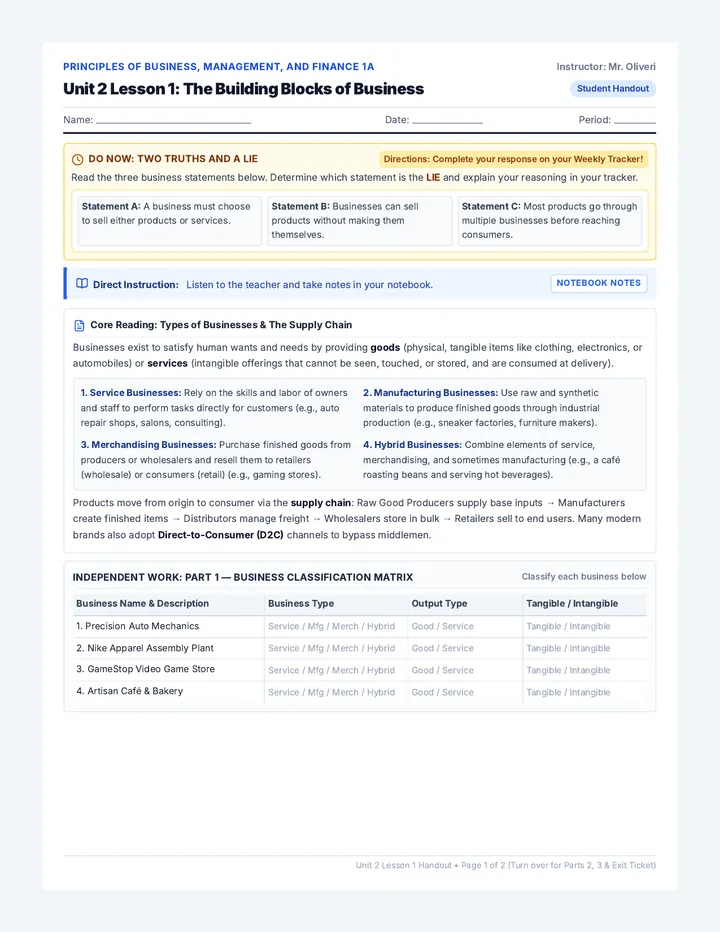
Building Blocks Worksheet

Business World

A comprehensive four-lesson unit exploring the fundamentals of commerce, business structures, factors of production, and socially responsible entrepreneurship.

TO

Thomas Oliveri

8
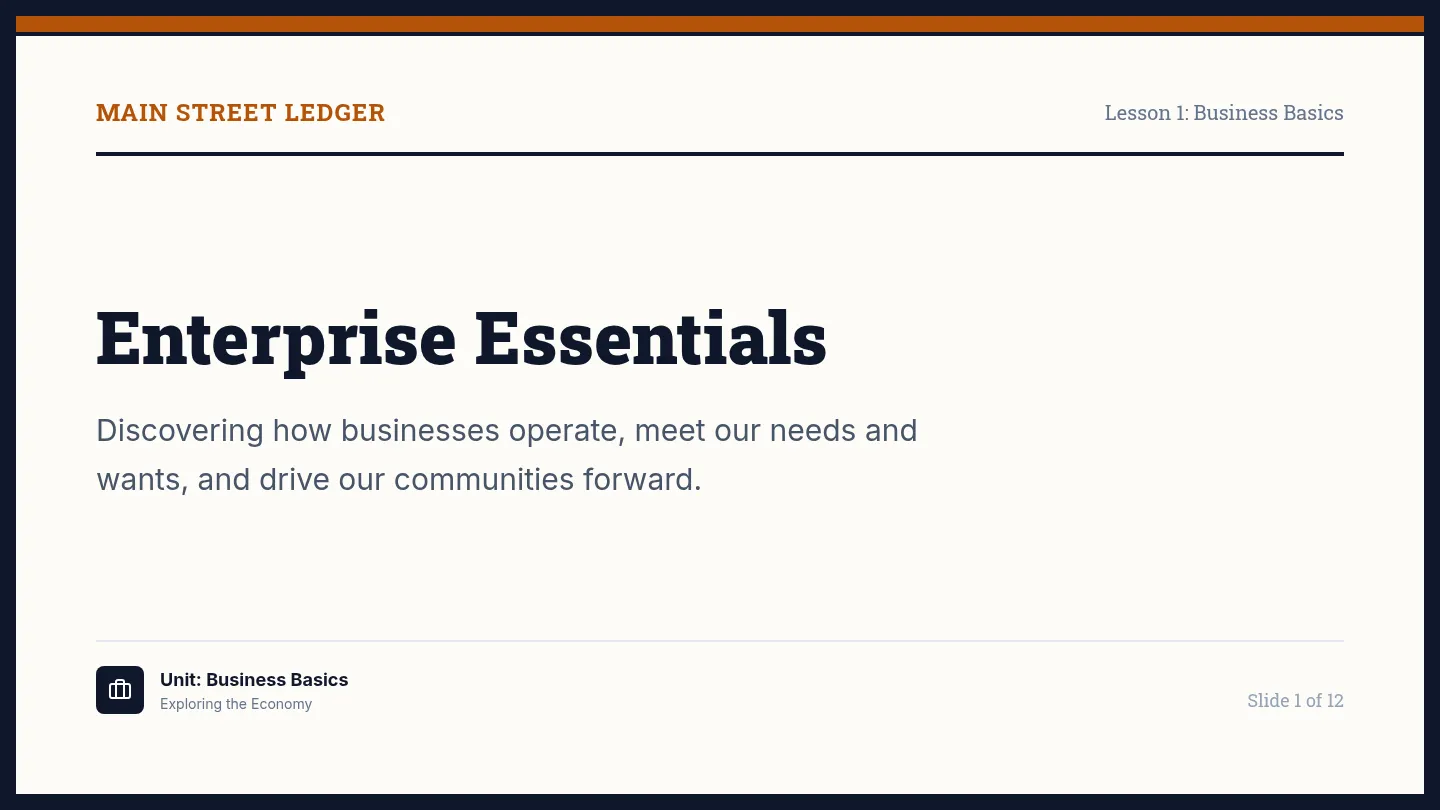
Enterprise Essentials Slides

Main Street Builders

A comprehensive introduction to business fundamentals, financial literacy, and entrepreneurship. Students explore the core purpose of enterprises, navigate roles and decisions, build business plans, and master pricing and profit dynamics.

MK

Marlyce Kemp

13
Mobilization Intro Slides

Global Conflict WWII

A comprehensive 2-day unit covering World War II for 11th Grade US History, aligned with TEKS. It focuses on the transition from isolationism to total war, the home front experience, major turning points in both the European and Pacific theaters, and the strategic decisions that ended the conflict.

BB

Bridgette Burdick

17
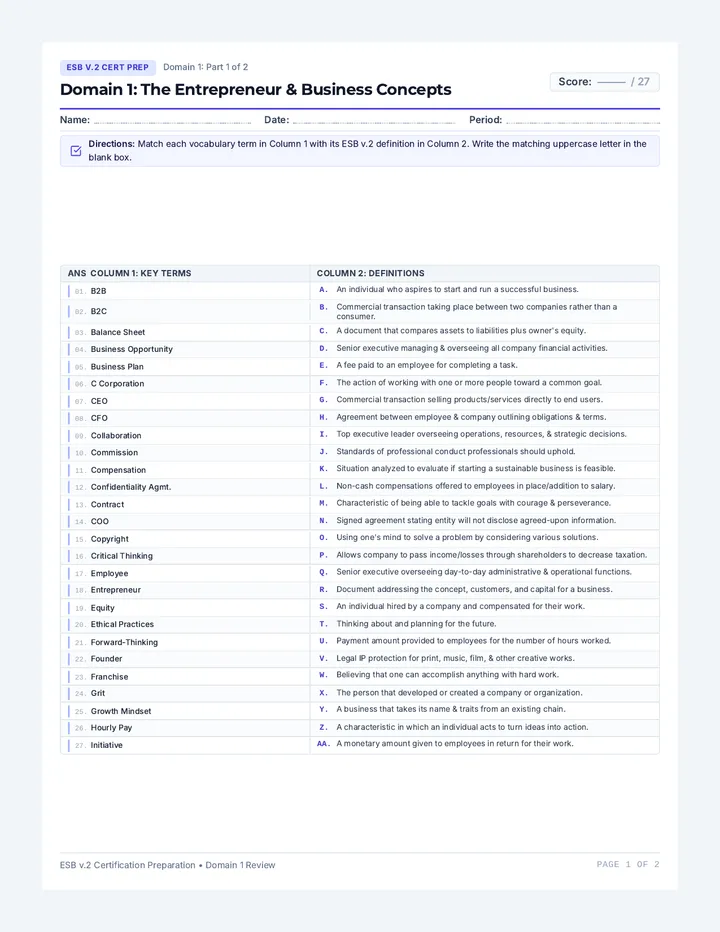
Domain One Match Worksheet

ESB Exam Edge

A targeted ESB v.2 certification prep curriculum covering core exam domains with aligned vocabulary matching worksheets and complete teacher answer keys.

RP

Rafael Paredes

8
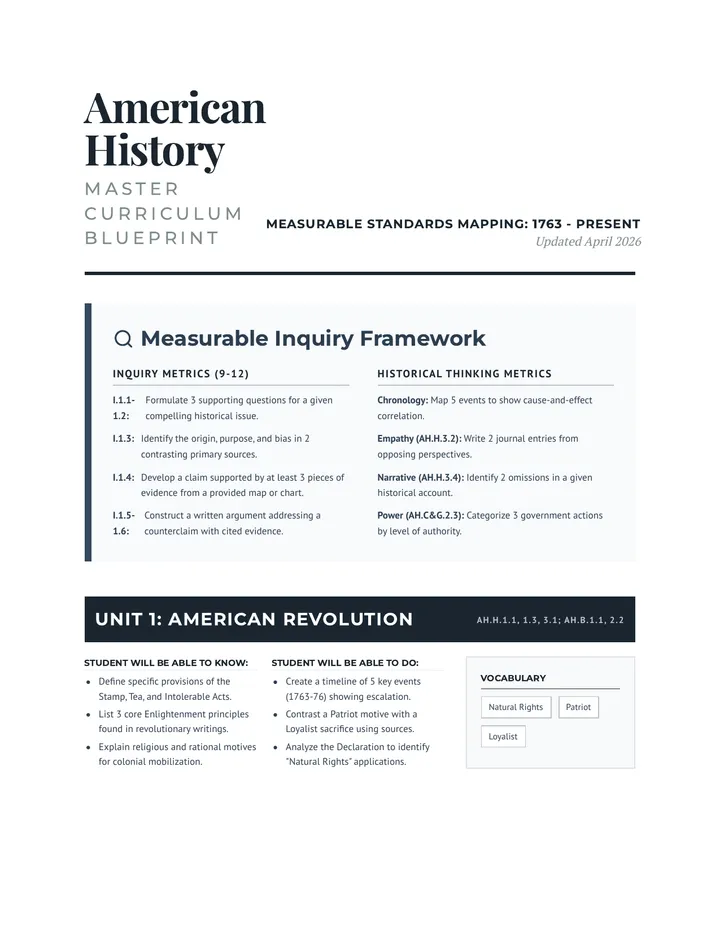
Curriculum Blueprint Document v2

History Horizon Sequence

A comprehensive high school curriculum plan for American History, covering 13 units from the American Revolution to the modern era, aligned with North Carolina Social Studies standards.

AK

Amity Kea

21

Lessons

History Sprint Pacing Guide

STAAR History Sprint

A comprehensive pacing guide and activity resource designed to cover the remaining 11th Grade US History TEKS before the STAAR test on April 16th. This lesson provides a day-by-day calendar for A/B block schedules and high-engagement activities for each remaining historical era.

BB

Bridgette Burdick

51
Border Lines Activity

Harriet Tubman Escape

A lesson exploring Harriet Tubman's 1850 escape and the significance of the Mason-Dixon Line as a geographical and legal boundary in the pre-Civil War United States.

TL

Tanya Larson

46
Modern Era Reader Part 1

The Modern Ledger

A comprehensive exploration of the 1990s through the modern day, covering technological shifts, political milestones, military conflicts, and cultural evolution in the United States.

CE

Chelsea Elliott

20
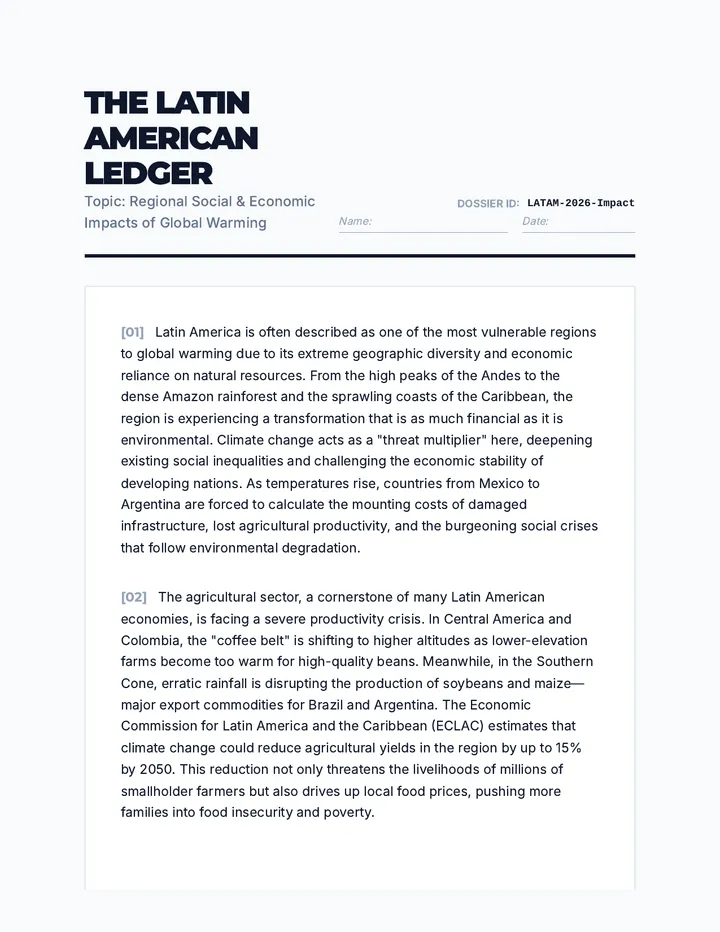
Latin American Ledger Reading

The Latin American Ledger Project

A regional investigation into the social and economic consequences of global warming in Latin America, focusing on human displacement, glacial melt in the Andes, and agricultural shifts. Students analyze a detailed text and construct a Claim-Evidence-Reasoning (CER) argument.

GJ

Gerardo Jimenez Ramirez

10
Mission Briefing Teacher Guide

Modern Era Missions

A 100-minute station-based lesson covering pivotal events from the 1970s to the modern era, including Stagflation, the Camp David Accords, Reaganomics, and the War on Terror. Students rotate through four 20-minute missions using primary sources, political cartoons, data mapping, and manipulatives to master STAAR-aligned content.

LF

Lindsey Foulks

9
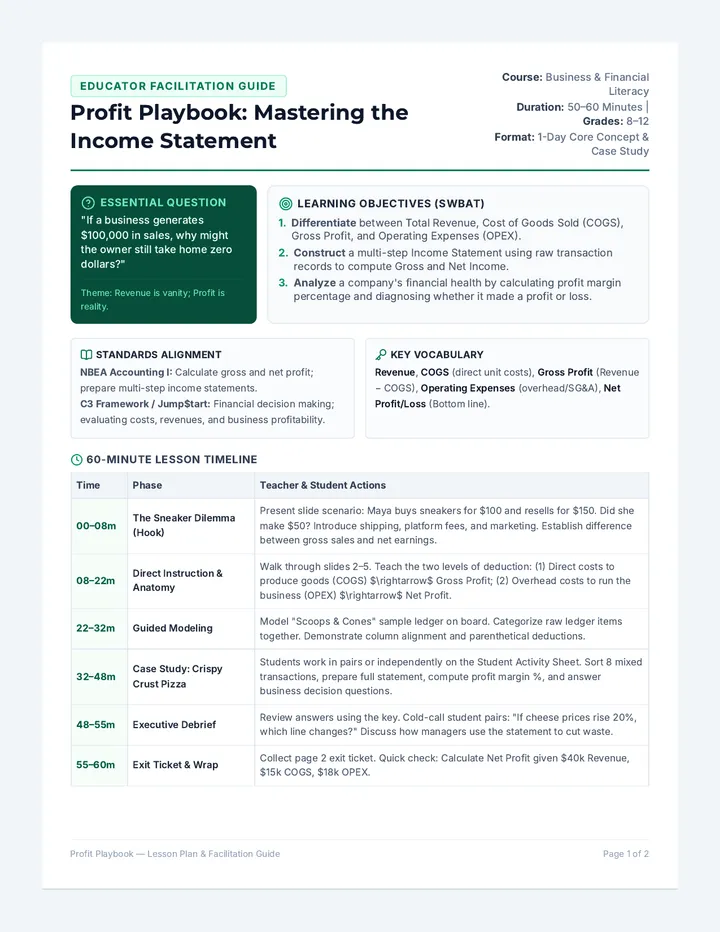
Profit Playbook Lesson Plan

Profit Playbook

A comprehensive one-day secondary business and financial literacy lesson that guides students through calculating gross and net profit, classifying business expenses, and constructing and interpreting multi-step income statements.

E

Edwin.Keller

4