Lenny.com
Explore
Create
ActivitiesNewMathEnglish Language ArtsScience & EngineeringSocial StudiesGlobal LanguagesHealth & Physical EducationSpecial EducationCounseling & Life SkillsArts & CreativityESL
Lenny.com
Lenny.com
Explore
Create
ActivitiesNewMathEnglish Language ArtsScience & EngineeringSocial StudiesGlobal LanguagesHealth & Physical EducationSpecial EducationCounseling & Life SkillsArts & CreativityESL
Lenny.com
Lenny.com

Solutions

Lenny for EducatorsLenny for SchoolsLenny for Districts

Product

ExploreSign inCreateSupportAbout

Resources

Getting startedMTSS Acceleration Program

Newsletters

School Funding Newsletter

© 2026 Lenny Learning Inc.

TermsPrivacyAccessibility
LinkedInInstagramX
Lenny

Corporations and Power

Corporate structures, legal personhood, and the socio-economic influence of multinational firms. Examines how lobbying, monopolies, and labor practices shape public policy and global markets.

Social StudiesSocial Studies PracticesLocation WordsMapsOrder EventsChronology and CausationEvaluating SourcesHistorical ThinkingGeography, Humans, & the EnvironmentAmerican Symbols and LandmarksCitiesStatesState CapitalsRegions of the United StatesGeographic SkillsPhysical GeographyHuman GeographyRegional GeographyGeography of AfricaGeography of AsiaGeography of EuropeGeography of OceaniaGeography of the AmericasSociety and Environment of EuropeSociety and Environment of AsiaSociety and Environment of The AmericasSociety and Environment of the Middle EastSociety and Environment of AfricaHistoryPrehistoryComparing Ancient River CivilizationsAncient MesopotamiaAncient Egypt and KushAncient South AsiaEarly ChinaGreeceRome and the Byzantine EmpireAncient World HistoryNative Peoples of North AmericaNative Peoples of Mesoamerica and South AmericaAfrican EmpiresMedieval AsiaMedieval EuropeThe Silk RoadMedieval HistoryIslamic EmpiresWorld ReligionsRenaissance PeriodAge of ExplorationThe Thirteen ColoniesThe American RevolutionUS History Early RepublicFounding of the United StatesUS History AntebellumUS Civil WarReconstruction PeriodThe Gilded AgeUS ImperialismWorld ImperialismWorld War IUS History 1920sGreat DepressionWorld War IIThe Cold WarUS History 1950-60sUS History 1960s-70sWorld History 20th CenturyContemporary US HistoryContemporary World HistoryHolidaysCivics and GovernmentCitizenshipGovernment FoundationsThe ConstitutionUS ConstitutionExecutive BranchLegislative BranchJudicial BranchState and LocalPolitical ParticipationPublic PolicyPolitical SystemsPower and AuthoritySocial MovementsDefining DevianceTheories of DevianceCrime and Criminal JusticeEconomicsBasic Economic PrinciplesSupply and DemandWhat is MoneyEconomic FundamentalsMicroeconomicsMacroeconomicsBanking and FinanceEconomic SystemsGlobal EconomicsCorporations and PowerThe Changing WorkplaceUnemployment and LaborClass and InequalitySocial MobilityGlobal InequalityPsychologyHistory of PsychologyPsychology as a ScienceBrain and Nervous SystemNeuroscience and BehaviorGenetics and BehaviorSleep and ConsciousnessSensory ProcessesPerceptual OrganizationClassical ConditioningOperant ConditioningObservational LearningCognitive LearningMemory ProcessesThinking and Problem SolvingLanguage and CognitionTheories of MotivationStress and CopingPrenatal and Infant DevelopmentChildhood DevelopmentAdolescent DevelopmentAdulthood and AgingSelf and IdentitySocial CognitionSocial InfluenceAttraction and RelationshipsGroup BehaviorPrejudice and DiscriminationAnxiety and Mood DisordersClinical PsychologyForensic PsychologyPhilosophy & EthicsIntroduction to PhilosophyMajor Philosophers & IdeasMind and Body ProblemFree Will vs DeterminismEthics & MoralityReligion & PhilosophyPolitical Philosophy

Videos

How Imperialism Transformed the Pacific Rim

How Imperialism Transformed the Pacific Rim

This educational video explores the expansion of Western colonial powers into the Pacific Rim during the age of imperialism. It specifically examines three distinct case studies: the Dutch in the East Indies (modern-day Indonesia), the French in Indochina (specifically Vietnam), and the United States in Hawaii. The narrator guides students through the historical context of each region before colonization, the methods used by foreign powers to gain control, and the resulting economic and social shifts that occurred.

Miacademy & MiaPrep Learning ChannelMiacademy & MiaPrep Learning Channel

10mins 27s

How Big Business Shaped the Gilded Age

How Big Business Shaped the Gilded Age

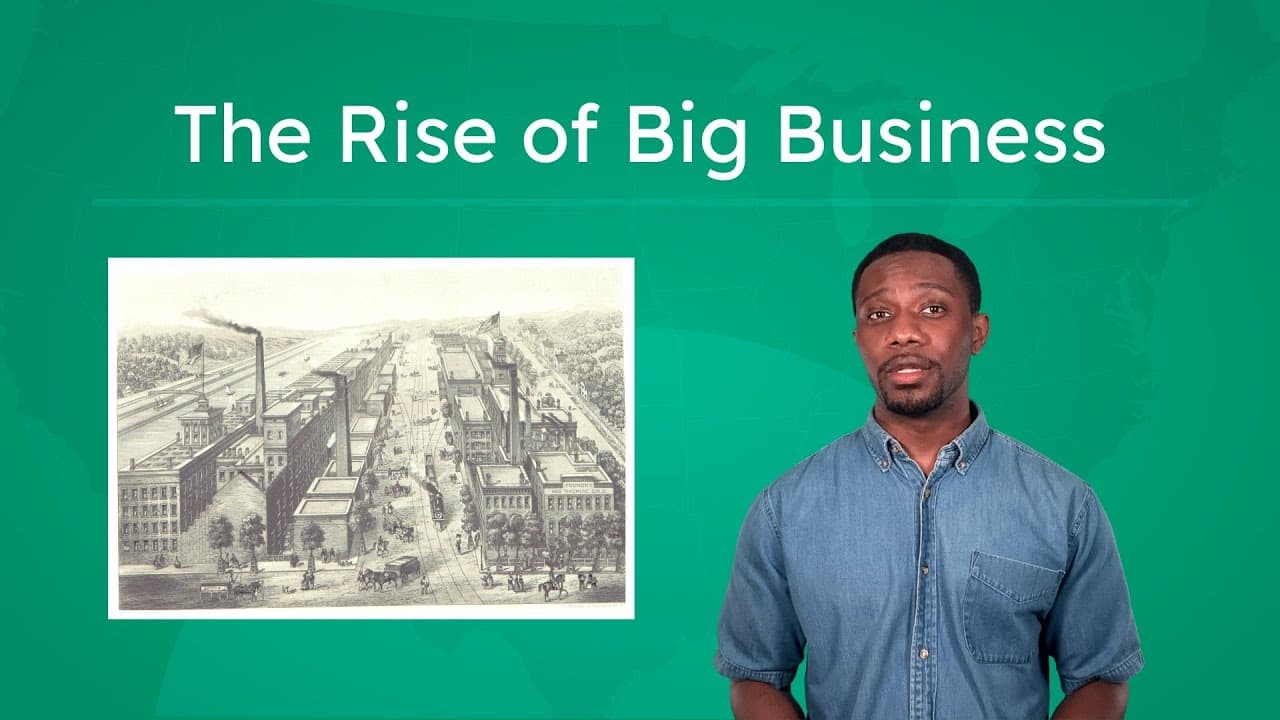
This educational video explores the Gilded Age in American history, specifically focusing on the rapid rise of big business in the late 19th century. Using the accessible analogy of the board game Monopoly, the narrator introduces complex economic and historical concepts in a way that is engaging for students. The video breaks down the era into three main sections: the factors that fueled industrial growth, the profiles of key industrial figures, and the broader impact of this growth on American society.

Miacademy & MiaPrep Learning ChannelMiacademy & MiaPrep Learning Channel

11mins 45s

The History of Conflict in the Congo and Africa's World War

The History of Conflict in the Congo and Africa's World War

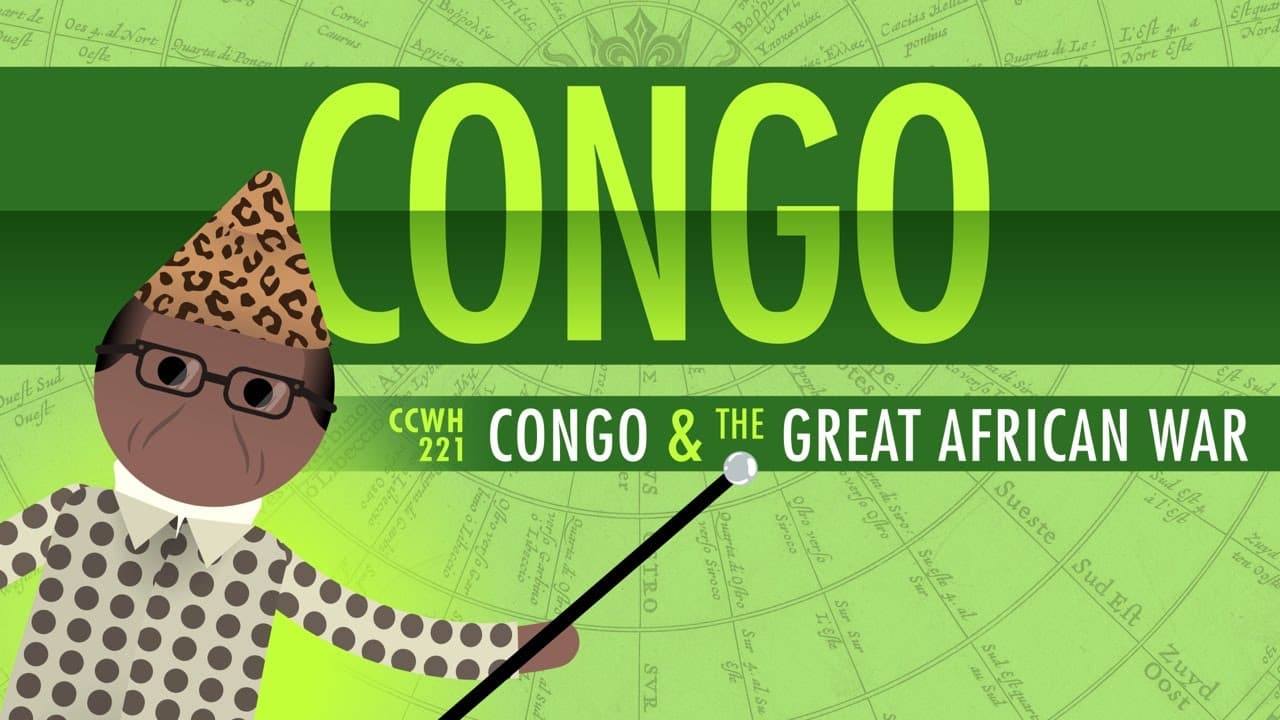
This educational video provides a comprehensive historical analysis of the Democratic Republic of Congo (DRC) from its decolonization in 1960 through the devastating conflicts known as "Africa's World War." Hosted by John Green, the video explores the structural challenges left by Belgian colonialism, the rise of the dictator Mobutu Sese Seko, and the complex geopolitical web that led to the First and Second Congo Wars. It specifically connects the Rwandan Genocide to the destabilization of the Congo, illustrating how regional ethnic tensions and refugee crises sparked continent-wide warfare. The content delves into key themes such as the "resource curse," examining how the Congo's vast mineral wealth (gold, diamonds, coltan) has paradoxically fueled violence and corruption rather than prosperity. It also analyzes the concepts of kleptocracy and clientelism under Mobutu, the impact of Cold War politics on African leadership, and the shifting dynamics of international intervention, ranging from Western financial institutions like the IMF to recent infrastructure deals with China. For educators, this resource is invaluable for teaching modern World History, African Studies, and Geopolitics. It helps students move beyond stereotypes of "backwardness" to understand the specific historical, economic, and political drivers of instability in Central Africa. The video provides a rigorous framework for discussing difficult topics like genocide, neo-colonialism, and the ethics of global supply chains, making it highly relevant for high school and undergraduate classrooms dealing with post-colonial history and international relations.

CrashCourseCrashCourse

12mins 57s

How Your T-Shirt Explains the Global Economy

How Your T-Shirt Explains the Global Economy

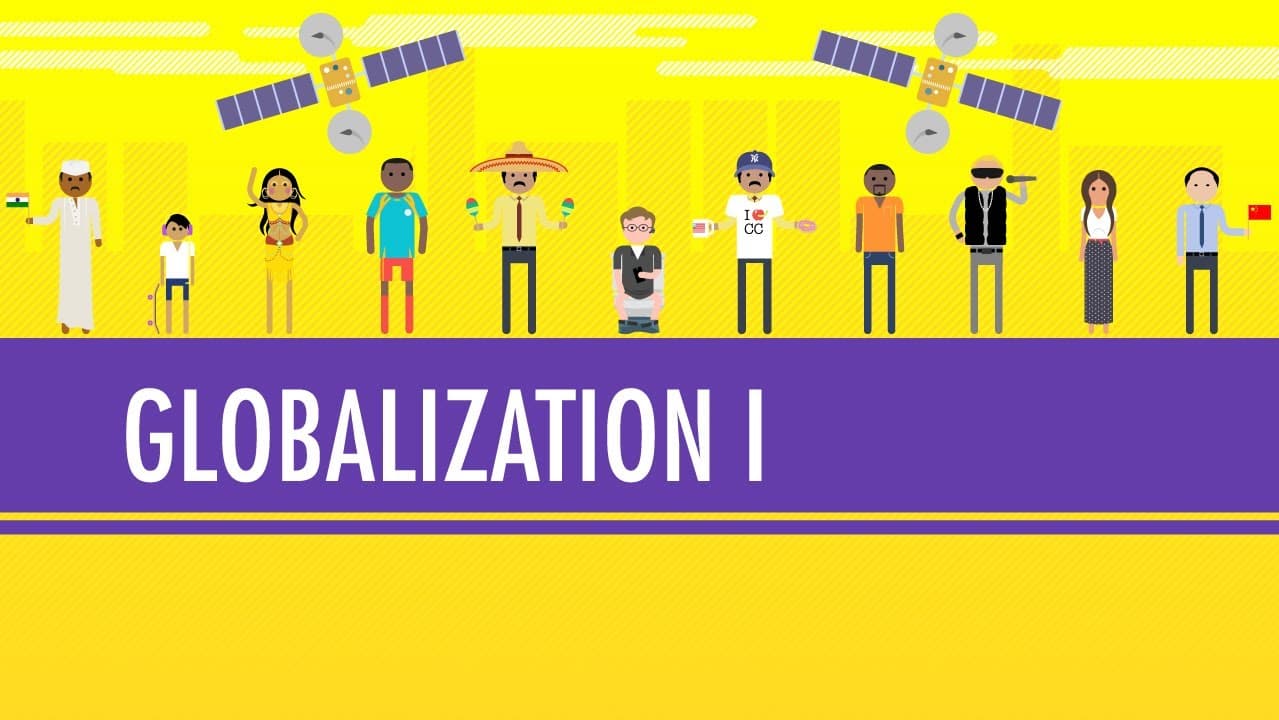
In this energetic installment of Crash Course World History, John Green tackles the complex subject of globalization by focusing primarily on international trade and cultural exchange. Using the lifecycle of a simple cotton t-shirt as a central case study, the video illustrates how economic interdependence connects farmers in the US, textile workers in low-wage countries, and consumers worldwide. It breaks down the drivers of modern globalization, including multinational corporations, cheap shipping, and reduced government regulations. The video explores both the benefits and drawbacks of this interconnected system. It highlights how globalization has lifted hundreds of millions out of poverty in developing nations through manufacturing jobs, while simultaneously disrupting industries in developed nations and raising questions about environmental sustainability and labor conditions. The narrative also touches on cultural globalization, discussing migration, remittances, and the blending of global cultures through food, media, and sports. For educators, this video serves as an excellent primer for units on modern economics, human geography, or contemporary history. It provides concrete examples that make abstract economic concepts tangible for students. The "Journey of a T-Shirt" segment offers a perfect launchpad for classroom activities involving supply chain mapping, while the discussion on cultural homogenization versus diversification provides rich material for debates and essays.

CrashCourseCrashCourse

11mins 51s

The Rise of American Imperialism in Latin America

The Rise of American Imperialism in Latin America

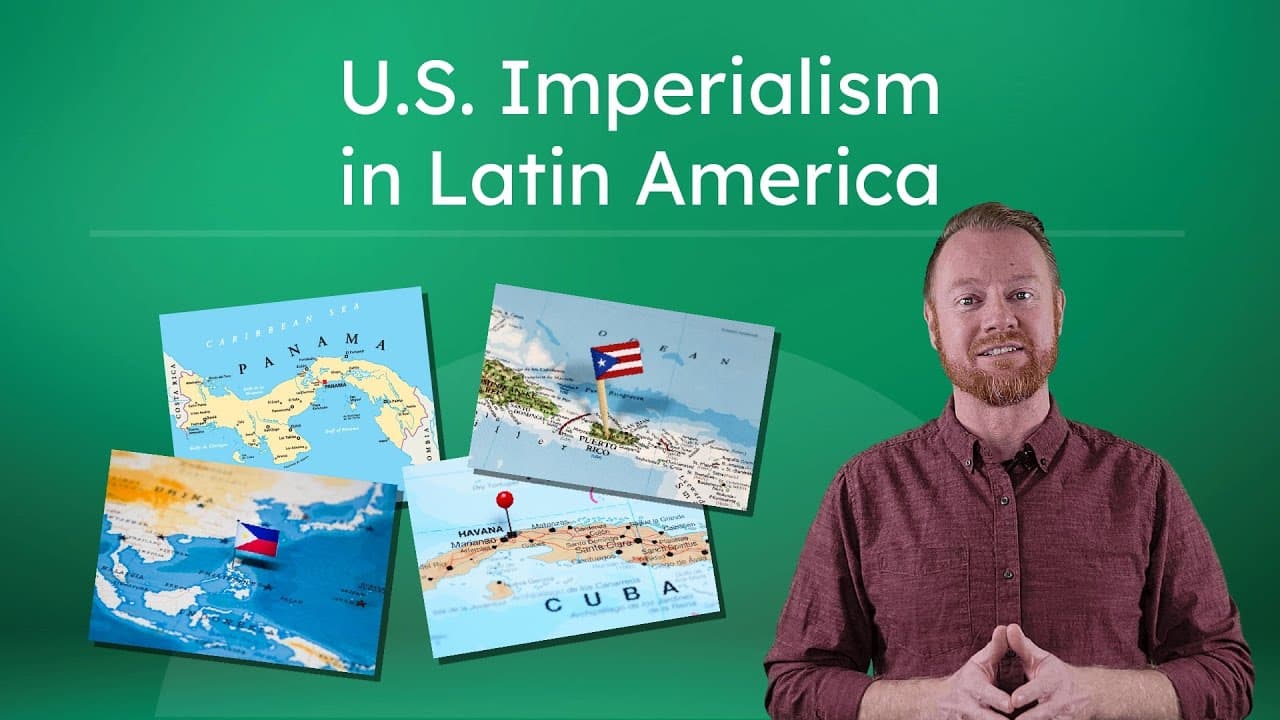
This educational video provides a comprehensive overview of United States imperialism in Latin America during the late 19th and early 20th centuries. It explores the transition of the U.S. from a developing nation to a global imperial power, using the Spanish-American War of 1898 as a central turning point. The narrator connects everyday items like bananas and sugar to complex historical events, making the geopolitical motivations of the era accessible to students. Key themes include the economic and security motivations behind imperialism, the Monroe Doctrine, the concept of "Big Stick Diplomacy," and the Roosevelt Corollary. The video details specific historical events such as the explosion of the USS Maine, the acquisition of territories like Puerto Rico and the Philippines, and the political maneuvering behind the construction of the Panama Canal. It also addresses the influence of European expansion (the Scramble for Africa) on American foreign policy decisions. For educators, this video serves as an excellent anchor for units on US History or World History. It effectively breaks down the "why" behind historical events—linking business interests and national security to foreign intervention. The inclusion of guiding questions and clear definitions of terms like "Imperialism" and "Big Stick Diplomacy" makes it a ready-made resource for structuring classroom discussions and reinforcing vocabulary.

Miacademy & MiaPrep Learning ChannelMiacademy & MiaPrep Learning Channel

10mins 53s

Comparing Democrats and Republicans: History and Stances

Comparing Democrats and Republicans: History and Stances

This educational video provides a comprehensive overview of the history, evolution, and core beliefs of the two major political parties in the United States: the Democratic Party and the Republican Party. It begins by exploring the origins of the American political system, highlighting George Washington's initial warnings against factions and tracing the lineage from early Federalists and Democratic-Republicans to the modern parties we know today. The narrative explains how historical figures like Alexander Hamilton, Thomas Jefferson, Abraham Lincoln, and Franklin D. Roosevelt shaped these organizations. The video then shifts to a detailed comparison of the contemporary platforms of both parties. It systematically breaks down their differing stances on critical issues including taxation, government spending, trade, labor laws, healthcare, foreign policy, environmental protection, and social issues like gun control and the death penalty. Using clear visual charts, it contrasts the Democratic preference for larger government services and regulation with the Republican preference for smaller government, free markets, and individual liberties. For educators, this video serves as an essential, neutral resource for civics and U.S. history classrooms. It helps students move beyond partisan rhetoric to understand the philosophical and practical differences that drive American politics. By presenting complex policy disagreements in a structured, side-by-side format, it enables students to analyze political debates critically and understand the historical context behind current events.
Miacademy & MiaPrep Learning ChannelMiacademy & MiaPrep Learning Channel

10mins 46s

Materials

Brand Blueprint Gallery Walk Worksheet

Brand Blueprint Gallery Walk Worksheet

A two-sided Brand Blueprint Gallery Walk worksheet featuring a simplified 8-company observational log on the front and an expanded 6-part Big Picture Reflection on the back with ample writing lines and guaranteed zero cutoff.

L

Landry.Stahl

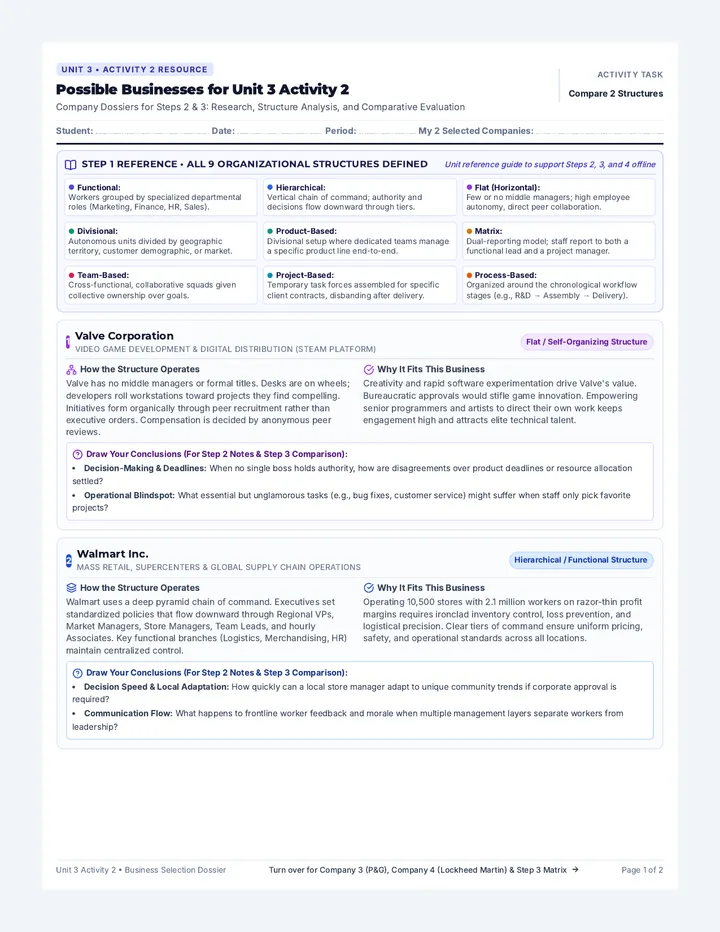
Possible Businesses Handout

Possible Businesses Handout

Printable two-page case dossier for Unit 3 Activity 2 featuring an organizational structure definition reference covering all 9 unit structures, four real-world company dossiers, and a Step 3 comparison matrix for offline student research.

TO

Thomas Oliveri

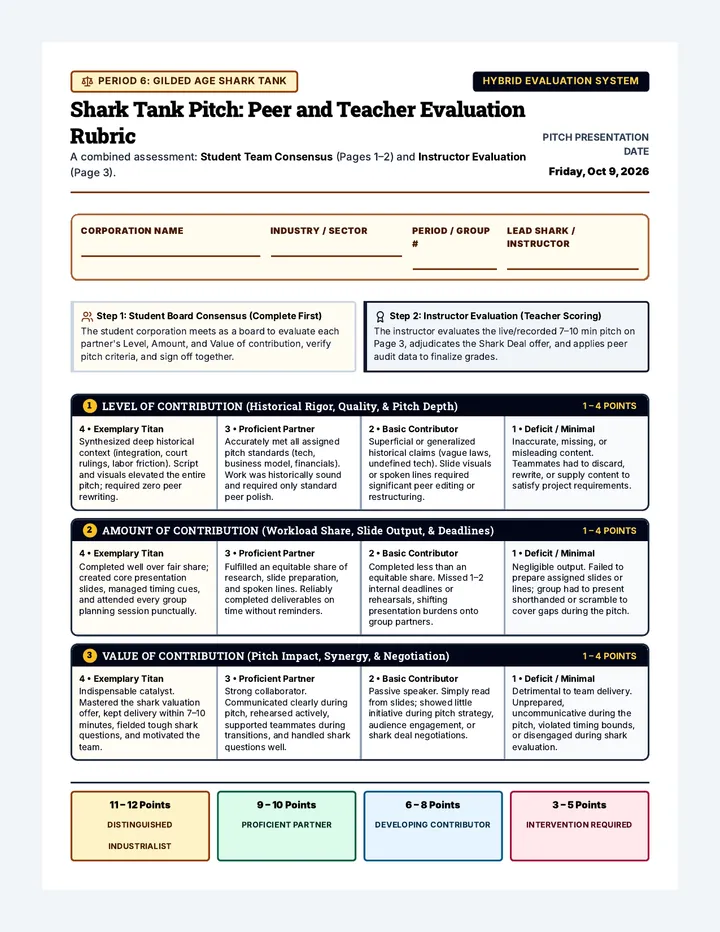
Gilded Shark Peer Rubric

Gilded Shark Peer Rubric

A print-optimized 3-page hybrid peer and teacher evaluation rubric for the Gilded Age Shark Tank pitch. Features evenly balanced column widths across all instructor performance tiers, dark high-contrast typography, and defined, crisp grid lines engineered specifically for physical printing and handwriting.

JG

Joshua Griffith

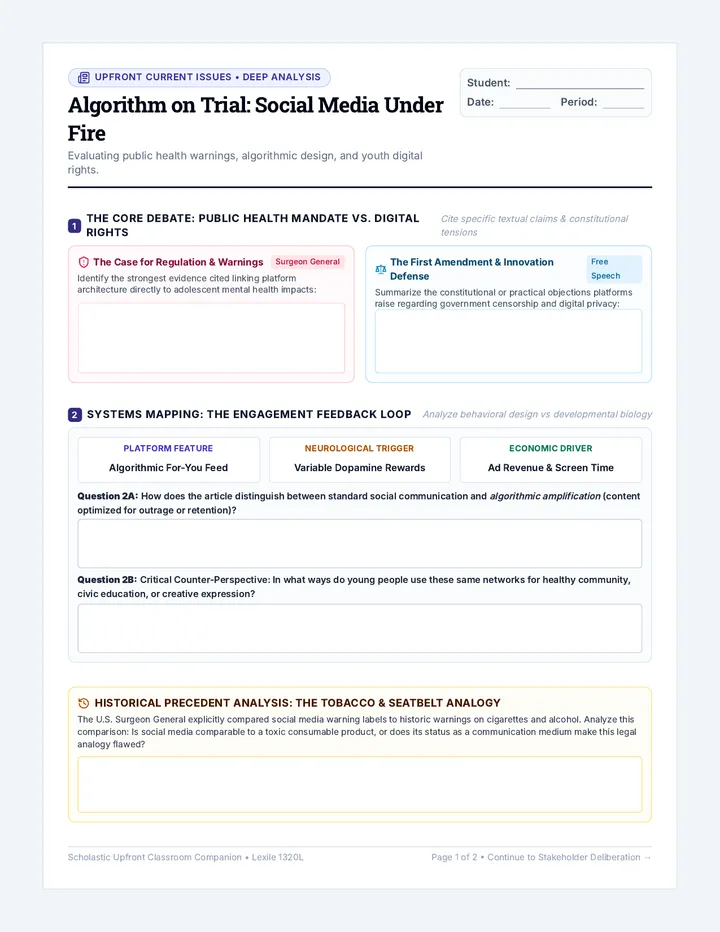
Algorithm Trial Inquiry Worksheet

Algorithm Trial Inquiry Worksheet

A two-page deeper learning inquiry worksheet guiding students through critical analysis, algorithmic systems mapping, stakeholder tensions, and constitutional policy debates on youth social media regulation.

T

tsundstrom

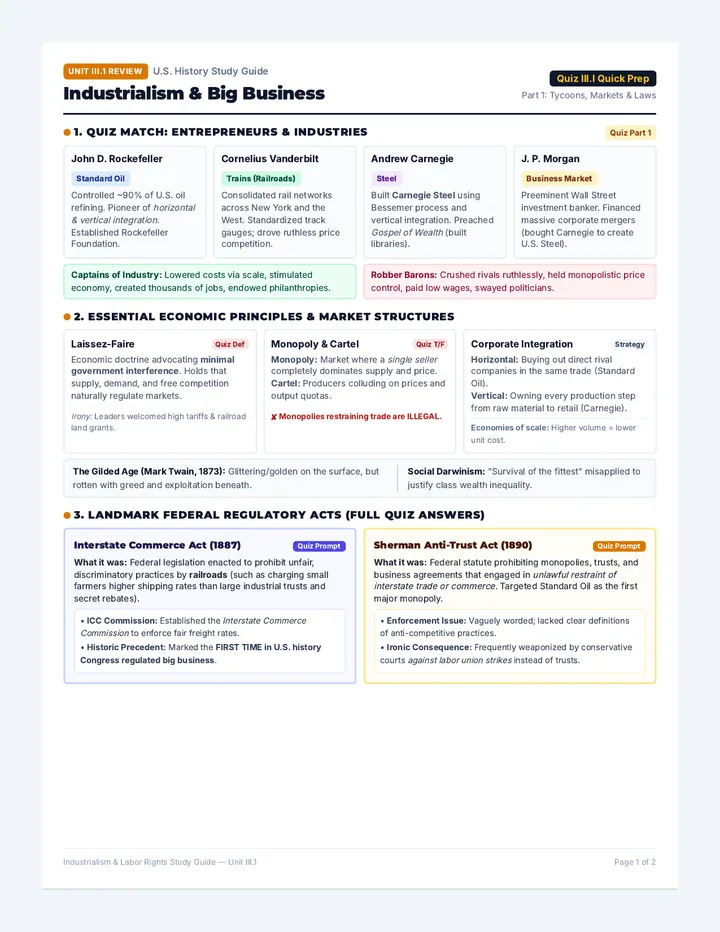
Industrial Titans Study Guide

Industrial Titans Study Guide

A streamlined, high-yield two-page study guide for Quiz III.I on Industrialism and Labor Rights. Features entrepreneur matching profiles, economic concepts, antitrust acts, union history, the Pullman Strike, and model quiz answers formatted to fit perfectly within printable page boundaries.

AI

Allison Ingraham

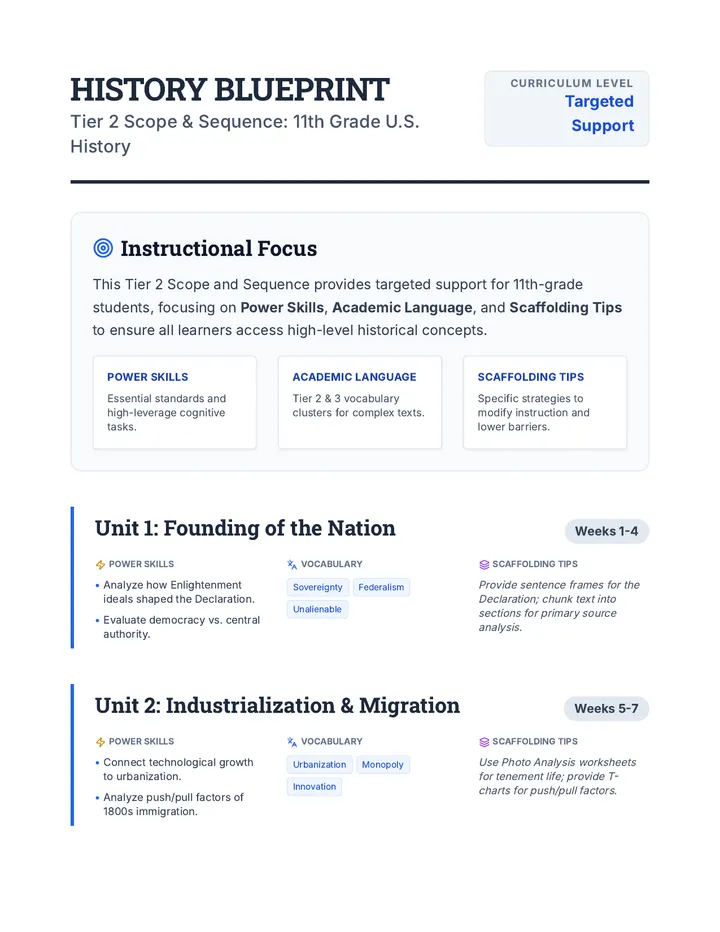
History Blueprint Scope and Sequence

History Blueprint Scope and Sequence

An updated Tier 2 Scope and Sequence for 11th Grade U.S. History, now including specific scaffolding tips for each unit alongside power skills and academic vocabulary. The layout is optimized for teacher reference with instructional strategies tailored for targeted support.

D

dfleisch

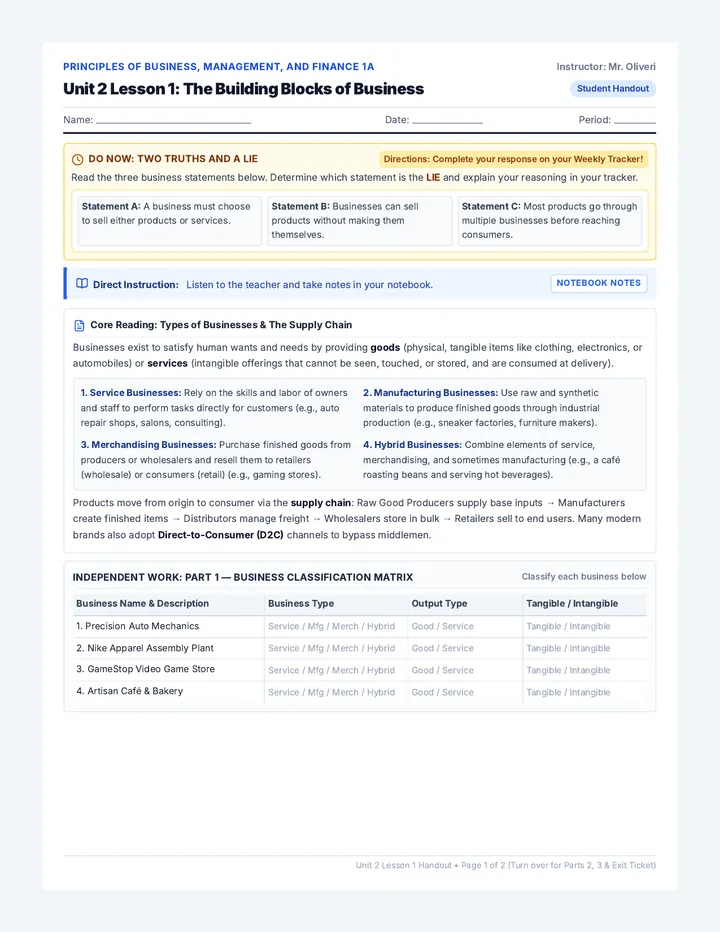
Sequences

Building Blocks Worksheet

Business World

A comprehensive four-lesson unit exploring the fundamentals of commerce, business structures, factors of production, and socially responsible entrepreneurship.

TO

Thomas Oliveri

8
Reconstruction Reckoning Worksheet

Modern America

A comprehensive journey through United States history from the aftermath of the Civil War to the contemporary era, exploring the social, political, and economic shifts that shaped the modern nation.

DP

Darren Polamalu

18
Era of Crisis Study Guide

Superpowers and Scandals

A comprehensive unit covering United States history from 1960 to 1980, focusing on the Cold War, domestic policy, and political scandals.

AH

Ashley Hopf

5
Funding Foundation Checklist

Ethics Engine

A 5-week immersive ethics storyline following the evolution of a single nonprofit organization as it navigates a massive corporate grant, data ethics, policy clashes, and eventual sustainability crises.

DE

Dr. Erick Clinton Lear

11
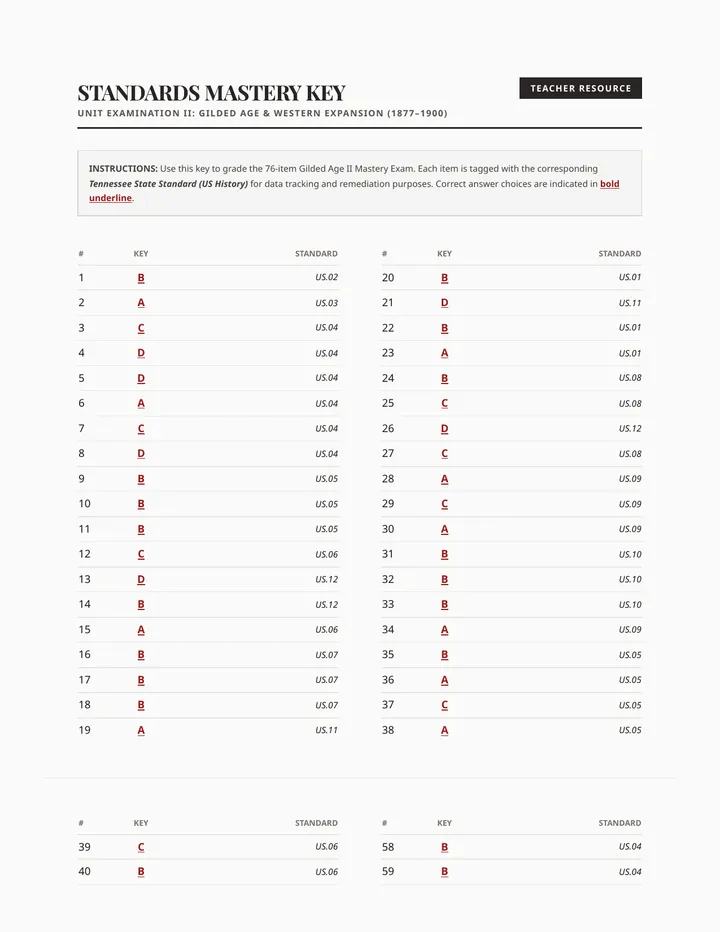
Gilded Age II Standards Key

Modern America Mastery

A comprehensive curriculum sequence covering late 19th and early 20th-century American history, focusing on economic transformation, Western expansion, global imperialism, and the impact of the Great War.

A

Andrew

29
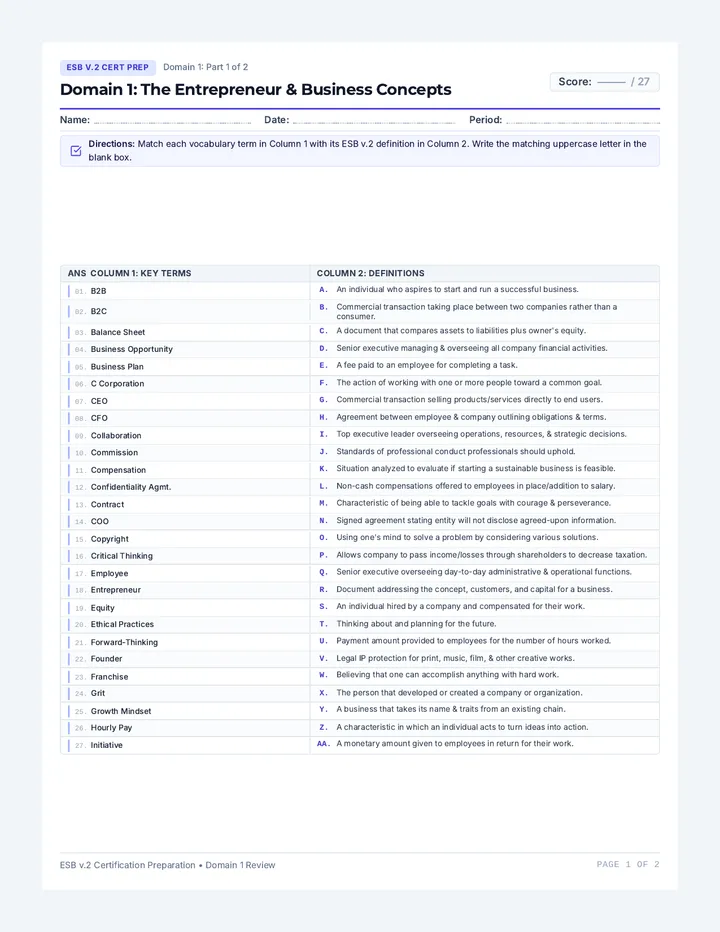
Domain One Match Worksheet

ESB Exam Edge

A targeted ESB v.2 certification prep curriculum covering core exam domains with aligned vocabulary matching worksheets and complete teacher answer keys.

RP

Rafael Paredes

8

Lessons

History Sprint Pacing Guide

STAAR History Sprint

A comprehensive pacing guide and activity resource designed to cover the remaining 11th Grade US History TEKS before the STAAR test on April 16th. This lesson provides a day-by-day calendar for A/B block schedules and high-engagement activities for each remaining historical era.

BB

Bridgette Burdick

51
Modern Era Reader Part 1

The Modern Ledger

A comprehensive exploration of the 1990s through the modern day, covering technological shifts, political milestones, military conflicts, and cultural evolution in the United States.

CE

Chelsea Elliott

20
Mission Briefing Teacher Guide

Modern Era Missions

A 100-minute station-based lesson covering pivotal events from the 1970s to the modern era, including Stagflation, the Camp David Accords, Reaganomics, and the War on Terror. Students rotate through four 20-minute missions using primary sources, political cartoons, data mapping, and manipulatives to master STAAR-aligned content.

LF

Lindsey Foulks

9
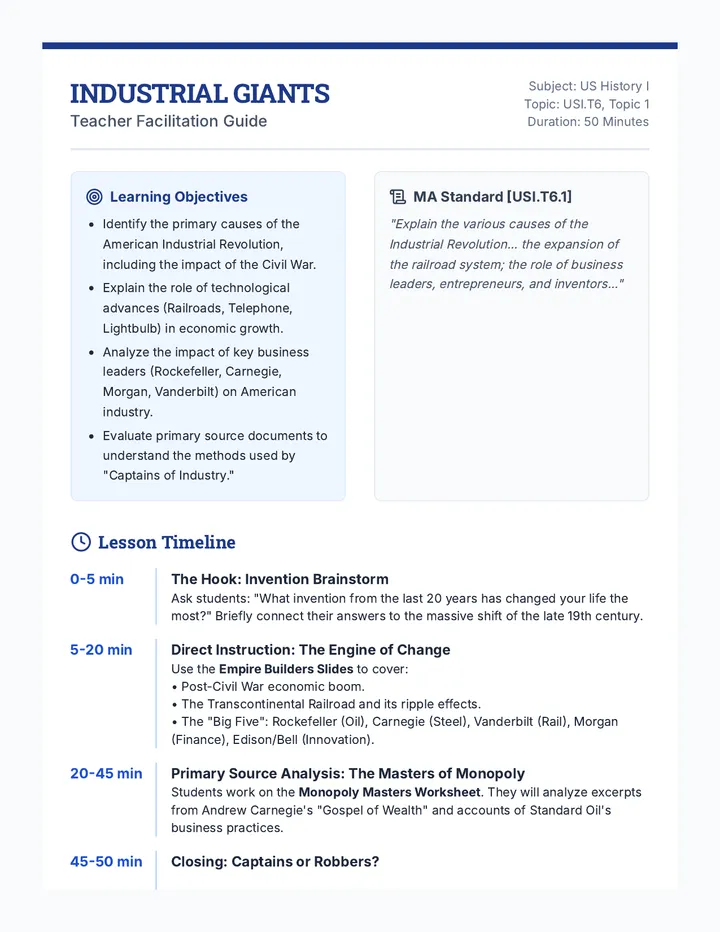
Industrial Giants Lesson Plan

Industrial Giants

An introductory lesson on the American Industrial Revolution, focusing on technological advances, the expansion of railroads, and the rise of industrial giants like Rockefeller, Carnegie, and Morgan. Students analyze primary sources to understand the shift from agrarian to industrial society.

TA

Trey Attanasio

4
Era Review Challenge Practice Sheet

Era Review Challenge

A quick review lesson designed to prepare students for US History STAAR assessments, focusing on four key eras: Imperialism, the Roaring 20s, the Great Depression, and WWII.

BB

Bridgette Burdick

14
Path Through Panama Teacher Guide

Path Through Panama

A 40-minute introductory lesson exploring the geopolitical, military, and economic motivations behind the US involvement in the Panama Canal's construction and Panamanian independence.

GE

Genevieve Eubanks

12