Lenny.com
Explore
Create
ActivitiesNewMathEnglish Language ArtsScience & EngineeringSocial StudiesGlobal LanguagesHealth & Physical EducationSpecial EducationCounseling & Life SkillsArts & CreativityESL
Lenny.com
Lenny.com
Explore
Create
ActivitiesNewMathEnglish Language ArtsScience & EngineeringSocial StudiesGlobal LanguagesHealth & Physical EducationSpecial EducationCounseling & Life SkillsArts & CreativityESL
Lenny.com
Lenny.com

Solutions

Lenny for EducatorsLenny for SchoolsLenny for Districts

Product

ExploreSign inCreateSupportAbout

Resources

Getting startedMTSS Acceleration Program

Newsletters

School Funding Newsletter

© 2026 Lenny Learning Inc.

TermsPrivacyAccessibility
LinkedInInstagramX
Lenny

US Constitution

Principles of American democracy through the three branches of government, checks and balances, and the Bill of Rights. Examines the amendment process and the distribution of power between federal and state authorities.

Social StudiesSocial Studies PracticesLocation WordsMapsOrder EventsChronology and CausationEvaluating SourcesHistorical ThinkingGeography, Humans, & the EnvironmentAmerican Symbols and LandmarksCitiesStatesState CapitalsRegions of the United StatesGeographic SkillsPhysical GeographyHuman GeographyRegional GeographyGeography of AfricaGeography of AsiaGeography of EuropeGeography of OceaniaGeography of the AmericasSociety and Environment of EuropeSociety and Environment of AsiaSociety and Environment of The AmericasSociety and Environment of the Middle EastSociety and Environment of AfricaHistoryPrehistoryComparing Ancient River CivilizationsAncient MesopotamiaAncient Egypt and KushAncient South AsiaEarly ChinaGreeceRome and the Byzantine EmpireAncient World HistoryNative Peoples of North AmericaNative Peoples of Mesoamerica and South AmericaAfrican EmpiresMedieval AsiaMedieval EuropeThe Silk RoadMedieval HistoryIslamic EmpiresWorld ReligionsRenaissance PeriodAge of ExplorationThe Thirteen ColoniesThe American RevolutionUS History Early RepublicFounding of the United StatesUS History AntebellumUS Civil WarReconstruction PeriodThe Gilded AgeUS ImperialismWorld ImperialismWorld War IUS History 1920sGreat DepressionWorld War IIThe Cold WarUS History 1950-60sUS History 1960s-70sWorld History 20th CenturyContemporary US HistoryContemporary World HistoryHolidaysCivics and GovernmentCitizenshipGovernment FoundationsThe ConstitutionUS ConstitutionExecutive BranchLegislative BranchJudicial BranchState and LocalPolitical ParticipationPublic PolicyPolitical SystemsPower and AuthoritySocial MovementsDefining DevianceTheories of DevianceCrime and Criminal JusticeEconomicsBasic Economic PrinciplesSupply and DemandWhat is MoneyEconomic FundamentalsMicroeconomicsMacroeconomicsBanking and FinanceEconomic SystemsGlobal EconomicsCorporations and PowerThe Changing WorkplaceUnemployment and LaborClass and InequalitySocial MobilityGlobal InequalityPsychologyHistory of PsychologyPsychology as a ScienceBrain and Nervous SystemNeuroscience and BehaviorGenetics and BehaviorSleep and ConsciousnessSensory ProcessesPerceptual OrganizationClassical ConditioningOperant ConditioningObservational LearningCognitive LearningMemory ProcessesThinking and Problem SolvingLanguage and CognitionTheories of MotivationStress and CopingPrenatal and Infant DevelopmentChildhood DevelopmentAdolescent DevelopmentAdulthood and AgingSelf and IdentitySocial CognitionSocial InfluenceAttraction and RelationshipsGroup BehaviorPrejudice and DiscriminationAnxiety and Mood DisordersClinical PsychologyForensic PsychologyPhilosophy & EthicsIntroduction to PhilosophyMajor Philosophers & IdeasMind and Body ProblemFree Will vs DeterminismEthics & MoralityReligion & PhilosophyPolitical Philosophy

Videos

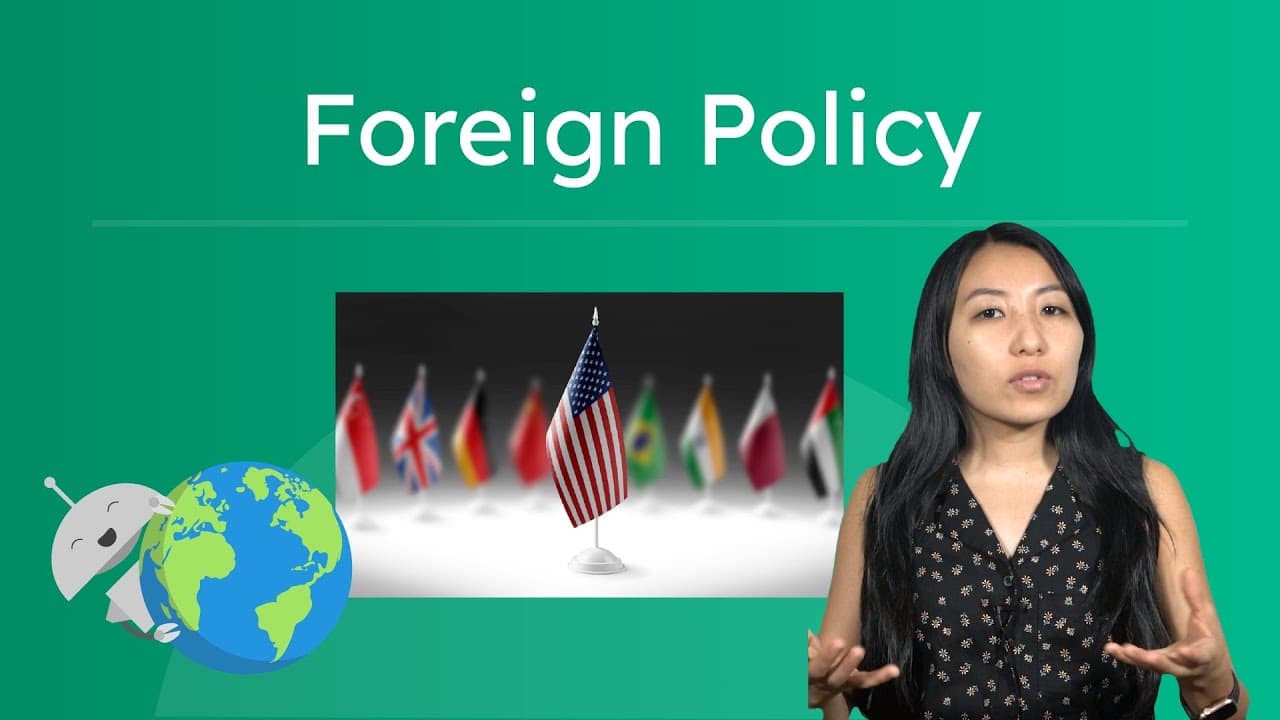
Evolution of US Foreign Policy: From Isolation to Superpower

Evolution of US Foreign Policy: From Isolation to Superpower

This educational video provides a comprehensive overview of United States foreign policy, tracing its evolution from the nation's founding to the modern era. It begins by establishing the Constitutional roles of the Executive, Legislative, and Judicial branches in crafting foreign policy, clarifying the balance of power between the President and Congress. The narrative then moves chronologically, highlighting George Washington's initial advice of isolationism and the shift toward interventionism through the Monroe Doctrine, territorial expansion, and the World Wars. The video explores the US's transition into a global superpower during the 20th century, covering the Cold War, the containment of communism, and post-9/11 military engagements. It also addresses contemporary issues such as foreign aid, trade deficits with nations like China, the rise of new economic powers like India, and global challenges like climate change and nuclear proliferation. The content emphasizes how historical events have shaped current diplomatic relationships and military presence worldwide. Designed for civics and history classrooms, this resource helps students connect historical precedents to current events. It concludes with a strong message about civic engagement, encouraging students to understand these complex issues so they can participate effectively in the democratic process through voting and debate. The video is an excellent tool for teaching the practical application of checks and balances and the history of America's role on the world stage.

Miacademy & MiaPrep Learning ChannelMiacademy & MiaPrep Learning Channel

9mins 54s

Exploring the American Revolution: Battles, Ideas, and Contradictions

Exploring the American Revolution: Battles, Ideas, and Contradictions

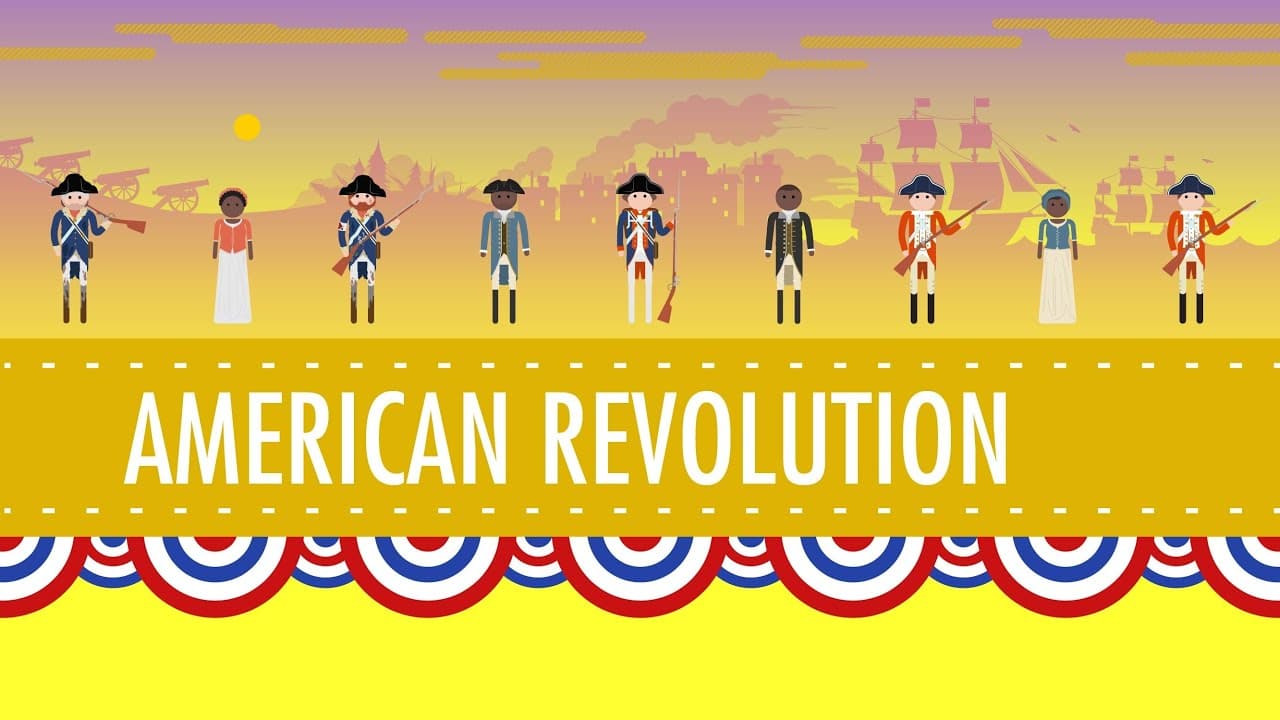
This fast-paced and engaging educational video dives deep into the American Revolution, moving beyond simple battle tactics to explore the complex social and political shifts—and stagnations—of the era. Host John Green challenges students to consider whether the American Revolution was truly "revolutionary" by examining who actually benefited from the war. While covering key military turning points like Saratoga and Yorktown, the narrative places equal weight on the experiences of soldiers, women, Native Americans, and enslaved people, offering a more nuanced view of the founding era than traditional textbooks often provide. Key themes include the contrast between the war's idealistic rhetoric and the reality of life for marginalized groups. The video tackles the "hypocrisy of liberty" by discussing how the Founding Fathers fought for freedom while maintaining a system of slavery. It introduces critical historical concepts such as "Republican Motherhood," the strategic differences between the British and Continental armies, and the varying motivations for different groups to join the fight. The role of international intervention, specifically from France, is also highlighted as a decisive factor in the war's outcome. For educators, this resource is an excellent tool for high school U.S. History and Civics classrooms. It serves as a powerful springboard for discussions about historical memory, the definition of freedom, and the long-term impacts of the Revolution on American society. Teachers can use the video's analysis to help students critique primary sources, understand historical irony, and evaluate the complexities of the founding documents in the context of the late 18th century.

CrashCourseCrashCourse

12mins 41s

How US Elections Work: The Constitution, Plurality, and Two Parties

How US Elections Work: The Constitution, Plurality, and Two Parties

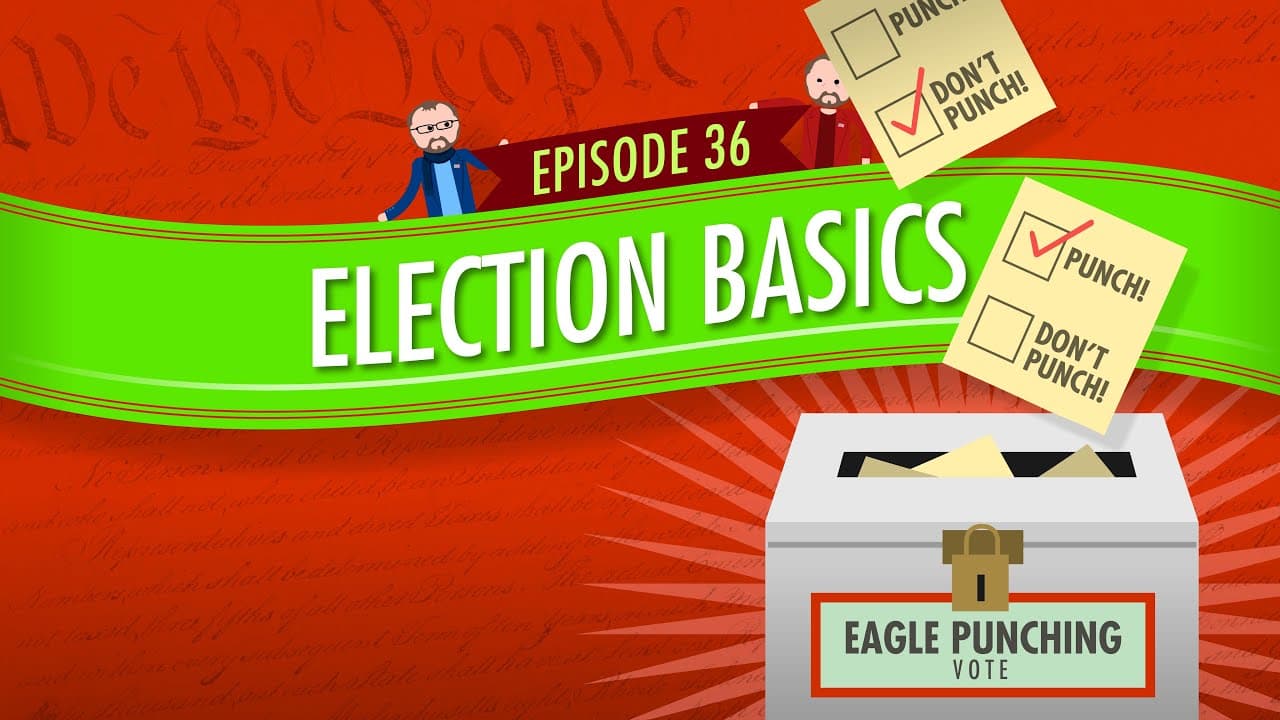
This fast-paced educational video explores the fundamental structures, rules, and theories behind elections in the United States. Hosted by Craig Benzine, the video moves beyond media coverage of campaigns to examine the constitutional and legal frameworks that dictate how elections actually work. It clarifies the division of power between federal and state governments in running elections, explaining that while the Constitution sets basic guidelines, individual states hold significant control over the "times, places, and manner" of elections. The video dives deep into political science concepts like "Adverse Selection" and the "Plurality Rule" (often called winner-take-all), using animated diagrams to demonstrate how these mathematical realities inevitably lead to the United States' two-party system through Duverger's Law. It also covers the history of voting rights, referencing key Constitutional amendments (12th, 17th, 24th, 26th) and the Voting Rights Act of 1965. For educators, this resource is an essential tool for high school Civics and Government classrooms. It helps students transition from a surface-level understanding of voting to a structural analysis of the political system. By explaining *why* the system produces specific outcomes (like why third parties rarely win), it empowers students to engage critically with political institutions rather than just observing candidates.

CrashCourseCrashCourse

8mins 46s

The Progressive Presidents: Roosevelt, Taft, and Wilson

The Progressive Presidents: Roosevelt, Taft, and Wilson

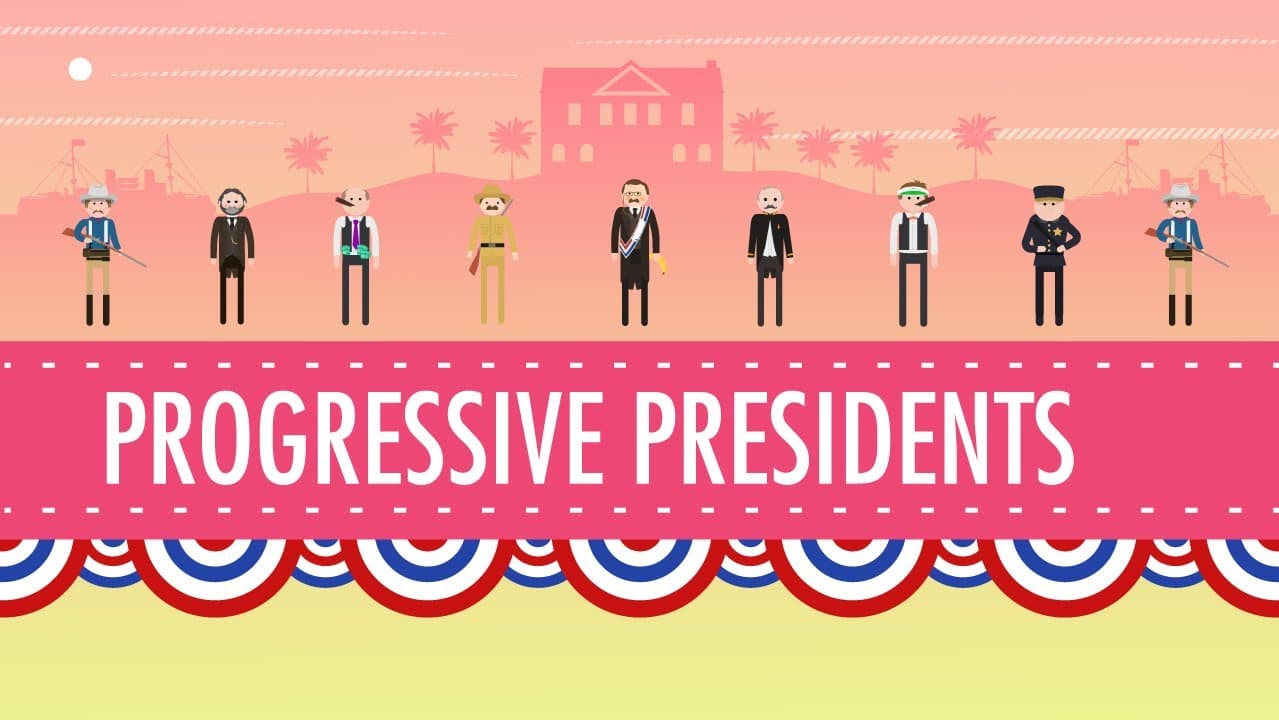
In this installment of Crash Course US History, John Green explores the Progressive Era through the lens of three key presidents: Theodore Roosevelt, William Howard Taft, and Woodrow Wilson. The video examines how the role of the federal government expanded significantly during the early 20th century, moving away from laissez-faire economics toward active regulation of big business and protection of social welfare. It contrasts the differing political philosophies of the time, such as Roosevelt's "New Nationalism" versus Wilson's "New Freedom," while highlighting the chaotic four-way election of 1912. The video delves deeply into the foreign policies of these presidents, challenging the notion that Progressivism was solely a domestic movement. It details the "Big Stick" diplomacy of Roosevelt, the "Dollar Diplomacy" of Taft, and the "Moral Diplomacy" of Wilson, showing how each led to increased U.S. intervention in Latin America and the Caribbean. Specific historical events like the construction of the Panama Canal, the occupation of Veracruz, and the pursuit of Pancho Villa are used to illustrate the contradictions between American ideals of freedom and its imperialistic actions abroad. This resource is highly valuable for high school history classrooms, particularly AP US History, as it synthesizes complex political and economic concepts into an engaging narrative. It provides concrete examples of federal legislation (like the Clayton Antitrust Act and the Federal Reserve Act) and constitutional amendments (16th, 17th, 18th, 19th) that reshaped American society. Teachers can use this video to spark discussions on the definition of the "modern presidency," the balance between liberty and government control, and the historical roots of American foreign policy.
CrashCourseCrashCourse

15mins 7s

How Federal Indian Law Shapes Native Sovereignty

How Federal Indian Law Shapes Native Sovereignty

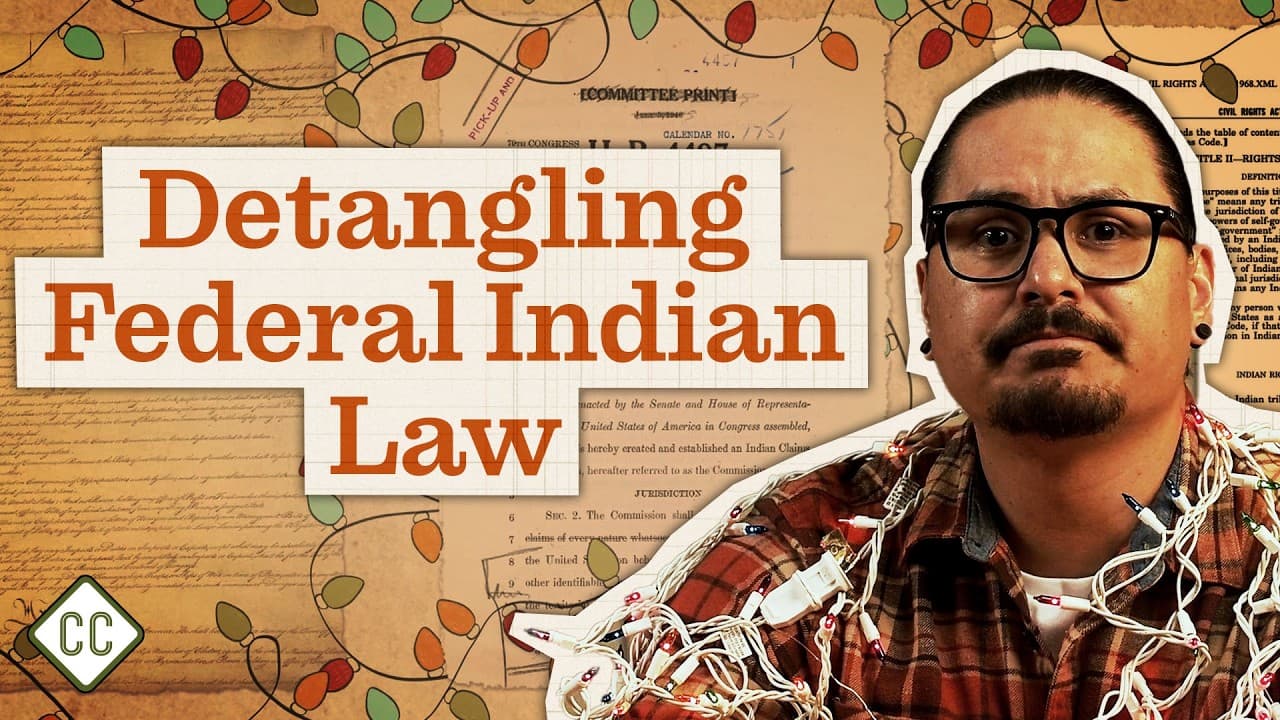
This episode of Crash Course Native American History tackles the incredibly complex and often confusing subject of Federal Indian Law. Host Che Jim explains that this isn't just a single set of rules, but a centuries-long accumulation of treaties, court cases, executive orders, and statutes that define the legal relationship between the United States government and Native nations. The video uses the metaphor of a tangled string of Christmas lights to visualize how messy and interconnected these legal precedents are, covering everything from international travel to criminal jurisdiction. The video explores three main levels of impact: the individual, the community, and the land. It provides concrete examples for each, such as the Haudenosaunee lacrosse team's struggle to travel on their own passports, the jurisdictional crisis contributing to the Missing and Murdered Indigenous Women (MMIW) epidemic, and the legal hurdles regarding land use and hunting rights. The concept of "Domestic Dependent Nations" is introduced to explain how tribes retain sovereignty while still being subject to U.S. federal power. For educators, this video is a vital resource for civics, government, and U.S. history classes. It moves beyond abstract definitions of sovereignty to show real-world consequences of legal technicalities. It addresses hard truths about systemic inequalities while also highlighting Indigenous resilience and legal victories, such as the restoration of hunting rights and the revival of traditional ecological practices like clam gardening to combat climate change.

CrashCourseCrashCourse

10mins 44s

How Constitutional Amendments Changed Government Structure

How Constitutional Amendments Changed Government Structure

This educational video explores the specific amendments to the U.S. Constitution that altered the structure and function of the federal government, rather than just focusing on individual rights. It categorizes these amendments into two main groups: those dealing with general government procedures (like taxation and congressional pay) and those specifically refining the office of the Presidency (including elections, terms, and succession). The video provides a chronological and thematic breakdown of Amendments 10, 11, 12, 16, 17, 20, 22, 23, 25, and 27. Key historical contexts are provided for each, such as the *Chisholm v. Georgia* Supreme Court case leading to the 11th Amendment and FDR's four terms leading to the 22nd Amendment. It effectively uses visual aids like maps, historical photos, and diagrams to explain complex concepts like Federalism and the Electoral College. Teachers can use this video to deepen students' understanding of U.S. Civics beyond the Bill of Rights. It is particularly useful for units on the Constitution, the Executive Branch, and the evolution of American democracy. The content explains *why* the government operates the way it does today, making abstract political rules concrete through historical examples.

Miacademy & MiaPrep Learning ChannelMiacademy & MiaPrep Learning Channel

8mins 46s

Materials

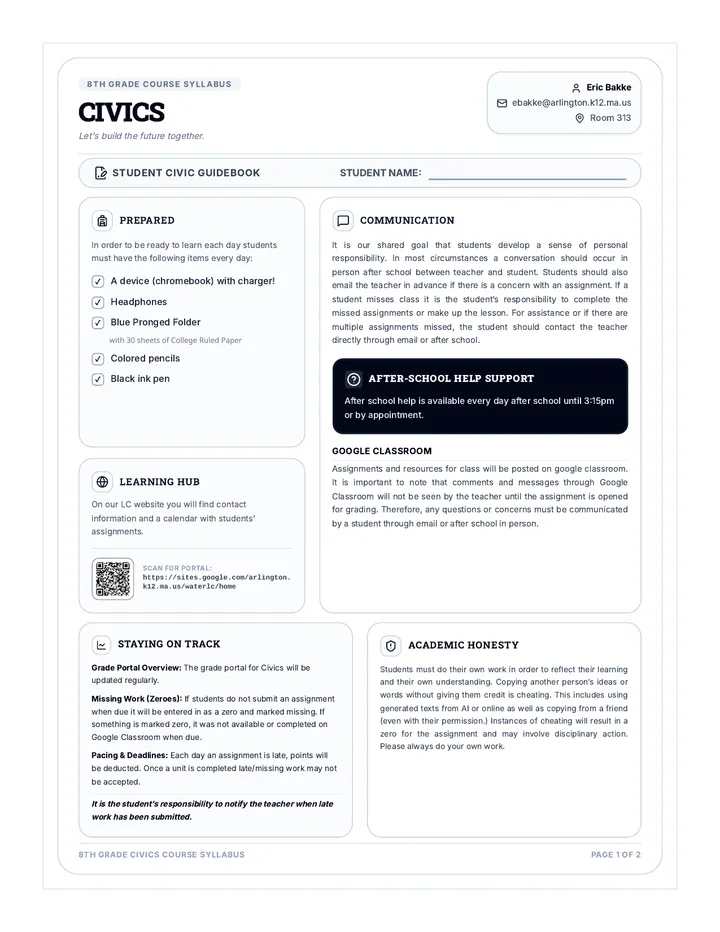
Civics Class Syllabus

Civics Class Syllabus

Civics Class Syllabus updated with an extra large QR code filling approximately half of the Digital Spaces container for maximum visibility and effortless scanning.

E

ebakke

Loving Legacy Worksheet

Loving Legacy Worksheet

A comprehensive, two-page student worksheet and reading comprehension guide about the landmark Supreme Court case Loving v. Virginia (1967). Designed for 8th-grade civics, it utilizes a clean legal-docket theme and includes deep reading passages on the 14th Amendment, followed by critical-thinking analysis prompts with dedicated writing areas.

T

tsundstrom

Southern Reconstruction Lecture Slides

Southern Reconstruction Lecture Slides

A comprehensive high school US History lecture slide deck analyzing how the southern economy and society transformed after the Civil War, covering devastation, labor shifts, sharecropping, constitutional amendments, racial backlash, and the Compromise of 1877.

LS

LeVar St Germain

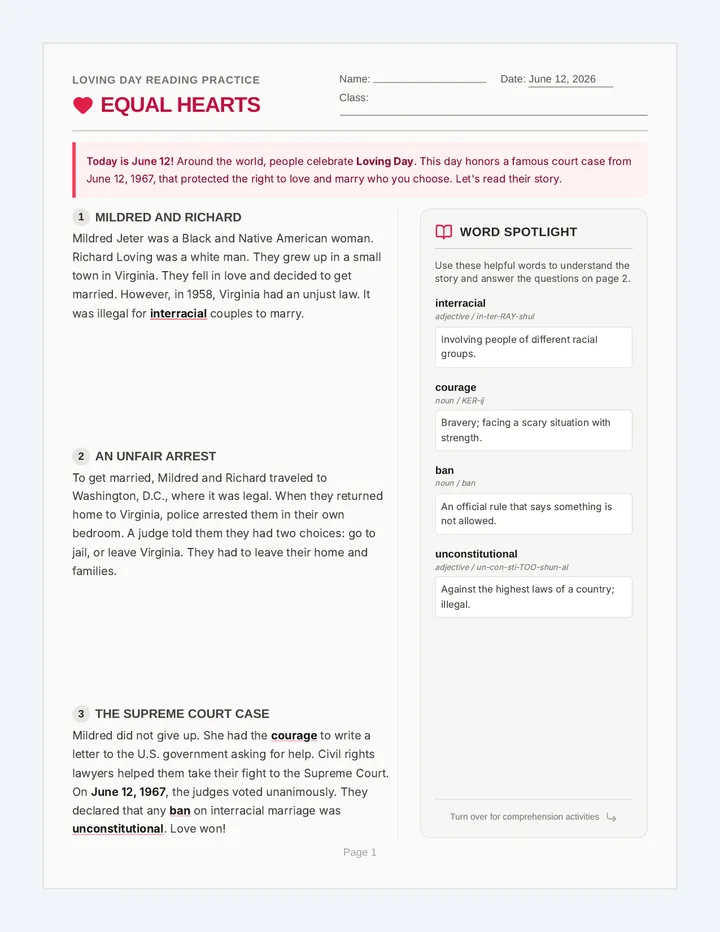
Equal Hearts Worksheet

Equal Hearts Worksheet

A standalone, double-sided printable reading worksheet designed for English Language Learners (ELL) focusing on Loving Day (June 12, 1967). Includes an accessible, scaffolded reading passage, a visual vocabulary spotlight, text-dependent comprehension questions with writing frames, and a creative reflection activity.

KO

Kelly Oshinnaiye

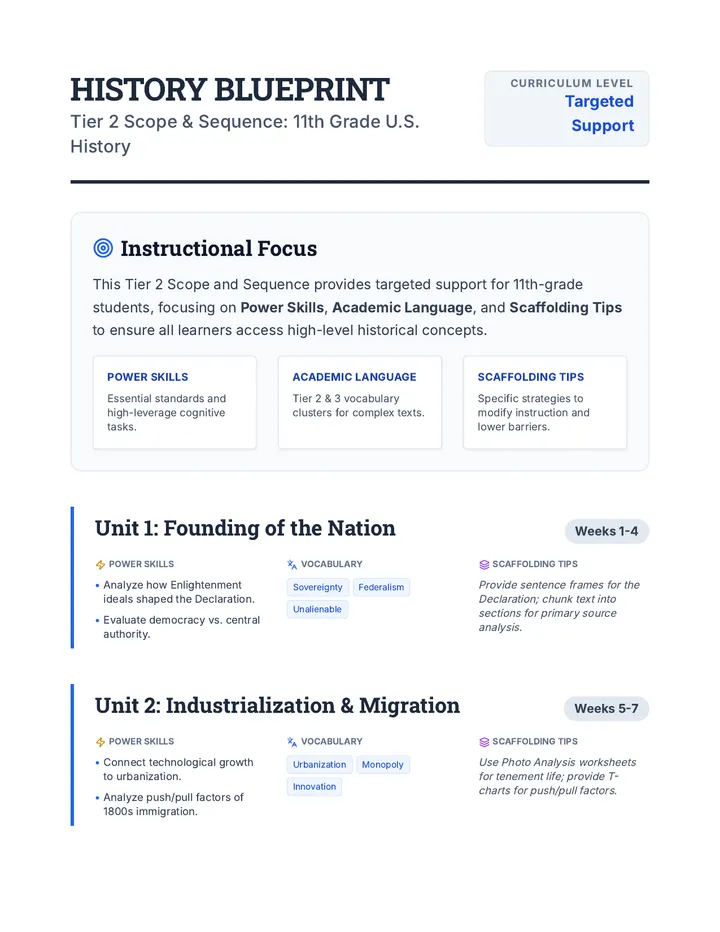
History Blueprint Scope and Sequence

History Blueprint Scope and Sequence

An updated Tier 2 Scope and Sequence for 11th Grade U.S. History, now including specific scaffolding tips for each unit alongside power skills and academic vocabulary. The layout is optimized for teacher reference with instructional strategies tailored for targeted support.

D

dfleisch

GoPo Vocabulary Ledger Document

GoPo Vocabulary Ledger Document

A simplified, course-long 5-page student vocabulary ledger for high school government classes. It provides a standardized definition writing system for 70 foundational terms across five major course units, offering clean lined handwriting grids for student notes.

HD

Howard Doblado

Sequences

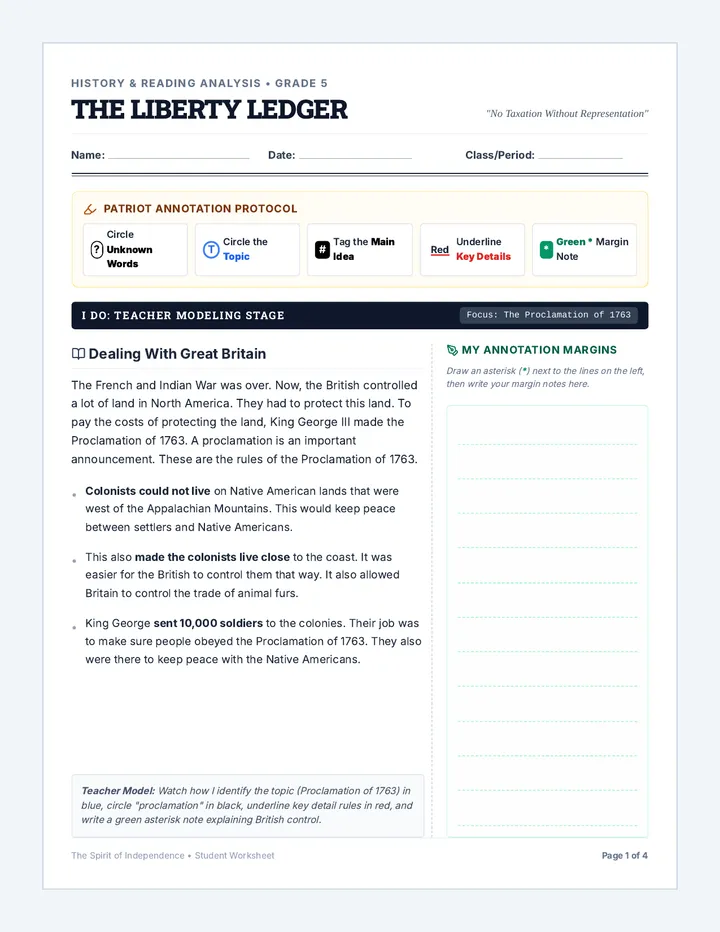
Liberty Ledger Annotation Worksheet

Spirit of Independence

A fifth-grade social studies and active reading unit exploring the growing friction between Great Britain and the American colonies, focusing on the causes, consequences, and motivated actions that led to the American Revolution.

MN

Monica Nava

7
Teacher Facilitation Guide

Revolutionary Dilemmas

A comprehensive book club unit for the historical fiction novel 'My Brother Sam is Dead', focusing on the moral complexities of the Revolutionary War, character transformation, and historical context.

KL

Kim Leary

8
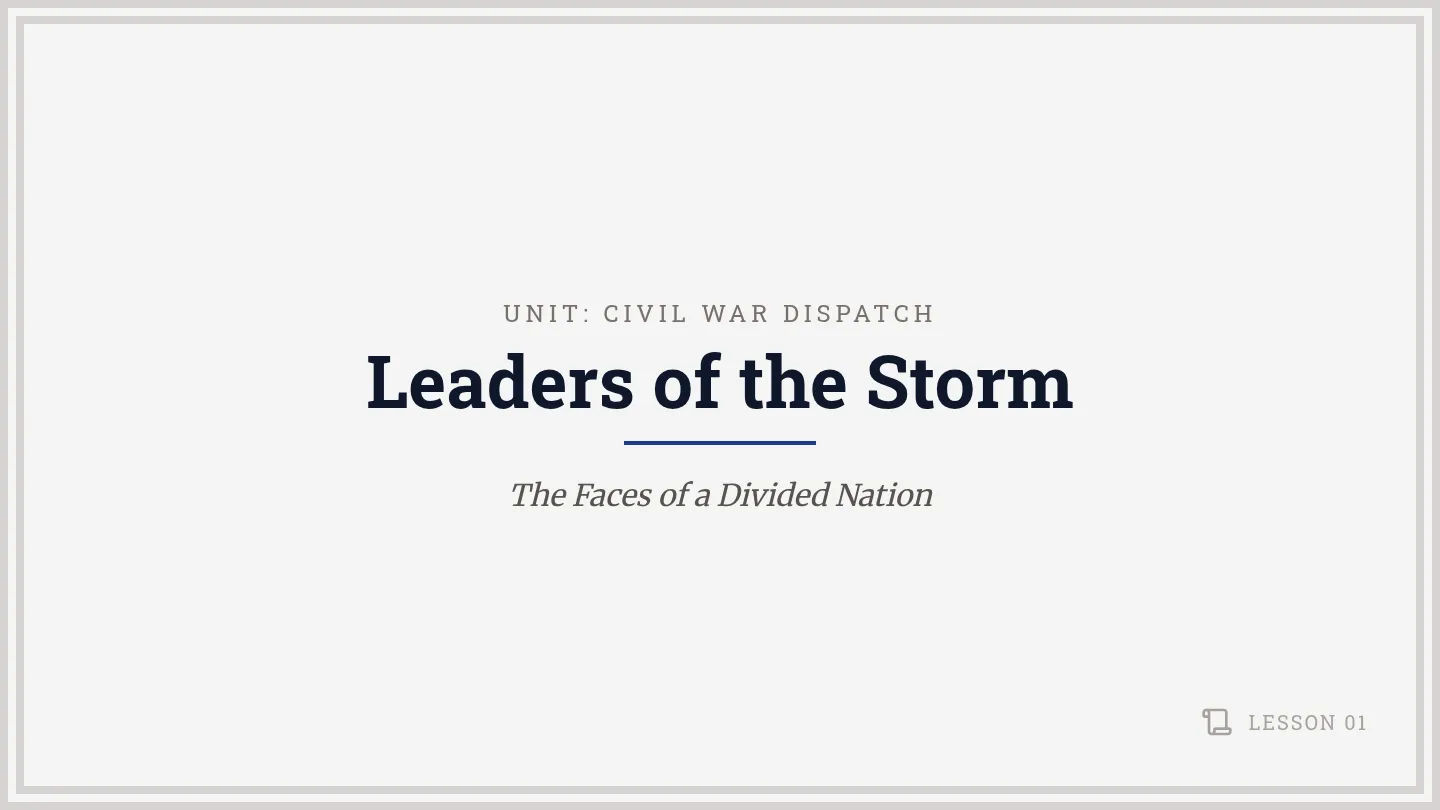
Leaders of the Storm Slides

Civil War Dispatch

A comprehensive 4-lesson unit for 5th grade exploring the pivotal figures, major conflicts, and the courageous escape routes of the American Civil War. Students engage with historical primary-source styles while learning about leadership and the quest for freedom.

IA

Isabella Adkins

12
Thirteen Friends Worksheet

Democratic Foundations

A series of lessons exploring the foundational documents and processes of the United States government, from the birth of the nation to the creation of modern laws.

SB

Stephanie Bizeur

40
Unity Roadmap Teacher Guide

Unity and Growth

A modified Modern US History curriculum (Founding to Present) for Tier 2 and 3 special education students, based on Grade 11 Social Studies standards. Focuses on government, industrialization, world wars, and civil rights.

D

dfleisch

26
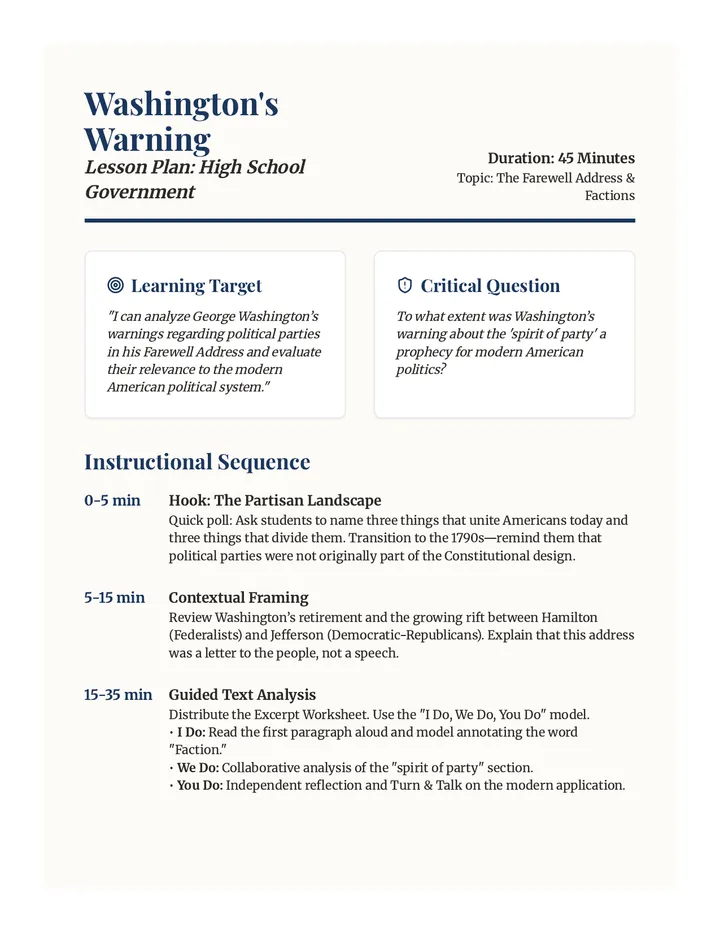
Washingtons Warning Lesson Plan

Washington's Farewell Legacy

A two-part sequence that takes students from a deep-dive analysis of George Washington's Farewell Address to a modern-day evaluation of his warnings regarding political parties, media bias, and national unity.

CE

Chelsea Elliott

24

Lessons

History Sprint Pacing Guide

STAAR History Sprint

A comprehensive pacing guide and activity resource designed to cover the remaining 11th Grade US History TEKS before the STAAR test on April 16th. This lesson provides a day-by-day calendar for A/B block schedules and high-engagement activities for each remaining historical era.

BB

Bridgette Burdick

51
Border Lines Activity

Harriet Tubman Escape

A lesson exploring Harriet Tubman's 1850 escape and the significance of the Mason-Dixon Line as a geographical and legal boundary in the pre-Civil War United States.

TL

Tanya Larson

46
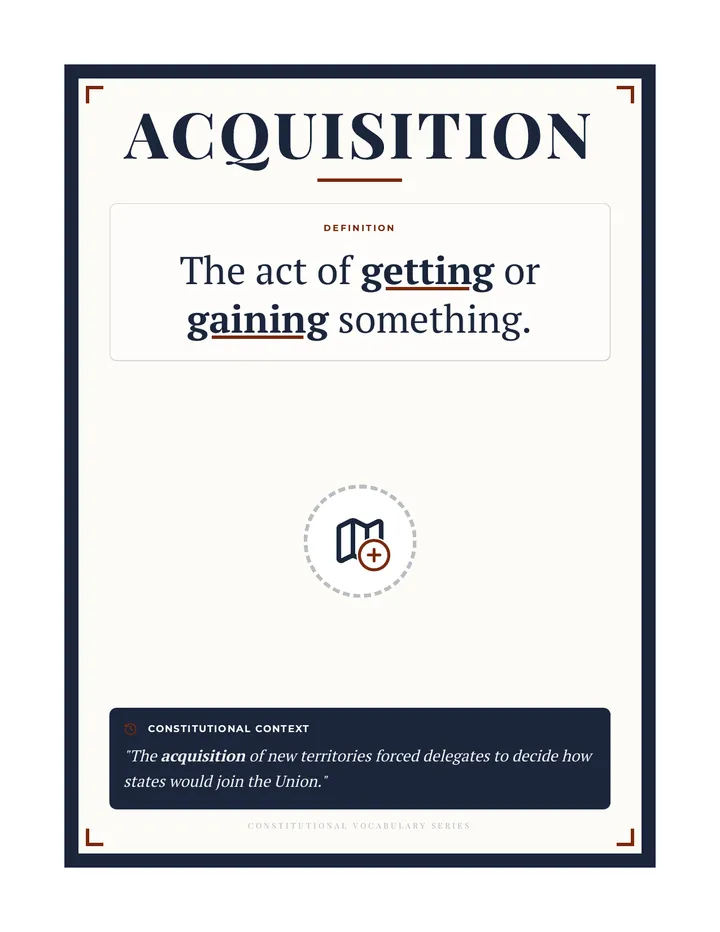
Constitutional Vocabulary Poster Set

Constitutional Vocabulary

A set of vocabulary posters focused on key terms from the Constitutional Convention, including government structures, legislative roles, and foundational principles like compromise and federalism.

SA

Senta Agnello-Shelton

21
Modern Era Reader Part 1

The Modern Ledger

A comprehensive exploration of the 1990s through the modern day, covering technological shifts, political milestones, military conflicts, and cultural evolution in the United States.

CE

Chelsea Elliott

20
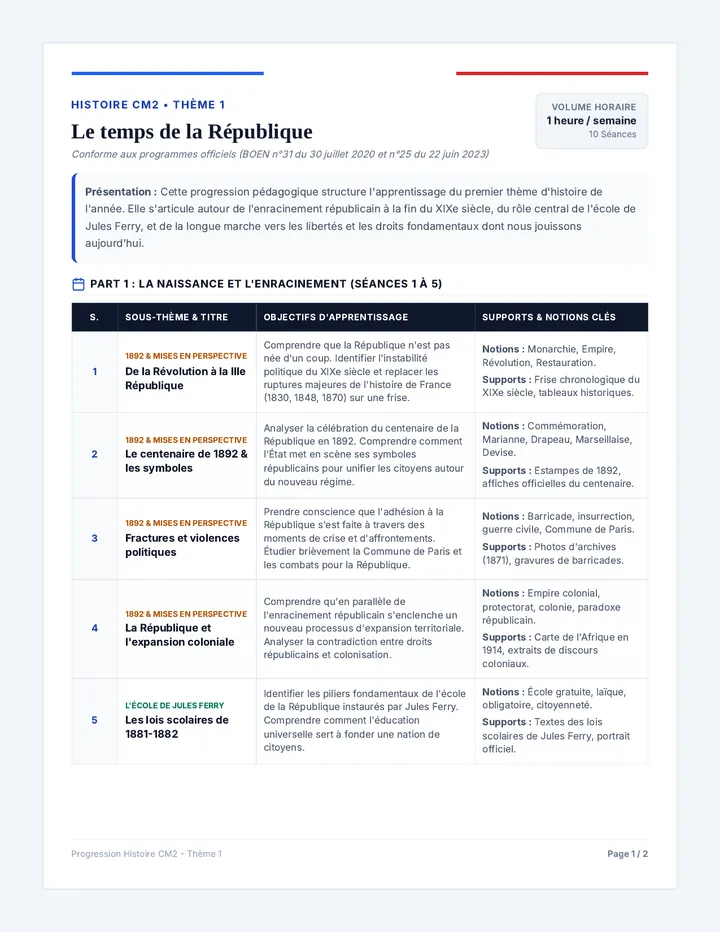
Progression Annuelle Histoire CM2

Le Temps de la République

Une progression pédagogique de 10 séances d'histoire pour le CM2, couvrant l'intégralité du premier thème 'Le temps de la République' selon les programmes officiels de 2020 et 2023. Elle structure la mise en perspective historique de 1892, l'école de Jules Ferry, ainsi que la conquête des libertés, droits et devoirs.

AC

anne chandelier

37
Branch Breakdown Reading

Branch Builders

A comprehensive introduction to the three branches of the U.S. government, focusing on the roles and responsibilities of the Legislative, Executive, and Judicial branches.

GM

Geneva Manus

10