A 4-week unit sequence for 10th-grade CP American Studies detailing the transition from colonial foundations to the Declaration of Independence. The sequence guides students through regional geographies, mercantile friction, imperial wars, taxation without representation, street activism, and the Enlightenment philosophy that culminated in the 1776 voting for independence. This unit scaffolds toward a summative assignment where students draft an open letter to the Second Continental Congress from the perspective of a New Hampshire delegate.
Summative Connection Reminder: You will use these findings in paragraph 2 of your delegate letter to describe the "long history of independent governance" that pre-dates Parliamentary taxes.
Road to Revolution • Colonial Charters Analysis Page 2 of 2
Crucial Link: This historic "taxation by consent" habit is why 1765 direct taxes triggered outrage! Slide 4 of 6
Day 4 Focus
Charter Showdown: Virginia vs. Massachusetts
Primary Sources
Virginia Charter (1606)
Motivation: Joint-stock commercial venture seeking immediate economic return and expansion.
Established corporate hierarchy but guaranteed that colonists retained "all liberties, franchises, and immunities" as if born in England.
Massachusetts Bay Charter (1629)
Motivation: Religious commonwealth escaping Anglican conformity to establish a pure community.
Compact-based, community-focused, merging church and state, with an emphasis on mutual civic covenant.
Worksheet Check: Ensure your "Charter Showdown Worksheet" comparison chart is completed! Slide 5 of 6
Week 1 Synthesis
Scaffolding Your Delegate Persona
Summative Link
New Hampshire Delegate Evidence Tasks
1. Regional Identity
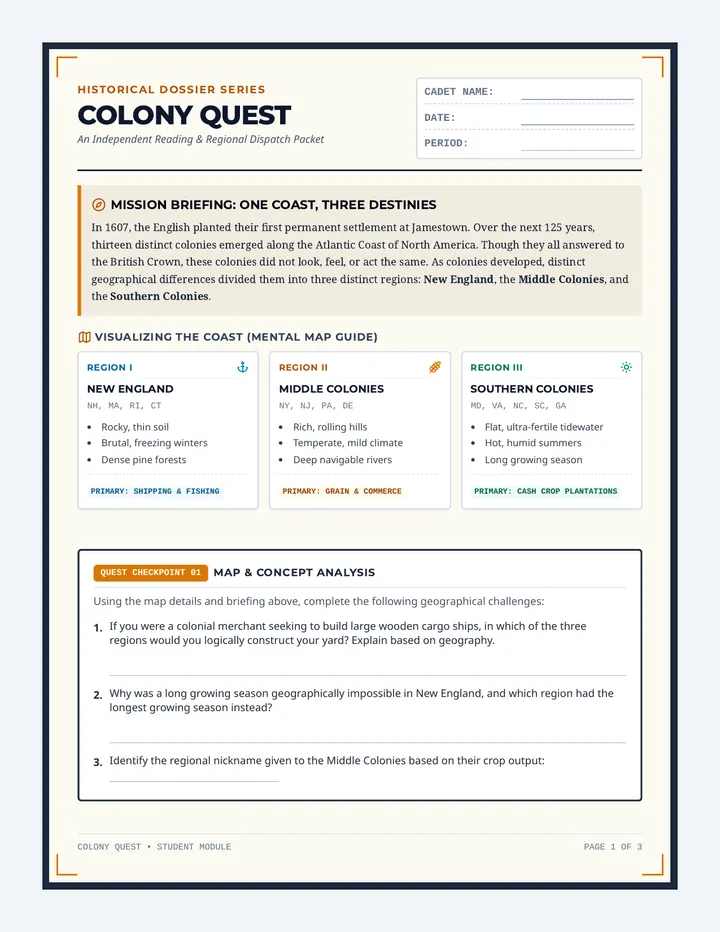
Record New Hampshire's maritime economic activities (shipping, timber, naval stores) and Puritan heritage in your Delegate Evidence Journal (Page 1).
2. The "Right of Self-Rule" Argument
Document how decades of Salutary Neglect allowed your colony to control local taxes, establishing the fundamental constitutional precedent of "consent."
Remember: Every colonial grievance starts as a violated legal charter right. Slide 6 of 6
Core Content Outline
Mercantilist Theory
Wealth is finite, measured in gold/silver. Mother country forces colonies to export raw materials and import finished industrial goods. Promotes complete commercial subordination.
The Navigation Acts
Requires all colonial exports to travel on British ships. Enumerated articles (e.g., timber, tobacco) must land in England first for taxation. Restricts direct continental trading.
Immersive Activity: The Customs Collector Game
Setup (10 Mins): Designate three students as Royal Customs Officers with tax stamps, and the rest as Smuggling Captains. Give Captains hidden cargo cargo cards (tea, molasses, timber).
Action (15 Mins): Smuggling Captains must physically move across the room to a designated "Dutch Port" desk. If intercepted by an Officer, they must declare their cargo under the Navigation Acts guidelines, paying token fines or forfeiting materials.
Summative Integration: Demonstrates the friction created by the King’s "Broad Arrow" policy (marking NH white pines for the Royal Navy), showing students the physical weight of royal intervention.
Day 2 Exit Ticket (Formative Checklist)
Prompt for Students: "How did the British Broad Arrow policy on New Hampshire white pines create friction between colonial lumbermen and royal officials?"
Teacher Guide: Students should note that royal surveyors marked the tallest white pines (prime mast timber) as Crown property, prohibiting local landowners from harvesting them. This represented a direct infringement on private property rights.
Road to Revolution • Days 1-4 Teacher Plans Page 2 of 4
Teacher Lesson Plans • Day 3
Colonial Foundations
Day 3: Democratic Experiments & Salutary Neglect
Day 3
Lesson Goal
Deconstruct how the administrative policy of "salutary neglect" enabled the rise of autonomous legislative assemblies and direct democracy practices in colonial America.
Core Content Outline
Democratic Institutions
New England town meetings developed pure local democracy. Virginia's House of Burgesses established representative assembly and the absolute right to write local tax law.
Salutary Neglect
British policy of loose enforcement of trade laws. Driven by geographical distance, high administrative costs, and focus on European wars, this built a habit of complete self-rule.
Immersive Activity: The Town Meeting Fishbowl
Setup (10 Mins): Arrange desks in concentric rings. Place six desks in the center for "Portsmouth Selectmen." The teacher acts as the Royal Governor, sitting in the corner and remaining silent.
Action (15 Mins): Selectmen must debate and vote on a local property tax to repair a bridge. Outer ring students can tag in. Students experience how local funding decisions were historically held completely out of royal hands.
Summative Integration: Scaffolds the historical self-governance arguments required in the final letter, proving that self-rule was an established regional norm rather than a radical innovation.
Day 3 Exit Ticket (Formative Checklist)
Prompt for Students: "Why did decades of 'salutary neglect' make later direct British taxation feel like a constitutional crisis rather than routine imperial administration?"
Teacher Guide: Students must argue that because Britain let the colonial assemblies legislate and tax themselves for generations, colonists viewed local legislative consent as an established legal right, making parliamentary taxation feel like an illegal seizure.
Road to Revolution • Days 1-4 Teacher Plans Page 3 of 4
Teacher Lesson Plans • Day 4
Colonial Foundations
Day 4: Comparing Charters: Virginia vs. Massachusetts Bay
Day 4
Lesson Goal
Deconstruct early colonial charters to evaluate corporate vs. religious covenant models of governance, comparing how legal boundaries defined individual and collective liberty.
Core Content Outline
Virginia Charter (1606)
Corporate, joint-stock model. Designed for resource extraction and trade profit. Guaranteed settlers and their heirs the same legal liberties as if they were residing in England.
Massachusetts Bay (1629)
Religious covenant model. Charter document physically relocated to America, enabling self-rule away from royal agents. Framed as a biblically accountable social contract.
Immersive Activity: The Charter Autopsy
Setup (10 Mins): Distribute the Charter Showdown Worksheet. Place students in analysis pairs.
Action (15 Mins): Pairs execute textual analysis. Highlight sovereign authority limits in green, and "English liberties" in pink. Complete the comparative analysis matrix, evaluating where ultimate authority lies.
Summative Integration: Teaches students to treat historical documents as contracts, showing that local rights were charter-guaranteed law, which makes parliament's subsequent moves illegal.
Day 4 Exit Ticket (Formative Checklist)
Prompt for Students: "Why did colonial lawyers emphasize that royal charters guaranteed them the 'rights of Englishmen' equal to those citizens living in London?"
Teacher Guide: Students should explain that charters functioned as written, legally binding contracts. By proving they held the same rights as citizens in London, they could claim that taxing or governing them without representation broke that contract.
Road to Revolution • Days 1-4 Teacher Plans Page 4 of 4
SS 1.1 (Evaluate Context)
Road to Revolution • Boston Massacre Perspectives Page 2 of 2
Colonial Counter: Denied. Only regional colonial assemblies have the authority to raise internal taxes!
Discussion: What is the constitutional difference between an internal tax and a custom tariff? Slide 4 of 7
Day 8 Focus
Sons of Liberty & Committees of Correspondence
Organized Resistance
Sons of Liberty
Radical resistance networks led by figures like Samuel Adams. They enforced total commercial boycotts of British imports through:
• Public protests and burning of effigies.
• Direct coercion (tarring & feathering of royal tax collectors).
Committees of Correspondence
The first horizontal inter-colonial communications network. They bypassed royal censors and colonial governors to:
• Share news of British overreach.
• Coordinate uniform, colony-wide boycotts and legal arguments.
Takeaway: The colonies are building the horizontal infrastructure of a unified state. Slide 5 of 7
Day 9 Focus
The Boston Massacre: Sourcing & Propaganda
March 5, 1770
The Patriot Frame (Revere)
Paul Revere's highly selective engraving. It depicts orderly, smirking British soldiers firing a coordinated volley into a peaceful, defenseless crowd of upper-class colonists.
Goal: Stoke instant, emotional outrage across all colonies.
The Crown Deposition (Preston)
Captain Thomas Preston's official court testimony. He depicts a chaotic, violent, 100-man mob armed with clubs and ice chunks throwing items and yelling "Fire if you dare!"
Goal: Prove self-defense and royal order against urban anarchy.
Worksheet Check: Complete the "Boston Massacre Perspectives Worksheet" source analysis! Slide 6 of 7
Week 2 Synthesis
Scaffolding Your Delegate Persona
Summative Link
New Hampshire Delegate Evidence Tasks
1. Track "Crown Abuses" (A)
Record the Proclamation of 1763, the quartering of peace-time standing armies, and the direct taxation of the Stamp Act on Page 2 of your Delegate Evidence Journal.
2. Analyze the Colonial Response
How does New Hampshire's port (Portsmouth) cooperate with the horizontal boyotts of the Sons of Liberty? Use these networks as proof of colonial readiness for self-regulation.
Every abuse is a link in the chain that binds the colonies to revolt. Slide 7 of 7
Proclamation of 1763
King George III forbids colonial settlement west of the Appalachian Mountains. Designed to prevent expensive conflicts with Native Americans (like Pontiac's Rebellion), but deeply angered land speculators.
Imperial Financial Crisis
War debt ballooned to over £140 million. British taxpayers are over-burdened, prompting Parliament to seek administrative cost-recovery directly from the American colonies via new standing armies.
Immersive Activity: The Redcoat Tax Bill Calculations
Setup (10 Mins): Provide simple mathematical values on the board: British Debt in 1763 (£140,000,000); annual cost of 10,000 redcoats stationed on the frontier (£220,000); average tax paid by a British resident vs. a colonist (approx 50:1 ratio).
Action (15 Mins): Students act as clerks in the British Treasury Office under Chancellor George Grenville. They must propose an emergency imperial budget allocating tax revenue across the empire to cover the troop cost, discovering why Parliament targeted colonial commerce.
Summative Integration: Contextualizes the initial, direct infractions of colonial property and physical security that their delegate will cite as historical abuses in the final open letter.
Day 6 Exit Ticket (Formative Checklist)
Prompt for Students: "Why did the Proclamation of 1763 feel like a betrayal to colonial veterans who had just fought in the Seven Years' War?"
Teacher Guide: Students should identify that veterans expected to claim fertile farm plots in the Ohio Valley as a reward for their service. The boundary line felt like the King was prioritizing Native allies over his own loyal subjects' labor and sacrifice.
Road to Revolution • Days 5-9 Teacher Plans Page 2 of 5
Teacher Lesson Plans • Day 7
The Imperial Crisis
Day 7: Stamp Act & Colonial Reactions
Day 7
Lesson Goal
Deconstruct the constitutional debate over "taxation without representation" vs "virtual representation," and analyze the coordinate work of the Stamp Act Congress and local economic boycotts.
Core Content Outline
Internal vs. External Taxes
Stamp Act (1765) is the first direct, internal tax on paper, legal writs, and playbills. Unlike external customs duties on imports, this bypassed local assemblies entirely.
Representation Theories
British: "Virtual representation" claims Parliament represents all subjects. Colonists: "Actual representation" demands that only representatives physically elected by colonists can levy taxes.
Immersive Activity: Stamp Act Congress Debate
Setup (10 Mins): Appoint three students to sit at the front as "British Ministers defending the Stamp Tax." Group the remaining class as colonial delegates to the 1765 Stamp Act Congress.
Action (15 Mins): Delegates draft formal, respectful resolutions outlining why an internal tax violates the British Constitution. Students must challenge the ministers' theory of "virtual representation" using legal and chartered precedents.
Summative Integration: Establishes the constitutional vocabulary regarding legislative sovereignty and consent that must be integrated into the delegate's letter to Congress.
Day 7 Exit Ticket (Formative Checklist)
Prompt for Students: "Explain the difference between Great Britain's theory of 'virtual representation' and the American colonists' demand for 'actual representation'."
Teacher Guide: Students must state that virtual representation argued Parliament cared for all British subjects regardless of voting presence, whereas actual representation required physical, local election of legislators for tax consent to be valid.
Road to Revolution • Days 5-9 Teacher Plans Page 3 of 5
Teacher Lesson Plans • Day 8
The Imperial Crisis
Day 8: Sons of Liberty: Propaganda & Activism
Day 8
Lesson Goal
Investigate the radical resistance strategies of the Sons and Daughters of Liberty, and analyze how the Committees of Correspondence created a unified horizontal communication network.
Core Content Outline
Direct & Economic Resistance
Sons of Liberty deploy crowd actions, tax-collector intimidation (tarring and feathering). Daughters of Liberty coordinate massive non-importation boycotts of British goods, spinning homespun cloth.
Committees of Correspondence
Created by Samuel Adams to share news of royal abuses across colonies. Sidestepped royal postal systems to build inter-colonial trust, uniting disparate regional interests.
Immersive Activity: Committee of Correspondence Dispatch
Setup (5 Mins): Distribute parchment paper or basic writing templates. Appoint students to represent local Committees in Portsmouth, NH, Boston, MA, and Charleston, SC.
Action (20 Mins): Boston writes a circular describing a recent royal tariff. They must physically "pass" it to New Hampshire. NH must draft an addition confirming solidarity and outlining how they will enforce a regional boycott of English imports.
Summative Integration: Demonstrates how New Hampshire delegates used horizontal communication networks to align policy, setting up their collaborative perspective in the Second Continental Congress.
Day 8 Exit Ticket (Formative Checklist)
Prompt for Students: "How did the Committees of Correspondence successfully bridge regional, religious, and economic divides among the thirteen colonies?"
Teacher Guide: Look for students to explain that the committees allowed colonies to share real-time, verified news of royal abuses directly. By standardizing information, it framed local Boston grievances as a shared threat to all American chartered liberties.
Road to Revolution • Days 5-9 Teacher Plans Page 4 of 5
Teacher Lesson Plans • Day 9
The Imperial Crisis
Day 9: The Boston Massacre: Sourcing Perspectives
Day 9
Lesson Goal
Conduct a detailed DBQ sourcing analysis comparing Paul Revere's Boston Massacre engraving and Captain Preston's trial deposition, deconstructing bias and loaded rhetoric.
Core Content Outline
Paul Revere's Propaganda
Engraving titles event a "Bloody Massacre." Depicts defenseless citizens shot in cold blood by a coordinated firing squad under order. Suppresses mob actions (ice, club throwing).
Captain Preston's Deposition
Claims the mob was aggressive, shouting death threats. Asserts he never gave the command to "fire" and that the shots were chaotic reactions to an soldier being physically struck.
Immersive Activity: The Boston Massacre Mock Inquest
Setup (10 Mins): Distribute the Boston Massacre Perspectives Worksheet containing Captain Preston's deposition and Revere's print. Divide class into two legal teams (Defense and Prosecution).
Action (15 Mins): The Prosecution team highlights Preston's statements that show gross negligence, while the Defense team highlights witness testimony showing the crowd's violent behavior. Each team presents a 2-minute closing argument to a student jury.
Summative Integration: Builds student proficiency in analyzing contradictory, biased historical accounts, a critical skill when framing grievances in their final delegate letters.
Day 9 Exit Ticket (Formative Checklist)
Prompt for Students: "How does a comparison of Paul Revere's engraving and Captain Preston's deposition show the power of media framing in revolutionary mobilization?"
Teacher Guide: Look for students to analyze how Revere edited the image (bright red coats, daytime lighting, defensive layout) to trigger outrage, whereas Preston's text highlights chaotic self-defense in a pitch-black alley, showcasing media's power to shape public anger.
Road to Revolution • Days 5-9 Teacher Plans Page 5 of 5
Lexington & Concord
Royal General Gage orders troops to seize colonial weapon stockpiles. Armed local minutemen clash with Redcoats. The "shot heard 'round the world" is fired.
The Shift: The dispute transitions from constitutional debate to physical, blood-shedding warfare.
Discussion: Can colonies return to reconciliation once British soldiers fire on British subjects? Slide 4 of 7
Day 13 Focus
The Enlightenment: Shift to Reason
Intellectual Shift
What was the Enlightenment?
An 18th-century philosophical movement emphasizing reason, science, and individual skepticism over traditional authority.
Key Shifts: • Old World: Kings rule by Divine Right (chosen by God), subjects owe absolute obedience.
• Enlightened World: Governments are human inventions created to preserve individual natural rights.
Natural Laws
Just as Isaac Newton discovered natural laws governing gravity, political philosophers argued that there are natural laws that govern human societies and individual rights.
Vocabulary: Natural Rights, Consent, and Contract.
Discussion: Why did this scientific view of government directly threaten monarchies? Slide 5 of 7
Day 14 Focus
John Locke & The Second Treatise
The Social Contract
State of Nature & Rights
Locke argues humans were born free and equal in a state of nature.
We possess inalienable Natural Rights: Life, Liberty, and Property.
"Government is built to protect these rights, not to take them away."
The Social Contract
Citizens voluntarily yield some absolute freedom to form a government, giving consent of the governed in exchange for security and property protection.
The Right to Revolt: If a ruler acts as a tyrant and systematically breaches this contract, the contract is broken and citizens possess a moral obligation to overthrow the regime!
Task: Ensure you've completed your Locke source extraction in the Lock & Paine Worksheet! Slide 6 of 7
Week 3 Synthesis
Scaffolding Your Delegate Persona
Summative Link
New Hampshire Delegate Evidence Tasks
1. Log physical trigger events
Record the Coercive Acts and the clashes at Lexington & Concord on Page 3 of your Evidence Journal. These prove British force has escalated beyond repair.
2. Build the "Right to Revolt" logic
Use John Locke's social contract principles to build your philosophical arguments: Great Britain has broken its sacred contract by blockading colonial ports and taxing without consent.
Philosophy supplies the logical justification; physical abuses supply the empirical evidence. Slide 7 of 7
Core Content Outline
Boston Tea Party (Dec 1773)
Sons of Liberty dump 342 chests of tea (£10,000 value) into Boston Harbor. Highly organized, quiet property destruction, refusing to steal or damage non-tea cargo.
Coercive Acts (1774)
Called "Intolerable" in America. Closes Boston Harbor, suspends Massachusetts town meetings and local self-rule, establishes a military governor (Gage), and updates the Quartering Act.
Immersive Activity: The Intolerable Acts Impact Map
Setup (10 Mins): Distribute worksheets with four concentric circular zones labeled: 1. Individual Property, 2. Local Community Business, 3. Chartered Government, and 4. Inter-colonial Alliance.
Action (15 Mins): Students analyze the provisions of the Boston Port Act and Massachusetts Government Act. They must plot these laws onto the concentric zones, showing how the acts physically stripped colonists of their fundamental chartered rights.
Summative Integration: The Coercive Acts are the critical "abuses" that drive New Hampshire's delegate to favor armed coordination, proving that the King had broken his charter obligations.
Day 11 Exit Ticket (Formative Checklist)
Prompt for Students: "Why did the Coercive Acts, aimed specifically at punishing Massachusetts, unify other colonies rather than isolating Boston as Parliament intended?"
Teacher Guide: Students should explain that other colonies realized that if Parliament could arbitrarily suspend Massachusetts' royal charter and close their port, they could do the same to any other colony. It made local chartered liberties feel universally threatened by royal power.
Road to Revolution • Days 10-14 Teacher Plans Page 2 of 5
Teacher Lesson Plans • Day 12
Escalation & Philosophy
Day 12: Continental Congress & Armed Escalation
Day 12
Lesson Goal
Trace the political work of the First Continental Congress, and evaluate how the armed clashes at Lexington and Concord in April 1775 shifted the colonial resistance from protest to physical defense.
Core Content Outline
First Continental Congress (1774)
Twelve colonies meet in Philadelphia. Draft Declaration of Rights and Grievances. Form "The Association" to enforce complete boycotts. Crucially endorse the radical Suffolk Resolves.
Lexington & Concord (April 1775)
British troops seek to seize colonial weapon caches in Concord. Gunfire at Lexington ("Shot heard 'round the world"). Guerilla warfare along the road back to Boston.
Immersive Activity: The Suffolk Resolves Crisis Debate
Setup (10 Mins): Group students as delegations at the First Continental Congress. Distribute copies of the Suffolk Resolves (urging tax withholding, boycott, and local militia drills).
Action (15 Mins): Delegations must debate whether to endorse these resolutions. Conservative delegates (Joseph Galloway) warn it will trigger civil war; radical delegates (John Adams) argue that a show of military willingness is the only language Parliament understands.
Summative Integration: Connects directly to the shift from peaceful petitioning to active military organization in New Hampshire, as students write from their delegate persona.
Day 12 Exit Ticket (Formative Checklist)
Prompt for Students: "How did the battles at Lexington and Concord change the nature of the dispute between the American colonies and Great Britain from a constitutional debate to a military war?"
Teacher Guide: Students must state that prior to April 1775, colonial resistance was centered on economic boycotts and constitutional legal arguments. Once British soldiers and colonial militia spilled each other's blood on American soil, reconciliation became nearly impossible, requiring active physical mobilization.
Road to Revolution • Days 10-14 Teacher Plans Page 3 of 5
Teacher Lesson Plans • Day 13
Escalation & Philosophy
Day 13: The Enlightenment & Natural Rights Philosophy
Day 13
Lesson Goal
Trace the European intellectual shift from traditional divine monarchies to rational political observation, establishing the vocabulary of natural laws and innate human value.
Core Content Outline
The Scientific Roots
Newton and Galileo proved the universe runs on rational, discoverable physical laws. Enlightenment thinkers applied this scientific method directly to human society and politics.
The Critique of Monarchy
Challenged the absolute divine right of kings. Argued that political systems are creations of human reason, designed to serve human needs, and therefore subject to criticism.
Immersive Activity: The Scientific Revolution of Society
Setup (10 Mins): Present two columns on the board: Tradition & Faith vs. Reason & Science. Provide students with cards depicting 18th-century social customs.
Action (15 Mins): Students must physically categorize their cards. For example, "King George rules because God chose his family" goes to Tradition; "Governments are formed by agreements to protect property" goes to Reason, modeling the deep shift in human thought.
Summative Integration: Establishes the high-level intellectual vocabulary and logical premises of individual value and rights that students will deploy to justify revolution.
Day 13 Exit Ticket (Formative Checklist)
Prompt for Students: "How did the Enlightenment's focus on human reason challenge traditional political arguments that monarchs ruled by divine, unquestionable right?"
Teacher Guide: Students should argue that by asserting that human societies are governed by natural, rational laws rather than direct divine intervention, the Enlightenment made monarchies subject to critique. If a king's rule was irrational or harmful, it could be questioned and altered by human action.
Road to Revolution • Days 10-14 Teacher Plans Page 4 of 5
Teacher Lesson Plans • Day 14
Escalation & Philosophy
Day 14: Enlightenment Ideals: John Locke's "Second Treatise"
Day 14
Lesson Goal
Deconstruct John Locke's political principles including natural rights, the social contract, consent of the governed, and the legal criteria that trigger a right to revolution.
Core Content Outline
Social Contract Theory
Humans are born with innate, inalienable rights (life, liberty, property). To protect these rights, they consensually form a government, yielding minor personal freedoms in exchange for collective legal protection.
Right to Revolution
If a sovereign repeatedly abuses their power and violates natural rights, the contract is broken. Power returns to the people, who have a moral obligation to erect a new representative framework.
Immersive Activity: The Social Contract Breach Notice
Setup (10 Mins): Distribute the Locke and Paine Sources Worksheet. Direct students to read the excerpts from John Locke's Second Treatise of Government.
Action (15 Mins): In pairs, students draft a formal legal "Breach of Contract Notice" from the American Colonies to King George III. They must explicitly cite Locke's clauses on property and consent to show exactly how the King failed his duties.
Summative Integration: This acts as the direct intellectual outline for Section 3 of their final New Hampshire delegate letter, justifying the shift to complete sovereignty.
Day 14 Exit Ticket (Formative Checklist)
Prompt for Students: "Under John Locke's social contract theory, at what precise point do citizens have a legal and moral right to overthrow their established government?"
Teacher Guide: Students must state that the right to revolution is triggered when a government commits a "long train of abuses" that systematically violates the citizens' natural rights (life, liberty, property) and fails to protect the public good, thereby breaching the contract.
Road to Revolution • Days 10-14 Teacher Plans Page 5 of 5
|
| Day 14 | John Locke's Natural Rights | I |
|
Road to Revolution Portfolio • Evidence & Journal Page 3 of 4
Student Running Portfolio • Road to Revolution
Delegate Evidence Journal
Week 4 Log: Rhetoric & Declaration (Days 15–18)
| Day | Historical Event / Concept | Type
[A] or [I] | Analysis: How does this affect New Hampshire's case? |
| --- | --- | --- | --- |
| Day 15 | Common Sense (Part 1) | I |
|
| Day 16 | Common Sense (Part 2) | I |
|
| Day 17 | The Declaration Drafts | I |
|
| Day 18 | Grievance Sourcing Matrix | I |
|
Day 18 Checkpoint: Connecting Grievance to Cause
The Declaration lists multiple grievances. Pick two and link them directly to the physical historical policies from previous weeks.
1. Declaration Grievance: "For imposing Taxes on us without our Consent."
2. Declaration Grievance: "For keeping among us, in times of peace, Standing Armies..."
Road to Revolution Portfolio • Evidence & Journal Page 4 of 4
Rubric Competency Check: These exercises align directly to standard S.S. 2.1 (Analyzing Civic and Political Institutions), demonstrating your ability to explain the origins, functions, and philosophical systems of representative government using foundational texts.
Road to Revolution • Locke & Paine Sources Page 2 of 2
Road to Revolution • Delegate Letter Scaffolder Page 2 of 2
3
Statement of Sovereignty
The formal resolution. Declares the colonies to be "Free and Independent States" with full powers of war, peace, and alliances.
Core Sourcing: Why did Jefferson target the King specifically rather than Parliament? Slide 4 of 7
Day 18 Focus
Grievance Sourcing: Mapping History
Historical Mapping
Jefferson's Text:
• "For cutting off our Trade with all parts of the world..."
• "For quartering large bodies of armed troops among us..."
• "For imposing Taxes on us without our Consent..."
Historical Origin (Weeks 1-3):
➜ Navigation Acts (1660) & Boston Port Act (1774)
➜ The Quartering Acts (1765 / 1774)
➜ The Stamp Act (1765) & Townshend Duties (1767)
This mapping is critical for Section 4 of your final delegate letter!
Check: Use your Delegate Evidence Journal to complete this direct alignment today! Slide 5 of 7
Day 19 Focus
Summative Workshop & Execution
Execution Day
The Letter Structure
Salutation: To the Second Continental Congress in July 1776.
Persona Context: New Hampshire delegate details.
Philosophy: Apply Locke's right to revolt.
Historical Abuses: Embed 3 mapped crown abuses.
Call to Action: Plead for independent sovereignty.
Rubric Success Check
Have you clearly integrated:
• New Hampshire's maritime and trade interests?
• Specific references to John Locke's "State of Nature"?
• Direct mappings of historical trade restrictions and tax acts?
Workshop Rule: Complete peer reviews and final letters using the Delegate Letter Scaffolder. Slide 6 of 7
Final Push
Sign the Scroll of Sovereignty
The Climax
"We Mutually Pledge To Each Other Our Lives, Our Fortunes, And Our Sacred Honor."
Your letter is the final voice advocating for this pledge. Formulate your arguments with empirical rigor and rhetorical fire.
Submit your completed New Hampshire Delegate Letter at the end of Day 19! Slide 7 of 7
Paine argues that nature disproves hereditary monarchy by frequently giving mankind asses for kings. He traces kingship back to plunderers and brigands, stripping it of holy status.
Geographical Realities
Argues it is physically absurd for a tiny island 3,000 miles away to govern a massive, resource-rich continent. Asserts that the "law should be King" in America, not George III.
Immersive Activity: The Continental Crown Debate
Setup (10 Mins): Distribute the Locke and Paine Sources Worksheet (Page 2). Review Paine's passage proposing a continental charter and crowning the Law.
Action (15 Mins): In small groups, students act as delegates at a mock 1776 provincial congress. They must draft their own "Continental Charter Outline" that specifies how power flows in a republic, ensuring that laws—not a physical person—rule supreme.
Summative Integration: Provides students with powerful rhetorical arguments demonstrating why full, republican self-rule is the only logical remedy for imperial abuses.
Day 16 Exit Ticket (Formative Checklist)
Prompt for Students: "What main argument did Thomas Paine use to prove that the concept of hereditary monarchy was naturally absurd and harmful to society?"
Teacher Guide: Students should identify that Paine argues all humans are born equal, and no single family can have a natural right to set itself above all others forever. He notes that hereditary succession frequently results in foolish, incompetent rulers, proving nature itself rejects the model.
Road to Revolution • Days 15-19 Teacher Plans Page 2 of 5
Teacher Lesson Plans • Day 17
Liberty & Independence
Day 17: The Declaration of Independence: Jefferson & Committee Work
Day 17
Lesson Goal
Analyze the structural layout of the Declaration of Independence and deconstruct how the Committee of Five edited Jefferson's draft to achieve inter-colonial consensus.
Core Content Outline
Structural Sections
1. Preamble (Lockean principles, natural rights). 2. Grievance List (27 specific royal infractions of property, law, security). 3. Statement of Sovereignty (formal, legal declaration of separation).
The Committee's Edits
Congress deleted over 25% of Jefferson's draft. Crucially, they removed a lengthy passage condemning the transatlantic slave trade to secure necessary consensus from Georgia and South Carolina.
Immersive Activity: The Editor's Scissors
Setup (10 Mins): Distribute sheets showing Jefferson's original rough draft side-by-side with the final, edited Declaration.
Action (15 Mins): Students act as the "Committee of the Whole." They must locate and circle three deleted passages (including the slave trade clause). Groups debate why the Continental Congress deleted these lines, experiencing the compromise required for unity.
Summative Integration: Outlines the exact physical document that the New Hampshire delegate is actively pleading for Congress to sign, showing them the direct purpose of their letter.
Day 17 Exit Ticket (Formative Checklist)
Prompt for Students: "What are the three main structural sections of the Declaration of Independence, and what is the primary communicative purpose of each?"
Teacher Guide: Look for students to name: 1. Preamble (states natural rights and the philosophical grounds for revolt); 2. List of Grievances (proves the King breached the social contract with specific facts); 3. Statement of Sovereignty (declares free and independent status).
Road to Revolution • Days 15-19 Teacher Plans Page 3 of 5
Teacher Lesson Plans • Day 18
Liberty & Independence
Day 18: Grievance Sourcing: Linking Text to Experience
Day 18
Lesson Goal
Correlate specific abstract grievances listed in the Declaration of Independence to the actual physical policies and historical events studied across the entire unit.
Core Content Outline
The Sourcing Task
Jefferson did not date his grievances. Sourcing requires matching text like "For imposing Taxes on us without our Consent" directly to the Stamp, Townshend, and Tea Acts.
Administrative Tyranny
Matching "For suspending our own Legislatures" directly to the Massachusetts Government Act (Coercive Acts) and the suspension of the New York Assembly, showing systematic abuse.
Immersive Activity: The Grievance Grid Lock
Setup (5 Mins): Distribute the Delegate Evidence Journal (Page 3). Have students sit with their running notes.
Action (20 Mins): Students match five abstract grievances from the final Declaration to their specific historical dates, locations, and acts from Weeks 1-3. They must write a brief, legally detailed summary explaining how representative self-rule is the only cure.
Summative Integration: Directly maps and drafts Section 4 of their New Hampshire delegate letter, grounding their arguments in absolute historical fact.
Day 18 Exit Ticket (Formative Checklist)
Prompt for Students: "Explain how Jefferson's grievance about 'depriving us in many cases of the benefits of Trial by Jury' links directly to a specific British policy studied in this unit."
Teacher Guide: Students must connect the grievance to the Stamp Act and Townshend Acts, which directed tax violators to be prosecuted in royal Admiralty Courts in Halifax without a local jury of their peers, directly violating English Common Law.
Road to Revolution • Days 15-19 Teacher Plans Page 4 of 5
Teacher Lesson Plans • Day 19
Liberty & Independence
Day 19: Common Assessment Workshop & Writing
Day 19
Lesson Goal
Execute the final writing workshop, integrating geographic context, natural contract theory, and sourced grievances into a polished, persuasive Open Letter from a NH delegate.
Core Content Outline
The Synthesis Task
Students must adopt the historical persona of Josiah Bartlett or William Whipple (NH Delegates). They synthesize the regional shipping concerns of New Hampshire with Lockean contract theory and specific imperial abuses.
Calibrated Rubrics
Evaluation rests on: 1. Historical Sourcing (SS 1.1), 2. Application of Philosophical Models (SS 2.1), and 3. Persuasive Claim and Structure (ELA 3.1 & 3.2).
Immersive Activity: Delegate Peer Calibration
Setup (5 Mins): Distribute the Delegate Letter Scaffolder and the grading rubrics to writing pairs.
Action (20 Mins): Pairs swap draft letters. Using a peer feedback sheet, they check for 3 specific criteria: Did they state their Portsmouth shipping interests? Did they reference Locke's contract terms? Did they list at least three specific crown actions?
Summative Integration: This serves as the final, formal workshop and submission of their CP American Studies summative writing assessment.
Day 19 Exit Ticket (Formative Checklist)
Prompt for Students: "How did your New Hampshire delegate persona successfully synthesize both local economic interests (maritime shipping) and universal ideological arguments (natural rights) in your final letter?"
Teacher Guide: Look for students to reflect on how they linked Portsmouth's shipping needs (lumber, molasses, opposition to Broad Arrow/Customs tariffs) to the broader philosophical argument that arbitrary taxation without consent systematically violates their Lockean property rights.
Road to Revolution • Days 15-19 Teacher Plans Page 5 of 5