Source 4: Seeds of Inequality Reading
World History • Early Civilizations
Name: Date: Period:
Source Investigation
Seeds of Inequality: Was Farming a Trap?
Adapted from World Economic Forum research: "Can inequality be blamed on the Agricultural Revolution?"
The Progress Myth
For centuries, historians told a simple story about the Neolithic Revolution. Around 10,000 BCE, humans traded the dangerous, roaming life of hunters and gatherers for settled farm villages. According to this classic view, agriculture was a brilliant leap forward that freed humanity from starvation, unlocked leisure time, and built civilization.
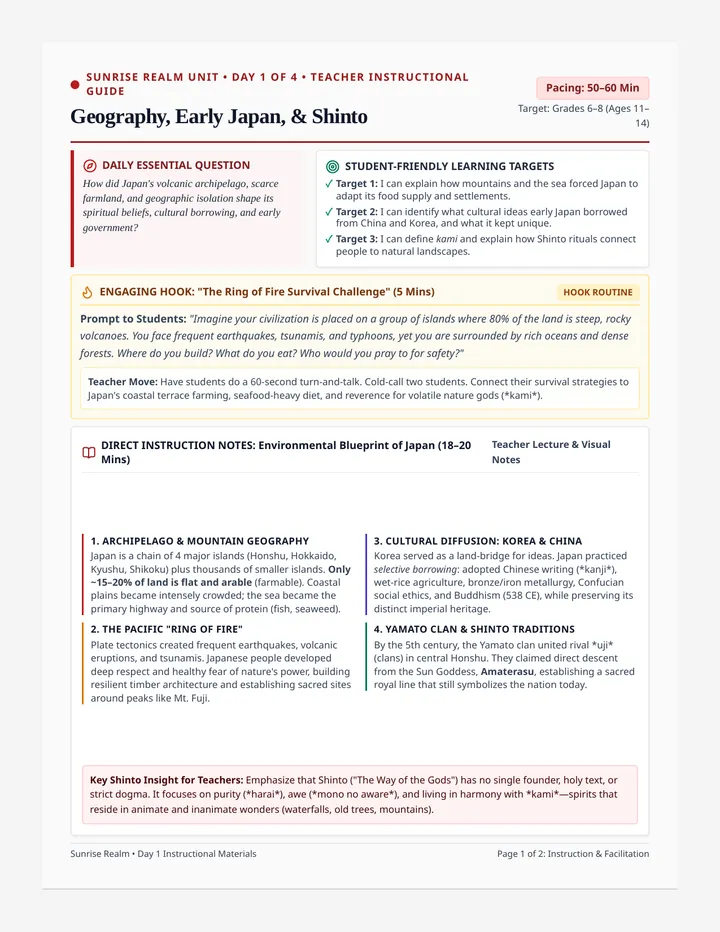
However, modern archaeologists and anthropologists are uncovering a far darker reality. When humans abandoned foraging to plant wheat, rice, and barley, life did not suddenly become easier. For the vast majority of ordinary people, farming brought longer workdays, painful diseases, malnutrition, and the birth of deep social divides that haunt our world today.
The Bone Detectives: Health and Diet
Before farming, hunter-gatherer bands enjoyed an extraordinarily varied diet. Foragers consumed dozens of distinct species of wild roots, seasonal berries, seeds, nuts, fish, and wild game. If one food source vanished due to weather, many others remained.
Farmers, by contrast, depended on an unvaried diet. Entire communities ate almost exclusively a single starchy grain crop—like wheat porridge morning, noon, and night. When droughts, floods, or swarms of locusts destroyed that single crop, catastrophic famine struck.
Ancient skeletal evidence confirms this nutritional crash. When scientists examine ancient bones, early farmers were on average three to five inches shorter than their forager ancestors. Their teeth were riddled with painful cavities from grain starches, their bones showed severe iron-deficiency anemia, and their spines were permanently bent from hours spent bent double weeding and grinding grain between heavy stones.
Key Discovery: Anthropologists studying modern foragers like the !Kung people discovered they only spend about 15 to 20 hours per week securing food. Early farmers, meanwhile, worked over 50 grueling hours every week!
Vocab Bank (Part 1) Page 1
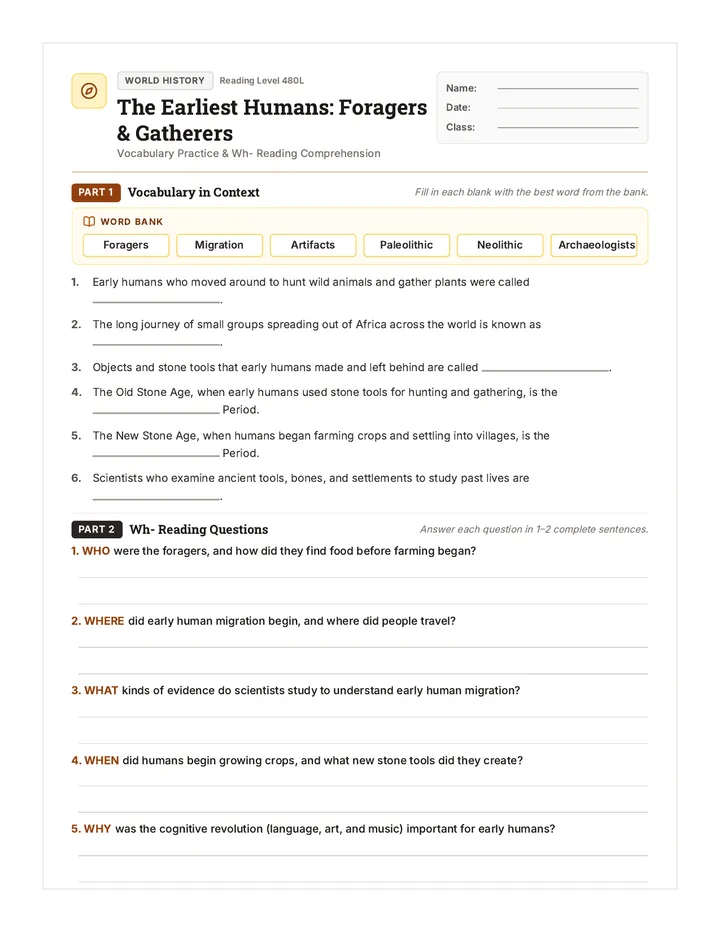
Neolithic Revolution The historical transition (~10,000 BCE) from nomadic hunting and gathering to settled crop farming.
Varied Diverse; made up of many different types (such as eating wild fruits, nuts, plants, and animals).
Unvaried Lacking diversity; staying the same, such as eating mostly one single crop (like wheat porridge) every day.
Skeletal Evidence Clues left behind in preserved human bones and teeth that reveal health, height, disease, and wear.
!Kung A modern hunter-gatherer society in Southern Africa studied by scientists to understand ancient human life and leisure.
Egalitarianism A social belief or system where all members share equal status, rights, and shared access to resources.
Continue to Page 2 for the origins of social classes and wealth Page 1 of 2
World History • Early Civilizations Part II: Wealth, Power, & Gender
Surpluses, Power, and the End of Equality
How storing grain transformed human relationships and created the first social ladders.
Sharing vs. Storing
In foraging bands, egalitarianism was a matter of survival. Because hunter-gatherers were constantly on the move, they owned only what they could physically carry. Meat spoiled quickly in the sun, so hunters shared their catch immediately with the entire group, knowing others would share tomorrow. No single person could stockpile wealth.
Farming changed everything because it required humans to become sedentary. Instead of traveling lightly, farmers built permanent mud-brick houses and storage granaries. For the first time in human history, communities produced food surpluses—grain that could be preserved in clay jars for months or even years.
The Rise of Hierarchy
Surplus food opened the door to intense inequality. A small group of individuals gained control over the central granaries and the best fertile fields. With food locked away, these elites no longer needed to farm themselves. Instead, they became full-time chiefs, tax collectors, priests, and military commanders.
This gave rise to a rigid social hierarchy. At the top stood a tiny ruling class living in luxury; at the very bottom laboured the peasant majority and enslaved war captives.
A Gendered Divide
This social shift was deeply gendered. In foraging bands, women gathered roughly 60% to 70% of total calories and held substantial community voice. But in early farming societies, heavy plow farming and private property laws concentrated legal land ownership in the hands of men. Women were increasingly restricted to domestic chores, constant grain grinding, and bearing more children to provide farm field hands.
Vocab Bank (Part 2) Page 2
Sedentary Settling permanently in one single location instead of migrating from place to place.
Surpluses Extra amounts of food or resources beyond what is immediately needed to survive day-to-day.
Inequality An unfair situation where some people have significantly more wealth, land, or power than others.
Hierarchy A social ranking system where people are organized into levels from highest power to lowest.
Gendered Biased or divided according to gender roles, giving different expectations, rights, and burdens to men and women.
Think Like a Historian: Quick Reflection
1. Evidence Analysis: Why did hunter-gatherers have an egalitarian society, while settled farming villages quickly formed strict hierarchies? Write 1–2 sentences referencing surpluses and mobility:
The Neolithic Revolution: Health, Labor, and Society Page 2 of 2