Mesopotamia Knowledge Test
Unit Assessment NC 6th Grade Social Studies
Total Points: 35 PAGE 1 / 4
Ancient Mesopotamia Comprehensive Knowledge Test
Section I: Multiple Choice Questions 1–20 • Circle the single best answer for each question.
Student Name:
Class:
Date:
1
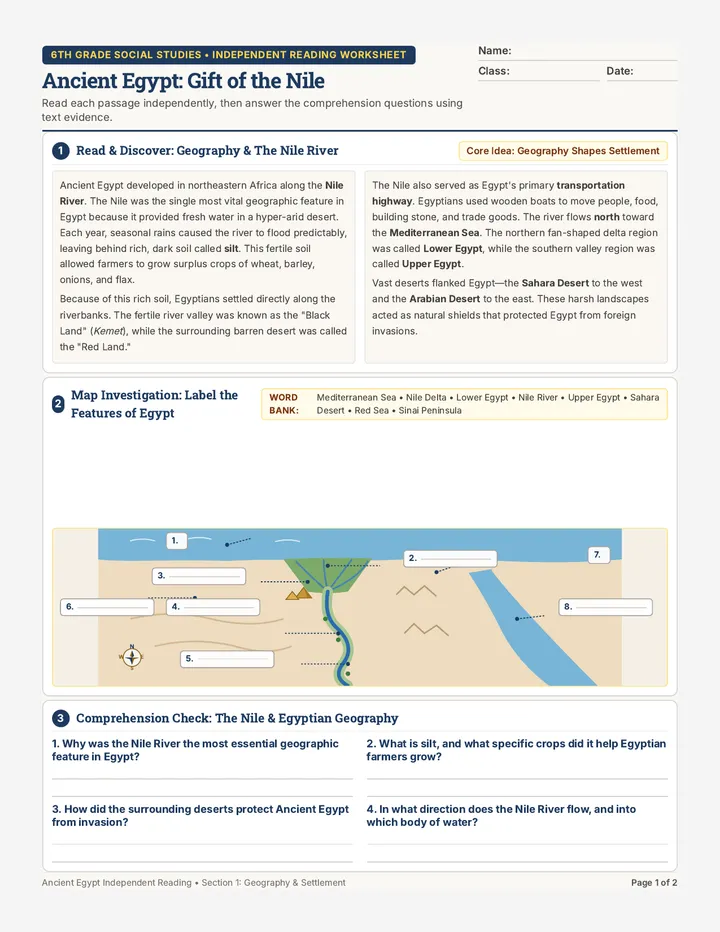
Which two major rivers created the fertile river valley of ancient Mesopotamia?
A Nile and Amazon Rivers
B Tigris and Euphrates Rivers
C Indus and Yellow Rivers
D Danube and Rhine Rivers
2
What is the rich, nutrient-packed fertile mud left behind after seasonal river floods called?
A Bedrock
B Silt
C Limestone
D Gravel
3
Why was geography described as both a "gift and a challenge" for Mesopotamians?
A Rivers provided water and silt, but floods could destroy homes and crops
B Dense rainforests gave shade, but wild beasts attacked cities
C Mountains blocked cold winds, but kept rain from reaching farms
D Oceans allowed fishing, but tsunamis constantly flooded crops
4
What environmental factor made Mesopotamian settlements vulnerable to outside invasion?
A Surrounding high rocky cliffs prevented soldiers from fighting
B Flat open plains with few natural barriers allowed armies to march in easily
C Thick fog prevented lookout guards from seeing approaching boats
D Deep swamp marshes swallowed defensive army equipment
5
What did Mesopotamian farmers build along river edges to keep roaring floodwaters back?
A Wooden bridges
B Dirt levees
C Cuneiform steles
D Stone pyramids
6
How did farmers ensure crops had water during scorching rainless dry seasons?
A They dug irrigation canals and storage basins to route and save river water
B They imported bottles of clean water from distant foreign oceans
C They dismantled their mud houses and migrated back to northern caves
D They stopped farming and lived entirely by eating wild dates
7
What major breakthrough allowed nomadic hunter-gatherers to settle in one place permanently?
A The invention of iron swords
B The discovery of agriculture and animal domestication
C The construction of ocean sailing ships
D The printing of paper money
Part 1 Continued
Multiple Choice Questions 8–14
PAGE 2 / 4
8
What is the best definition of an "irrigation system"?
A A method of predicting future rain using stargazing
B An engineered network of canals, ditches, and levees to move water to crops
C A military tactic used to flood enemy cities during sieges
D A religious prayer ceremony to ask the gods for gentle showers
9
What historical term means producing more food than what farmers immediately need to survive?
A Famine
B Surplus
C Ration
D Deficit
10
In the 5-step "Chain of Change," what directly occurred after agricultural surpluses were created?
A Cities collapsed because no one wanted to work anymore
B Populations grew and people specialized in non-farming jobs (crafts, trade, religion)
C Farmers burned the extra food to keep market prices high
D People returned to wandering across grasslands hunting mammoth
11
Why could societies NOT support specialized jobs (like weavers, metalworkers, or scribes) before farming?
A Ancient kings made crafting other items illegal
B Every individual had to spend all their daylight finding food just to survive
C There were no tools invented yet on Earth
D People were forbidden from speaking to one another
12
What was the wedge-shaped writing system invented by ancient Sumerians called?
A Hieroglyphics
B Cuneiform
C Sanskrit
D Latin Alphabet
13
What medium did Mesopotamian scribes press sharp reed styluses into to record trade and taxes?
A Papyrus paper rolls
B Damp clay tablets baked in the sun
C Carved animal bones
D Stretched tree bark
14
What was a "ziggurat," and why was it positioned at the center of every Mesopotamian city?
A A military fortress used only to execute lawbreakers
B A massive stepped mud-brick temple honoring the city's patron god and storing grain
C A burial pyramid holding tomb treasures for dead kings
D A public bathhouse where all citizens gathered to wash
Part 1 Conclusion
Multiple Choice Questions 15–20
PAGE 3 / 4
15
Which of the following is considered one of the primary characteristics of a civilization?
A A single shared global language
B Organized government and formal systems of law
C Equal distribution of identical gold coins to all families
D A completely nomadic lifestyle without permanent structures
16
How did written legal codes (such as the Code of Hammurabi) help stabilize complex urban societies?
A They encouraged citizens to fight duels to settle disagreements
B They established public rules and consequences so conflicts could be resolved fairly and order maintained
C They eliminated all taxes and made all goods completely free
D They ordered all city walls to be torn down
17
What was an ancient Mesopotamian "city-state"?
A A colony ruled by a distant king across the sea
B An independent self-governing city and its surrounding farms with its own king and laws
C A small temporary tent village set up during harvest month
D A religious temple where only priests were permitted to reside
18
Which group correctly lists four famous independent Sumerian city-states?
A Rome, Athens, Sparta, and Carthage
B Ur, Uruk, Kish, and Lagash
C Cairo, Alexandria, Thebes, and Memphis
D Beijing, Chang'an, Luoyang, and Anyang
19
What was the most frequent cause of warfare and violent conflict between neighboring city-states?
A Arguments over musical instruments
B Competition over river water, canal access, and boundary farmland
C Disagreements over how to construct mud bricks
D Refusal to trade copper spears
20
Why did Mesopotamian city-states construct thick, towering mud-brick defensive walls?
A To prevent river fish from swimming into streets
B To defend citizens and stored food against attacking rival armies across open plains
C To keep cool ocean breezes inside the market
D To support heavy wooden roofs covering the whole city
End of Section I (Multiple Choice 1–20)
Section I Score: / 20 pts
Separate Section 15 Points • Key Terms
PAGE 4 / 4
Section II: Key Vocabulary Matching Assessment
Match each vocabulary term (1–15) to its correct historical definition (A–O). Write the letter in the blank.
Key Vocabulary Terms: 15 Terms
1. Silt
2. Irrigation
3. Levee
4. Canal
5. Surplus
6. Agriculture
7. Domestication
8. Civilization
9. Government
10. Cuneiform
11. Ziggurat
12. Social Hierarchy
13. City-State
14. Natural Barrier
15. Specialized Worker
Lettered Definitions: A through O
A.
Complex, organized society with cities, government, religion, & writing.
B.
An independent self-governing city and its surrounding farmlands.
C.
An engineered network of channels built to move river water to crops.
D.
Extra supply of food or goods remaining beyond what is needed to survive.
E.
Wedge-shaped writing pressed on clay tablets for laws and taxes.
F.
An earthen dirt wall built along riverbanks to hold back floodwaters.
G.
Rich, nutrient-dense fertile soil deposited by river floods.
H.
A physical feature (like high mountains) protecting against attack.
I.
A giant stepped pyramid temple dedicated to a city's patron god.
J.
The practice of farming crops and domesticating animals for food.
K.
Taming wild plants and animals for human use, work, and harvest.
L.
Leaders and official systems making laws, collecting taxes, and keeping order.
M.
A man-made artificial waterway dug to transport water miles to fields.
N.
A trained worker in a single trade (weaver, potter, metalworker, scribe).
O.
Ranking society members into tiers based on wealth, power, and occupation.
Section I (MC) ____ / 20
Section II (Vocab) ____ / 15
=
Total Score ____ / 35
Teacher Signature: