Rule Detectives Slides
Upper Elementary Civics
Community & Governance
Rule Detectives:
Rules vs. Laws
Investigating authority, order, and justice across our school, community, state, and nation.
School
Classroom Rules
Community
Town Ordinances
State
State Statutes
Nation
Federal Law
Core Concept
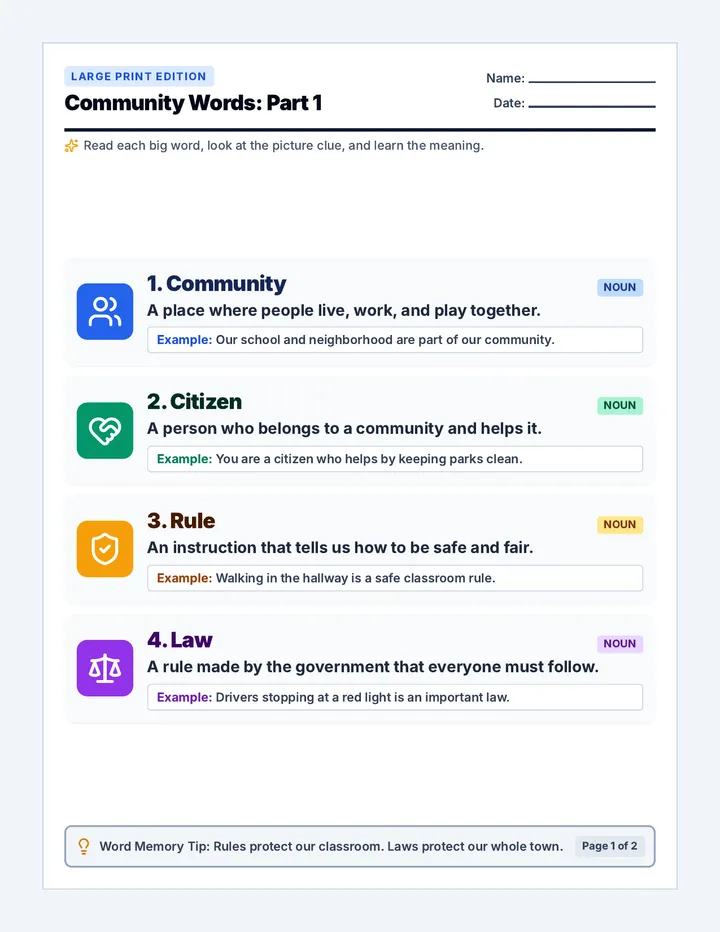
Rule vs. Law: What's the Difference?
RULE Small Groups
Guidelines for Specific Places
- Made by: Parents, teachers, principals, coaches, club leaders.
- Who follows: Only members of that specific group or household.
- Consequences: Warnings, time-outs, loss of privileges (recess, devices).
Example: Walking quietly in the hallway during school hours.
LAW Entire Society
Legal Codes for Everyone
- Made by: Elected representatives (city council, legislature, Congress).
- Who follows: Every single person living or visiting that territory.
- Consequences: Enforced by police & courts; fines, court orders, jail.
Example: Stopping at red lights when driving a car on public streets.
Think Fast: Can you break a rule without breaking a law? What about the other way around?
Turn & Talk
Levels of Authority • Part 1
School Rules vs. Community Laws
Level 1: School Level 2: Community
Level 1: School Rules
Classrooms, Hallways, Playground
Who Makes Them: Principals, teachers, staff, and school boards.
Where They Apply: Inside school buildings, buses, and field trips.
Real Examples: Raise hand to speak, no running in halls, return books.
Level 2: Community Laws
Town, City, or Village Ordinances
Who Makes Them: City councils, town boards, and town mayors.
Where They Apply: Anywhere inside the city or town limits.
Real Examples: Leash laws in parks, noise curfews, crosswalk safety.
Detective Clue: Principals handle classroom rules, but only city officers write citations on town streets!
Levels of Authority • Part 2
State Laws vs. National Laws
Level 3: State Level 4: National
Level 3: State Laws
Each of the 50 Individual States
Who Makes Them: State Legislature (Senators & Reps) & Governor.
Where They Apply: Across the entire state (stops at the border!).
Real Examples: Driver's licenses, graduation standards, state parks.
Level 4: National Laws
The Supreme Law of the Whole Land
Who Makes Them: U.S. Congress in Washington, D.C. & the President.
Where They Apply: Every single state and territory across the country.
Real Examples: U.S. currency, airport security, protecting wildlife.
Supremacy Principle: Federal constitutional laws are the supreme law of the land for all 50 states!
Big Picture View
The Ladder of Authority
From Smallest Circle to Largest Circle
Level 1
School
Who leads? Principal & Staff
Who must obey? Enrolled Students
Where? School Building
Key Rule: No talking during tests
Level 2
Community
Who leads? Mayor & City Council
Who must obey? Town Residents
Where? Town / City Limits
Key Law: Recycling & noise rules
Level 3
State
Who leads? Governor & Legislature
Who must obey? State Inhabitants
Where? Entire State Area
Key Law: Driving test age (16)
Level 4
Nation
Who leads? President & Congress
Who must obey? All People in the U.S.
Where? All 50 States
Key Law: Federal passport rules
Golden Rule of Government: As the circle grows bigger, laws protect more people across wider spaces!
4 Levels Working Together
Class Investigation
Detective Challenge: Who Made It?
Can You Classify Each Case?
A
Case 1 Community Law
"Dogs must be on a 6-ft leash at Sunset City Park."
Clue: Decided by the town council for local public parks.
B
Case 2 National Law
"Every airline passenger must pass airport screening."
Clue: Applies at every airport in all 50 states for safety.
C
Case 3 State Law
"You must be 16 years old to get a driver's license."
Clue: Passed by the state legislature for all state roads.
D
Case 4 School Rule
"Chromebook screens must stay at 50% brightness in library."
Clue: Only students inside this specific media center follow this.
Detective Strategy: Always ask: "Who has the legal power to enforce this consequence?"
100% Accuracy Goal!
The Purpose of Law
Why Do We Have Rules and Laws?
The Common Good
1. Keeping Safe
Preventing physical harm, protecting public health, and stopping dangerous actions.
Examples: Speed limits, fire alarms, bicycle helmet laws.
2. Ensuring Fairness
Making sure everyone gets an equal chance, contracts are honored, and no one is cheated.
Examples: Equal sports rules, fair voting laws, honest business.
3. Protecting Rights
Defending freedom of expression, property ownership, and the right to live peacefully.
Examples: Free speech protections, private property rights.
Thought Experiment: "The Rule-Free Island"
If all rules and laws vanished for 48 hours, what would improve? What would collapse?
Class Debate
Application Challenge
You Are the Lawmaker!
Final Partner Challenge
1 CREATE A NEW SCHOOL RULE
Classroom or Playground
Propose ONE new rule our school should adopt. Think about:
- What problem does this rule solve?
- Who has the power to enforce it fairly?
- What is a reasonable consequence?
Target: Applies only to members of our school community.
2 PROPOSE A COMMUNITY OR STATE LAW
Town, City, or State Level
Propose ONE new law for your town or state. Think about:
- Which government body must vote on it?
- How will police or officers enforce it?
- Does it treat all citizens equally?
Target: Applies to every resident and visitor in the jurisdiction.
Active Citizenship: Citizens of all ages have a voice in shaping the rules and laws that protect our communities!
Great Job, Detectives!