A Grade 4 local history lesson exploring the life of British diplomat Sir Paul Methuen, the 1725 founding of Methuen, Massachusetts, and why colonial towns were named after prominent leaders across the Atlantic. Students examine historical clues through slides, an informational reading passage, and guided note-taking.
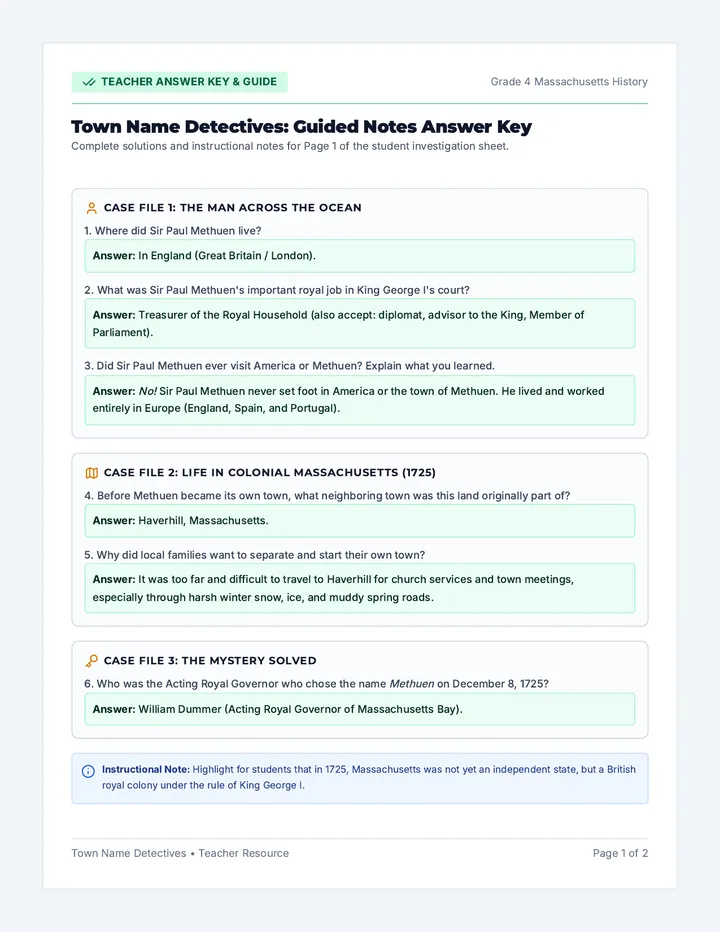
When the Massachusetts General Court agreed to create the town on December 8, 1725, the acting royal governor was a man named William Dummer. At that time, colonial governors often named new communities in honor of powerful friends, noblemen, or royal leaders back in England.
Governor Dummer decided to name the new town Methuen in honor of Sir Paul Methuen. By doing this, colonial leaders showed respect to King George's royal court and honored Sir Paul’s long years of public service. Here is the big surprise: Sir Paul Methuen never visited America! He lived his whole life across the ocean, but his family name became part of Massachusetts history forever.
4 How Methuen Grew Over Time
In its early days, Methuen was a peaceful farming community. Families raised livestock, grew corn, and ground grain at small watermills. But during the 1800s, everything began to change.
The roaring water at Spicket Falls provided power for large textile and manufacturing mills. Factories produced cotton cloth, woolen goods, and fashionable hats. Workers arrived from Ireland, Italy, French Canada, and England to build new lives. Methuen transformed from a quiet farming hamlet into a bustling industrial center.
Methuen's Crown Jewel: The Music Hall
In the late 1800s, a wealthy philanthropist named Edward F. Searles helped shape Methuen's architecture. He built schools, stone walls, and the famous Methuen Memorial Music Hall. This world-renowned building was constructed specifically to house the "Great Organ"—a massive, historic pipe organ with over 6,000 pipes!
Think Like a Historian
Colonial leaders named Methuen after an English leader to show loyalty and honor. If leaders in your city today were creating a new park or school, what kind of person would you choose to honor, and what values should they represent?
Unit: Town Name Detectives Page 2 of 2
D. To officially organize as a separate town with its own leaders.
Case File 6: Historian's Final Verdict
10. Why do you think colonial leaders chose to name towns after British leaders like Sir Paul Methuen instead of naming them after local farmers or builders?
Town Name Detectives • Student Investigation Sheet Page 2 of 2
Case File 5: Vocabulary Detective Solutions
1. Diplomat → B (Official who travels abroad for peace)
2. Colony → C (Settlement ruled by distant country)
3. Incorporate → D (Officially organize as a town)
4. Charter → A (Official document granting legal rights)
Case File 6: Sample Student Response & Grading Guide
10. Why do you think colonial leaders chose to name towns after British leaders like Sir Paul Methuen instead of local farmers?
Exemplary Response:"Colonial leaders wanted to honor the King and his top officials to show loyalty and keep a good relationship with Great Britain. Naming towns after important nobles and royal treasurers was a custom that brought prestige and favor to the colony."
Scoring Note: Award full credit for any response recognizing respect for British leadership, political favor/loyalty, or colonial custom.
Town Name Detectives • Teacher Resource Page 2 of 2