Gas Mystery Catchup Slides
UNIT 7.1 • LESSON 2 CATCH-UP
Science Review
Where Is the Gas Coming From?
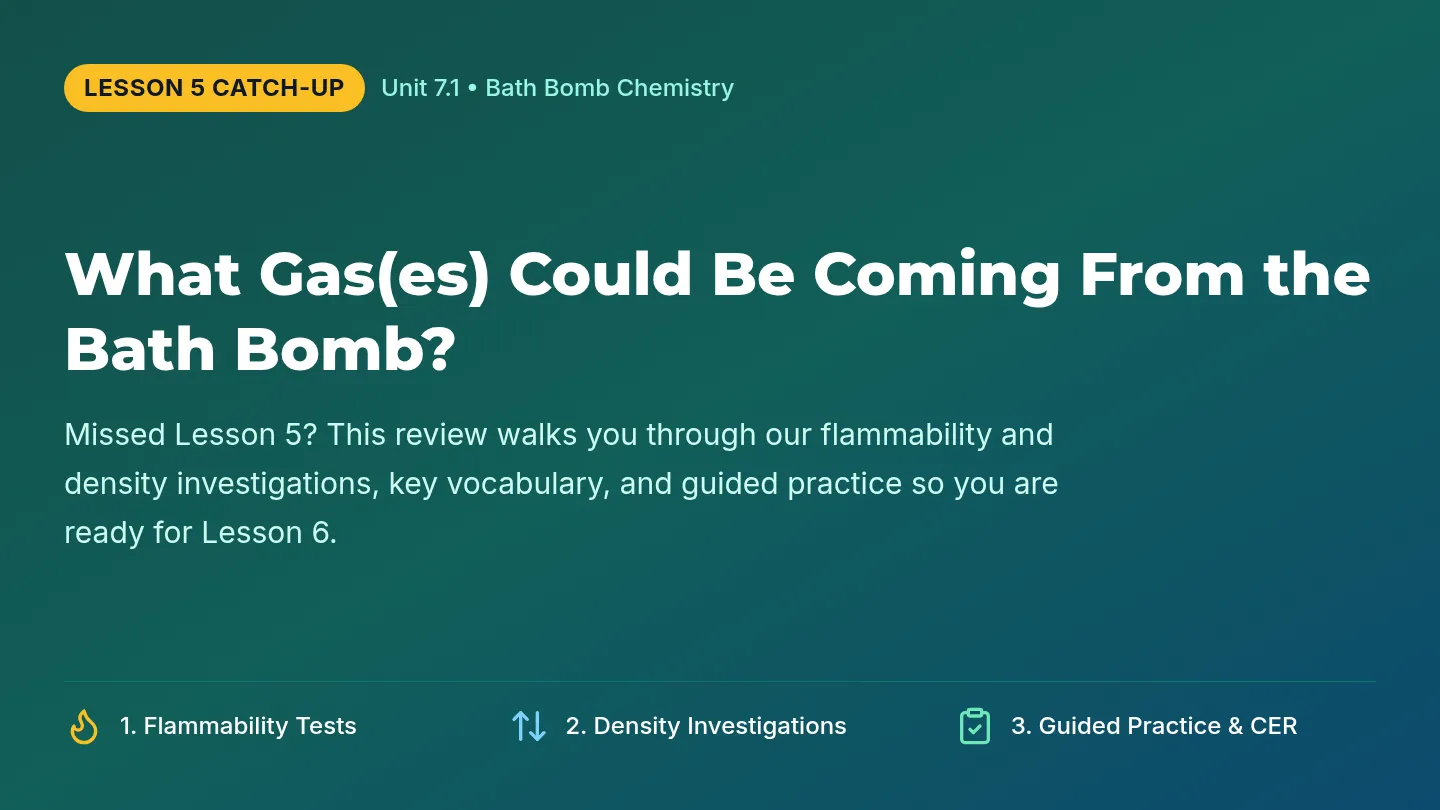
Missed Lesson 2? Use this guide to review our investigations, explore the class data, and practice building a scientific argument.
1. Review 2 Lab Investigations
2. Update Key Model Ideas
3. Guided Practice & CER
Where We Left Off
The Bath Bomb Mystery
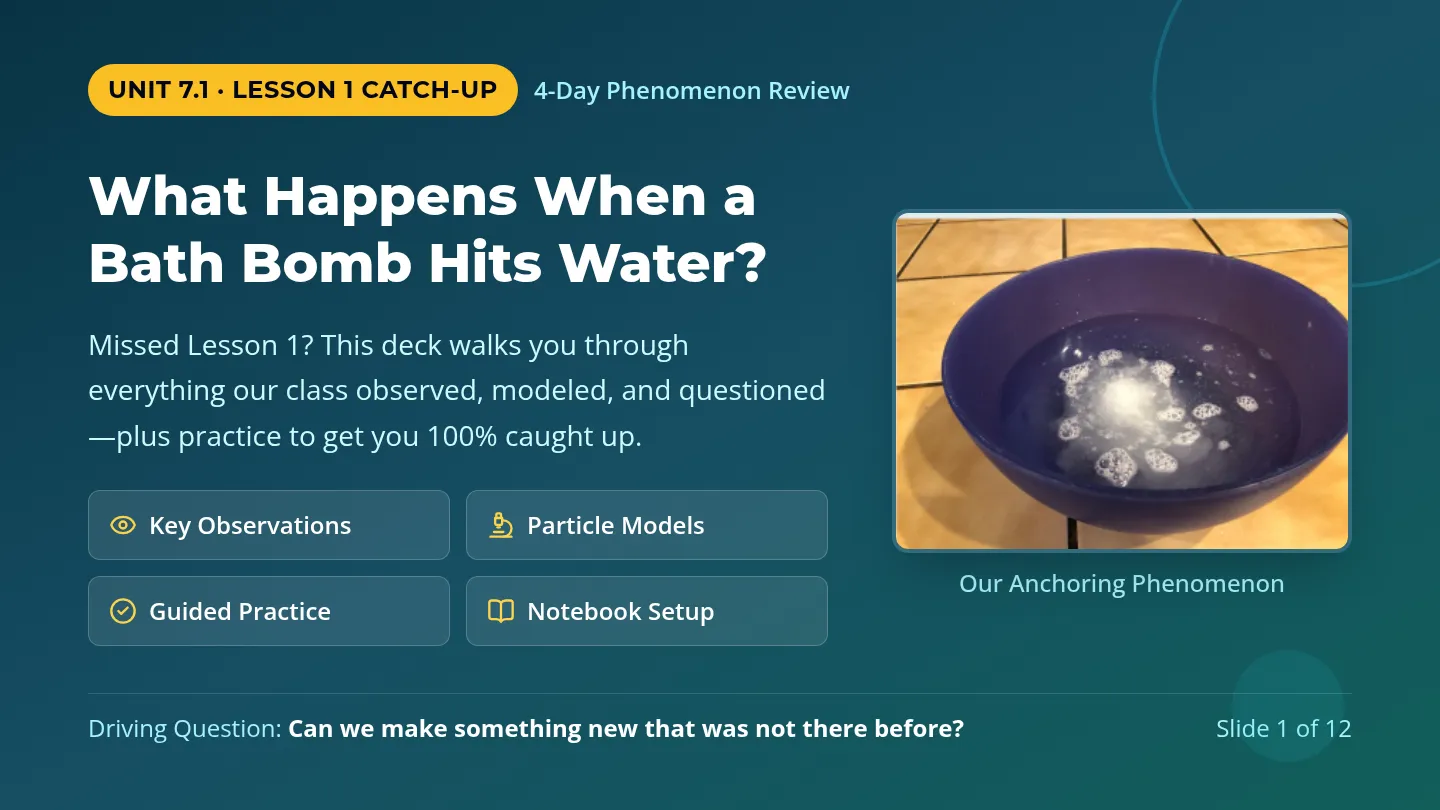
In Lesson 1, we dropped a solid bath bomb into liquid water and observed gas bubbles fizzing out. That left us with a big question on our Driving Question Board:
“Where do those gas bubbles actually come from?”
Idea A
Already Trapped Inside
Maybe the gas was already inside the dry bath bomb, waiting to be released.
Idea B
Made When Mixed
Maybe the gas formed when the bath bomb and water combined and changed.
Part 1 • Close Observation
What Is Inside a Dry Bath Bomb?
What We Observed
- • Using a hand lens, we examined dry mini bath bomb cubes closely.
- • We noticed tiny powders packed together with small air spaces between them.
Our First Testable Claim
“The gas is already part of the bath bomb, trapped inside those tiny spaces.”
Big Question
If gas really is trapped inside a dry bath bomb, how can we test it without adding water?
Part 2 • Tools for Thinking
Key Model Ideas We Already Know
About Matter & Gases
- Solids, liquids, and gases are all matter.
- All matter is made of particles too small to see.
- Matter has mass and takes up space.
Closed vs. Open Systems
Closed System: No matter can get in or out, so the mass stays the same.
Open System: Matter can get in or out, so the mass can change if matter escapes or enters.
Investigation 1 • Testing the Trapped-Gas Claim
Crushing Dry Bath Bombs in a Bag
What We Did
- Put 8 mini bath bombs in a ziplock bag, squeezed out air, and sealed it.
- Measured the starting mass on a digital scale.
- Crushed the bath bombs with a heavy book (without puncturing the bag).
- Observed the bag and measured the closed system mass.
- Opened the bag and measured the open system mass.
What Would Support “Trapped Gas”?
- The sealed bag would inflate because gas takes up space.
- When we opened the bag, trapped gas would escape and the mass would decrease.
Investigation 1 • Results
What Happened When We Crushed Them?
What We Observed
For or Against “Trapped Gas”?
The closed bag did NOT inflate.
Against
The closed system mass stayed the same.
Against
The open system mass stayed the same.
Against
Conclusion: The gas is NOT trapped inside the dry bath bomb! We only see gas when water is added.
Investigation 2 • Bath Bombs + Water
Is the Gas Brand-New Matter, or From What Was Already There?
Why Use a Soda Bottle?
A rigid bottle with a screw-on cap traps gas pressure safely and stays flat on the scale (unlike a puffy baggie).
Lab Procedure
- Put 100 g water + a test tube of 8 bath bombs in the bottle.
- Tighten the cap & record starting mass.
- Tip bottle to mix; record closed mass after fizzing.
- Open cap (listen for a hiss!) & record open mass (with cap on scale).
Embedded media
Watch the Bath Bombs in a Bottle lab demonstration
Investigation 2 • Sample Class Data
What Did the Mass Measurements Show?
| Group | Closed System
Mass Change (g) | After Opening
Mass Change (g) |
| --- | --- | --- |
| 1 | 0.0 g | -0.6 g |
| 2 | -0.1 g | -0.7 g |
| 3 | 0.0 g | -0.4 g |
| 4 | 0.0 g | -0.4 g |
| 5 | +0.1 g | -0.4 g |
| 6 | -0.1 g | -0.9 g |
Closed System
Changes of ±0.1 g are within normal digital scale error. So the mass stayed the same!
Open System
When we unscrewed the cap, we heard a hiss and lost 0.4 g to 0.9 g of mass!
Making Sense of the Evidence
Which Claim Does the Data Support?
Claim 1 Refuted
“The gas is brand-new matter that was not there to start with.”
Why it fails: If brand-new matter were added, the closed system's mass would have increased—and it didn't.
Claim 2 Supported
“The gas is NOT new matter—it comes from a change to what was already there.”
Why it works: Closed mass stayed constant, and when gas escaped, mass dropped—proving the gas came from the starting materials!
Class Consensus • Notebook Update
Our Updated Key Model Ideas
Gases, liquids, and solids are all matter.
Matter has mass and takes up space.
All matter is made of particles.
NEW: In a closed system, no matter can get in or out, so the mass stays the same—even when changes happen to the matter (such as becoming a gas).
In an open system, matter can get in or out, so the mass can change if that happens.
Guided Practice 1 • Pause & Think
Check Your Understanding
Question 1
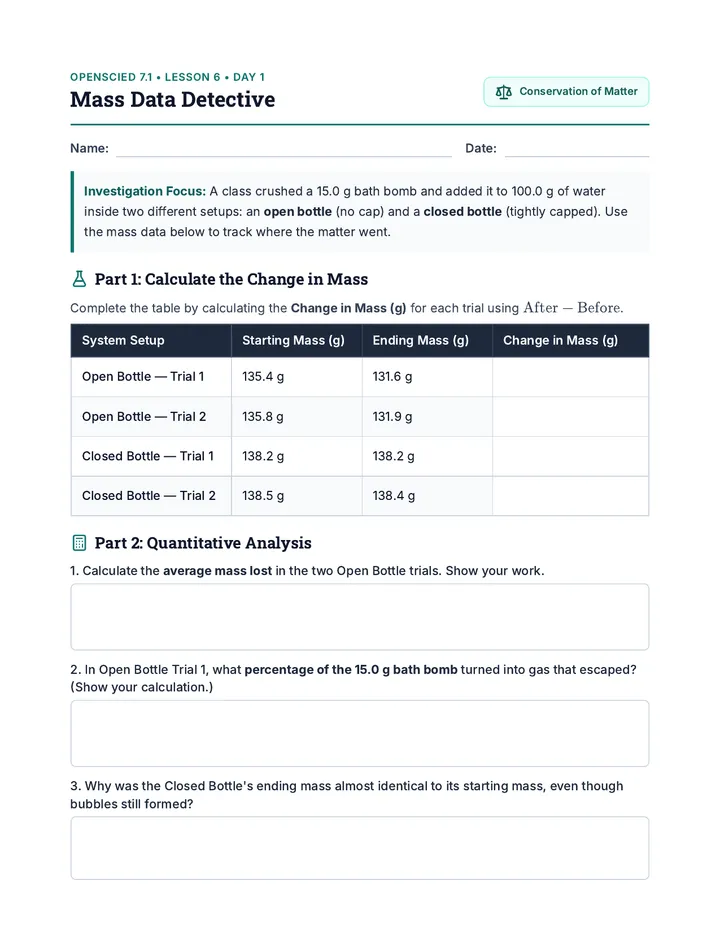
A student mixes a bath bomb and water in a sealed bottle. Before mixing, the mass is 145.2 g. After fizzing stops, the scale reads 145.1 g. Did matter escape?
Check: No! A change of -0.1 g is within the scale's ±0.1 g accuracy limit. The closed system mass stayed the same.
Question 2
Next, the student takes off the cap and puts both the bottle and cap back on the scale. Now the mass is 144.5 g. Why did the mass drop by 0.6 g?
Check: Opening the bottle made an open system. Gas escaped into the air, and since gas has mass, the total mass decreased.
Guided Practice 2 • Scientific Argumentation
Spot the Claim, Evidence & Key Model Idea
Read this sample student response. Can you identify the 3 parts?
“The gas must come from a change to the matter already in the bottle, not new matter. When we opened the bottle, we heard a hiss and the mass went down by 0.6 g. This means some matter left the system because we know that gases are matter that have mass.”
1. Claim
Answers the question
2. Evidence
Data from our labs
3. Reasoning
Uses Key Model Ideas
Guided Practice 2 • Breakdown
How Evidence & Key Model Ideas Work Together
“The gas must come from a change to the matter already in the bottle, not new matter. When we opened the bottle, we heard a hiss and the mass went down by 0.6 g. This means some matter left the system because we know that gases are matter that have mass.”
■ Highlighted Blue = Claim Underlined = Evidence ■ Highlighted Yellow = Key Model Idea
Sentence Starters for Your Argument
- • Evidence: “When we did the ______ investigation, the data showed that ______.”
- • Reasoning: “This means ______ because we know ______ (Key Model Idea).”
Get Up to Speed
Your Lesson 2 Catch-Up Checklist
1. Update your notebook: Copy the 5 Key Model Ideas (Slide 10).
2. Write your argument: On looseleaf paper, answer “Where is the gas coming from?” using evidence from both labs and Key Model Ideas.
3. Exit Ticket (1–4): At the bottom of your page, rate your confidence (4 = independent, 1 = need help) and explain why.
Up Next in Lesson 3: Testing the individual ingredients inside a bath bomb!