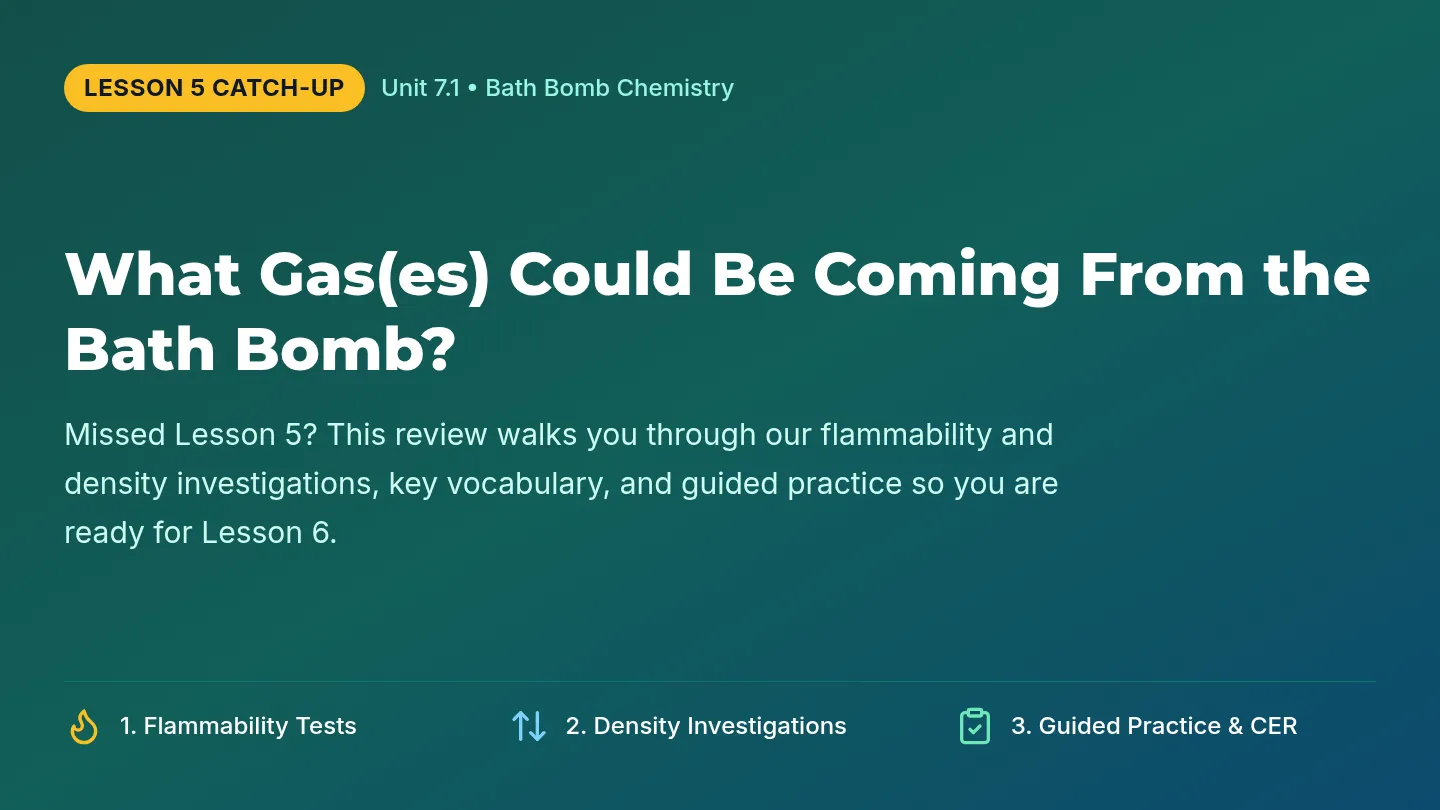
7.1 Lesson 5 Review Packet
Unit 7.1 • Lesson 5 Review Page 1 of 4
7.1 Lesson 5 Review Packet
Synthesizing what we figured out: What gas(es) could be coming from the bath bomb?
Name:
Date:
Part 1: Word Wall & Key Concepts
Define each term in your own words and explain how it helps scientists identify an unknown gas.
1. Flammability
2. Density
3. Control Condition (and why we tested room air and helium)
Part 2: Check for Understanding
4. Why can density be used as a characteristic property to help identify an unknown gas?
A. All invisible gases have the exact same density no matter what substance they are.
B. The density of a gas stays constant when measured at the same temperature and location.
C. Density changes randomly every time a gas is placed in a new container.
D. Only gases that are flammable have a measurable density.
5. What happens when a lit match is placed inside a flask filled with a high concentration of a non-flammable gas?
A. The flame burns brighter and larger.
B. The gas explodes immediately.
C. The flame goes out (is extinguished).
D. The flame stays lit just like it does in room air.
6. State the Key Model Idea about how gases (and liquids) behave based on their density. Give one everyday example (such as a helium balloon or oil and water).
Gas Detective Review Packet Page 2 of 4
Part 3: Analyzing Common Gases Data
Use the reference data table below (measured at room temperature) to answer Questions 7–10. Note that room air has a density between 1.160 and 1.161 g/L.
| Gas Substance |
Density (g/L) |
Flammability (Interaction with Flame) |
| Hydrogen |
0.08 g/L |
Flammable (burns / explodes) |
| Helium |
0.16 g/L |
Non-flammable (extinguishes flame) |
| Methane |
0.66 g/L |
Flammable (burns / explodes) |
| Neon |
0.82 g/L |
Non-flammable (extinguishes flame) |
| Room Air (Control) |
1.160 – 1.161 g/L |
Supports burning (flame stays lit) |
| Nitrogen |
1.165 g/L |
Non-flammable (extinguishes flame) |
| Oxygen |
1.31 g/L |
Supports burning (helps things burn) |
| Argon |
1.63 g/L |
Non-flammable (extinguishes flame) |
| Carbon Dioxide |
1.80 g/L |
Non-flammable (extinguishes flame) |
| Propane |
1.83 g/L |
Flammable (burns / explodes) |
7. Look at the density column. List all gases that are less dense than room air:
8. In the flammability test, the gas from the bath bomb immediately extinguished the lit match. Which 5 gases can you eliminate from the table, and why?
9. In the density test, the bath bomb gas extinguished a candle placed below the tilted bottle, not a match above it. Which 2 additional gases does this eliminate, and why?
10. Which 3 candidate gases remain as possibilities for the bath bomb gas?
Gas Detective Review Packet Page 3 of 4
Part 4: Predictive Reasoning & Lab Application
11. Complete the "If–Then" predictive explanation for a non-flammable gas tested in a flask:
If an unknown non-flammable gas puts out a flame above the flask, that means it is dense than room air, which has a known density between g/L. I know this because If evidence supports this prediction, the unknown gas could be .
12. Lab Procedure Application: In our helium lab, we turned the glass flask completely upside down over a match. Why couldn't we hold the plastic soda bottle completely upside down over the candle when testing the bath bomb gas? What did we do instead?
13. During the density test, students were reminded to hold the lit match at least 1 inch above the plastic bottle. Give two reasons why holding the match closer than 1 inch could cause a problem or give misleading results.
14. Apply to a New Gas: Suppose a scientist traps Argon (1.63 g/L) in a bottle. Predict what will happen to a lit match held above the opening vs. a lit candle placed below the tilted opening. Explain your reasoning.
Gas Detective Review Packet Page 4 of 4
Part 5: Construct an Evidence-Based Argument
Driving Question: What gas(es) could be produced by a bath bomb placed in water?
Write a complete scientific argument answering the question above. Use the checklist below to make sure your argument is assessment-ready:
☐ Claim: Name the 3 remaining candidate gases.
☐ Evidence 1: Cite the flammability test & data table.
☐ Evidence 2: Cite the density test & data table.
☐ Reasoning: Connect to Key Model Ideas (properties & density).
Part 6: Assessment Readiness Self-Check
☐ I can use patterns in property data (density and flammability) to narrow down an unknown gas.
☐ I can explain why less dense gases float upward and more dense gases sink downward in room air.
☐ I can write a Claim–Evidence–Reasoning argument explaining why the bath bomb gas could be CO2, N2, or Ar.