Motion Recall Warmup Day 1 • Spiral Warmup
Motion Recall Warmup
Name: ________________________
Date: ______________
Activate what you already know about forces and motion. Answer each question carefully before we begin today's investigation.
1. ⚽ A soccer ball sits completely still on the grass. Which statement explains why it starts rolling when a player kicks it?
A. Gravity suddenly disappears so the ball can move forward.
B. The kick applies an unbalanced push force that changes the ball's motion.
C. Balanced forces always make objects speed up in one direction.
D. Friction pushes the ball forward across the grass.
2. Identify the main force acting in each situation. Write Gravity, Friction, or Push/Pull on each line.
a) 📘 A book slides across a carpet and slows to a stop. ____________________
b) 🍎 An apple falls straight down from a tree branch. ____________________
c) 🛒 A student tugs a wagon handle to roll it down the sidewalk. ____________________
3. 🪁 Think Ahead: Imagine pushing a child on a playground swing. Describe the pattern of movement you see after the push.
Today's Goal: Explain how forces create 3 predictable motion patterns in a system.
Ready? [ ] Yes [ ] Need a hint
Three Motion Paths Slides Day 1 • 20-Min Virtual Lesson
Forces & Systems
Three Motion Paths
How forces create predictable patterns when objects move in a system.
Learning Target: I can explain how forces create patterns in a system: moving in one direction, shifting back and forth, or moving in cycles.
Spiral Warmup (3 Min)
Type in Chat
1. ⚽ A soccer ball sits still on grass. Why does it roll when kicked?
A. Gravity disappears.
B. The kick applies an unbalanced push force.
C. Balanced forces make it speed up.
D. Friction pushes it forward.
2. Name the force (Gravity, Friction, or Push/Pull):
a) 📘 Sliding book slows down on a rug.
b) 🍎 Apple falls down from a tree.
3. 🪁 Think Ahead:
When someone pushes a playground swing, what motion pattern do you see?
Drop your answers in the chat box!
Read & Discover: Forces Shape Motion
Mini-Reading
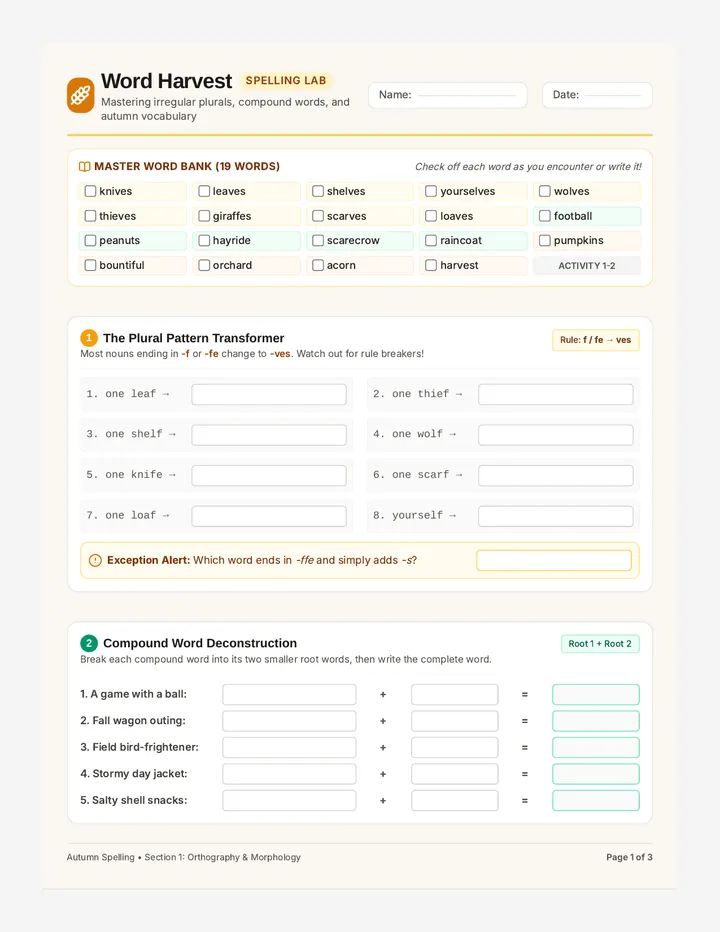
A force is a push or a pull that can start, stop, or change how an object moves. Inside a system—a group of connected parts working together—steady forces create predictable motion patterns.
Gravity, pushes, pulls, and friction work together to guide objects along three main paths: moving in one direction, shifting back and forth, or moving in cycles.
Key Question: How can we tell which of the 3 patterns a force is creating?
The Three Motion Patterns
1. One Direction
Unbalanced force pushes or pulls along a single path (e.g., marble on a ramp, sled).
2. Back & Forth
Restoring force pulls back toward center, reversing direction (e.g., swing, pendulum).
3. In Cycles
Inward pull keeps turning the object in a repeating loop (e.g., Ferris wheel, bike wheel).
One Direction = straight path • Back & Forth = reverses • Cycles = full loop
Spot the Pattern!
Chat Check
Type A, B, or C with its pattern in the chat:
System A 🛹
Skateboarder on a Hill
Coasts straight down a slanted street.
System B 🕰️
Metronome Arm
Ticks steadily left to right and back again.
System C 🎡
Ferris Wheel
Turns around its center axle in a circle.
"System ___ moves ___ because the force of ___ acts on it."
Next Steps (10 Minutes)
1. Quick Practice (6 min)
Read the passage and complete your 1-page Pattern Spotters Worksheet.
2. Exit Ticket (4 min)
Submit your Path Check Exit Ticket before logging off.
Tomorrow: We test what makes these three patterns speed up or slow down!
Pattern Spotters Worksheet Day 1 • Reading & Practice
Pattern Spotters Worksheet
Name: ________________________
Date: ______________
Reading Passage: Forces Shape Every Move
A force is a push or a pull that starts, stops, or changes how an object moves. Inside a system —a group of connected parts working together—steady forces create predictable motion patterns. When an unbalanced force pushes or pulls one way, an object moves in one direction , like a marble rolling down a ramp. When a force pulls an object back toward a center point, it shifts back and forth , like a swing. When an inward pull keeps turning an object around a center, it moves in cycles , like a Ferris wheel.
Classify the System & Explain the Force
1. 📐 A marble rolls down a slanted ramp.
One Direction Back & Forth Cycles
Which force creates this pattern?
2. 🪀 A washer tied to a string swings left and right.
One Direction Back & Forth Cycles
Which forces create this pattern?
3. 🎠 A carousel spins riders around a central pole.
One Direction Back & Forth Cycles
Which forces create this pattern?
4. 🪁 Quick Sketch: Draw a playground swing and add arrows to show gravity and its back-and-forth motion.
Next: Complete your Day 1 Path Check Exit Ticket!
Path Check Exit Ticket Day 1 • Exit Ticket
Path Check Exit Ticket
Name: ________________________
Date: ______________
1. Which system best shows a back-and-forth motion pattern?
A. A Ferris wheel carrying passengers in a full circle
B. A toy car rolling straight down a slanted board
C. A pendulum swinging from left to right and back again
D. A rocket launching straight up into the sky
2. Compare moving in one direction and moving in cycles. Give one real-world example of each.
3. Choose one system from today's lesson. Name the main force acting on it and explain how that force creates a predictable pattern.
Confidence Check [ ] I can explain all 3 patterns [ ] I need a quick review [ ] I'm still stuck
Three Paths Teacher Guide Day 1 • 20-Min Virtual Guide
Three Paths Teacher Guide
Lesson 1 of 2
Suggested Time: 20 minutes
Day 1 Objective
Students will explain how forces create predictable patterns within a system: moving in one direction, shifting back and forth, or moving in cycles.
Virtual Class Setup
• Screen-share Three Motion Paths Slides (6 slides)
• Use chat box / polls for quick checks
• Share digital links for Worksheet & Exit Ticket
20-Minute Virtual Pacing Plan
Time
Activity
Virtual Teacher Moves
0–3 min
Slide 2: Spiral Warmup
Display Slide 2; students type answers in chat. Quickly confirm Q1–Q3 on mic.
3–10 min
Slides 3–5: Reading & Paths
Read Slide 3 aloud together, walk through the 3 pattern diagrams on Slide 4, and run Chat Check on Slide 5.
10–16 min
Pattern Spotters Worksheet
Students read the short passage and complete items 1–4 independently (or in quick breakout pairs).
16–20 min
Path Check Exit Ticket
Students submit digitally before logging off to guide Day 2 grouping.
Spiral Warmup Answer Key
1. B — The kick applies an unbalanced push force that changes the ball's motion.
2a. Friction (opposes sliding motion) | 2b. Gravity (pulls downward) | 2c. Push/Pull (hand pulling wagon).
3. Sample Response: The swing moves forward, slows down, reverses, and swings backward repeatedly (back-and-forth pattern).
Page 2: Facilitation, Misconceptions & Keys →
Facilitation & Answer Keys
Day 1 • Page 2
Common Misconceptions
Confusing "back and forth" with "cycles": Remind students that back-and-forth motion reverses direction along the same path, while cycles complete a full loop without reversing.
Thinking motion needs a continuous push: Clarify that once a force starts a pendulum, gravity keeps pulling it back toward the center.
Virtual Differentiation
Support: Paste sentence frames into the chat ("The force of ___ pulls/pushes the ___ so it moves ___") and highlight key terms in the reading passage.
Extension: Ask early finishers to post in chat a real-world system that combines two patterns (e.g., a bicycle: wheels move in cycles while the bike moves in one direction).
Pattern Spotters Worksheet Key
1. One Direction — Gravity pulls the marble steadily down the slanted ramp in one direction.
2. Back & Forth — Gravity pulls the washer back toward the center while the string holds it in an arc, making it swing left and right.
3. Cycles — The motor pushes the carousel while the central pole pulls inward, keeping riders moving in a continuous circle.
4. Swing Sketch: Should show a downward gravity arrow + curved back-and-forth motion arrows.
Path Check Exit Ticket Key
1. C — A pendulum swinging from left to right and back again.
2. Sample Response: Moving in one direction means traveling along a single path without reversing (e.g., a sled sliding down a hill). Moving in cycles means traveling in a repeating loop around a center (e.g., a Ferris wheel).
3. Sample Response: In a ramp-and-marble system, gravity pulls the marble downward along the slope, creating a one-direction motion pattern.
Bridge to Day 2: Tomorrow's 20-minute lesson explores what makes these three patterns speed up or slow down!
Pattern Recall Warmup Day 2 • Spiral Warmup
Pattern Recall Warmup
Name: ________________________
Date: ______________
Review yesterday's three motion patterns, then predict what makes a pattern speed up or slow down.
1. Match each system to its motion pattern. Write One Direction, Back and Forth, or Cycles.
a) 🎡 A Ferris wheel turning smoothly at a fair ____________________
b) 🛷 A sled gliding straight down a snowy hill ____________________
c) 🪑 A rocking chair moving forward and backward ____________________
2. 📐 Why does a marble roll down a ramp in a predictable one-direction pattern?
A. Gravity pulls the marble steadily downward along the slope.
B. The marble has no forces acting on it once it starts moving.
C. Friction pushes the marble faster and faster down the ramp.
D. Balanced forces make the marble speed up in one direction.
3. 💡 Bridge to Today: Imagine rolling that same marble down a steeper ramp covered in rough sandpaper. How might those two conditions change how fast the marble moves?
Today's Goal: Describe conditions that make motion patterns happen faster or slower.
Ready? [ ] Yes [ ] Need a hint
Speed Shifters Slides Day 2 • 20-Min Virtual Lesson
Conditions & Speed
Speed Shifters Lab
What conditions make motion patterns happen faster or more slowly?
Learning Target: I can describe conditions that affect how fast or slowly motion patterns occur in a system.
Spiral Warmup (3 Min)
Type in Chat
1. Match each system to its pattern (One Direction, Back & Forth, or Cycles):
a) 🎡 Ferris wheel turning smoothly
b) 🛷 Sled gliding straight down a hill
c) 🪑 Rocking chair moving forward & back
2. 📐 Why does a marble roll down a ramp in one direction?
A. Gravity pulls it steadily down the slope.
B. No forces act on it once moving.
C. Friction pushes it faster down the ramp.
3. 💡 Bridge to Today:
How would a steeper ramp covered in rough sandpaper change the marble's speed?
Drop your answers in the chat box!
Read & Discover: What Shifts Speed?
Mini-Reading
The exact same motion pattern can happen quickly or slowly depending on the conditions in the system. A stronger force speeds a pattern up, while greater mass or rougher friction slows it down.
How the system is built matters too! A steeper ramp makes objects roll faster in one direction, and a shorter pendulum string swings back and forth more quickly.
4 Conditions: Force Strength • Object Mass • Surface Friction • System Setup
4 Conditions That Shift Speed
1. Force Strength
Stronger push/pull = Faster pattern. Weaker push = Slower.
2. Object Mass
🛒🪨
More mass = Slower with the same push. Less mass = Faster.
3. Surface Friction
Rougher surface = more friction = Slower. Smooth/oiled = Faster.
4. System Setup
Steeper ramp or shorter pendulum string = Faster pattern.
Predict the Speed Shift!
Chat Check
1. A marble rolls down a ramp covered in felt instead of smooth wood.
Faster or slower? Name the condition in the chat!
2. You shorten the chains on a swing set by half.
Will the back-and-forth pattern happen faster or slower?
3. You give a merry-go-round a much stronger spin.
How does the cyclic pattern change?
Next Steps (10 Minutes)
1. Quick Practice (6 min)
Read the passage and complete your 1-page Speed Conditions Worksheet.
2. Exit Ticket (4 min)
Submit your Speed Check Exit Ticket before logging off.
Great job investigating forces, patterns, and speed!
Speed Conditions Worksheet Day 2 • Reading & Practice
Speed Conditions Worksheet
Name: ________________________
Date: ______________
Reading Passage: What Shifts the Speed?
The same motion pattern can happen quickly or slowly depending on the conditions in the system. Applying a stronger force makes a pattern move faster, while adding more mass makes an object harder to speed up. Friction —the rubbing force between surfaces—slows motion down, so rough surfaces like carpet slow objects more than smooth tile. Finally, changing the system setup shifts speed: a steeper ramp speeds up a one-direction roll, and a shorter pendulum string speeds up back-and-forth swings.
Predict the Speed Change (Circle Faster or Slower & Explain)
1. 📐 A ramp is raised higher so it is steeper (One Direction).
Faster Slower
Why?
2. 🚗 A toy car rolls from smooth tile onto a fuzzy rug (One Direction).
Faster Slower
Why?
3. 🕰️ You shorten the string of a swinging pendulum (Back and Forth).
Faster Slower
Why?
4. 🎠 Design a Shift: Five kids sit on a merry-go-round instead of one. Does it spin faster or slower with the same push, and what could you change to speed it back up?
Next: Complete your Day 2 Speed Check Exit Ticket!
Speed Check Exit Ticket Day 2 • Exit Ticket
Speed Check Exit Ticket
Name: ________________________
Date: ______________
1. A wooden block slides down a smooth ramp in one direction. Which change would make the block move more slowly?
A. Making the ramp steeper so gravity pulls harder
B. Gluing rough sandpaper onto the surface of the ramp
C. Giving the block a stronger push at the top of the ramp
D. Rubbing wax onto the ramp to make it extra slippery
2. A bicycle wheel is spinning in cycles. Describe how changing force strength OR friction could make the wheel spin faster.
3. Two pendulums are swinging back and forth. Pendulum A has a short string, and Pendulum B has a long string. Which one completes its back-and-forth pattern faster, and why?
Confidence Check [ ] I can explain all 4 speed conditions [ ] I need a quick review [ ] I'm still stuck
Speed Shifters Teacher Guide Day 2 • 20-Min Virtual Guide
Speed Shifters Teacher Guide
Lesson 2 of 2
Suggested Time: 20 minutes
Day 2 Objective
Students will describe conditions (force strength, mass, friction, and system setup) that affect how fast or slowly motion patterns occur.
Virtual Class Setup
• Screen-share Speed Shifters Slides (6 slides)
• Use chat box / polls for Faster vs. Slower checks
• Share digital links for Worksheet & Exit Ticket
20-Minute Virtual Pacing Plan
Time
Activity
Virtual Teacher Moves
0–3 min
Slide 2: Spiral Warmup
Display Slide 2; students type Day 1 pattern matches in chat and share Q3 predictions on mic.
3–10 min
Slides 3–5: Reading & Speed
Read Slide 3 aloud, review the 4 speed conditions on Slide 4, and run Chat Check on Slide 5.
10–16 min
Speed Conditions Worksheet
Students read the short passage and complete items 1–4 independently. Remind them to name the specific condition.
16–20 min
Speed Check Exit Ticket
Students submit digitally before logging off to assess mastery of Day 1 & Day 2 objectives.
Pattern Recall Warmup Key
1a. Cycles (Ferris wheel) | 1b. One Direction (sled on hill) | 1c. Back and Forth (rocking chair).
2. A — Gravity pulls the marble steadily downward along the slope.
3. Sample Response: A steeper ramp increases speed because gravity pulls it down faster, while rough sandpaper increases friction and slows it down.
Page 2: Facilitation, Misconceptions & Keys →
Facilitation & Answer Keys
Day 2 • Page 2
Common Misconceptions
"Heavier pendulums swing faster": In a pendulum, string length controls how fast it swings back and forth—not the weight at the end.
"Friction is only for stopping": Clarify that friction slows patterns down continuously, even when objects keep moving.
Virtual Differentiation
Support: Highlight the bolded condition terms in the reading passage and model underlining the changed variable in item 1.
Extension: Challenge early finishers to post in chat how they could slow down a marble run at the end without using a wall (e.g., flatten the slope + add felt).
Speed Conditions Worksheet Key
1. Faster — A steeper ramp (system setup) lets gravity pull the marble down more quickly.
2. Slower — A fuzzy rug creates more friction than tile, opposing the car's motion.
3. Faster — A shorter string gives the pendulum a smaller arc to travel, so it swings back and forth more quickly.
4. Slower — Five kids add more mass, so it accelerates more slowly. To speed it up, apply a stronger push or reduce friction at the center axle.
Speed Check Exit Ticket Key
1. B — Gluing rough sandpaper onto the surface of the ramp (increases friction).
2. Sample Response: You could pedal harder (stronger force) to push the wheel faster, or oil the axle/chain to reduce friction so it spins faster.
3. Sample Response: Pendulum A (short string) completes its back-and-forth pattern faster because it has a shorter path to swing.
Sequence Complete! Use digital Exit Ticket data to identify students needing small-group review on force vs. friction.