Ion Charge Slides Middle School Science
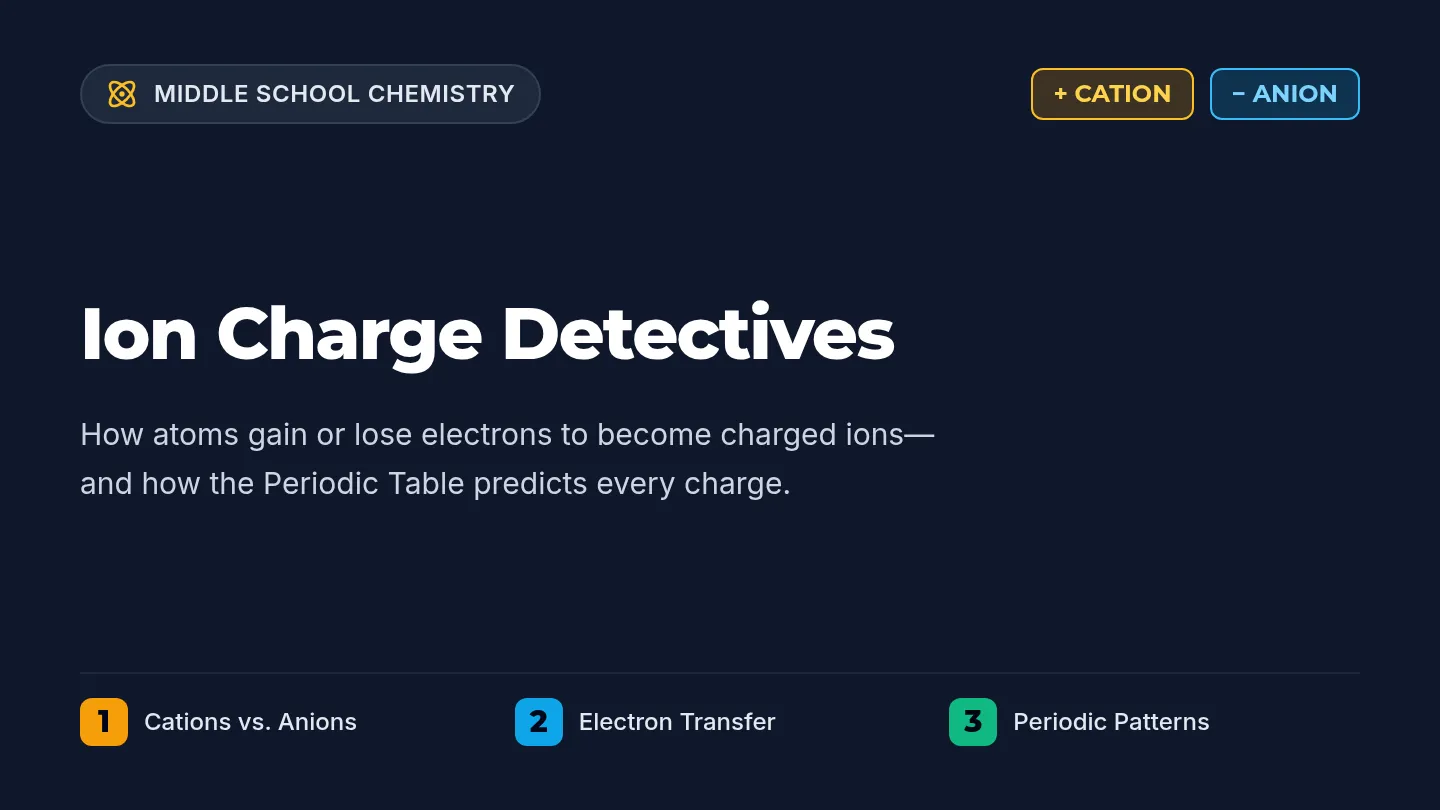
Simple Ions & Compounds
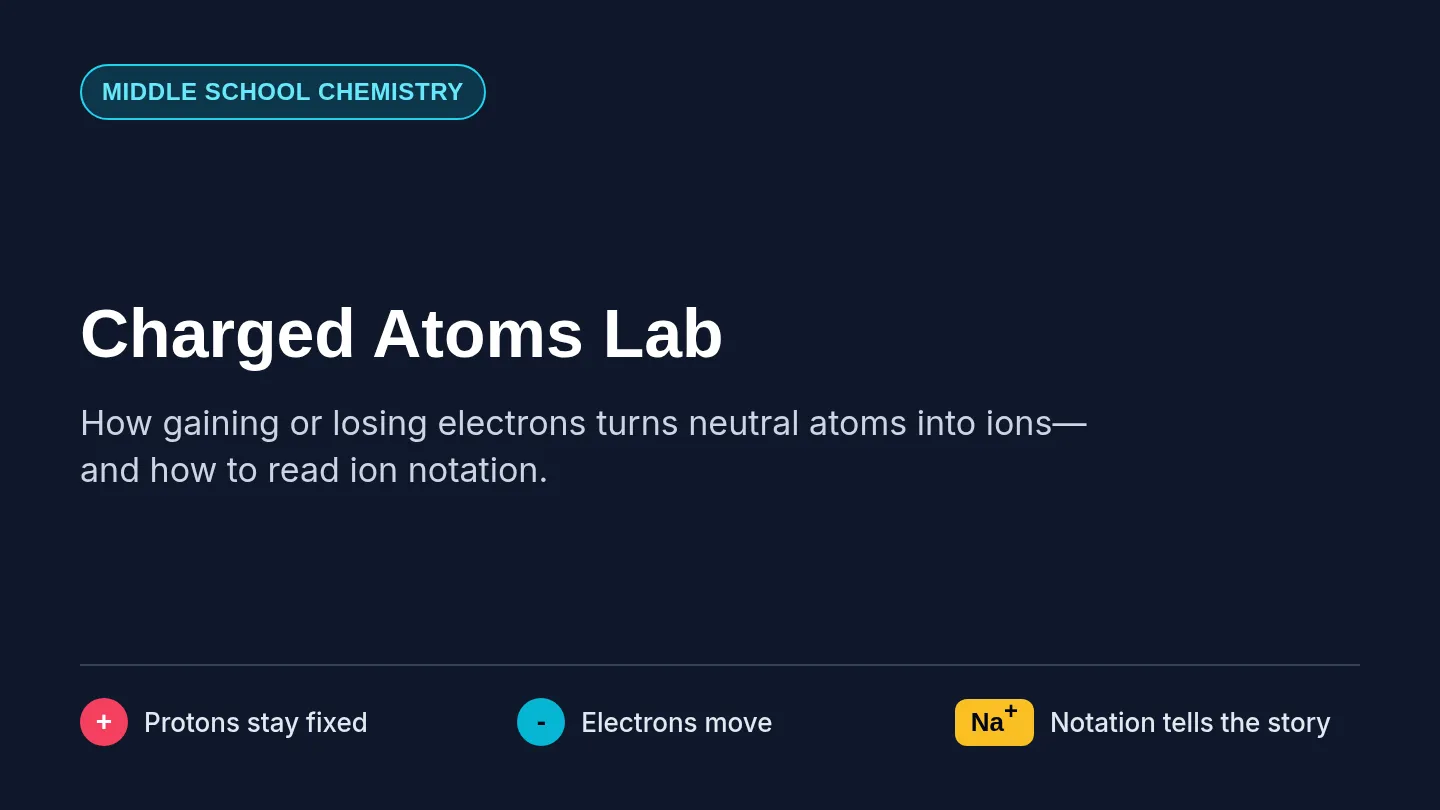
Ion Charge Lab
How atoms gain or lose electrons, how to read ion symbols, and how opposite charges team up to make compounds like table salt!
11 +1
Na+
Sodium ion
17 -1
Cl-
Chloride ion
1. Gaining & Losing Electrons • 2. Reading Ion Symbols • 3. Building Compounds
Neutral Atoms vs. Ions
Part 1: Ion Basics
Neutral Atom (0 Charge)
Everything Cancels Out
A neutral atom has the same number of positive protons (+) and negative electrons (-).
Lithium (Li): 3 p+ and 3 e- → Charge = 0
Ion (Charged Atom)
Electrons Move!
An ion forms when an atom gains or loses electrons . Protons never leave the center!
Quick Math: Charge = Protons - Electrons
Rule #1: Protons stay locked in the nucleus. Only outer electrons can move in or out.
Two Types of Ions
Part 1: Ion Basics
Cation (+) Positive
Forms when an atom loses negative electrons (usually metals).
Example: Lithium (Li)
3 protons (+3) & 2 electrons (-2)
1 extra + → Li+
Memory Trick: CAT -ions are paws -itive!
Anion (-) Negative
Forms when an atom gains negative electrons (usually nonmetals).
Example: Fluorine (F)
9 protons (+9) & 10 electrons (-10)
1 extra - → F-
Memory Trick: A -N -ion = A N egative ion!
Think of it like losing or gaining negative points: losing a minus makes you positive!
Reading Ion Symbols
Part 2: Notation
Mg2+
1. Element Symbol (Mg)
Tells us which element it is: Magnesium.
2. Raised Number & Sign (2+)
Number first, then sign. 2+ means it lost 2 electrons .
3. The Invisible "1"
If the charge is +1 or -1, we hide the 1: just write Li+ or F- .
O2- = Oxygen gained 2 e- • Al3+ = Aluminum lost 3 e- • Cl- = Chlorine gained 1 e-
Naming Simple Ions
Part 2: Notation
Positive Cations (+)
Keep the Name + "ion"
Na+ Sodium → Sodium ion
Ca2+ Calcium → Calcium ion
Al3+ Aluminum → Aluminum ion
Negative Anions (-)
Change Ending to "-ide"
Cl- Chlorine → Chloride ion
O2- Oxygen → Oxide ion
S2- Sulfur → Sulfide ion
Tip: Only negative ions get the -ide ending!
Quick Check: Read the Ion
Partner Talk
K+
• Potassium
• Lost or Gained e-?
• Ion Name: ___________
S2-
• Sulfur
• Lost or Gained e-?
• Ion Name: ___________
Ca2+
• Calcium
• Lost or Gained e-?
• Ion Name: ___________
Tell a partner how many electrons each atom gained or lost and what its ion name is!
Building Ionic Compounds
Part 3: Compounds
Opposite charges attract like magnets! When they team up, the total charge must add up to zero .
Na+
Charge: +1
Cl-
Charge: -1
→
NaCl
Sodium chloride (+1 - 1 = 0)
Formula Rule: Always write the positive metal first, then the negative nonmetal. Drop the charge signs!
When Charges Don't Match
Part 3: Compounds
Combine Mg2+ and Cl-
One magnesium ion has a +2 charge. One chloride ion only has a -1 charge.
To make the total equal zero, we need two Cl- ions:
(+2) + (-1) + (-1) = 0
Mg2+
Cl-
Cl-
↓
MgCl2
Magnesium chloride
The small lowered number (2) tells us how many of that ion are in the compound.
Exit Challenge
Try It!
Challenge 1
Li+ + S2- → ?
How many lithium ions (Li+) do you need to balance one sulfide ion (S2-)? Write the formula and name.
Boss Challenge
Al3+ + O2- → ?
Hint: Try counting by 3s and 2s until both charges add up to 6! Write the formula and name.
Great job! Next up: practice on your Ion Charge Worksheet .
Ion Charge Worksheet Middle School Science
Ion Charge Worksheet
Name: ________________________ Date: ____________
Charge Math: Protons (+) − Electrons (−)
Cation (+): Lost e− • Name + ion
Anion (−): Gained e− • Ending changes to -ide ion
Part 1: Ion Basics (Gaining & Losing Electrons)
Use the example row to help you fill in the table.
Element
Protons (+)
Electrons (−)
Total Charge
Cation or Anion?
Example: Sodium (Na)
11
10
+1
Cation
1. Lithium (Li)
3
2
2. Fluorine (F)
9
10
3. Magnesium (Mg)
12
10
4. Oxygen (O)
8
10
5. In your own words, why does losing an electron give an atom a positive charge?
Part 2: Reading Ion Symbols
Write the element name, how electrons changed, and the ion name.
Element Clues: Cl = Chlorine | Ca = Calcium | O = Oxygen | Li = Lithium | F = Fluorine | S = Sulfur
Ion Symbol
Element Name
Lost or Gained Electrons?
Ion Name
Mg2+
Magnesium
Lost 2 electrons
Magnesium ion
Cl−
Ca2+
O2−
Li+
F−
S2−
Ion Charge Worksheet — Page 2 Name: ________________________
Part 3: Building Ionic Compounds
Goal: Make the positive and negative charges add up to 0!
Example: Combine Mg2+ and Cl− 1 Mg2+ (+2) + 2 Cl− (−2) = 0 Formula: MgCl2 | Name: Magnesium chloride
Problem 1 K+ and Br−
Show how charges balance to 0:
Formula: ____________
Name: ___________________
Problem 2 Ca2+ and O2−
Show how charges balance to 0:
Formula: ____________
Name: ___________________
Problem 3 Li+ and S2−
Show how charges balance to 0:
Formula: ____________
Name: ___________________
Problem 4 Ca2+ and Cl−
Show how charges balance to 0:
Formula: ____________
Name: ___________________
Problem 5 Al3+ and F−
Show how charges balance to 0:
Formula: ____________
Name: ___________________
Bonus Challenge Al3+ and O2−
Show how charges balance to 0:
Formula: ____________
Name: ___________________
Part 4: Check & Reflect
1. Why do protons never leave an atom when it turns into an ion?
2. A classmate writes the formula for sodium sulfide (from Na+ and S2−) as NaS . What did they forget to do, and what is the correct formula?
Ion Charge Answer Key Middle School Science • Teacher Resource
Ion Charge Answer Key
Matches Ion Charge Worksheet
Part 1: Ion Basics
Element
p+
e−
Total Charge
Type
1. Lithium (Li)
3
2
+1
Cation
2. Fluorine (F)
9
10
−1
Anion
3. Magnesium (Mg)
12
10
+2
Cation
4. Oxygen (O)
8
10
−2
Anion
5. Electrons have a negative charge. When an atom loses a negative electron, it has more positive protons than negative electrons left over, giving it a positive charge.
Part 2: Reading Ion Symbols
Symbol
Element Name
Electron Change
Ion Name
Cl−
Chlorine
Gained 1 electron
Chloride ion
Ca2+
Calcium
Lost 2 electrons
Calcium ion
O2−
Oxygen
Gained 2 electrons
Oxide ion
Li+
Lithium
Lost 1 electron
Lithium ion
F−
Fluorine
Gained 1 electron
Fluoride ion
S2−
Sulfur
Gained 2 electrons
Sulfide ion
Part 3: Building Ionic Compounds
1. K+ + Br−: (+1) + (−1) = 0 → KBr (Potassium bromide)
2. Ca2+ + O2−: (+2) + (−2) = 0 → CaO (Calcium oxide)
3. Li+ + S2−: 2(+1) + (−2) = 0 → Li2S (Lithium sulfide)
4. Ca2+ + Cl−: (+2) + 2(−1) = 0 → CaCl2 (Calcium chloride)
5. Al3+ + F−: (+3) + 3(−1) = 0 → AlF3 (Aluminum fluoride)
Bonus. Al3+ + O2−: 2(+3) + 3(−2) = 0 → Al2O3 (Aluminum oxide)
Part 4: Check & Reflect
1. Protons are locked inside the center (nucleus) of the atom and decide what element it is. Changing the protons would change it into a completely different element.
2. They forgot to balance the charges to zero. Since S2− is −2 and Na+ is only +1, you need two Na+ ions to balance one S2− ion: Na2S .
Ion Charge Teacher Guide Middle School Science • 45-Minute Lesson
Ion Charge Teacher Guide
Grades 6–8 Slides + Worksheet
Learning Objectives
Explain how atoms form positive cations (losing electrons) and negative anions (gaining electrons).
Read ion symbols (e.g., Mg2+, Cl−) to identify the element, electron change, and ion name.
Combine simple cations and anions so total charges balance to zero and write ionic formulas.
Materials Needed
Ion Charge Slides
Ion Charge Worksheet (1/student)
Ion Charge Answer Key
Optional: 2-color +/- counters
Pacing & Facilitation Plan (45 Minutes)
Time
Lesson Segment
Teacher Moves & Discussion Prompts
0–12 min
Ion Basics
Slides 1–3
Introduce NaCl (table salt) on Slide 1. Emphasize that protons stay in the center while electrons move. Use the CAT-ion = paws-itive memory trick on Slide 3.
12–22 min
Reading Symbols
Slides 4–6
Highlight the "invisible 1" rule (Li+, F−) and the -ide ending for negative ions. On Slide 6, have students turn-and-talk to decode K+, S2−, and Ca2+.
22–32 min
Building Compounds
Slides 7–9
Model balancing charges to zero using Mg2+ and two Cl− ions on Slide 8. Preview Slide 9 challenges before handing out the worksheet.
32–45 min
Independent Practice
Worksheet Parts 1–4
Students complete the 2-page Ion Charge Worksheet. Circulate to check Part 1 sign errors (+ vs −) and Part 3 charge-balancing boxes.
Common Misconceptions & Quick Fixes
"Gaining electrons makes an ion positive." — Remind students that electrons are negative . Gaining negative points lowers your score; losing negative points makes it go up!
"Atoms gain or lose protons to get a charge." — Reinforce that protons are locked in the nucleus and decide what element the atom is. Only outer electrons move.
"Charges stay in the final formula (e.g., Na+Cl−)." — Explain that once positive and negative charges cancel to zero, the compound is neutral, so we drop the charge signs (NaCl ).
Differentiation Strategies
Extra Support (Scaffolding)
Give students physical "+" and "−" chips (or have them draw + and − signs in the Part 3 boxes) to pair and cross out opposite charges until zero remain. Point out the Element Clues box on Page 1.
Extension (Early Finishers)
Ask students who finish the Al3+ + O2− Bonus Challenge to find the formula for Magnesium nitride (Mg2+ and N3−) and explain the "least common multiple" pattern they used.