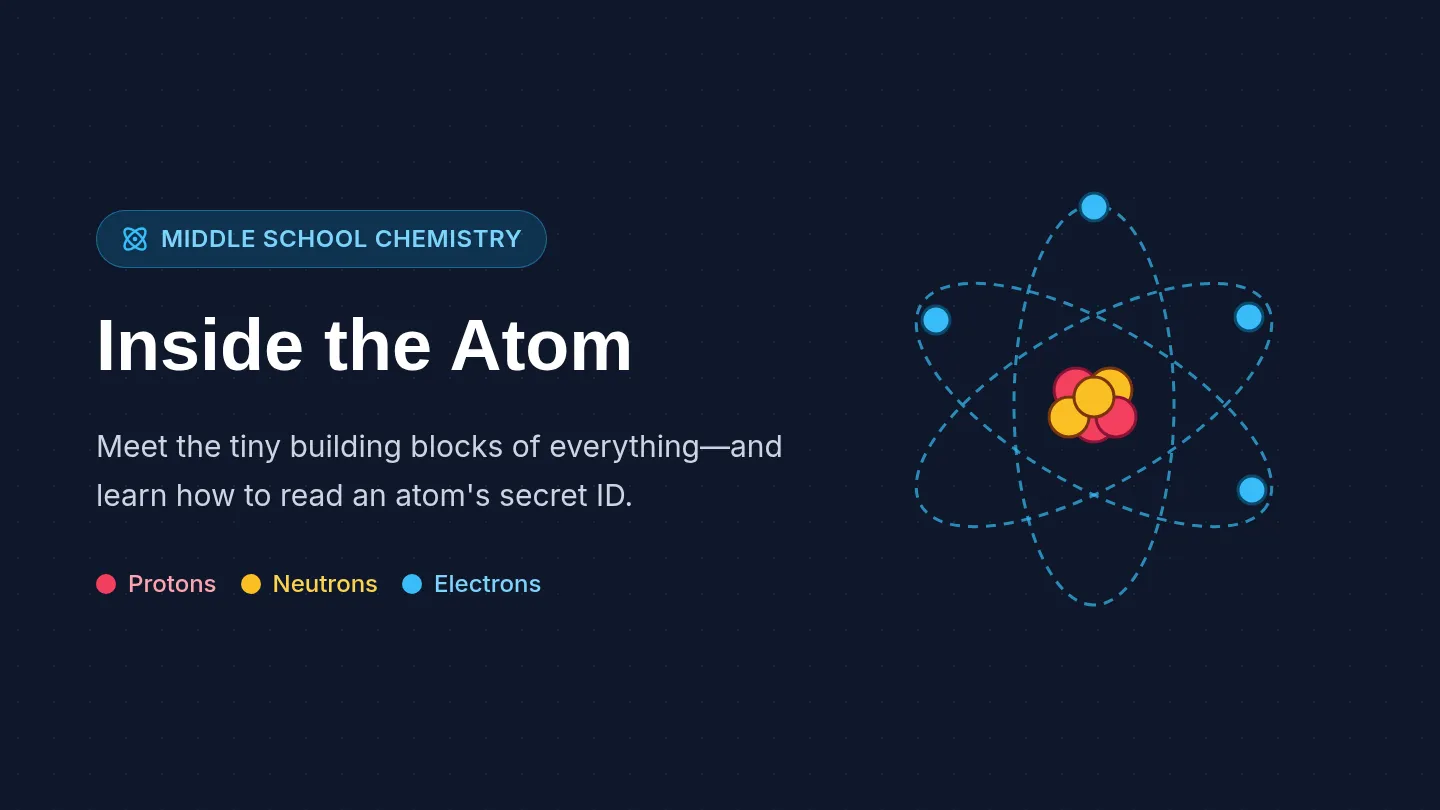
Ion Charge Slides Middle School Chemistry
Charged Atoms Lab
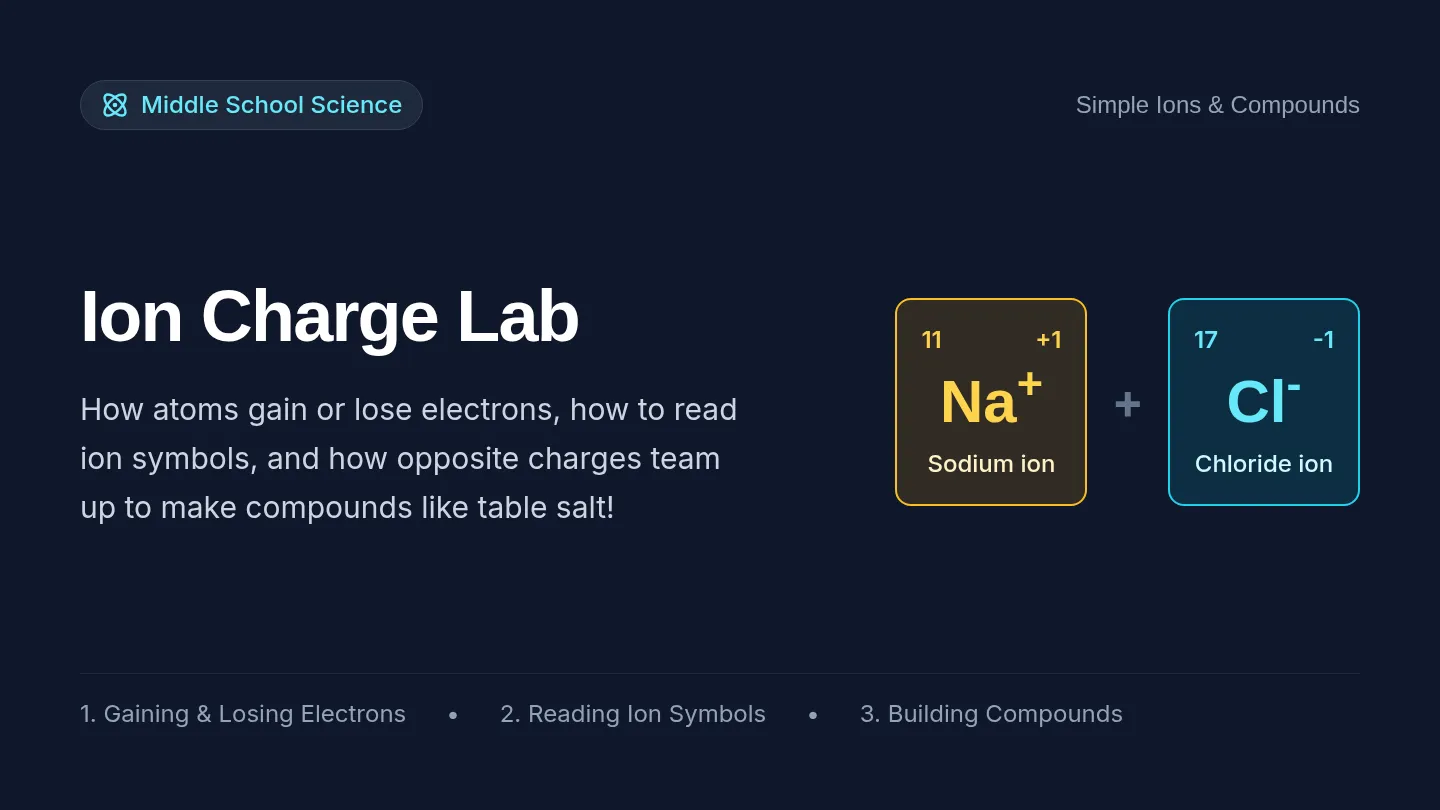
How gaining or losing electrons turns neutral atoms into ions—and how to read ion notation.
Protons stay fixed
-
Electrons move
Na+
Notation tells the story
Concept 1
Start Neutral: Balanced Charges
Every atom has positive protons (+) in its nucleus and negative electrons (−) outside.
Protons = Electrons → Charge is 0
Equal numbers of + and − cancel each other out.
Neutral Lithium Atom (Li)
3 Protons
=
3 Electrons
−
−
−
Net Charge: (+3) + (−3) = 0
Concept 2
How Ions Form: Only Electrons Move
Golden Rule: An atom never gains or loses protons to become an ion—only electrons!
Lose Electrons
Cation (+)
Fewer negative electrons remain, so protons outnumber electrons.
>
−
−
= +1
Gain Electrons
Anion (−)
Extra negative electrons arrive, so electrons outnumber protons.
<
−
−
−
−
= −1
Concept 3
Reading Ion Notation
Mg 2 +
Magnesium ion (lost 2 electrons)
1. Element Symbol (Mg)
Identifies the element and its fixed number of protons (12 for Mg).
2. Charge Number (2)
Shows how many electrons were gained or lost. If there is no number, it means 1!
3. Charge Sign (+ or −)
means electrons were lost. − means electrons were gained.
Na+ = +1 charge (lost 1 e−) | Cl− = −1 charge (gained 1 e−)
Worked Example 1
Sodium (Na) Loses 1 Electron
Na+
Step 1: Neutral
Neutral Sodium has:
11 Protons (+) 11 Electrons (−)
Net Charge = 0
Step 2: Change
Atom loses 1 electron :
11 Protons (+) 10 Electrons (−)
Protons stay at 11!
Step 3: Charge
Subtract electrons from protons:
11 − 10 = +1
Write Na+ (skip the 1).
Formula to remember: Ion Charge = Protons − Electrons
Worked Example 2
Oxygen (O) Gains 2 Electrons
O2−
Step 1: Neutral
Neutral Oxygen has:
8 Protons (+) 8 Electrons (−)
Net Charge = 0
Step 2: Change
Atom gains 2 electrons :
8 Protons (+) 10 Electrons (−)
Protons stay at 8!
Step 3: Charge
Subtract electrons from protons:
8 − 10 = −2
Write O2− (number first, then sign).
Tip: In chemistry notation, write the number before the sign (2−, not −2).
Your Turn
Quick Check Before Practice
Challenge A
An aluminum atom (Al ) has 13 protons and loses 3 electrons .
• How many electrons does it have now?
• What is its net charge?
• How do you write the ion notation?
Challenge B
You see the ion notation S2− on a lab bottle.
• Did sulfur gain or lose electrons?
• How many electrons changed?
• If S has 16 protons, how many electrons does S2− have?
Discuss with a partner, then complete your Ion Notation Worksheet!
Ion Notation Worksheet Charged Atoms Lab
Ion Notation Worksheet
Name: _______________________ Date: _____________
Key Formula: Net Charge = Protons (+) − Electrons (−)
Remember: Protons never change! Only electrons are gained (−) or lost (+).
Mg2+
Symbol • Number • Sign
Part 1: Protons, Electrons, and Net Charge
Complete the missing cells in the table below. The first row is done as an example.
Atom / Ion
Protons
Electrons
Electron Change
Net Charge
Ion / Neutral?
Carbon (C)
6
6
No change
0
Neutral
Lithium (Li+)
3
+1
Fluorine (F−)
9
10
Magnesium (Mg2+)
12
Lost 2 electrons
Nitrogen (N3−)
7
10
Neon (Ne)
10
10
Part 2: Reading Ion Notation
For each ion symbol, write the net charge and describe how the electrons changed.
1. Ca2+ Calcium
Net Charge:
Electrons:
2. Cl− Chlorine
Net Charge:
Electrons:
3. Al3+ Aluminum
Net Charge:
Electrons:
4. S2− Sulfur
Net Charge:
Electrons:
Ion Notation Worksheet — Page 2 Name: _______________________
Part 3: Build the Ion Notation
Use the clues to calculate the net charge and write the correct ion notation (example: Na+ or O2−).
1. Potassium (K): 19 protons, loses 1 electron
Charge:
Notation:
2. Phosphorus (P): 15 protons, 18 electrons
Charge:
Notation:
3. Beryllium (Be): 4 protons, 2 electrons
Charge:
Notation:
4. Bromine (Br): 35 protons, gains 1 electron
Charge:
Notation:
Part 4: Quick Concept Check
1. An atom of Zinc (Zn) has 30 protons and 28 electrons. What is its correct ion notation?
A. Zn2−
B. Zn2+
C. Zn30+
D. Zn28−
2. Which statement best explains how a neutral chlorine atom becomes a Cl− ion?
A. It loses 1 proton from its nucleus.
B. It gains 1 proton in its nucleus.
C. It gains 1 electron.
D. It loses 1 electron.
Part 5: Explain Your Thinking
Why does losing an electron give an atom a positive (+) charge instead of a negative charge? Use the words protons and electrons in your answer.
Ion Notation Answer Key Teacher Resource • Charged Atoms Lab
Ion Notation Answer Key
Complete Solutions
Part 1: Protons, Electrons, and Net Charge
Atom / Ion
Protons
Electrons
Electron Change
Net Charge
Ion / Neutral?
Carbon (C)
6
6
No change
0
Neutral
Lithium (Li+)
3
2
Lost 1 electron
+1
Ion (Cation)
Fluorine (F−)
9
10
Gained 1 electron
−1
Ion (Anion)
Magnesium (Mg2+)
12
10
Lost 2 electrons
+2
Ion (Cation)
Nitrogen (N3−)
7
10
Gained 3 electrons
−3
Ion (Anion)
Neon (Ne)
10
10
No change
0
Neutral
Part 2: Reading Ion Notation
1. Ca2+: Charge = +2 • Lost 2 electrons
2. Cl−: Charge = −1 • Gained 1 electron
3. Al3+: Charge = +3 • Lost 3 electrons
4. S2−: Charge = −2 • Gained 2 electrons
Part 3: Build the Ion Notation
1. Potassium (K): Charge = +1 • Notation: K+
2. Phosphorus (P): Charge = −3 • Notation: P3−
3. Beryllium (Be): Charge = +2 • Notation: Be2+
4. Bromine (Br): Charge = −1 • Notation: Br−
Part 4: Quick Concept Check
1. B (Zn2+) — 30 protons − 28 electrons = +2
2. C (It gains 1 electron.) — Extra e− gives −1 charge.
Part 5: Explain Your Thinking (Sample Response)
Electrons have a negative charge and protons have a positive charge. A neutral atom has equal numbers of protons and electrons. When an atom loses an electron, there are now more positive protons than negative electrons left, giving the atom an overall positive (+) charge.