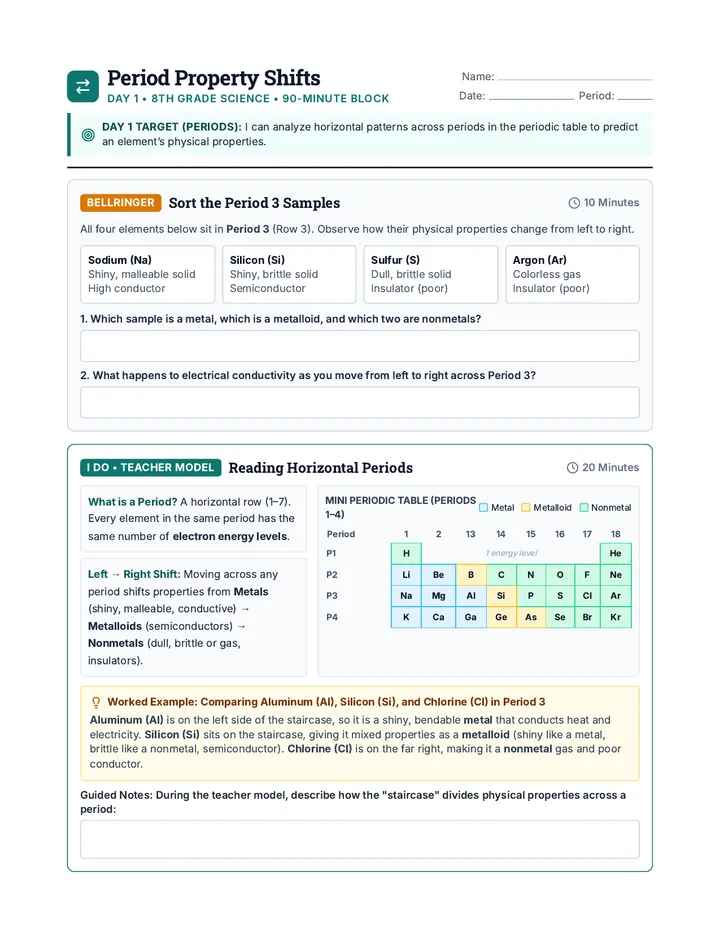
Period Property Shifts Worksheet Period Property Shifts
Day 1 • 8th Grade Science • 90-Minute Block
Name:
Date: Period:
Day 1 Target (Periods): I can analyze horizontal patterns across periods in the periodic table to predict an element’s physical properties.
Bellringer
Sort the Period 3 Samples
10 Minutes
All four elements below sit in Period 3 (Row 3). Observe how their physical properties change from left to right.
Sodium (Na)
Shiny, malleable solid
High conductor
Silicon (Si)
Shiny, brittle solid
Semiconductor
Sulfur (S)
Dull, brittle solid
Insulator (poor)
Argon (Ar)
Colorless gas
Insulator (poor)
1. Which sample is a metal, which is a metalloid, and which two are nonmetals?
2. What happens to electrical conductivity as you move from left to right across Period 3?
I Do • Teacher Model
Reading Horizontal Periods
20 Minutes
What is a Period? A horizontal row (1–7). Every element in the same period has the same number of electron energy levels .
Left → Right Shift: Moving across any period shifts properties from Metals (shiny, malleable, conductive) → Metalloids (semiconductors) → Nonmetals (dull, brittle or gas, insulators).
Mini Periodic Table (Periods 1–4)
Metal Metalloid Nonmetal
Period
1
2
13
14
15
16
17
18
P1
H
1 energy level
He
P2
Li
Be
B
C
N
O
F
Ne
P3
Na
Mg
Al
Si
P
S
Cl
Ar
P4
K
Ca
Ga
Ge
As
Se
Br
Kr
Worked Example: Comparing Aluminum (Al), Silicon (Si), and Chlorine (Cl) in Period 3
Aluminum (Al) is on the left side of the staircase, so it is a shiny, bendable metal that conducts heat and electricity. Silicon (Si) sits on the staircase, giving it mixed properties as a metalloid (shiny like a metal, brittle like a nonmetal, semiconductor). Chlorine (Cl) is on the far right, making it a nonmetal gas and poor conductor.
Guided Notes: During the teacher model, describe how the "staircase" divides physical properties across a period:
We Do • Guided Practice
Horizontal Period Investigation
25 Minutes
Part A: Period 2 Property Spectrum (Left to Right)
With your partner, use the Mini Periodic Table on Page 1 to complete the physical property profile for selected elements in Period 2 .
Element (Period 2)
Classification
State at 20°C
Luster & Conductivity
Lithium (Li)
Metal
Solid
Shiny, malleable, high electrical conductivity.
Beryllium (Be)
Boron (B)
Carbon (C)
Nonmetal
Solid
Dull (charcoal/graphite), brittle, mostly poor conductor.
Fluorine (F)
1. Why does Boron (B) have properties of both metals and nonmetals?
2. Compare Lithium (Li) on the left of Period 2 to Fluorine (F) on the right. List two physical property differences:
Part B: Predict Across Period 4
Apply the same horizontal pattern to Period 4 . Predict each element's physical properties before checking with your teacher.
Element (Period 4)
Metal / Metalloid / Nonmetal
Malleable or Brittle?
Conductivity (High / Semi / Low)
Calcium (Ca) — Left
Germanium (Ge) — Staircase
Bromine (Br) — Right
3. Do elements in the same period share similar physical properties? Explain why or why not:
You Do • Independent
Material Engineering Lab
25 Minutes
Task 1: Locate the Period 3 Mystery Samples
Four unlabeled samples from Period 3 were tested in the lab. Use their physical properties to determine each sample's classification and where it sits in Period 3.
Sample A
Silvery, shiny, can be hammered into sheets
High thermal & electrical conductivity
Classification:
Period 3 Region (Left / Staircase / Right):
Possible Element & Evidence:
Sample B
Metallic luster, but shatters when struck
Conducts electricity only when warmed (semiconductor)
Classification:
Period 3 Region (Left / Staircase / Right):
Possible Element & Evidence:
Sample C
Dull, powdery yellow solid
Does not conduct heat or electricity
Classification:
Period 3 Region (Left / Staircase / Right):
Possible Element & Evidence:
Sample D
Pale green-yellow gas at room temperature
Electrical insulator (poor conductor)
Classification:
Period 3 Region (Left / Staircase / Right):
Possible Element & Evidence:
Task 2: Engineering Design Scenarios
1. A smartphone company needs a material that can control electrical flow (semiconductor) without melting. Should they test Magnesium (Mg), Silicon (Si), or Phosphorus (P)? Explain using period patterns.
2. An engineer needs to bend a metal rod into a frame and use it to transfer heat. Which region of Period 4 (left, middle staircase, or far right) should they choose and why?
You Do • Synthesis
Claim-Evidence-Reasoning (CER)
Scenario: Compare Gallium (Ga) (Period 4, left of the staircase) and Selenium (Se) (Period 4, right of the staircase). Predict how their physical properties (luster, malleability, conductivity) will differ.
CLAIM (Predict the physical properties of Gallium vs. Selenium):
EVIDENCE (Cite their positions in Period 4 relative to the metalloid staircase):
REASONING (Explain how horizontal period patterns support your prediction):
Exit Ticket
Day 1 Mastery Check
10 Minutes
1. Moving from left to right across Period 3 (Na → Si → Cl), how do physical properties change?
A. Nonmetal → Metalloid → Metal
B. Metal → Metalloid → Nonmetal
C. All elements stay shiny conductors
D. Conductivity increases from left to right
2. Which physical property is typical of an element located on the far right of Period 2 (excluding Group 18)?
A. Malleable solid
B. High electrical conductor
C. Poor conductor / insulator
D. Shiny metallic luster
3. Confidence Check: What is one physical property pattern across a period you can explain, and one question for Day 2?
Period Property Shifts Slides Day 1 • 8th Grade Science
90-Minute Block
Period Property Shifts
Learning Target
I can analyze horizontal patterns across periods in the periodic table to predict an element’s physical properties.
10 min
Bellringer
20 min
I Do
25 min
We Do
25 min
You Do
10 min
Exit Ticket
Bellringer • 10 Minutes Period 3 Samples
Sort the Period 3 Samples
Sodium (Na)
Shiny, malleable
High conductor
Silicon (Si)
Shiny, brittle
Semiconductor
Sulfur (S)
Dull, brittle
Insulator
Argon (Ar)
Colorless gas
Insulator
On Page 1 of your worksheet:
1. Identify which sample is a metal, metalloid, and nonmetal.
2. Describe how conductivity changes from left to right.
I Do • Teacher Model 20 Minutes
The Left-to-Right Period Shift
Every horizontal Period (Row 1–7) follows the same physical property pattern:
1. Metals (Left)
Shiny luster
Malleable & ductile
High conductors
2. Metalloids (Staircase)
Mixed properties
Shiny, yet brittle
Semiconductors
3. Nonmetals (Right)
Dull or colorless gas
Brittle solids
Insulators (poor)
Key Rule: Elements in the same period do NOT share the same properties—they transition across the row!
I Do • Worked Example Period 3 Spotlight
Predicting Al, Si, and Cl in Period 3
Aluminum (Al) — Left of Staircase
Metal: Shiny, bendable solid that conducts heat and electricity well.
Silicon (Si) — On the Staircase
Metalloid: Shiny like a metal, brittle like a nonmetal, semiconductor.
Chlorine (Cl) — Far Right
Nonmetal: Yellow-green gas at room temperature and poor conductor.
Complete your Guided Notes on Page 1 before we move to partner practice.
We Do • Partner Practice 25 Minutes
Horizontal Period Investigation (Page 2)
Part A: Period 2 Spectrum
Classify Be, B, and F
Predict state, luster, & conductivity
Explain why Boron (B) has mixed traits
Part B: Predict Period 4
Calcium (Ca) → Left
Germanium (Ge) → Staircase
Bromine (Br) → Right
Partner Check: Be ready to share how you used the staircase line to make your predictions.
You Do & Exit Ticket 35 Minutes Total
You Do (25 min) • Pages 3–4
Task 1: Locate 4 Period 3 Mystery SamplesTask 2: Engineering Design ScenariosCER: Predict Gallium (Ga) vs. Selenium (Se)
Exit Ticket (10 min) • Page 4
2 Multiple-Choice Mastery Checks
1 Confidence Check & Question for Day 2
Turn in before the bell!
Up Next (Day 2): Vertical Groups, Valence Electrons, & Chemical Reactivity!
Group Reactivity Showdown Worksheet Group Reactivity Showdown
Day 2 • 8th Grade Science • 90-Minute Block
Name:
Date: Period:
Day 2 Target (Groups): I can analyze vertical group patterns and valence electrons to predict an element’s chemical reactivity.
Bellringer
Spot the Odd Element Out
10 Minutes
Examine the four element cards below. Three belong to the same vertical family (Group 1), and one does not.
Lithium (Li)
1 valence e⁻
Fizzes in water
Sodium (Na)
1 valence e⁻
Reacts fast in water
Argon (Ar)
8 valence e⁻
No reaction in water
Potassium (K)
1 valence e⁻
Ignites in water
1. Which element is the "odd one out," and how do its valence electrons explain its behavior?
2. What happens to reactivity as you move down Group 1 from Lithium (Li) to Potassium (K)?
I Do • Teacher Model
Valence Electrons & Family Reactivity
20 Minutes
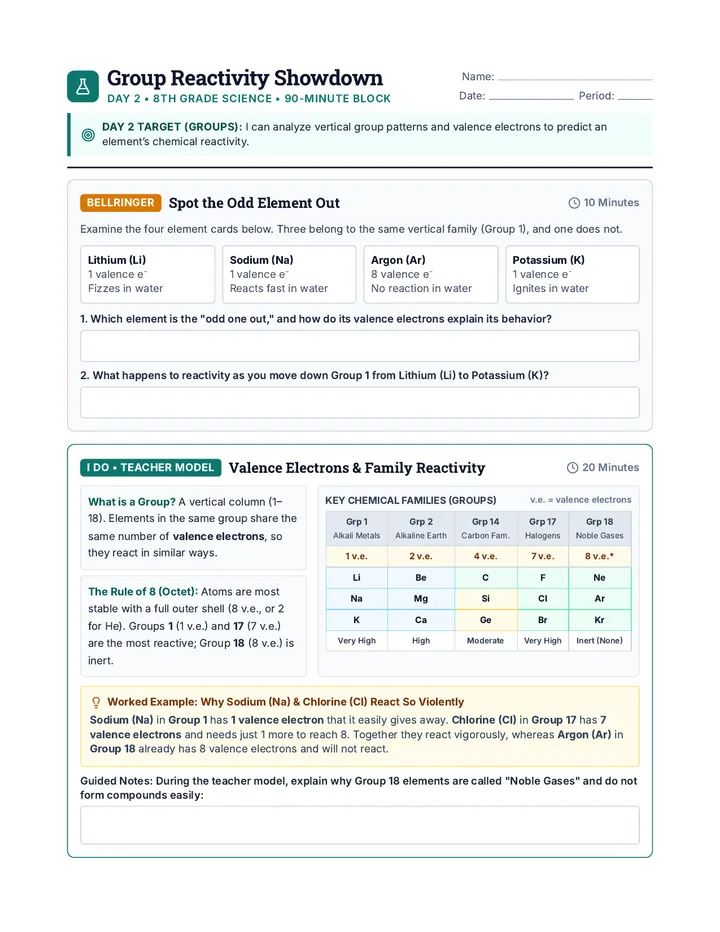
What is a Group? A vertical column (1–18). Elements in the same group share the same number of valence electrons , so they react in similar ways.
The Rule of 8 (Octet): Atoms are most stable with a full outer shell (8 v.e., or 2 for He). Groups 1 (1 v.e.) and 17 (7 v.e.) are the most reactive; Group 18 (8 v.e.) is inert.
Key Chemical Families (Groups) v.e. = valence electrons
| Grp 1
Worked Example: Why Sodium (Na) & Chlorine (Cl) React So Violently
Sodium (Na) in Group 1 has 1 valence electron that it easily gives away. Chlorine (Cl) in Group 17 has 7 valence electrons and needs just 1 more to reach 8. Together they react vigorously, whereas Argon (Ar) in Group 18 already has 8 valence electrons and will not react.
Guided Notes: During the teacher model, explain why Group 18 elements are called "Noble Gases" and do not form compounds easily:
We Do • Guided Practice
Group Reactivity Investigation
25 Minutes
Part A: Comparing Chemical Families (Vertical Patterns)
Work with your partner and the Key Chemical Families table on Page 1 to fill in the missing predictions.
Element & Group
Valence e⁻
Family Name
Predicted Reactivity & Why
Potassium (K)
Group 1, Period 4
1
Alkali Metal
Very high; easily loses 1 valence electron.
Rubidium (Rb)
Group 1, Period 5
Bromine (Br)
Group 17, Period 4
Krypton (Kr)
Group 18, Period 4
1. Why do Potassium (K) and Rubidium (Rb) have similar reactivity even though Rubidium is in Period 5?
2. Both Bromine (Group 17) and Krypton (Group 18) are in Period 4. Why is Bromine highly reactive while Krypton is inert?
Part B: Reactivity Trends Down a Group
In Group 1 (Alkali Metals) , reactivity increases as you move down the group because the outer electron is farther from the nucleus and easier to lose.
Group 1 Element
Period (# of Energy Levels)
Reaction Speed in Water (Rank 1 = Slowest, 3 = Fastest)
Lithium (Li)
Sodium (Na)
Potassium (K)
3. Predict how Cesium (Cs, Group 1, Period 6) would react in water compared to Potassium (K):
You Do • Independent
Mystery Element Reactivity Lab
25 Minutes
Task 1: Identify the Group & Reactivity
Use each element's valence electrons and chemical clues to predict its Group #, Reactivity Level, and a matching element from Periods 2–4.
Mystery Element W
Has 1 valence electron
Tarnishes instantly in air; fizzes in water
Group #:
Reactivity (Very High / Mod / Inert):
Possible Element & Why:
Mystery Element X
Has 8 valence electrons
Used inside lightbulbs because it won't burn
Group #:
Reactivity (Very High / Mod / Inert):
Possible Element & Why:
Mystery Element Y
Has 7 valence electrons
Reacts vigorously with Group 1 metals to form salts
Group #:
Reactivity (Very High / Mod / Inert):
Possible Element & Why:
Mystery Element Z
Has 2 valence electrons
Reacts with acid, but less violently than Group 1
Group #:
Reactivity (Very High / Mod / Inert):
Possible Element & Why:
Task 2: Reactivity Prediction Challenge
1. A chemist runs out of Sodium (Na) for an experiment that needs a soft metal with 1 valence electron. Which element could she substitute—Magnesium (Mg) or Potassium (K)? Explain why.
2. Why are Noble Gases (Group 18) safe to use in neon signs and party balloons without catching fire?
You Do • Two-Day Synthesis
Claim-Evidence-Reasoning (CER)
Final Challenge (Periods + Groups): Scientists discover a sample of Rubidium (Rb) in Group 1, Period 5 . Using both Day 1 (Periods) and Day 2 (Groups), predict Rubidium's physical properties (luster, conductivity) AND its reactivity compared to Sodium (Na, Group 1, Period 3).
CLAIM (Predict Rubidium's physical properties and reactivity):
EVIDENCE (Cite its Period 5 position, Group 1 valence electrons, and comparison to Na):
REASONING (Explain how both period and group patterns support your claim):
Exit Ticket
Day 2 Mastery Check
10 Minutes
1. Which pair of elements will have the most similar chemical reactivity?
A. Sodium (Na) and Chlorine (Cl)
B. Fluorine (F) and Bromine (Br)
C. Carbon (C) and Nitrogen (N)
D. Neon (Ne) and Oxygen (O)
2. An element has 7 valence electrons. How would you classify its reactivity?
A. Inert (does not react)
B. Very low reactivity
C. Very high reactivity
D. Only reacts with Group 18
3. Confidence Check: Explain in one sentence the difference between what a Period tells you and what a Group tells you:
Group Reactivity Showdown Slides Day 2 • 8th Grade Science
90-Minute Block
Group Reactivity Showdown
Learning Target
I can analyze vertical group patterns and valence electrons to predict an element’s chemical reactivity.
10 min
Bellringer
20 min
I Do
25 min
We Do
25 min
You Do
10 min
Exit Ticket
Bellringer • 10 Minutes Chemical Families
Spot the Odd Element Out
Lithium (Li)
1 valence e⁻
Fizzes in water
Sodium (Na)
1 valence e⁻
Reacts fast
Argon (Ar)
8 valence e⁻
No reaction
Potassium (K)
1 valence e⁻
Ignites in water
On Page 1 of your worksheet:
1. Identify the "odd one out" using valence electrons.
2. Describe how reactivity changes going down Group 1.
I Do • Teacher Model 20 Minutes
Valence Electrons Drive Reactivity
Elements in the same Group (Column) have the same valence electrons—and similar reactivity.
Group 1 (1 v.e.)
Alkali Metals
Easily lose 1 electron
Very High reactivity
Group 17 (7 v.e.)
Halogens
Need 1 electron for 8
Very High reactivity
Group 18 (8 v.e.*)
Noble Gases
Full outer shell
Inert (Unreactive)
Rule of 8: Atoms react to reach a full outer shell of 8 valence electrons (2 for Helium).
I Do • Worked Example Na vs. Cl vs. Ar
Why Sodium & Chlorine React Violently
Sodium (Na) — Group 1 (1 v.e.)
Gives away its 1 outer electron easily to become stable.
Chlorine (Cl) — Group 17 (7 v.e.)
Pulls in 1 electron from Sodium to complete its full shell of 8.
Argon (Ar) — Group 18 (8 v.e.)
Already has 8 valence electrons—no need to react with anything!
Complete your Guided Notes on Page 1 before moving to partner practice.
We Do • Partner Practice 25 Minutes
Group Reactivity Investigation (Page 2)
Part A: Chemical Families
Predict Rb (Grp 1), Br (Grp 17), & Kr (Grp 18)
Compare valence electron counts
Explain why K and Rb behave alike
Part B: Down a Group
Rank Li, Na, & K reaction speeds
More energy levels = easier to lose 1 e⁻
Predict Cesium (Cs) in Period 6!
Partner Check: Compare how both Group number and Period number affect reactivity.
You Do & Exit Ticket 35 Minutes Total
You Do (25 min) • Pages 3–4
Task 1: Mystery Elements W, X, Y, ZTask 2: Reactivity Prediction Challenge2-Day CER: Predict Rubidium (Rb) properties & reactivity
Exit Ticket (10 min) • Page 4
2 Multiple-Choice Mastery Checks
1 Sentence: Period vs. Group
Turn in before the bell!
Remember: Periods = Physical Property Shifts (Left → Right) | Groups = Reactivity (Valence Electrons)