Water Cycle Video Guide
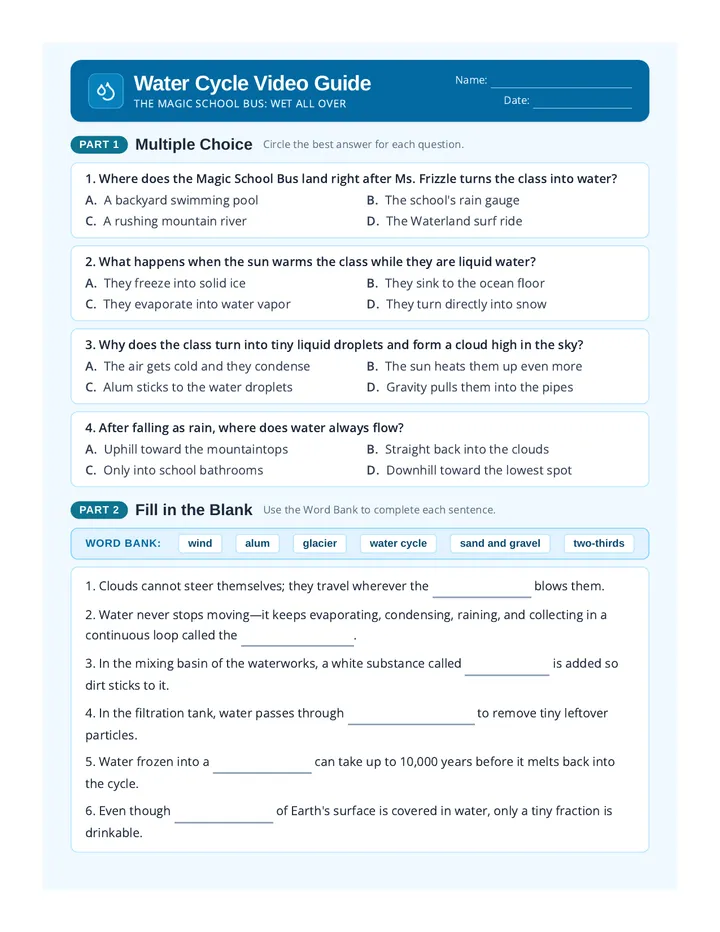
Water Cycle Video Guide
Bill Nye the Science Guy • Hydrological Cycle
Lab Notebook
Earth & Space Science
Name:
Date:
PART 1
Multiple Choice
— Circle the best answer for each question.
1. What does the Greek root hydro mean in the term “hydrological cycle”?
A Earth
B Water
C Sky
D Energy
2. What provides the energy that drives evaporation in Earth’s water cycle?
A Ocean currents
B Gravity
C The Sun
D Wind
3. In Bill Nye’s glass jug demonstration, why did a cloud only form after he added smoke from matches?
A The smoke heated the water so it could boil.
B Water vapor needed tiny dust particles to stick to in order to condense.
C The smoke turned directly into liquid raindrops.
D The jug needed extra oxygen to expand.
4. Which of the following is NOT one of the four forms of precipitation highlighted in the video?
A Rain
B Snow
C Steam
D Hail
PART 2
Fill in the Blank
— Use the Word Bank to complete each sentence.
Word Bank: condensation • evaporation • glacier • molecules • three billion
1. Almost all the water on Earth is the same water that has been here for over years.
2. Everything in the universe is made of tiny, constantly moving particles called .
3. Liquid water gaining energy and turning into water vapor (a gas) is called .
4. When water vapor cools down, loses energy, and turns back into liquid droplets, this process is called .
5. A is a slow-moving “river of ice” formed where snow piles up year-round.
Water Cycle Video Guide
Part 3 & Part 4
PART 3
Open-Ended Questions
— Answer in complete sentences using details from the video.
1. Explain why a puddle on the sidewalk can still evaporate even though the water is not boiling. (Hint: Think about how water molecules move!)
2. Describe the steps that happen inside a cloud to turn tiny water droplets into falling rain.
3. Bill Nye compares the Earth to a baseball to show how much drinkable water exists. What point is he making, and why is keeping water clean so important?
PART 4
Reflection Questions
— Connect what you learned to the real world.
1. Bill Nye jokes that when you drink a glass of water, you might be drinking “dinosaur spit.” How does knowing that Earth recycles the same water over and over change the way you think about protecting water?
2. Where have you observed evaporation or condensation in your own daily life? Describe one specific example and explain what is happening to the water molecules.
Water Cycle Answer Key
Water Cycle Answer Key
Bill Nye the Science Guy • Teacher Reference
Answer Key
With Video Timestamps
PART 1
Multiple Choice
- 1. B — Water (01:44)
Hydro is Greek for water; hydrological cycle means water cycle.
- 2. C — The Sun (02:07, 15:10)
Solar energy heats surface water and drives evaporation.
- 3. B — Dust particles (13:09)
Water vapor needs a surface/particle to stick to in order to condense into a cloud.
- 4. C — Steam (03:18, 16:54)
The four forms highlighted are rain, snow, sleet, and hail.
PART 2
Fill in the Blank
- 1. three billion (00:46)
Earth’s water has been cycling for over three billion years.
- 2. molecules (06:14)
Tiny, constantly moving particles that make up matter.
- 3. evaporation (02:09)
Liquid water gaining energy and becoming vapor.
- 4. condensation (02:31, 11:50)
Water vapor cooling, losing energy, and turning back to liquid.
- 5. glacier (17:16)
A slow-moving river of ice formed from packed snow.
PART 3
Open-Ended Questions (Sample Responses)
1. Puddle Evaporation (07:54–08:42)
Not all molecules in liquid water move at the same speed. Even at room temperature, some molecules gain enough energy to move fast enough to escape into the air as water vapor.
2. Cloud to Rain (16:09–16:46)
Water vapor rises, cools, and sticks to tiny dust particles to form droplets. Inside the cloud, droplets bump into each other and combine until they become too heavy to stay up and fall as rain.
3. Baseball Analogy & Clean Water (18:13–19:28)
If Earth were the size of a baseball, the amount of drinkable water would be tiny. Because all living things depend on this limited supply of recycled water, polluting it harms every living thing on Earth.
PART 4
Reflection Questions (Look-Fors)
1. Water Recycling & Conservation: Accept thoughtful responses noting that because Earth does not make “new” water, keeping our current water clean and conserving it protects the same water future generations and ecosystems will use.
2. Everyday Examples: Look for accurate real-world examples (e.g., wet laundry drying or puddles disappearing = evaporation as molecules gain energy and escape; foggy bathroom mirror, sweaty cold drink glass, or fogged glasses = condensation as water vapor cools on a surface and turns to liquid).