Motion Rules Writing Worksheet Motion Rules Writing Lab
Newton’s Three Laws of Motion — Chunked Reading & Writing
Name: ___________________________
Date: ___________________________
The Big Idea
Long ago, a scientist named Isaac Newton studied how things move. He wrote three simple rules called Newton’s Laws of Motion . Read one chunk at a time, check the example, and write your own ideas!
Chunk 1
Newton’s 1st Law: The “Keep Going” Rule
Things like to keep doing what they are already doing. If something is at rest (not moving), it stays still until a force (a push or pull) moves it. If something is in motion (moving), it keeps moving until a force stops it. Scientists call this inertia .
Real-Life Example: A soccer ball sits still on the grass. It does not move until your foot kicks it. Once it rolls, it keeps going until the grass or a goalie stops it.
Your Turn to Write
Word Bank: at rest in motion force inertia stops
1. In my own words, Newton’s 1st Law means...
2. One time I saw inertia happen in real life was when...
Page 1 of 3 — Law 1: Inertia Next: Law 2 & Law 3
Chunk 2
Newton’s 2nd Law: The “Big Push” Rule
Heavy things are harder to move than light things. An object’s mass is how much stuff is inside it. More mass needs a bigger force (push or pull) to speed it up. A bigger push also makes an object go faster!
Real-Life Example: Pushing an empty shopping cart is easy. Pushing a cart packed with heavy groceries takes a much bigger push to make it move.
Word Bank: mass heavy light bigger push faster
3. Newton’s 2nd Law says that heavy things need...
4. If I kick a bowling ball and a beach ball with the same force, the...
Chunk 3
Newton’s 3rd Law: The “Push Back” Rule
Forces always come in pairs. When you push on something, it pushes back just as hard in the opposite direction. The first push is the action , and the push back is the reaction .
Real-Life Example: When you jump on a trampoline, your feet push down on the mat (action). The mat pushes you back up into the air (reaction)!
Word Bank: action reaction equal opposite pushes back
5. For every action, there is...
6. Another real-life example of pushing back is when...
Page 2 of 3 — Law 2 & Law 3 Next: Put It All Together
Chunk 4
Put It All Together: My Motion Paragraph
1st Law: Inertia
Still things stay still. Moving things keep moving unless a force stops them.
2nd Law: Force & Mass
Heavier things need a bigger push to move or speed up.
3rd Law: Push Back
Every push (action) has an equal push back (reaction).
Use These Sentence Starters to Build Your Paragraph:
Sentence 1 (Topic): Newton’s three laws explain how everything around us moves.Sentence 2 (1st Law): First, the 1st Law says that things keep doing what they are doing unless...Sentence 3 (2nd Law): Next, the 2nd Law shows that heavy objects need...Sentence 4 (3rd Law): Finally, the 3rd Law tells us that every push...Sentence 5 (Example): You can see Newton’s laws in real life when...
Write Your Final Paragraph Below:
Writer’s Self-Check
I explained all 3 laws.
I used 3+ science words.
I gave a real-life example.
Page 3 of 3 — Final Paragraph & Self-Check Great work!
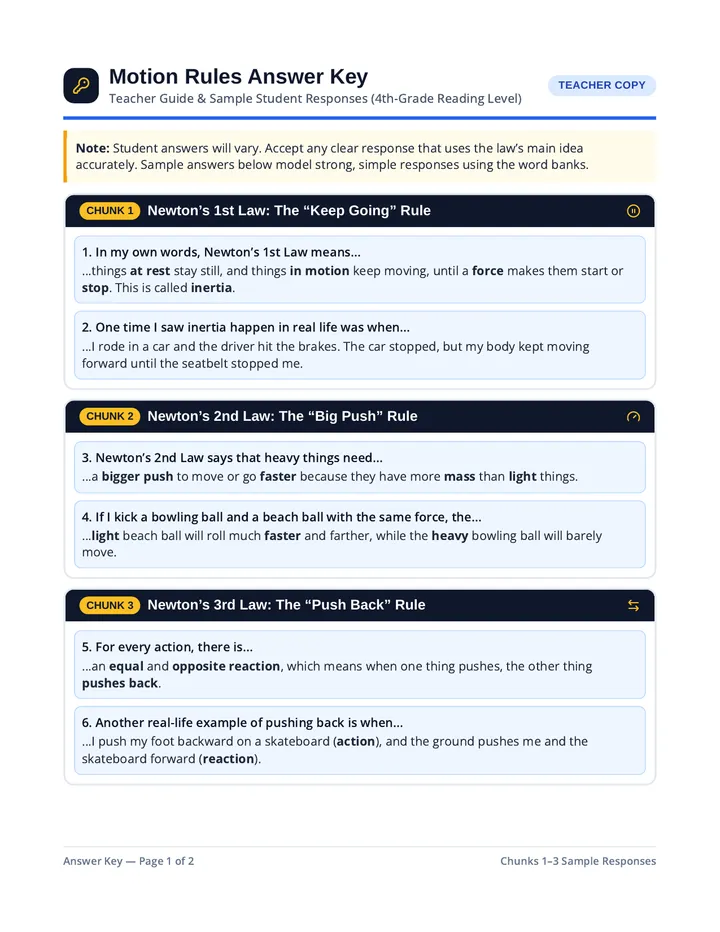
Motion Rules Answer Key Motion Rules Answer Key
Teacher Guide & Sample Student Responses (4th-Grade Reading Level)
Teacher Copy
Note: Student answers will vary. Accept any clear response that uses the law’s main idea accurately. Sample answers below model strong, simple responses using the word banks.
Chunk 1
Newton’s 1st Law: The “Keep Going” Rule
1. In my own words, Newton’s 1st Law means...
...things at rest stay still, and things in motion keep moving, until a force makes them start or stop . This is called inertia .
2. One time I saw inertia happen in real life was when...
...I rode in a car and the driver hit the brakes. The car stopped, but my body kept moving forward until the seatbelt stopped me.
Chunk 2
Newton’s 2nd Law: The “Big Push” Rule
3. Newton’s 2nd Law says that heavy things need...
...a bigger push to move or go faster because they have more mass than light things.
4. If I kick a bowling ball and a beach ball with the same force, the...
...light beach ball will roll much faster and farther, while the heavy bowling ball will barely move.
Chunk 3
Newton’s 3rd Law: The “Push Back” Rule
5. For every action, there is...
...an equal and opposite reaction , which means when one thing pushes, the other thing pushes back .
6. Another real-life example of pushing back is when...
...I push my foot backward on a skateboard (action ), and the ground pushes me and the skateboard forward (reaction ).
Answer Key — Page 1 of 2 Chunks 1–3 Sample Responses
Chunk 4
Model Summary Paragraph
Sample Student Response (Using Sentence Starters):
Newton’s three laws explain how everything around us moves. First, the 1st Law says that things keep doing what they are doing unless a force makes them start or stop. Next, the 2nd Law shows that heavy objects need a bigger push to move or speed up than light objects. Finally, the 3rd Law tells us that every push has an equal and opposite push back. You can see Newton’s laws in real life when you kick a soccer ball, push a full shopping cart, or jump on a trampoline.
Quick Teacher Look-Fors & Support Tips
1
All Three Laws Included
Check that the student accurately describes (1) staying still/moving until a force acts, (2) heavier mass needing more force, and (3) action/reaction pairs.
2
Word Bank Usage
Look for at least 3–5 target science terms used correctly in context (e.g., inertia, force, mass, action, reaction, opposite ).
3
Common Misconception Watch
Students often think moving objects naturally slow down on their own (1st Law). Remind them that friction or air resistance is the outside force that stops them.
Answer Key — Page 2 of 2 Chunk 4 Model & Teacher Look-Fors
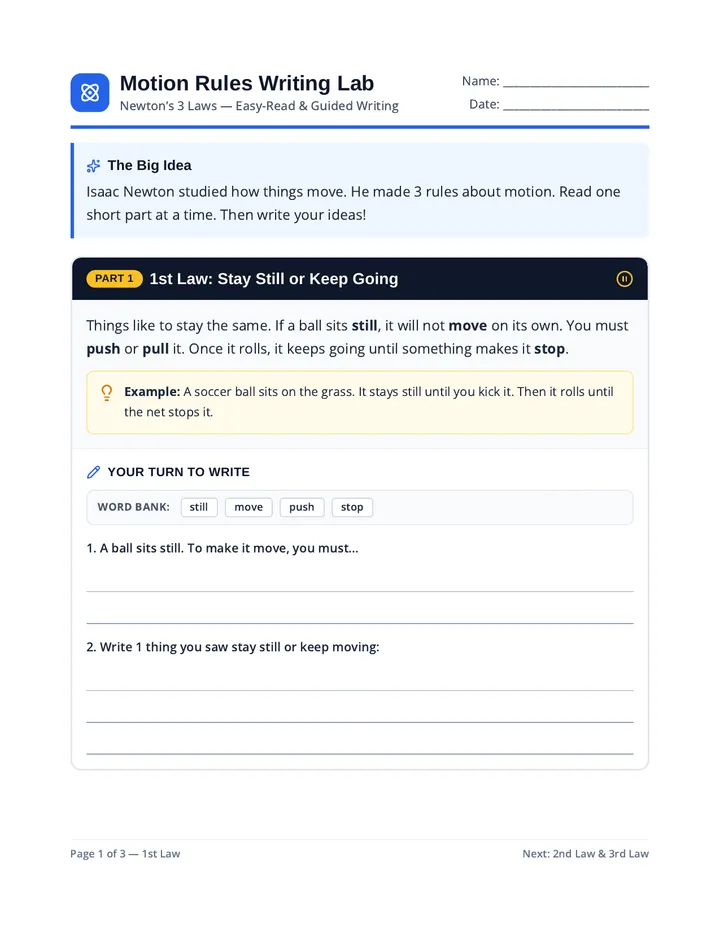
Motion Rules Supported Worksheet Motion Rules Writing Lab
Newton’s 3 Laws — Easy-Read & Guided Writing
Name: ___________________________
Date: ___________________________
The Big Idea
Isaac Newton studied how things move. He made 3 rules about motion. Read one short part at a time. Then write your ideas!
Part 1
1st Law: Stay Still or Keep Going
Things like to stay the same. If a ball sits still , it will not move on its own. You must push or pull it. Once it rolls, it keeps going until something makes it stop .
Example: A soccer ball sits on the grass. It stays still until you kick it. Then it rolls until the net stops it.
Your Turn to Write
Word Bank: still move push stop
1. A ball sits still. To make it move, you must...
2. Write 1 thing you saw stay still or keep moving:
Page 1 of 3 — 1st Law Next: 2nd Law & 3rd Law
Part 2
2nd Law: Heavy Things Need a Big Push
Light things are easy to move. Heavy things are hard to move. A heavy thing needs a big push to start. A bigger push also makes things go fast .
Example: An empty cart is easy to push. A cart full of food is heavy. You must push much harder!
Word Bank: heavy light big push fast
3. A heavy box is hard to move. It needs a...
4. If I kick a light ball and a heavy ball, the light ball goes...
Part 3
3rd Law: Push and Push Back
Pushes always come in pairs. When you push on something, it pushes back on you. It pushes just as hard, but the other way .
Example: You jump on a trampoline. Your feet push down. The mat pushes you back up!
Word Bank: push pushes back up other way
5. When I push on a wall, the wall...
6. On a skateboard, I push back with my foot. The board goes...
Page 2 of 3 — 2nd Law & 3rd Law Next: Put It All Together
Part 4
Put It All Together!
1st Law
Still things stay still. Moving things keep going until stopped.
2nd Law
Heavy things need a big push to move or go fast.
3rd Law
When you push something, it pushes back.
Finish each sentence to tell about all 3 laws:
Use the Word Banks!
1. Newton’s 1st Law says a still ball will not move until...
2. Newton’s 2nd Law says heavy things need...
3. Newton’s 3rd Law says when I push something, it...
4. One place I see these rules in real life is...
My Check-Up
I wrote about all 3 laws.
I used the word bank.
I gave 1 real example.
Page 3 of 3 — Wrap-Up & Check-Up Nice job!