Particle Detectives Slides OPENSCiED 7.1 • LESSON 7
Particle Detectives
How can we model what happens to the particles when a bath bomb is added to water?
Chemical Reactions & Matter
Day 1: Macroscopic to Microscopic
What We Observed
EVIDENCE REVIEW
1. A New Gas Forms
Mixing baking soda, citric acid, and water produces bubbles of carbon dioxide gas (CO2).
2. New Properties
The gas extinguishes a flame and sinks in air—different properties from the starting solids and water.
3. Closed vs. Open
In a sealed bottle, total mass stays the same. Where did the new gas come from?
Turn & Talk: Why couldn't we see the new gas inside the dry bath bomb before adding water?
Zooming In to the Particle Scale
KEY VOCABULARY
A
Atom
The basic building block of matter. Each type of atom (like Carbon, Oxygen, or Hydrogen) has its own size and properties.
Carbon (C)
Oxygen (O)
Hydrogen (H)
M
Molecule
Two or more atoms bonded together in a specific arrangement. Different arrangements make different substances!
CO2
H2O
Before & After a Reaction
CHEMICAL REACTION
BEFORE (STARTING)
Reactants
Baking Soda (NaHCO3)
Citric Acid (C6H8O7)
Water (H2O)
REACTS
AFTER (NEW)
Products
Carbon Dioxide Gas (CO2)
Water (H2O)
Sodium Citrate (dissolved)
Notice: Every product substance has different properties than the starting reactants!
Where Do the New Particles Come From?
PREDICT
Idea A
Brand-new atoms are created out of nothing when the bath bomb touches water.
Idea B
The gas molecules were already hiding whole inside the solid bath bomb.
Idea C
Existing atoms in the reactants break apart and rearrange into new molecules.
On your Particle Detectives Worksheet, choose an idea and use our mass evidence to defend your prediction.
LAB NOTEBOOK MISSION
Complete Your Particle Detectives Worksheet
1
Sort the bath bomb ingredients into Reactants and Products .
2
Draw your initial model of what happens to particles during the fizzing reaction.
3
Check your model against our closed-system mass evidence.
Next Lesson: We will use physical atom models to test which idea actually works!
Particle Detectives Worksheet OpenSciEd 7.1 • Lesson 7 Investigation
Particle Detectives Worksheet
Name: ______________________________
Date: ________________ Period: ______
Question: What happens to the particles when a bath bomb fizzes in water?
Part 1: Before & After Sorting
Write each substance from the Word Bank in the correct column. The first row is done for you.
Word Bank: Baking Soda • Carbon Dioxide Gas • Citric Acid • Sodium Citrate • Water
Reactants (Before Reaction)
Products (After Reaction)
Example: Baking Soda (solid)
Example: Carbon Dioxide (gas)
Part 2: Where Does the Gas Come From?
Circle one idea you agree with most:
Idea A: Brand-new atoms are created from nothing.
Idea B: Gas molecules were already hiding whole inside the bath bomb.
Idea C: Existing atoms break apart and rearrange into new molecules.
Why did you pick this idea? (Hint: Think about mass in a closed bottle!)
Atom Rearrangers • Lesson 1 Page 1 of 2
OpenSciEd 7.1 • Lesson 7 Investigation
Part 3: Draw Your Particle Model
Name: ________________________
Atom Key:
Carbon (C)
Oxygen (O)
Hydrogen (H)
Sodium (Na)
Draw circles using the Atom Key to show particles before and after the reaction in a sealed bottle. Label H2O and CO2 !
BEFORE: Bath Bomb + Water
AFTER: Gas + Liquid in Bottle
Part 4: Atom vs. Molecule
How is an atom different from a molecule ? Give one example of each.
Atom Rearrangers • Lesson 1 Page 2 of 2
Particle Detectives Teacher Guide Teacher Resource • OpenSciEd 7.1 Lesson 7
Particle Detectives Teacher Guide
45 MIN PACING
Lesson Pacing & Facilitation
Time
Segment
Teacher Moves & Key Prompts
0–10 min
Slides 1–2: Evidence Review
Reconnect to Lessons 1–6: gas forms, extinguishes flame, mass stays constant in a closed system. Ask: "If mass didn't change, where did the gas come from?"
10–20 min
Slides 3–4: Atoms & Molecules
Introduce atom vs. molecule using the color key. Emphasize that reactants and products are different substances with different properties.
20–35 min
Worksheet Parts 1–3
Students sort reactants/products, evaluate Ideas A–C, and draw an initial particle model. Circulate to see if students conserve atom counts.
35–45 min
Part 4 & Consensus
Collect exit check. Preview Day 2: testing Ideas B and C using physical/visual atom models.
Common Misconceptions
"Gas has no mass": Remind students of the closed-bottle scale data."Atoms disappear or appear": Probe how mass could stay constant if atoms vanished or appeared."Molecules = Substances": Clarify that many identical molecules together make a substance.
Differentiation Supports
Scaffolding: Provide physical colored counters or sticky dots for Part 3 before drawing.Multilingual Learners: Keep the Atom Key visible on the board; pair "Before = Reactant" and "After = Product".Extension: Ask early finishers to count exact C, O, and H atoms in their drawing.
Worksheet Answer Key
Part 1 (Reactants): Baking Soda (white solid), Citric Acid (white solid), Water (clear liquid). (Products): Carbon Dioxide Gas (colorless gas, extinguishes flame, denser than air), Water (liquid), Sodium Citrate (dissolved solid).
Part 2 (Hypotheses): Idea C is supported. Closed-bottle mass stays constant, so atoms cannot be created (ruling out Idea A). Dry bath bombs do not fizz or release CO2 until water allows particles to interact and rearrange (challenging Idea B).
Part 3 (Initial Model): Look for distinct molecules before (baking soda, citric acid, water) and new molecules after (including CO2) with roughly the same types/numbers of atoms.
Part 4 (Quick Check): An atom is a single basic building block of matter (e.g., Carbon, Oxygen). A molecule is two or more atoms bonded together (e.g., CO2, H2O).
Atom Rearrangers • Teacher Guide Lesson 1
Atom Rearrangers Reference Sheet OpenSciEd 7.1 • Student Support Tool
Atom Rearrangers Reference Sheet
Name: ________________________
1. Visual Vocabulary Guide
Atom
One single building block of matter (e.g., 1 Carbon atom).
Molecule
Two or more atoms bonded together (e.g., CO2).
Reactants (Before)
Starting substances before the reaction happens.
Products (After)
New substances formed after atoms rearrange.
2. How to Count Atoms in a Formula
3 CO2
3 molecules of Carbon Dioxide
Big Number (Coefficient): Tells you how many molecules there are (3).
Small Number (Subscript): Tells you how many atoms of that element are in 1 molecule (2 Oxygen).
Total Atoms: Multiply! 3 × 1 C = 3 C ; 3 × 2 O = 6 O .
3. Science Writing Sentence Frames (CER)
Claim (Answer the question):
"In a closed system, the total mass stays the same because ________________________."
"I think Idea ___ is correct because ________________________."
Evidence (Use data or atom counts):
"Our data shows that before the reaction the mass was ____ g, and after it was ____ g."
"In our Atom Inventory, there were ____ atoms before and ____ atoms after."
Reasoning (Connect atoms to mass & properties):
"During a chemical reaction, existing atoms break apart and rearrange into new molecules. Because no atoms are created or destroyed, ________________________."
Atom Rearrangers • Student Reference Sheet Lessons 1–3
Atom Shuffle Slides OPENSCiED 7.1 • LESSON 7
Atom Shuffle
How do atoms in reactants rearrange to make brand-new substances?
Molecular Modeling Lab
Day 2: Tracking Every Atom
Think Like a Builder
CORE IDEA
1. Break Bonds
When reactants mix in water, the bonds holding reactant molecules together break apart into individual atoms.
2. Rearrange & Rebonds
Those exact same atoms snap together in new combinations to form product molecules with new properties.
Golden Rule: You cannot add extra atoms, and you cannot throw any atoms away!
Practice: Breaking & Rearranging
EXAMPLE
BEFORE: 2 H2O2
(Hydrogen Peroxide)
4 Hydrogen + 4 Oxygen
REARRANGE
AFTER: 2 H2O + O2
(Water + Oxygen Gas)
4 Hydrogen + 4 Oxygen
Same 8 atoms before and after—just connected in a new way!
The Bath Bomb Atom Inventory
DATA CHECK
3 NaHCO3 + C6H8O7 → 3 CO2 + 3 H2O + Na3C6H5O7
Baking Soda + Citric Acid → Carbon Dioxide + Water + Sodium Citrate
Sodium (Na)
3 → 3
Carbon (C)
9 → 9
Hydrogen (H)
11 → 11
Oxygen (O)
16 → 16
Every single atom from the reactants is accounted for in the products!
Which Hypothesis Wins?
EVIDENCE
Idea A (New atoms created): Ruled out! No new atoms appeared in our inventory.
Idea B (CO2 hiding whole): Ruled out! The C and O atoms were bonded inside NaHCO3.
Idea C (Atoms rearrange): Confirmed! Bonds break and atoms regroup into CO2, H2O, and sodium citrate.
YOUR MODELING TASK
Complete the Atom Shuffle Worksheet
1
Count and verify every atom in the Atom Inventory Table .
2
Draw a balanced particle rearrangement model showing before and after .
3
Explain why new properties appear even though the atoms stay the same.
Atom Shuffle Worksheet OpenSciEd 7.1 • Lesson 7 Modeling
Atom Shuffle Worksheet
Name: ______________________________
Date: ________________ Period: ______
Part 1: Bath Bomb Atom Inventory
Count each type of atom before (reactants) and after (products) the reaction. The first row is done as an example.
3 NaHCO3 + C6H8O7 → 3 CO2 + 3 H2O + Na3C6H5O7
Atom Type
Reactants (Before)
Products (After)
Same Number?
Sodium (Na)
3
3
Yes
Carbon (C)
Hydrogen (H)
Oxygen (O)
Part 2: Checking Our Ideas
How does your table prove that Idea A (new atoms are created) is wrong?
Atom Rearrangers • Lesson 2 Page 1 of 2
OpenSciEd 7.1 • Lesson 7 Modeling
Part 3: Draw a Balanced Model
Name: ________________________
Draw the reaction 2 H2O2 → 2 H2O + O2 using the key below. Check that both boxes have 4 H and 4 O atoms!
Oxygen (O)
Hydrogen (H)
Goal: 4 H, 4 O in each box
BEFORE: 2 H2O2 Molecules
AFTER: 2 H2O + 1 O2
Part 4: Same Atoms, New Properties
If the atoms stay the same, why do the products have new properties ? (Hint: Think about how atoms are connected!)
Atom Rearrangers • Lesson 2 Page 2 of 2
Atom Shuffle Practice Sheet OpenSciEd 7.1 • Lesson 7 Extra Practice
Atom Shuffle Practice Sheet
Name: ______________________________
Date: ________________ Period: ______
Practice 1: Vinegar & Baking Soda Atom Count
Count the atoms before and after the reaction. The first row is done for you.
NaHCO3 + HC2H3O2 → CO2 + H2O + NaC2H3O2
Atom Type
Reactants (Before)
Products (After)
Same Number?
Sodium (Na)
1
1
Yes
Carbon (C)
Hydrogen (H)
Oxygen (O)
Practice 2: Find the Balanced Reaction
Circle the one reaction that has the exact same atoms before and after. (Hint: Count C, H, and O!)
Model A: CH4 + O2 → CO2 + H2O
Model B: CH4 + 2 O2 → CO2 + 2 H2O
Model C: CH4 + 2 O2 → CO2 + H2O + O2
Why are the other two models impossible?
Atom Rearrangers • Lesson 2 Practice Page 1 of 2
OpenSciEd 7.1 • Lesson 7 Extra Practice
Practice 3 & 4: Missing Molecules & Mass
Name: ________________________
Practice 3: Draw the Missing Molecule
Count the atoms in Reactants (4 H, 2 O). Draw the one missing molecule in the dashed box so Products also has 4 H and 2 O!
REACTANTS (Before): 2 H2 + O2
Total: 4 Hydrogen (white), 2 Oxygen (red)
PRODUCTS (After): Draw Missing Molecule
H2O
Missing molecule formula: _______________
Practice 4: What Happens to the Mass?
Magnesium ribbon burns in air and bonds with oxygen gas:
2 Mg (solid) + O2 (gas) → 2 MgO (solid)
A student burns 5.0 g of magnesium in an open dish on a scale. Will the ending mass be more than, less than, or equal to 5.0 g? Explain why!
Atom Rearrangers • Lesson 2 Practice Page 2 of 2
Atom Shuffle Answer Key Teacher Resource • OpenSciEd 7.1 Lesson 7
Atom Shuffle Answer Key
KEY & RUBRIC
Worksheet Part 1: Completed Atom Inventory
Atom Type
Reactants (Before)
Products (After)
Conserved?
Sodium (Na)
3
3
Yes
Carbon (C)
3 + 6 = 9
3 + 6 = 9
Yes
Hydrogen (H)
3 + 8 = 11
6 + 5 = 11
Yes
Oxygen (O)
9 + 7 = 16
6 + 3 + 7 = 16
Yes
Worksheet Part 2: Checking Hypotheses
The exact same number of Na, C, H, and O atoms exist before and after the reaction, so no new atoms were created (ruling out Idea A). In the reactants, the carbon and oxygen atoms are bonded inside NaHCO3 molecules—not as separate CO2 gas molecules—so Idea B is ruled out.
Worksheet Part 3: Balanced Drawing Checklist
Before box: Two H2O2 molecules (each drawn as H–O–O–H). Total: 4 H, 4 O.After box: Two H2O molecules (each H–O–H) and one O2 molecule (O–O). Total: 4 H, 4 O.Atoms are bonded in new arrangements; no loose/extra atoms appear.
Worksheet Part 4: Same Atoms, New Properties
A substance's properties depend on how its atoms are arranged and bonded together into molecules, not just which atoms it contains. Rearranging the same atoms into new molecules (like CO2) creates brand-new substances with different properties.
Atom Rearrangers • Lesson 2 Answer Key Page 1 of 2
Teacher Resource • OpenSciEd 7.1 Lesson 7
Practice Sheet Answer Key
EXTRA PRACTICE
Practice 1: Vinegar & Baking Soda Atom Inventory
Atom Type
Reactants (Before)
Products (After)
Conserved?
Sodium (Na)
1
1
Yes
Carbon (C)
1 + 2 = 3
1 + 2 = 3
Yes
Hydrogen (H)
1 + 4 = 5
2 + 3 = 5
Yes
Oxygen (O)
3 + 2 = 5
2 + 1 + 2 = 5
Yes
Practice 2: Spot the Impossible Reaction
Model B obeys conservation of atoms (1 C, 4 H, 4 O on both sides). Model A is impossible because 2 H atoms disappear and 1 extra O atom appears (4 H, 2 O → 2 H, 3 O). Model C is impossible because 2 H atoms disappear and 1 extra O atom appears (4 H, 4 O → 2 H, 5 O).
Practice 3: Missing Product Molecule
Students should draw a second H2O molecule (2 white H circles bonded to 1 red O circle) and write the formula H2O . Together, both water molecules account for all 4 H atoms and 2 O atoms.
Practice 4: Predicting Mass in a New Reaction
The scale reading will be greater than 5.0 g . Even though the dish is open, the magnesium atoms bond with oxygen (O2) gas atoms from the air to form solid magnesium oxide (MgO). Adding those oxygen atoms to the solid increases the mass on the scale!
Atom Rearrangers • Lesson 2 Answer Key Page 2 of 2
Mass Matters Slides OPENSCiED 7.1 • LESSON 7
Mass Matters
How does our atom-rearrangement model explain conservation of mass in open and closed systems?
Conservation of Matter
Day 3: Consensus & Assessment
Open vs. Closed Systems
DATA COMPARISON
Open Bottle
Start: 120.0 g → End: 118.4 g
Mass appears to decrease because newly formed CO2 gas molecules escape into the room air.
Closed Bottle
Start: 120.0 g → End: 120.0 g
Mass stays identical because all rearranged atoms—including gas molecules—are trapped inside.
Connecting Atoms to Mass
BIG IDEA
1. Every Atom Has Mass
Each Carbon, Oxygen, Hydrogen, and Sodium atom has its own fixed mass—whether it is in a solid, liquid, or gas.
2. Rearranging Doesn't Change Mass
In a chemical reaction, atoms are never created or destroyed. Since the exact same atoms are present before and after, total mass is conserved!
Lesson 7 Consensus Model
SYNTHESIS
Step 1
Water allows reactant molecules (baking soda and citric acid) to collide and break bonds.
Step 2
The existing atoms rearrange and bond in new ways to form CO2 gas, water, and sodium citrate.
Step 3
New molecular arrangements give products new properties, while total atoms and mass stay conserved.
SHOW WHAT YOU KNOW
Mass Matters Assessment
1
Analyze open vs. closed bottle mass data.
2
Answer the 3 particle-model check questions.
3
Write a Claim-Evidence-Reasoning (CER) explanation for conservation of mass.
Mass Matters Assessment OpenSciEd 7.1 • Lesson 7 Assessment
Mass Matters Assessment
Name: ______________________________
Date: ________________ Period: ______
Part 1: Open vs. Closed System Data
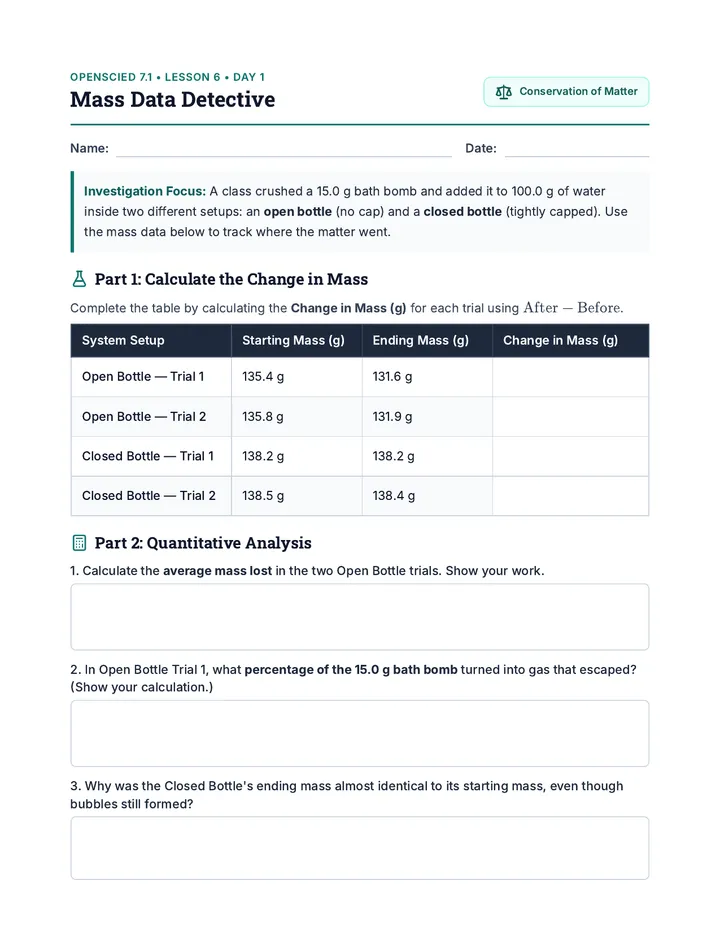
A student drops a 10.0 g bath bomb into 110.0 g of water in two different bottles and records the mass before and after fizzing stops.
System
Starting Mass (g)
Ending Mass (g)
Mass Change (g)
Bottle A (Open Cap)
120.0 g
118.4 g
Bottle B (Sealed Cap)
120.0 g
120.0 g
Part 2: Particle Model Check
1. Why did Bottle A lose 1.6 g of mass during the reaction?
A. Some atoms were destroyed when the bath bomb dissolved.
B. Carbon dioxide gas molecules escaped out of the open bottle into the air.
C. Gas molecules have zero mass once they leave the liquid.
D. Water atoms turned into empty space during fizzing.
2. Which statement best describes what happens to atoms during a chemical reaction?
A. New atoms are created to form the product molecules.
B. Atoms change into different elements with new masses.
C. Existing atoms break apart and rearrange into new molecules.
D. Reactant molecules stay intact and never break their bonds.
Atom Rearrangers • Lesson 3 Page 1 of 2
OpenSciEd 7.1 • Lesson 7 Assessment
Part 3: Claim-Evidence-Reasoning (CER)
Name: ________________________
Prompt: Explain why the total mass of Bottle B (the sealed bottle) stayed at 120.0 g even though a brand-new gas with different properties was formed. Include atoms , rearranging , and mass in your answer.
Claim (Answer the prompt directly):
Evidence (Use data from Bottle B and our Atom Inventory):
Reasoning (Explain how atom rearrangement connects your evidence to your claim):
Atom Rearrangers • Lesson 3 Page 2 of 2
Mass Matters Teacher Guide Teacher Resource • OpenSciEd 7.1 Lesson 7
Mass Matters Teacher Guide
40 MIN PACING
Facilitation Notes
0–15 min (Slides 1–4): Review open vs. closed bottle mass data. Build the 3-step Lesson 7 Consensus Model as a class and post it on the Driving Question Board.
15–40 min (Assessment): Students complete the Mass Matters Assessment independently. Allow students needing support to use the Atom Rearrangers Reference Sheet .
Tiered Differentiation Supports
Scaffolding: Provide a word bank (rearrange, conserved, gas, escaped, trapped ) and allow students to sketch Bottle A vs. Bottle B particles before writing Part 3.Multilingual Learners: Pair students with the Atom Rearrangers Reference Sheet CER sentence frames; accept labeled diagrams alongside written reasoning.Extension: Challenge early finishers to explain how the open-bottle mass loss (1.6 g) could be used to calculate the exact number of CO2 molecules that escaped.
Assessment Answer Key
Part 1 (Data Table): Bottle A Mass Change = -1.6 g ; Bottle B Mass Change = 0.0 g .
Part 2 (Multiple Choice): Question 1 = B (CO2 gas molecules escaped); Question 2 = C (Existing atoms break apart and rearrange).
Part 3: CER Exemplar & Scoring Rubric
Claim: The total mass of Bottle B stayed at 120.0 g because no atoms were created, destroyed, or allowed to escape during the reaction.
Evidence: Bottle B's starting mass and ending mass were both 120.0 g (0.0 g change). Our Atom Inventory also showed the exact same number of Na (3), C (9), H (11), and O (16) atoms before and after the reaction.
Reasoning: In a chemical reaction, reactant molecules break apart and their existing atoms rearrange into new product molecules like CO2 gas. Because each atom keeps its own mass and the sealed cap trapped all the gas molecules inside, the total mass remained conserved.
Component
Meets Expectations (2 pts each)
Claim
Accurately states that mass stays constant because atoms are conserved and trapped.
Evidence
Cites Bottle B mass data (120.0 g before/after) and/or equal atom counts.
Reasoning
Explains that atoms rearrange into new molecules without changing total mass, and the closed system prevents gas from escaping.
Atom Rearrangers • Teacher Guide Lesson 3