Energy Launchpad Slides 6th Grade Science PBL
PROPELLER POWER
Master Energy Forms, Transformations & Motion to Engineer the Fastest Cardboard Car
4 Self-Paced DOK Stations • Build, Test & Retest • Race Day Showdown
Your Mission
Design & Race a Propeller Car
Provided Supplies
• Cardboard chassis & axles
• Wheels (different sizes & textures)
• DC Motor & 3-blade or 4-blade propellers
• AA batteries vs. 9V batteries
The Goal: Maximum Speed
Use what you learn at the 4 Energy Stations to choose the best blades, battery, wheels, and design!
Speed = Distance ÷ Time
Core Concept 1
Potential vs. Kinetic Energy
Potential Energy
Stored energy ready to be used.
• A battery sitting on your desk
• A stretched rubber band
• A car parked at the top of a ramp
Kinetic Energy
The energy of motion.
• A spinning propeller blade
• A car racing down the track
• Moving air pushed backward
Energy Vocabulary
The 7 Forms You Need to Know
Gravitational: Stored energy due to height above the ground.
Kinetic: Energy of any moving object.
Chemical: Energy stored in bonds (batteries, food, fuel).
Elastic: Stored energy in stretched or compressed objects.
Thermal: Heat energy from particle motion or friction.
Electromagnetic: Light & wave energy (plus electric/magnetic fields).
Potential Energy is the umbrella for stored forms: Gravitational, Chemical, and Elastic!
Core Concept 2
What Changes GPE & KE?
Gravitational Potential (GPE)
Depends on two factors:
1. MASS (heavier = more GPE)
2. HEIGHT (higher = more GPE)
Kinetic Energy (KE)
Depends on two factors:
1. MASS (heavier = more KE)
2. SPEED (faster = MUCH more KE)
Core Concept 3
Energy Transformations in Your Car
Chemical
Stored in battery
Electrical
Flows to motor
Kinetic
Propeller & car move
Watch out for Thermal Energy! Friction in the wheels and heat in the motor steal energy away from speed.
Days 3–6 Roadmap
Your 4 Self-Paced Stations
STATION 1 • DOK 1
Energy Spotter
Identify all 7 energy forms & sort Potential vs. Kinetic.
STATION 2 • DOK 2
GPE & KE Factors Lab
Analyze how mass, height, and speed change energy.
STATION 3 • DOK 3
Transformation Detective
Trace energy chains & explain where thermal energy goes.
STATION 4 • DOK 4
Prop Car Engineering
Test variables & design your team's cardboard car blueprint.
Pacing And Unit Guide Teacher Unit Guide • 6th Grade Science
Propeller Power: Pacing & Unit Plan
Duration: 12–14 Days
Format: Self-Paced Stations + PBL
Core Learning Targets
• Distinguish between Potential (stored) and Kinetic (motion) energy.
• Identify 7 forms: potential, kinetic, gravitational, thermal, electromagnetic, chemical, elastic.
• Explain factors affecting GPE (mass, height) and KE (mass, speed).
• Trace energy transformations & minimize friction (thermal loss).
PBL Engineering Challenge
Students apply station concepts to design, build, test, and retest a propeller-driven cardboard car .
Testable Variables: 3-blade vs. 4-blade propellers, AA vs. 9V batteries, wheel types/friction, and chassis mass.
12–14 Day Pacing Roadmap
Days
Phase
Instructional Activities
Days 1–2
Energy Launchpad
Present Energy Launchpad Slides , introduce the 7 energy forms, preview the propeller car challenge, and assign engineering teams (2–3 students).
Days 3–6
Self-Paced Stations (DOK 1–4)
Students travel at their own pace through Stations 1–4 using the Station Passport Worksheet . Teacher checks off each DOK gate and conferences with teams.
Days 7–8
Blueprint & Initial Build
Teams complete their Prop Car Blueprint Log , collect cardboard, axles, wheels, motor, battery pack, and propeller, and assemble Prototype v1.
Days 9–11
Test, Retest & Optimize
Teams run timed track trials, test one variable at a time (3-blade vs. 4-blade, AA vs. 9V, wheel friction), calculate speed, and iterate their design.
Days 12–13
Race Day Showdown
Official timed heats on the classroom race track. Teams record data on the Race Day Scorecard and crown the fastest car.
Day 14
Reflection & Wrap-Up
Complete post-race energy transformation analysis and peer awards. (Can condense to 12 days by combining Day 14 into Day 13.)
Pacing Tip: Fast finishers on Day 5 can begin prototyping early, while students needing extra support on DOK 2–3 get small-group teacher check-ins on Day 6.
Supply Kit & Station Management
Page 2
Car Build Supplies (Per Team)
• Corrugated cardboard sheets (chassis)
• Wooden skewers or dowels + straws (axles/bearings)
• Assorted wheels (bottle caps, CDs, plastic wheels)
• 1 small DC hobby motor (3V–9V)
• 3-blade & 4-blade propellers (for testing)
• Battery holders: 2×AA (3V) & 9V snap connectors
• Hot glue / masking tape / rubber bands
Station Setup Materials
• Station 1 (DOK 1): Printed Station Card + optional object bin (battery, rubber band, toy car, flashlight).
• Station 2 (DOK 2): Printed Station Card + ramp, ruler, and 2 marbles/cars of different masses.
• Station 3 (DOK 3): Printed Station Card + 1 demo motor/battery circuit & elastic band.
• Station 4 (DOK 4): Printed Station Card + sample propellers, wheels, and batteries for inspection.
Managing Self-Paced DOK Stations
1. Gatekeeper Checkpoints
Students must complete Station 1 before moving to Station 2, and so on. Use a quick 30-second stamp or initial check between DOK 2 and DOK 3 to catch misconceptions early.
2. Duplicate Station Copies
Print 2–3 copies of each Station Card and place them around the room so groups never bottleneck at one table.
3. Built-in Differentiation
DOK 1–2 build foundational vocabulary and math patterns; DOK 3–4 push students to justify engineering trade-offs with evidence.
4. Safety First
Remind students never to touch spinning propeller blades and to disconnect batteries when adjusting wiring or hot-gluing.
Classroom Race Track Setup
Mark a straight 3-meter (or 5-meter) track on a smooth floor using painter's tape. Designate a clear Start Line and Finish Line. Have two timers per heat to average reaction times, and calculate speed using \( \text{Speed} = \frac{\text{Distance}}{\text{Time}} \).
DOK Station Cards Station 1 • DOK Level 1 (Recall & Identify)
Energy Spotter
Your Goal: Identify the 7 forms of energy and classify everyday examples as Potential (stored) or Kinetic (motion). Record all answers in your Station Passport .
Part A: Match the 7 Energy Forms
Read each definition below and match it to the correct energy term from the Word Bank.
Potential • Kinetic • Gravitational • Thermal • Electromagnetic • Chemical • Elastic
1. Stored energy ready to be released (general category).
2. The energy of any moving object.
3. Stored energy an object has because of its height above the ground.
4. Energy stored in chemical bonds, like in a battery or food.
5. Stored energy in an object that is stretched or compressed.
6. Heat energy caused by moving particles or friction.
7. Energy that travels in waves, such as light, radio waves, or electric/magnetic fields.
Part B: Potential or Kinetic Sort
Classify each item on your Passport as Potential (P) or Kinetic (K) :
A. A 9V battery sitting in a tray
B. A propeller spinning rapidly
C. A stretched rubber band
D. A cardboard car rolling across the floor
Checkpoint: Raise your hand or check with your teacher before moving to Station 2! DOK 1 COMPLETE
Station 2 • DOK Level 2 (Skill & Concept)
GPE & KE Factors Lab
Your Goal: Analyze experimental data to determine which factors affect Gravitational Potential Energy (GPE) and Kinetic Energy (KE) .
Part A: Ramp Height & Mass Data (GPE)
Students rolled two toy cars down a ramp and measured how far each car pushed a wooden block at the bottom (more push = more energy).
Trial
Car Mass
Ramp Height
Block Push Distance
1
50 g
15 cm
8 cm
2
50 g
30 cm
17 cm
3
100 g
15 cm
16 cm
4
100 g
30 cm
34 cm
Part B: Speed & Mass Data (KE)
Now compare two propeller cars tested on a flat track:
Car
Mass
Speed
Kinetic Energy (Joules)
Car X
100 g (0.1 kg)
2 m/s
0.20 J
Car Y
200 g (0.2 kg)
2 m/s
0.40 J
Car Z
100 g (0.1 kg)
4 m/s
0.80 J
Tasks on Your Passport:
1. Explain what happens to GPE when height doubles (compare Trials 1 & 2) and when mass doubles (Trials 1 & 3).
2. Compare Car X, Car Y, and Car Z: Which factor—doubling mass or doubling speed —gives a car MORE Kinetic Energy?
3. Predict: For our propeller car race, should your car be heavy or light to reach the highest speed? Why?
Checkpoint: Get a teacher stamp on your Passport before advancing to Station 3! DOK 2 COMPLETE
Station 3 • DOK Level 3 (Strategic Thinking)
Transformation Detective
Your Goal: Trace multi-step energy transformations and use evidence to explain how energy is conserved—even when a car slows down.
Scenario 1: The Propeller Circuit
A student connects a 9V battery to a DC motor with a propeller. The motor spins the blades, pushes air backward, and warms up slightly after 30 seconds.
Task: Draw the 4-step energy transformation chain on your Passport (starting with Chemical energy).
Scenario 2: The Elastic Slingshot
A student pulls back a rubber band launcher and shoots a foam ball straight up into the air. It rises high, pauses at the peak, and falls back down.
Task: Trace the energy from Elastic → Kinetic → Gravitational Potential → Kinetic.
Scenario 3: The Slowing Car Mystery
Team A's propeller car has crooked axles that rub hard against the cardboard. Even with a fresh battery, their car barely moves, and the axles feel warm!
Task: Explain where the car's energy went using the terms friction , thermal energy , and kinetic energy .
Checkpoint: Discuss Scenario 3 with your partner, then advance to Station 4! DOK 3 COMPLETE
Station 4 • DOK Level 4 (Extended Thinking)
Prop Car Engineering
Your Goal: Synthesize everything from Stations 1–3 to evaluate real car variables, form a scientific hypothesis, and design your team's prototype.
Inspect the Engineering Variables at This Table
1. Power Source: AA vs. 9V
Two AA batteries provide 3V; a 9V battery provides 9V (3× more electrical push), but a 9V is slightly heavier. How will voltage affect propeller kinetic energy?
2. Propeller: 3-Blade vs. 4-Blade
A 4-blade prop pushes more air per spin, but adds air resistance (drag) and weight to the motor. A 3-blade prop spins faster with less load.
3. Wheels & Axles (Friction)
Smooth plastic wheels inside straw bearings reduce rubbing. Rough or wobbly wheels convert useful kinetic energy into wasted thermal energy.
4. Cardboard Chassis Mass
Cutting extra cardboard lowers mass so the motor accelerates faster, but too thin a frame can bend or tip over.
Your DOK 4 Design Challenge (Record on Passport):
1. Choose Your Independent Variable: Pick ONE variable your team will test first during the Build Phase (blade count, battery voltage, OR wheel type).
2. Write a Scientific Hypothesis: Use "If... then... because..." and include at least TWO energy terms (kinetic, chemical, electrical, thermal, friction).
3. Sketch Prototype v1: Draw a labeled side-view of your cardboard car showing where the battery, motor, propeller, and axles will go.
Final Gate: Show your completed Passport to your teacher to unlock your Build Supplies! READY TO BUILD
Station Passport Worksheet Name: ___________________________
Date: _______________
Team: _______________
Station 1 Passport: Energy Spotter
DOK 1
Part A: Write the matching energy term for each definition (1–7):
Part B: Classify each example as Potential (P) or Kinetic (K):
A. 9V battery in a tray
B. Spinning propeller
C. Stretched rubber band
D. Rolling cardboard car
Quick Check: In your own words, what is the difference between Potential and Kinetic energy?
Teacher Initials for DOK 1: ______________ Page 1 of 4
Station 2 Passport: GPE & KE Factors
DOK 2
1. Based on Part A (Trials 1–4), how do height and mass affect Gravitational Potential Energy (GPE)?
2. Based on Part B (Cars X, Y, Z), which factor—mass or speed—has a BIGGER effect on Kinetic Energy? Use numbers from the table as evidence.
3. Engineering Prediction: Should your propeller car be heavy or light to reach the highest speed? Explain why.
Teacher Stamp / Initials for DOK 2: ______________ Page 2 of 4
Station 3 Passport: Transformation Detective
DOK 3
1. Scenario 1 (Propeller Circuit): Fill in the 4-step energy transformation chain.
2. Scenario 2 (Elastic Slingshot): Explain how energy transforms at launch, at the highest peak, and on the way back down.
3. Scenario 3 (Slowing Car Mystery): Why did Team A's car barely move even with a fresh battery? Use friction , thermal energy , and kinetic energy .
Teacher Initials for DOK 3: ______________ Page 3 of 4
Station 4 Passport: Prop Car Engineering
DOK 4
1. Which ONE variable will your team test first? (Circle one: Blade Count / Battery Voltage / Wheel Type)
2. Write your "If... then... because..." hypothesis using at least two energy terms:
3. Sketch Prototype v1 (Label: cardboard chassis, motor, propeller, battery, axles, wheels):
Teacher Approval to Build: ______________ Page 4 of 4
Stations Teacher Guide Teacher Resource • Answer Key
Stations 1–4 Answer Key & Guide
Page 1 of 2
Station 1 (DOK 1): Energy Spotter
Part A: Vocabulary Match
1. Potential2. Kinetic3. Gravitational4. Chemical5. Elastic6. Thermal7. Electromagnetic
Part B: Potential (P) vs. Kinetic (K)
A. 9V battery in tray = P (Chemical)B. Spinning propeller = K C. Stretched rubber band = P (Elastic)D. Rolling car = K
Quick Check: Potential is stored energy; Kinetic is energy of motion.
Station 2 (DOK 2): GPE & KE Factors Lab
1. GPE Factors: Doubling height (15 cm → 30 cm) roughly doubles the push distance (8 cm → 17 cm), showing GPE increases with height . Doubling mass (50 g → 100 g) also doubles push distance (8 cm → 16 cm), showing GPE increases with mass .
2. KE Factors: Doubling speed has a much bigger effect than doubling mass. When mass doubled from 100 g to 200 g (Car X to Y), KE doubled (0.20 J → 0.40 J). When speed doubled from 2 m/s to 4 m/s (Car X to Z), KE quadrupled (0.20 J → 0.80 J).
3. Engineering Prediction: A lighter car is better for racing because the motor can accelerate a smaller mass to a higher speed more easily.
Common Misconception Alert: Many 6th graders think heavier objects always go faster. Remind them that while heavier objects have more KE at the same speed , a small DC motor accelerates a lighter car much faster!
Stations 3–4 Key & Differentiation
Page 2 of 2
Station 3 (DOK 3): Transformation Detective
1. Propeller Circuit Chain: Chemical (battery) → Electrical / Electromagnetic (wires & motor) → Kinetic (spinning propeller) + Thermal (warm motor).
2. Elastic Slingshot: Stored Elastic potential energy transforms into Kinetic energy as the ball launches upward. As it rises and slows, Kinetic transforms into Gravitational Potential energy (maximum at the peak). Falling back down transforms GPE back into Kinetic energy.
3. Slowing Car Mystery: Friction between the crooked axles and cardboard converted much of the motor's useful kinetic energy into wasted thermal energy (heat), leaving less energy for forward motion.
Station 4 (DOK 4): Prop Car Engineering
Look-Fors in Student Hypotheses:
Clearly identifies ONE independent variable (e.g., 9V vs. AA battery, 3-blade vs. 4-blade prop, or smooth vs. rough wheels).
Connects the choice to energy concepts (e.g., "If we use a 9V battery instead of AA, then the car will have greater speed because more chemical/electrical energy transforms into propeller kinetic energy." ).
Prototype sketch clearly labels motor placement (propeller unobstructed at rear or front), battery placement (balanced center of mass), and straight axles.
Differentiation & Pacing Supports
Support for Struggling Learners: Provide sentence starters for DOK 2 & 3 (e.g., "When height doubled, the block moved..." ) and allow oral check-ins at the Station 2 gate.
Extension for Fast Finishers: Challenge early finishers at Station 4 to calculate the expected speed needed to beat a 2.5-second 3-meter benchmark and plan a second variable test.
Propeller Power • Lesson 2 Teacher Guide
Prop Car Blueprint Log Name(s): ___________________________
Date: _______________
Car Name: _______________
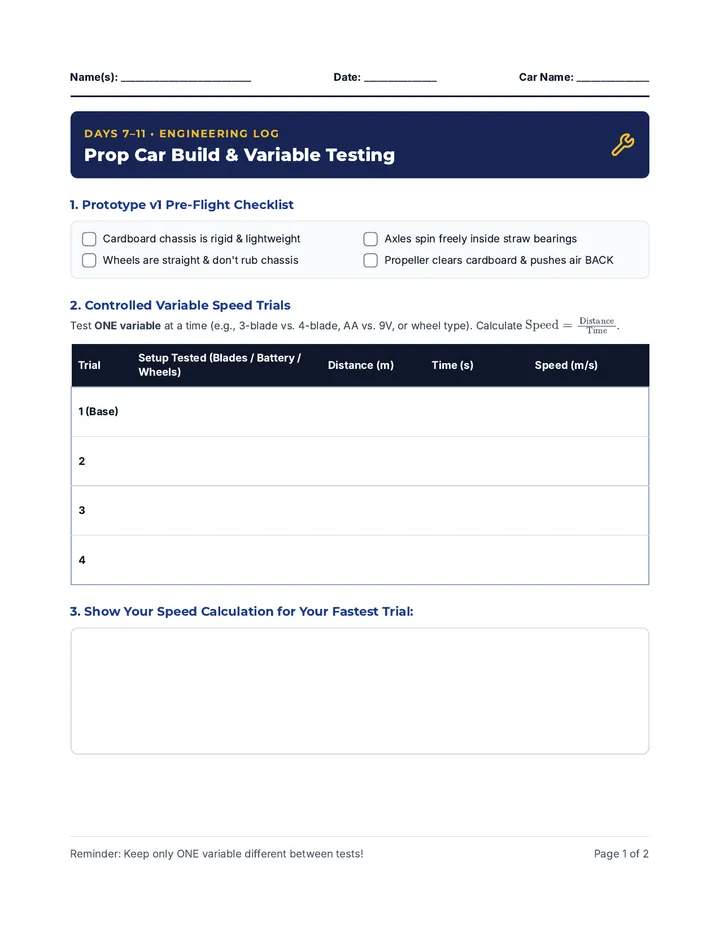
Days 7–11 • Engineering Log
Prop Car Build & Variable Testing
1. Prototype v1 Pre-Flight Checklist
Cardboard chassis is rigid & lightweight
Axles spin freely inside straw bearings
Wheels are straight & don't rub chassis
Propeller clears cardboard & pushes air BACK
2. Controlled Variable Speed Trials
Test ONE variable at a time (e.g., 3-blade vs. 4-blade, AA vs. 9V, or wheel type). Calculate \( \text{Speed} = \frac{\text{Distance}}{\text{Time}} \).
Trial
Setup Tested (Blades / Battery / Wheels)
Distance (m)
Time (s)
Speed (m/s)
1 (Base)
2
3
4
3. Show Your Speed Calculation for Your Fastest Trial:
Reminder: Keep only ONE variable different between tests! Page 1 of 2
Retest & Optimization Log
ITERATE
1. What problem(s) did you observe during your first test runs? (e.g., veering, wheel friction, slow start)
2. What specific change did you make for Prototype v2, and how did it affect Kinetic Energy or Thermal Energy (friction)?
3. Final Race-Day Configuration (Record your winning combination before Race Day):
Battery Choice (AA or 9V):
Propeller Choice (3-Blade or 4-Blade):
Wheel & Axle Setup:
Best Practice Speed (m/s):
Teacher Race-Day Inspection Stamp: ______________ Page 2 of 2
Build Phase Teacher Guide Teacher Resource • Days 7–11
Build Phase Facilitation & Troubleshooting
Page 1 of 2
Safety Protocol: Disconnect batteries before adjusting wires, propellers, or hot-gluing. Keep long hair tied back and fingers clear of spinning blades.
Common Build Issues & Physics Fixes
Symptom
Likely Cause
Coaching Question / Fix
Car moves backward!
Motor polarity is reversed, blowing air forward.
Have students swap the two battery leads so the propeller pushes air backward .
Propeller spins, car stays still
High wheel/axle friction or chassis too heavy.
Check if wheels rub cardboard; use straw bearings around skewers and trim excess cardboard.
Car veers sharply sideways
Crooked axles or uneven wheel sizes.
Align straws parallel to the chassis edge using a ruler before gluing.
9V motor stalls or gets hot
4-blade prop creates too much drag/load or battery is draining.
Test a 3-blade prop to reduce air resistance, or check for a short circuit.
Daily Build Check-Ins (Days 7–11)
• Day 7: Chassis cut, axles aligned, wheels spinning freely (rolling test down a gentle ramp).
• Day 8: Motor & battery mounted securely; Prototype v1 completes first powered run.
• Days 9–10: Controlled variable trials (3-blade vs. 4-blade, AA vs. 9V, wheel friction) logged with speed calculations.
• Day 11: Final optimizations, weight trimming, and Race-Day Readiness Inspection.
Propeller Power • Lesson 3 Teacher Guide
Propeller Power PBL Rubric
Page 2 of 2
Criteria
4 • Exceeds
3 • Meets
2 • Approaching
1 • Beginning
Energy Concepts
Accurately explains all 7 energy forms, GPE/KE factors, and transformations using evidence from their car.
Correctly identifies energy forms, GPE/KE factors, and basic transformations in their car.
Identifies some energy forms or transformations with minor misconceptions.
Struggles to distinguish potential vs. kinetic or trace energy changes.
Fair Testing & Data
Tests 1 variable at a time across 4+ trials; all speed calculations are accurate.
Tests variables systematically; speed calculations are mostly accurate.
Changes multiple variables at once or has incomplete speed data.
Minimal testing data recorded; speed not calculated.
Engineering & Iteration
Car is sturdy, low-friction, and clearly improved between v1 and v2 based on data.
Car rolls smoothly under propeller power and shows at least one data-driven revision.
Car moves inconsistently; limited revisions made after initial build.
Car does not move under its own power or lacks assembly effort.
Collaboration & Safety
Consistently follows safety rules, shares roles, and supports teammates.
Follows safety rules and works cooperatively with minimal reminders.
Needs occasional reminders on safety or equitable teamwork.
Frequently off-task or disregards motor/propeller safety.
Grading Note: Reward scientific reasoning and data-driven iteration just as much as raw race speed—even a slower car can earn a 4 if the team accurately diagnoses why!
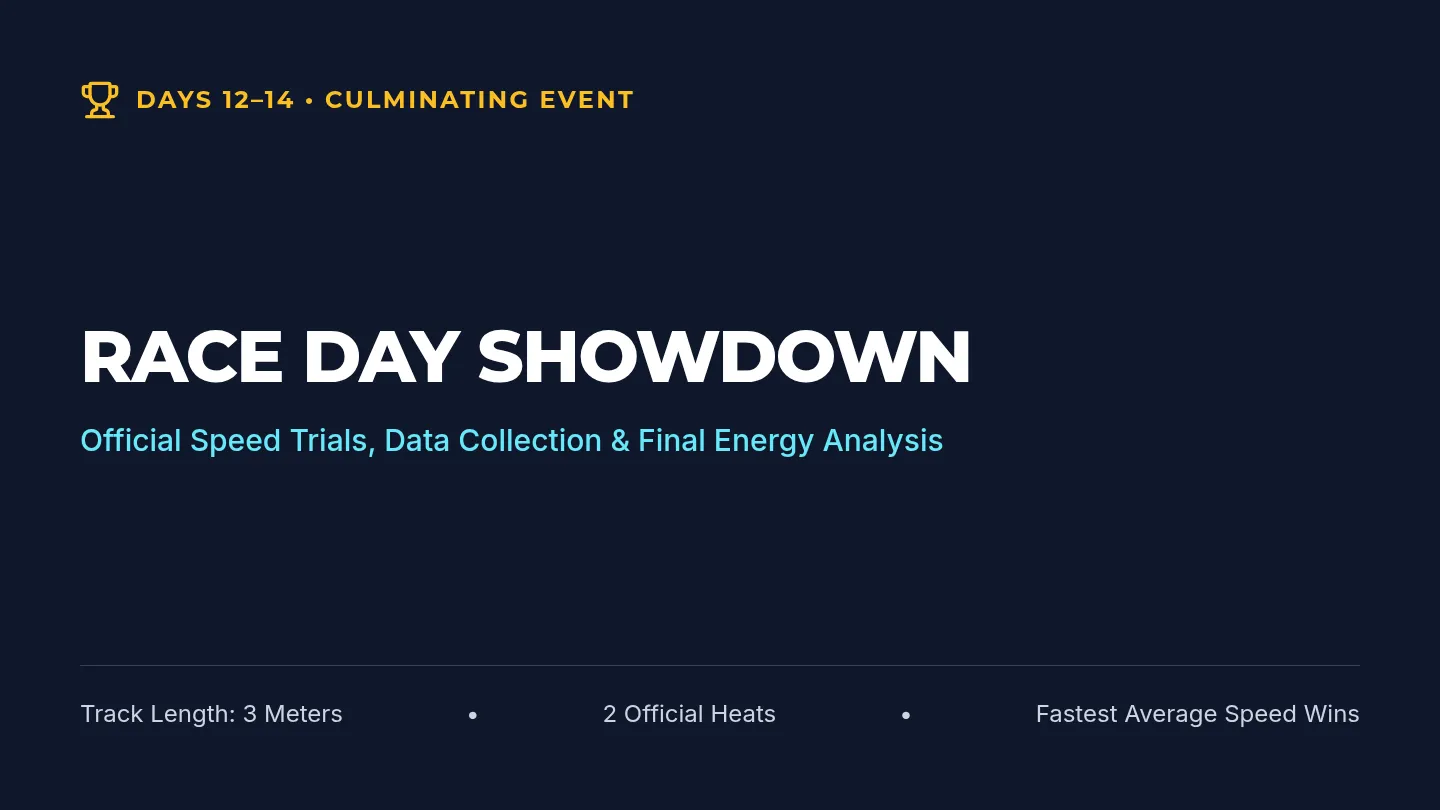
Race Day Slides Days 12–14 • Culminating Event
RACE DAY SHOWDOWN
Official Speed Trials, Data Collection & Final Energy Analysis
Track Length: 3 Meters • 2 Official Heats • Fastest Average Speed Wins
Fair Competition
Official Race Rules
1. No Push Starts
Release your car gently at the Start Line. Only the spinning propeller may move the car forward.
2. Two Official Heats
Every team gets 2 timed runs on the 3-meter track. We average your two speeds for the leaderboard.
3. Pit Stop Repairs
If a wire comes loose between heats, you have 2 minutes in the Pit Area to reconnect it.
4. Track Safety
Timers stand behind the Finish Line. Keep hands clear of spinning propellers at all times.
Race Math
How to Calculate Your Speed
Speed = Distance ÷ Time
Example:
Your car travels 3.0 meters in 1.5 seconds .
Speed = 3.0 m ÷ 1.5 s = 2.0 m/s
Class Debrief
What Made the Fastest Cars Win?
Power & Blades: Did 9V or AA batteries win? Did 3-blade or 4-blade propellers perform better?
Mass & Kinetic Energy: How did lightweight cardboard help acceleration?
Thermal Loss: How did the fastest teams reduce wheel and axle friction?
Race Day Scorecard Name(s): ___________________________
Date: _______________
Car Name: _______________
Days 12–14 • Official Results
Race Day Scorecard
1. Your Team's Official Speed Trials
Record your distance and time for each heat. Calculate speed using \( \text{Speed} = \frac{\text{Distance}}{\text{Time}} \).
Run
Distance (m)
Time (s)
Speed (m/s)
Heat 1
Heat 2
Average Speed
—
—
2. Show Your Average Speed Calculation:
3. Class Top 3 Leaderboard
Rank
Team / Car Name
Winning Setup
Avg Speed (m/s)
1st Place
2nd Place
3rd Place
Official Timer Initials: ______________ Page 1 of 2
Post-Race Energy Analysis
REFLECTION
1. Trace the complete energy transformation in your car from start to finish (include Chemical, Electrical/Electromagnetic, Kinetic, and Thermal energy):
2. Which design choice (propeller blades, battery voltage, wheel friction, or mass) had the BIGGEST impact on your car's Kinetic Energy? Explain with data.
3. If you had one more day to rebuild and retest, what ONE change would you make to increase speed or reduce thermal energy loss?
Propeller Power PBL • Final Reflection Page 2 of 2