Day Night Cycle Slides 7th Grade Earth & Space
Cosmic Observatory
Spinning Through Space
How Earth’s place and rotation in space create the daily rhythm of day and night.
24-Hour Rotation
4 Lab Stations
Cosmic Dispatch
Essential Question: Why do day and night follow a predictable pattern? Slide 1
Launch Mystery
Moving at 1,670 km/h
Right now, if you are near the equator, Earth is carrying you eastward faster than a commercial jet.
Turn & Talk: If Earth is spinning that fast, why don’t we feel the motion—and why does the Sun look like it’s moving across the sky?
Speed Check
Earth at Equator ~1,670 km/h
Passenger Jet ~900 km/h
Time for 1 Spin 24 Hours
Think-Pair-Share: 2 Minutes Slide 2
Core Concept 1
Rotation on a Tilted Axis
Rotation
Earth spins around an imaginary line called its axis , completing one full turn every 24 hours .
23.5° Tilt
Earth’s axis is tilted 23.5 degrees relative to its orbit around the Sun—pointing toward Polaris, the North Star.
West to East
Viewed from above the North Pole, Earth rotates counter-clockwise (west toward east).
Key Term: Axis — imaginary line through Earth’s poles Slide 3
Core Concept 2
Half Lit, Half Shadow
Because Earth is a sphere and the Sun is one light source, 50% of Earth is always in daylight while 50% is in darkness.
The Terminator: The moving boundary line between day and night—where sunrise and sunset happen!
Sunlight → Night Shadow
DAY
NIGHT
Gold Line = Terminator (Dawn / Dusk)
As Earth rotates through the terminator, your town enters day or night Slide 4
Core Concept 3
Apparent Motion vs. Reality
What We See
The Sun appears to rise in the East , arc across the sky, and set in the West .
This is called apparent motion —an optical illusion from standing on a spinning planet.
What Actually Happens
The Sun stays at the center of our solar system. Earth’s eastward spin turns your horizon toward the Sun at dawn and away at dusk.
Like trees passing a car window—you are moving, not the Sun!
Misconception Buster: The Sun does not orbit Earth each day Slide 5
Patterns Across Earth
Connecting Space to Daily Patterns
24 Time Zones
Earth rotates 360° in 24 hours—that’s 15° per hour . Different longitudes reach noon at different times.
Star Trails
Just like the Sun, stars appear to wheel across the night sky because Earth rotates underneath them.
Orbit View
Astronauts on the ISS orbit Earth every 90 minutes—seeing 16 sunrises and sunsets every 24 hours!
Math Connection: 360° ÷ 24 hours = 15° of rotation each hour Slide 6
Interactive Practice
Orbit Stations: 8 Minutes Each
Station 1: Terminator Reading
Read the field article and annotate key evidence about Earth’s spin.
Station 2: Cosmic Vocabulary
Match core astronomy terms and sketch visual memory cues.
Station 3: Time Zone Data
Analyze global sunlight data to predict day and night patterns.
Station 4: Myth Busters
Test your understanding and debunk common space misconceptions.
Rotate clockwise when the timer chimes • Bring your Orbit Stations Packet Slide 7
Creative Writing Mission
The Cosmic Dispatch
Use your Space Fact Bank to craft an imaginative story, journal entry, or news report grounded in real astronomy!
Prompt A
Chasing the Terminator
Fly in a supersonic jet trying to stay in permanent sunset.
Prompt B
16 Sunrises a Day
Write a log entry from aboard the International Space Station.
Prompt C
The Slow-Spin Planet
Imagine life on a world where one rotation takes 30 Earth days.
Requirement: Weave at least 3 accurate space facts into your writing Slide 8
Orbit Stations Packet Orbit Stations Field Log
7th Grade Earth & Space • Day & Night Patterns
Name: _______________________ Date: ____________
Station 1: Reading the Terminator
8 Minutes
The Moving Border Between Day and Night
Every 24 hours, Earth completes one full rotation on its imaginary axis —a line running from the North Pole to the South Pole, tilted at 23.5 degrees. Because Earth is a sphere illuminated by one Sun, only half of the planet can face the sunlight at any moment. The other half rests in Earth’s own shadow.
Where those two halves meet lies a dramatic, shifting boundary called the terminator . If you could look down at Earth from space, the terminator would appear as a soft band of orange and violet twilight wrapping around the globe. As Earth spins from west to east at roughly 1,670 kilometers per hour at the equator, cities and oceans continuously sweep across this line. Crossing the terminator into sunlight brings sunrise; crossing into shadow brings sunset.
From the ground, it looks as though the Sun climbs out of the eastern horizon and sinks in the west. In reality, the Sun is not orbiting us each day—our spinning planet is simply turning us toward and away from a steady star.
1. Based on the reading, what is the terminator , and what two daily events happen along it?
2. Why does the Sun appear to move from east to west across our sky each day?
3. Imagine Earth suddenly rotated twice as fast (one spin every 12 hours). How would day and night change?
Station 1 of 4 • Highlight or underline key evidence in the passage Page 1
Station 2: Cosmic Vocabulary Lab
8 Minutes
Part A: Term-to-Definition Match
Write the letter of the matching definition on the blank line next to each vocabulary term.
____ 1. Rotation
____ 2. Axis
____ 3. Terminator
____ 4. Apparent Motion
____ 5. Time Zone
A. The moving boundary line separating Earth’s lit day side from its dark night side.
B. A region of Earth that shares a standard clock time based on 15° slices of rotation.
C. The spinning of a planet on its own axis, taking 24 hours for Earth.
D. An optical illusion where the Sun seems to cross the sky because Earth is spinning.
E. An imaginary line through Earth’s poles tilted at 23.5 degrees.
Part B: Sketch & Explain
Draw a quick labeled diagram for each concept below, then explain it in your own words.
1. Tilted Axis & Rotation (23.5°)
My explanation:
2. Earth’s Terminator Line
My explanation:
Station 2 of 4 • Use arrows in your sketches to show spin direction Page 2
Station 3: Global Sunlight Data Lab
8 Minutes
Because Earth rotates 360° in 24 hours , it turns 15° every hour from west to east. Examine the snapshot below taken at the exact same moment (12:00 PM Noon in London ).
City
Longitude
Local Clock Time
Sky / Sunlight Condition
New York, USA
75° West
7:00 AM
Early morning; Sun rising in the East
London, UK
0° (Prime Meridian)
12:00 PM (Noon)
Midday; Sun high in the sky
Cairo, Egypt
30° East
2:00 PM
Afternoon; Sun moving westward
Tokyo, Japan
135° East
9:00 PM
Nighttime; city in Earth’s shadow
1. Which city in the table most recently crossed the morning terminator into daylight? Explain how the clock time proves it.
2. A city is located at 45° East . Using the 15°-per-hour rule, what is its local clock time when London is at 12:00 PM? Show your math.
3. Explain why Tokyo is in darkness at the exact same moment London is eating lunch. Use the words rotation and sphere .
Station 3 of 4 • Remember: East is ahead in time because Earth spins west-to-east Page 3
Station 4: Space Myth Busters
8 Minutes
Part A: Bust the Misconception
Read each incorrect statement below and write a scientific correction using evidence from this lesson.
Myth 1: “Night happens when the Sun turns off or moves behind the Moon.”
Myth 2: “If we can’t feel the ground moving, Earth must be sitting completely still.”
Part B: Station Exit Check
1. How long does it take Earth to complete one full rotation on its axis?
A. 12 hours
B. 24 hours
C. 30 days
D. 365 days
2. Why do astronauts aboard the International Space Station see about 16 sunrises every 24 hours?
A. The Sun blinks on and off rapidly in space.
B. The space station orbits Earth every 90 minutes, crossing the terminator repeatedly.
C. Earth spins 16 times faster when viewed from orbit.
D. The Moon blocks the Sun 16 times per day.
3. If Earth rotated from east to west instead of west to east, where would the Sun appear to rise?
A. In the North
B. In the South
C. In the East
D. In the West
Station 4 of 4 • Turn in or prepare for your Cosmic Dispatch writing mission! Page 4
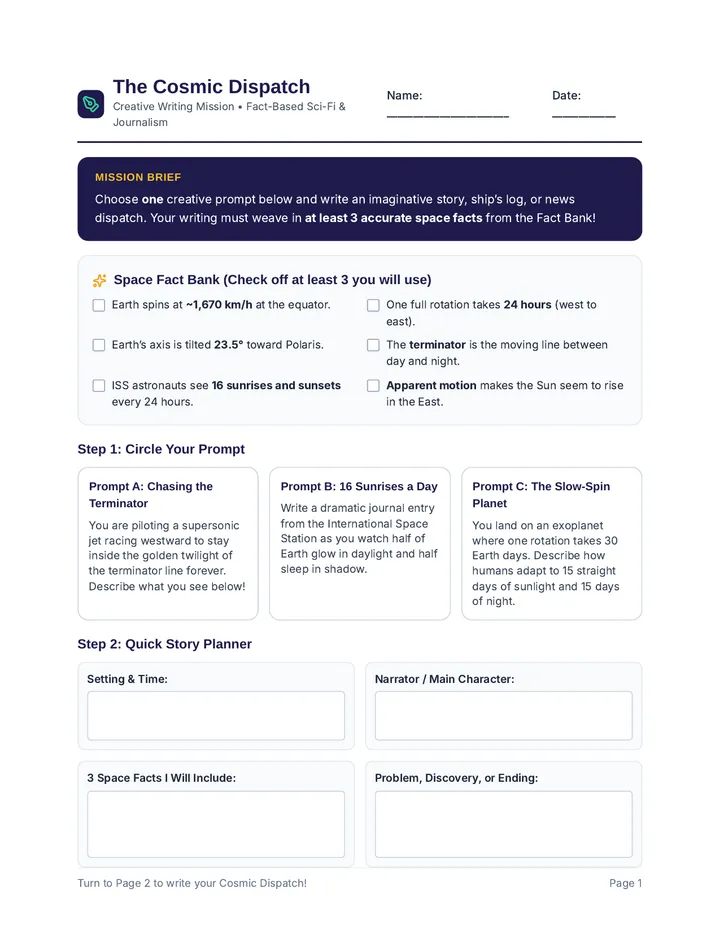
Cosmic Dispatch Writing Sheet The Cosmic Dispatch
Creative Writing Mission • Fact-Based Sci-Fi & Journalism
Name: _______________________ Date: ____________
Mission Brief Choose one creative prompt below and write an imaginative story, ship’s log, or news dispatch. Your writing must weave in at least 3 accurate space facts from the Fact Bank!
Space Fact Bank (Check off at least 3 you will use)
Earth spins at ~1,670 km/h at the equator.
One full rotation takes 24 hours (west to east).
Earth’s axis is tilted 23.5° toward Polaris.
The terminator is the moving line between day and night.
ISS astronauts see 16 sunrises and sunsets every 24 hours.
Apparent motion makes the Sun seem to rise in the East.
Step 1: Circle Your Prompt
Prompt A: Chasing the Terminator
You are piloting a supersonic jet racing westward to stay inside the golden twilight of the terminator line forever. Describe what you see below!
Prompt B: 16 Sunrises a Day
Write a dramatic journal entry from the International Space Station as you watch half of Earth glow in daylight and half sleep in shadow.
Prompt C: The Slow-Spin Planet
You land on an exoplanet where one rotation takes 30 Earth days. Describe how humans adapt to 15 straight days of sunlight and 15 days of night.
Step 2: Quick Story Planner
Setting & Time:
Narrator / Main Character:
3 Space Facts I Will Include:
Problem, Discovery, or Ending:
Turn to Page 2 to write your Cosmic Dispatch! Page 1
Step 3: Write Your Cosmic Dispatch
Prompt Choice (A / B / C): ______
Dispatch Title:
Writer’s Self-Check: 3+ Space Facts Included Clear Beginning, Middle, End Sensory Details
Cosmic Dispatch • Underline the 3 space facts in your final draft Page 2
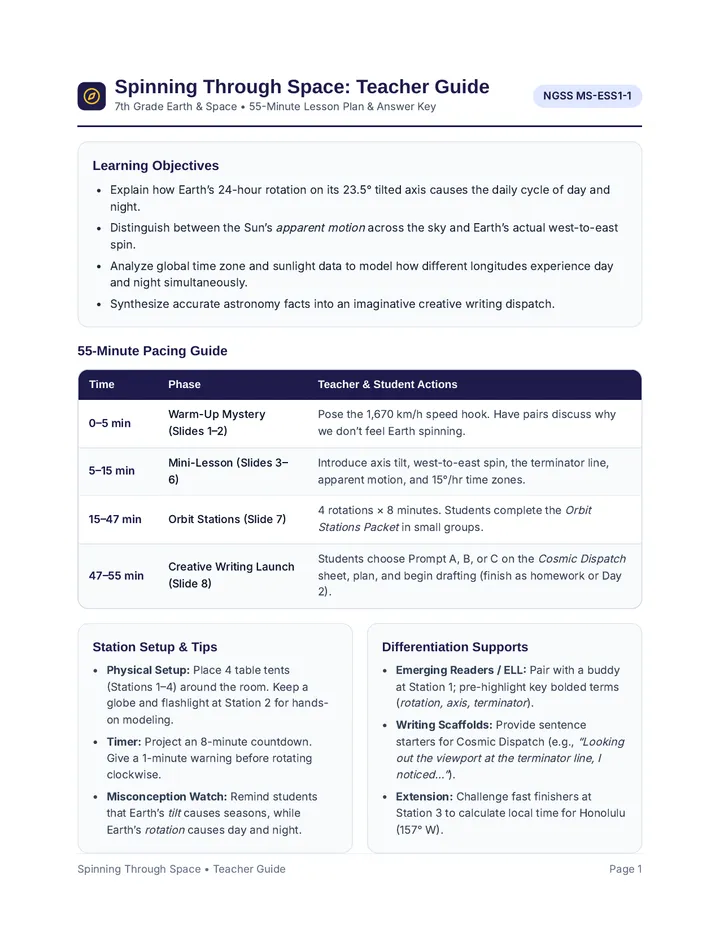
Spinning Space Teacher Guide Spinning Through Space: Teacher Guide
7th Grade Earth & Space • 55-Minute Lesson Plan & Answer Key
NGSS MS-ESS1-1
Learning Objectives
Explain how Earth’s 24-hour rotation on its 23.5° tilted axis causes the daily cycle of day and night.
Distinguish between the Sun’s apparent motion across the sky and Earth’s actual west-to-east spin.
Analyze global time zone and sunlight data to model how different longitudes experience day and night simultaneously.
Synthesize accurate astronomy facts into an imaginative creative writing dispatch.
55-Minute Pacing Guide
Time
Phase
Teacher & Student Actions
0–5 min
Warm-Up Mystery (Slides 1–2)
Pose the 1,670 km/h speed hook. Have pairs discuss why we don’t feel Earth spinning.
5–15 min
Mini-Lesson (Slides 3–6)
Introduce axis tilt, west-to-east spin, the terminator line, apparent motion, and 15°/hr time zones.
15–47 min
Orbit Stations (Slide 7)
4 rotations × 8 minutes. Students complete the Orbit Stations Packet in small groups.
47–55 min
Creative Writing Launch (Slide 8)
Students choose Prompt A, B, or C on the Cosmic Dispatch sheet, plan, and begin drafting (finish as homework or Day 2).
Station Setup & Tips
Physical Setup: Place 4 table tents (Stations 1–4) around the room. Keep a globe and flashlight at Station 2 for hands-on modeling.Timer: Project an 8-minute countdown. Give a 1-minute warning before rotating clockwise.Misconception Watch: Remind students that Earth’s tilt causes seasons, while Earth’s rotation causes day and night.
Differentiation Supports
Emerging Readers / ELL: Pair with a buddy at Station 1; pre-highlight key bolded terms (rotation, axis, terminator ).Writing Scaffolds: Provide sentence starters for Cosmic Dispatch (e.g., “Looking out the viewport at the terminator line, I noticed…” ).Extension: Challenge fast finishers at Station 3 to calculate local time for Honolulu (157° W).
Spinning Through Space • Teacher Guide Page 1
Orbit Stations Packet: Answer Key
Station 1: Reading the Terminator
1. The terminator is the moving boundary between Earth’s lit day side and dark night side. Sunrise and sunset happen along it.
2. Earth spins from west to east, turning us toward the Sun in the morning and away in the evening (apparent motion).
3. Day and night would each be half as long (~6 hours of daylight, ~6 hours of darkness).
Station 2: Vocabulary Lab
Part A Matching:
1. Rotation → C
2. Axis → E
3. Terminator → A
4. Apparent Motion → D
5. Time Zone → B
Part B Sketches: Look for a tilted axis line (23.5°) with spin arrows, and a half-lit/half-dark sphere with the terminator labeled.
Station 3: Global Sunlight Data
1. New York, USA. Its local time is 7:00 AM, and the Sun is just rising in the East.
2. 3:00 PM. 45° ÷ 15°/hr = 3 hours ahead of London (12:00 PM + 3 hours = 3:00 PM).
3. Because Earth is a sphere , sunlight only hits half of it at once. As Earth’s rotation turns London toward the Sun, Tokyo (135° East) has rotated into Earth’s shadow.
Station 4: Space Myth Busters
Myth 1: The Sun shines continuously. Night happens when our side of Earth rotates away from the Sun into Earth’s own shadow.
Myth 2: Earth’s rotation is smooth and constant (~1,670 km/h at the equator), and the air/atmosphere moves with us, so we don’t feel it.
Part B Exit Check: 1. B (24 hours) • 2. B (90-min orbit) • 3. D (In the West)
Cosmic Dispatch: Quick Grading Rubric (12 pts)
Criteria
4 – Exemplary
3 – Proficient
1–2 – Developing
Scientific Accuracy
3+ space facts woven seamlessly and accurately into the story.
3 space facts included with minor scientific imprecision.
Fewer than 3 facts or facts contain major misconceptions.
Creativity & Voice
Vivid sensory details, strong narrator voice, engaging plot.
Clear narrative voice and relevant details matching the prompt.
Minimal detail; reads more like a list than a story or dispatch.
Structure & Clarity
Clear beginning, middle, and end; polished conventions.
Organized sequence with few distracting errors.
Incomplete narrative or frequent errors that block meaning.
Spinning Through Space • Answer Key & Rubric Page 2