Crucible Blade Lesson Plan Ancient India Side Study • Lesson 1 Plan
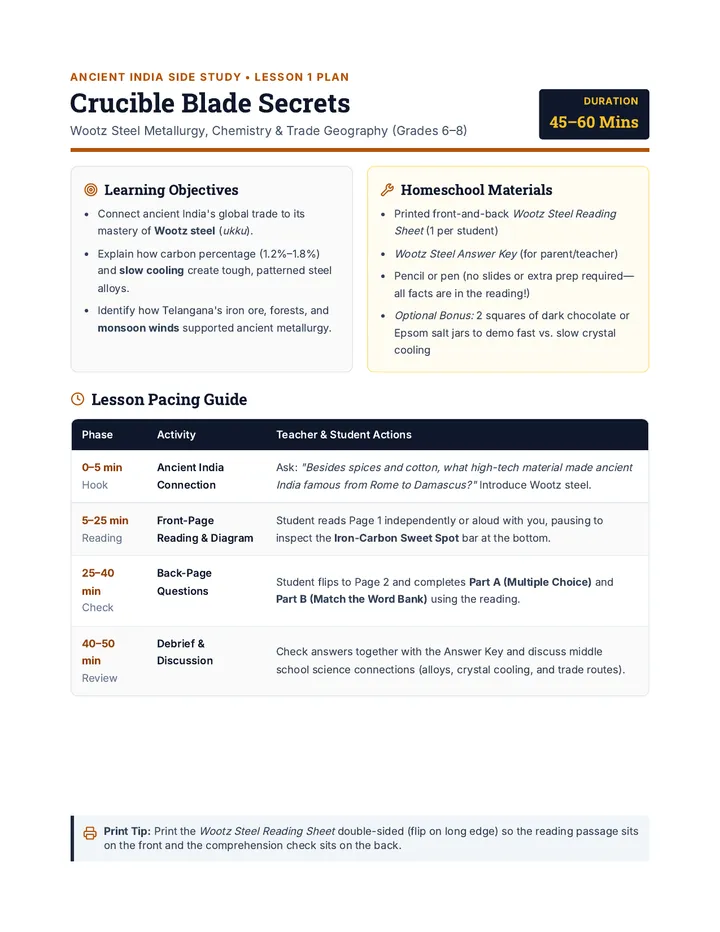
Crucible Blade Secrets
Wootz Steel Metallurgy, Chemistry & Trade Geography (Grades 6–8)
Duration
45–60 Mins
Learning Objectives
Connect ancient India's global trade to its mastery of Wootz steel (ukku ).
Explain how carbon percentage (1.2%–1.8%) and slow cooling create tough, patterned steel alloys.
Identify how Telangana's iron ore, forests, and monsoon winds supported ancient metallurgy.
Homeschool Materials
Printed front-and-back Wootz Steel Reading Sheet (1 per student)
Wootz Steel Answer Key (for parent/teacher)Pencil or pen (no slides or extra prep required—all facts are in the reading!)
Optional Bonus: 2 squares of dark chocolate or Epsom salt jars to demo fast vs. slow crystal cooling
Lesson Pacing Guide
Phase
Activity
Teacher & Student Actions
0–5 min
Hook
Ancient India Connection
Ask: "Besides spices and cotton, what high-tech material made ancient India famous from Rome to Damascus?" Introduce Wootz steel.
5–25 min
Reading
Front-Page Reading & Diagram
Student reads Page 1 independently or aloud with you, pausing to inspect the Iron-Carbon Sweet Spot bar at the bottom.
25–40 min
Check
Back-Page Questions
Student flips to Page 2 and completes Part A (Multiple Choice) and Part B (Match the Word Bank) using the reading.
40–50 min
Review
Debrief & Discussion
Check answers together with the Answer Key and discuss middle school science connections (alloys, crystal cooling, and trade routes).
Print Tip: Print the Wootz Steel Reading Sheet double-sided (flip on long edge) so the reading passage sits on the front and the comprehension check sits on the back.
Cross-Curricular Connections & Discussion
Lesson 1 • Page 2
Middle School Subject Connections
Ancient History (India & Trade)
Shows that ancient India wasn't only a center of philosophy and textiles—it was also the ancient world's metallurgy superpower, exporting ingots to Rome, Persia, and Syria.
Chemistry (Alloys & Carbon)
Demonstrates how changing a tiny percentage of a single element (carbon from 0.3% to 1.5% to 3%) completely transforms a material's physical properties.
Physical Science (Cooling & Crystals)
Connects thermal energy and cooling rates to crystal structure: slow cooling lets atoms organize into distinct cementite bands.
Geography (Monsoon Winds)
Highlights how South Indian smiths harnessed predictable seasonal winds as free, natural bellows for 1,300°C furnaces.
Optional 5-Minute Kitchen Demo: Cooling Rate
If you want a quick visual after reading, melt two small squares of dark chocolate. Chill one on an ice-cold metal spoon (fast cool = dull, brittle, tiny crystals) and wrap the other in a warm dish towel to cool slowly (slow cool = visible streaks and smoother snap)—just like Wootz ingots cooling inside clay crucibles!
Table Discussion Prompts
Why couldn't you just add more carbon to make a sword even stronger? (Cast iron becomes too brittle and shatters.)
Why do you think Indian smiths kept their exact leaf-and-clay crucible recipes secret?
Bridge to Lesson 2: Telangana sits on the eastern edge of India's Deccan Plateau —our next reading explores the giant volcanic eruptions that built that plateau!
Sequence: Iron and Basalt Lesson 1: Crucible Blade Secrets
Wootz Steel Reading Sheet Ancient India Side Study • Metallurgy & Geography
The Secret of Wootz Steel
Name: ___________________________
Date: ____________________________
1. Ancient India's Super-Metal
Long before European blacksmiths could melt steel, metalworkers in ancient southern India perfected a legendary metal called Wootz steel . For more than 2,000 years, Indian workshops produced small, hockey-puck-shaped cakes of steel called ingots . Merchants carried these ingots across the Arabian Sea and along overland caravans to Persia and Syria. In the city of Damascus, swordsmiths forged Indian ingots into blades so sharp and tough they could slice through silk in midair—or shatter ordinary iron armor. Even the English word wootz comes from a mistranslation of ukku , the ancient Kannada and Telugu word for steel.
2. The Chemistry of the Crucible
Pure iron by itself is too soft to hold a sharp edge. To turn iron into steel—an alloy (a mixture of a metal with another element)—smiths must add a precise amount of carbon . Ancient Indian smiths packed pure iron ore or wrought iron scraps into a sealed clay pot called a crucible , along with wood chips and dry leaves as a carbon source. After sealing the crucible airtight, they fired it in a furnace at roughly 1,300°C for days until the metal melted completely and absorbed between 1.2% and 1.8% carbon . Too little carbon leaves wrought iron (0%–0.3% carbon), which is soft and bends easily. Too much carbon makes cast iron (2.5%–4.0% carbon), which is very hard but brittle enough to snap on impact. Wootz hit the exact chemical sweet spot: hard enough for a razor edge, yet flexible enough not to shatter.
3. Slow Cooling and Watered Patterns
In physical science, how fast a melted material cools determines the size of its crystals. Instead of dunking their hot crucibles in water, Indian smiths let them cool very slowly over several days. Slow cooling gave carbon and iron atoms time to organize into microscopic bands of hard iron carbide, called cementite , layered inside softer steel. When a swordsmith hammered the ingot into a blade and etched it with mild acid, those cementite layers appeared as flowing, wavy ripples—giving Damascus blades their famous "watered" pattern.
4. Geography and Monsoon Furnaces
Why did southern India—especially the region around Konasamudram and Golconda in modern Telangana—become the ancient world's steel capital? Geography gave smiths three built-in advantages: hills rich in pure magnetite iron ore, dense forests for charcoal fuel, and powerful seasonal monsoon winds . Smiths aimed their furnace air vents directly into the steady monsoon winds, which acted like giant natural bellows to push furnace temperatures past 1,300°C.
Reference: The Iron-Carbon Sweet Spot
0% – 0.3% Carbon
1.2% – 1.8% Carbon
2.5% – 4.0% Carbon
Wrought Iron: Soft, bends easily
Wootz Steel: Hard + flexible
Cast Iron: Very hard, brittle
Wootz Steel Comprehension Check
Back Page • Questions
Part A: Multiple Choice (Circle the best answer based on the reading.)
1. Why did ancient Indian smiths seal wood chips and dry leaves inside a clay crucible with iron?
A. To cool the metal down faster
B. To add carbon and turn iron into steel
C. To keep the clay from cracking
D. To wash away rust from the ore
2. Why is Wootz steel (1.2%–1.8% carbon) better for blades than cast iron (2.5%–4.0% carbon)?
A. Cast iron is too soft and bends
B. Cast iron cannot be melted in a furnace
C. Cast iron is brittle and snaps on impact
D. Wootz steel contains zero carbon
3. How did slow cooling over several days affect the metal inside the crucible?
A. It formed organized cementite crystal bands
B. It turned the steel back into wrought iron
C. It prevented any crystals from forming
D. It caused the ingot to shatter into dust
4. How did South Indian smiths use local climate to push furnace temperatures past 1,300°C?
A. They built furnaces on snowy peaks
B. They aimed vents into seasonal monsoon winds
C. They burned river water as fuel
D. They only smelted metal during winter
5. Why did Indian traders export Wootz as compact ingots instead of finished swords?
A. Indian smiths did not know how to forge
B. Ingots were illegal to use inside India
C. Ingots were easier to pack and let foreign smiths forge local styles
D. Finished swords melted during sea voyages
6. Where does the English word "wootz" come from?
A. A mistranslation of ukku , the local word for steel
B. The name of a king in Damascus
C. A Greek word for volcanic rock
D. The Latin word for charcoal fuel
Part B: Match the Word Bank (Write the correct term on each line.)
Crucible • Cementite • Wrought Iron • Ingot • Monsoon Winds • Alloy
1. _______________ A mixture of a metal with another element, such as iron mixed with carbon.
2. _______________ An airtight clay pot used to melt iron ore and carbon sources at extreme heat.
3. _______________ Low-carbon iron (0%–0.3%) that is soft and bends easily.
4. _______________ Hard iron carbide bands that create the wavy "watered" pattern in Damascus blades.
5. _______________ A compact, hockey-puck-shaped cake of steel shaped for shipping and trade.
6. _______________ Steady seasonal airflow that acted like natural bellows for South Indian furnaces.
Ancient India Side Study • Lesson 1 The Secret of Wootz Steel
Wootz Steel Answer Key Lesson 1 • Teacher Reference
Wootz Steel Answer Key
Answer Key
Part A: Multiple Choice
1. B — To add carbon and turn iron into steel. (Wood chips and dry leaves served as the carbon source inside the sealed crucible.)
2. C — Cast iron is brittle and snaps on impact. (Wootz hits the 1.2%–1.8% carbon sweet spot: hard yet flexible.)
3. A — It formed organized cementite crystal bands. (Slow cooling gave atoms time to line up, creating the "watered" pattern.)
4. B — They aimed vents into seasonal monsoon winds. (The steady winds acted like giant natural bellows.)
5. C — Ingots were easier to pack and let foreign smiths forge local styles.
6. A — A mistranslation of ukku , the local Kannada/Telugu word for steel.
Part B: Match the Word Bank
#
Correct Term
Definition
1
Alloy
A mixture of a metal with another element, such as iron mixed with carbon.
2
Crucible
An airtight clay pot used to melt iron ore and carbon sources at extreme heat.
3
Wrought Iron
Low-carbon iron (0%–0.3%) that is soft and bends easily.
4
Cementite
Hard iron carbide bands that create the wavy "watered" pattern in Damascus blades.
5
Ingot
A compact, hockey-puck-shaped cake of steel shaped for shipping and trade.
6
Monsoon Winds
Steady seasonal airflow that acted like natural bellows for South Indian furnaces.
Ancient India Side Study • Lesson 1 The Secret of Wootz Steel
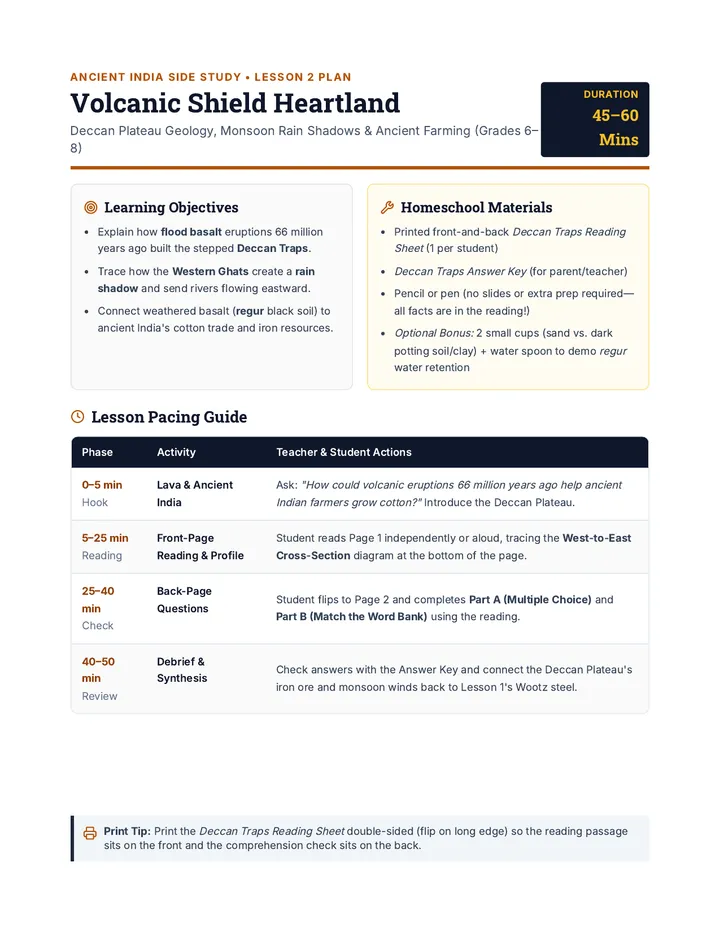
Volcanic Shield Lesson Plan Ancient India Side Study • Lesson 2 Plan
Volcanic Shield Heartland
Deccan Plateau Geology, Monsoon Rain Shadows & Ancient Farming (Grades 6–8)
Duration
45–60 Mins
Learning Objectives
Explain how flood basalt eruptions 66 million years ago built the stepped Deccan Traps .
Trace how the Western Ghats create a rain shadow and send rivers flowing eastward.
Connect weathered basalt (regur black soil) to ancient India's cotton trade and iron resources.
Homeschool Materials
Printed front-and-back Deccan Traps Reading Sheet (1 per student)
Deccan Traps Answer Key (for parent/teacher)Pencil or pen (no slides or extra prep required—all facts are in the reading!)
Optional Bonus: 2 small cups (sand vs. dark potting soil/clay) + water spoon to demo regur water retention
Lesson Pacing Guide
Phase
Activity
Teacher & Student Actions
0–5 min
Hook
Lava & Ancient India
Ask: "How could volcanic eruptions 66 million years ago help ancient Indian farmers grow cotton?" Introduce the Deccan Plateau.
5–25 min
Reading
Front-Page Reading & Profile
Student reads Page 1 independently or aloud, tracing the West-to-East Cross-Section diagram at the bottom of the page.
25–40 min
Check
Back-Page Questions
Student flips to Page 2 and completes Part A (Multiple Choice) and Part B (Match the Word Bank) using the reading.
40–50 min
Review
Debrief & Synthesis
Check answers with the Answer Key and connect the Deccan Plateau's iron ore and monsoon winds back to Lesson 1's Wootz steel.
Print Tip: Print the Deccan Traps Reading Sheet double-sided (flip on long edge) so the reading passage sits on the front and the comprehension check sits on the back.
Cross-Curricular Connections & Discussion
Lesson 2 • Page 2
Middle School Subject Connections
Earth History (Plate Tectonics)
Connects the Deccan Traps to India's northward plate drift over a mantle hotspot 66 million years ago—the same geologic era as the end-Cretaceous dinosaur extinction.
Weather & Climate (Rain Shadows)
Illustrates orographic lift: moist ocean air rises over the Western Ghats, cools, condenses into heavy rain, and leaves the plateau interior dry.
Soil Science (Weathering)
Shows how volcanic basalt weathers into iron-rich regur clay that swells and stores rainwater like a natural sponge.
Ancient India (Economy & Steel)
Links plateau geology directly to ancient India's two biggest exports: cotton textiles (from regur soil) and Wootz steel (from plateau iron ore).
Optional 5-Minute Demo: Black Soil Water Test
Spoon 2 tablespoons of sand into one small cup and 2 tablespoons of dark potting soil or clay into another. Add 1 tablespoon of water to each. Your student can immediately see how sandy soil lets water slip away while dark clay holds moisture—just like regur soil on the Deccan Plateau!
Table Discussion Prompts
Why don't Deccan rivers flow west into the Arabian Sea even though they start right next to it?
How did regur soil act like a "natural irrigation system" for ancient Indian cotton farmers?
How do Lesson 1 (Wootz Steel) and Lesson 2 (Deccan Plateau) fit together in the story of Ancient India?
Sequence: Iron and Basalt Lesson 2: Volcanic Shield Heartland
Deccan Traps Reading Sheet Ancient India Side Study • Geology & Geography
The Volcanic Deccan Plateau
Name: ___________________________
Date: ____________________________
1. Lava Bigger Than a Continent
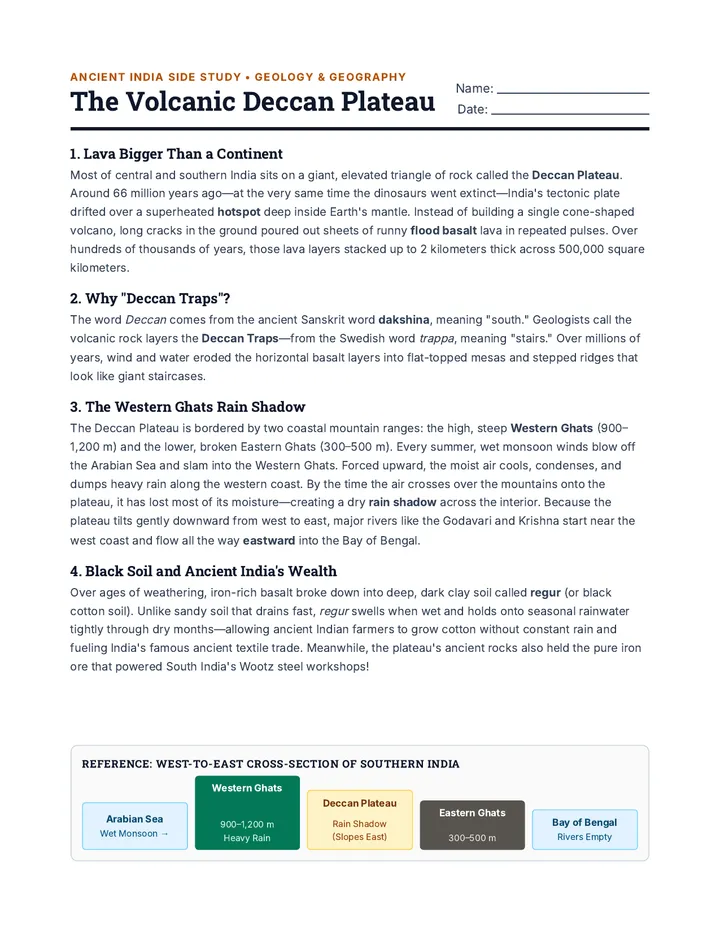
Most of central and southern India sits on a giant, elevated triangle of rock called the Deccan Plateau . Around 66 million years ago—at the very same time the dinosaurs went extinct—India's tectonic plate drifted over a superheated hotspot deep inside Earth's mantle. Instead of building a single cone-shaped volcano, long cracks in the ground poured out sheets of runny flood basalt lava in repeated pulses. Over hundreds of thousands of years, those lava layers stacked up to 2 kilometers thick across 500,000 square kilometers.
2. Why "Deccan Traps"?
The word Deccan comes from the ancient Sanskrit word dakshina , meaning "south." Geologists call the volcanic rock layers the Deccan Traps —from the Swedish word trappa , meaning "stairs." Over millions of years, wind and water eroded the horizontal basalt layers into flat-topped mesas and stepped ridges that look like giant staircases.
3. The Western Ghats Rain Shadow
The Deccan Plateau is bordered by two coastal mountain ranges: the high, steep Western Ghats (900–1,200 m) and the lower, broken Eastern Ghats (300–500 m). Every summer, wet monsoon winds blow off the Arabian Sea and slam into the Western Ghats. Forced upward, the moist air cools, condenses, and dumps heavy rain along the western coast. By the time the air crosses over the mountains onto the plateau, it has lost most of its moisture—creating a dry rain shadow across the interior. Because the plateau tilts gently downward from west to east, major rivers like the Godavari and Krishna start near the west coast and flow all the way eastward into the Bay of Bengal.
4. Black Soil and Ancient India's Wealth
Over ages of weathering, iron-rich basalt broke down into deep, dark clay soil called regur (or black cotton soil). Unlike sandy soil that drains fast, regur swells when wet and holds onto seasonal rainwater tightly through dry months—allowing ancient Indian farmers to grow cotton without constant rain and fueling India's famous ancient textile trade. Meanwhile, the plateau's ancient rocks also held the pure iron ore that powered South India's Wootz steel workshops!
Reference: West-to-East Cross-Section of Southern India
Arabian Sea
Wet Monsoon →
Western Ghats
900–1,200 m
Deccan Plateau
Rain Shadow
Eastern Ghats
300–500 m
Bay of Bengal
Rivers Empty
Deccan Plateau Comprehension Check
Back Page • Questions
Part A: Multiple Choice (Circle the best answer based on the reading.)
1. How did the Deccan Traps form around 66 million years ago?
A. A single giant ash cone exploded once
B. India drifted over a hotspot and runny lava poured from cracks
C. Ancient glaciers carved granite peaks
D. Ocean waves piled up sand dunes
2. Why are the plateau's rock formations called "Traps"?
A. Hunters used them to catch animals
B. They trap all river water underground
C. Erosion carved them into giant stairs (Swedish trappa )
D. It is the Sanskrit word for volcano
3. Why does the interior Deccan Plateau receive much less rain than India's west coast?
A. The Western Ghats block wet monsoon air, creating a rain shadow
B. The Arabian Sea has no evaporation
C. Monsoon winds only blow from the north
D. The Eastern Ghats are taller than the Himalayas
4. Which direction do major Deccan rivers like the Godavari and Krishna flow, and why?
A. Westward, because the Arabian Sea is lower
B. Northward, toward the Himalayan peaks
C. Eastward into the Bay of Bengal, because the plateau tilts east
D. Southward into underground caves
5. Why is black regur soil so valuable for growing cotton in a dry rain-shadow climate?
A. It drains water away instantly like sand
B. Its dark clay holds seasonal rainwater tightly through dry months
C. It is made of crushed sea shells
D. It stays frozen all summer long
6. How does the Deccan Plateau connect to ancient India's Wootz steel industry?
A. Basalt lava melted swords directly
B. Cotton plants were used as iron ore
C. Plateau rocks held rich iron ore and monsoon winds powered furnaces
D. Steel ingots were carved out of black clay
Part B: Match the Word Bank (Write the correct term on each line.)
Flood Basalt • Hotspot • Rain Shadow • Regur • Western Ghats • Dakshina
1. _______________ A superheated area deep inside Earth's mantle that melts rock above it.
2. _______________ Runny volcanic lava that pours out of cracks in huge, flat sheets.
3. _______________ The Sanskrit word meaning "south," which gave the Deccan its name.
4. _______________ The steep coastal mountain ridge (900–1,200 m) along India's western edge.
5. _______________ A dry zone on the leeward side of mountains after moist air drops its rain.
6. _______________ Fertile, dark clay soil formed from weathered basalt that holds moisture well.
Ancient India Side Study • Lesson 2 The Volcanic Deccan Plateau
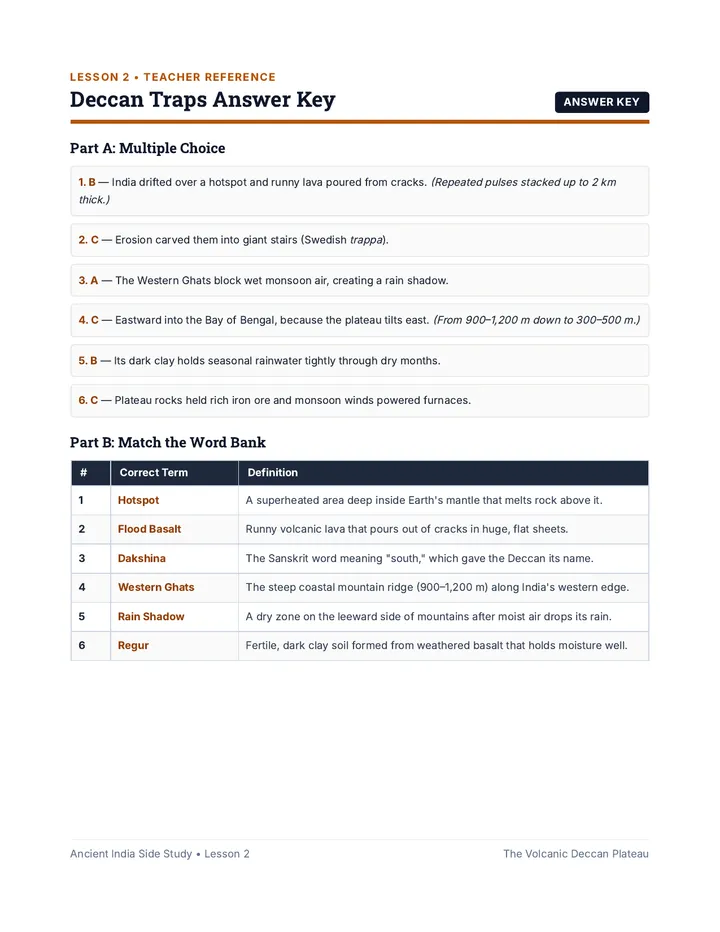
Deccan Traps Answer Key Lesson 2 • Teacher Reference
Deccan Traps Answer Key
Answer Key
Part A: Multiple Choice
1. B — India drifted over a hotspot and runny lava poured from cracks. (Repeated pulses stacked up to 2 km thick.)
2. C — Erosion carved them into giant stairs (Swedish trappa ).
3. A — The Western Ghats block wet monsoon air, creating a rain shadow.
4. C — Eastward into the Bay of Bengal, because the plateau tilts east. (From 900–1,200 m down to 300–500 m.)
5. B — Its dark clay holds seasonal rainwater tightly through dry months.
6. C — Plateau rocks held rich iron ore and monsoon winds powered furnaces.
Part B: Match the Word Bank
#
Correct Term
Definition
1
Hotspot
A superheated area deep inside Earth's mantle that melts rock above it.
2
Flood Basalt
Runny volcanic lava that pours out of cracks in huge, flat sheets.
3
Dakshina
The Sanskrit word meaning "south," which gave the Deccan its name.
4
Western Ghats
The steep coastal mountain ridge (900–1,200 m) along India's western edge.
5
Rain Shadow
A dry zone on the leeward side of mountains after moist air drops its rain.
6
Regur
Fertile, dark clay soil formed from weathered basalt that holds moisture well.
Ancient India Side Study • Lesson 2 The Volcanic Deccan Plateau