Rock Transformations Unit Map 6th Grade Earth Science • 13-Lesson Paced Sequence
Rock Transformations Unit Map
Pacing: 13 Lessons (~30 min/day)
Hands-On: Timed Labs & Demos
Assessments: Midway Quiz + Unit Test
NYS Next Gen Science Standards (NYSSLS) — 6th Grade
Primary: MS-ESS2-1
Develop a model to describe the cycling of Earth’s materials and the flow of energy that drives this process.
Supporting: MS-ESS2-2
Construct an explanation based on evidence for how geoscience processes have changed Earth’s surface at varying time and spatial scales.
SEP: Developing/Using Models; Constructing Explanations (CER)
DCI: ESS2.A Earth’s Materials & Systems (Internal + Sun Energy)
CCC: Energy & Matter; Stability & Change Across Scales
Part 1 Energy Engines, Weathering & Igneous Rocks (Lessons 1–6)
Integrates L1–4 Study Guide
L#
Title & Focus
Core Concepts & WNY
Demo / Lab & Time
HW Bridge
L1
Rock Thinking & Geologists
MS-ESS2-1 • Evidence
| Geologists observe color, texture, crystals, layers, & shape. Support claims with evidence before naming rocks. | Lab: 15 min
Hand-lens mystery rock station (property-only observations).
| HW 1: Observation Log — 2 local stones. |
| L2 |
Earth’s Two Energy Engines
MS-ESS2-1 • Energy
| Internal Earth heat (melting, magma, volcanoes) vs. Sun-driven weather (weathering, erosion, sediment). | Demo: 8 min
Heat-lamp vs. hot-plate convection/energy source contrast.
| HW 2: Energy Detective Sort. |
| L3 |
Weathering Up Close
MS-ESS2-2 • WNY
| Mechanical (Lockport quarry) vs. Chemical (Buffalo acid rain). Lake Erie waves: weathering, erosion, transport, deposition. | Lab: 15 min
Vinegar + chalk (chemical) & sugar-cube shake (mechanical).
| HW 3: WNY Weathering Case Study. |
| L4 |
Igneous: Intrusive vs. Extrusive
MS-ESS2-1 • Crystals
| Intrusive/slow (granite) vs. extrusive/fast (basalt, obsidian). Devils Tower (WY) exposed by erosion; WNY granite erratics. | Demo/Lab: 15 min
Melted chocolate lava flow on warm vs. ice-cold foil + rock compare.
| HW 4: Devils Tower Case Study & CER Draft. |
| L5 |
Midway Review & CER
SEP: Argumentation
| Vocab & concept stations (geologist, evidence, weathering, sediment, magma, intrusive/extrusive) + guided CER. | Activity: 15 min
4-station rock sample & vocab evidence sort + CER peer check.
| HW 5: L1–4 Study Guide & Self-Check. |
| L6 |
Midway Quiz (L1–4)
Checkpoint Test
| MCQs on energy sources, weathering, & crystal size; short responses; WNY examples; CER prompt. | Quiz: 30 min
Individual written checkpoint assessment.
| HW 6: Sediment Journey Prediction. |
30-Min Rhythm: 5 min Do-Now/HW check → 10–15 min Lab/Demo → 10 min Sensemaking & Exit Ticket. Page 1 of 2
Part 2 Sedimentary, Metamorphic & Full Rock Cycle (Lessons 7–13)
Completes MS-ESS2-1 & MS-ESS2-2
L#
Title & Focus
Core Concepts & WNY
Demo / Lab & Time
HW Bridge
L7
Sediment on the Move
MS-ESS2-2 • Transport
| Erosion, transportation, & deposition by water, wind, ice, gravity. Rocks form in one place and move over time. | Demo: 12 min
Paint-tray sand & water wave/slope erosion (Lake Erie model).
| HW 7: Deposition Layering Sketch. |
| L8 |
Sedimentary Rock
MS-ESS2-1 • WNY Layers
| Compaction & cementation. WNY geologic history: deep, stacked sedimentary rock layers (limestone, shale, sandstone). | Lab: 15 min
Cereal sedimentary rock (crush, layer, press + binder).
| HW 8: Sedimentary Detective Reading. |
| L9 |
Heat & Pressure
MS-ESS2-1 • Metamorphic
| Deep heat (without full melting) + pressure transform existing rocks into metamorphic rock (foliated vs. non-foliated). | Lab: 15 min
Starburst/clay heat & book-pressure folding (no melting).
| HW 9: 3-Way Rock Comparison Matrix. |
| L10 |
Subduction & Uplift
MS-ESS2-1 / ESS2-3
| Uplift & subduction move rocks—yet deep granite elsewhere may never change, while WNY sits on deep sedimentary layers. | Demo: 10 min
Foam-board / graham-cracker uplift & subduction model.
| HW 10: WNY Geology: Sedimentary-to-Sedimentary Loop. |
| L11 |
Not a Circle: Modeling
SEP: Modeling ESS2-1
| Rock cycle ≠ life cycle: non-linear web, unpredictable paths, & regional loops (WNY = mostly sedimentary → sedimentary). | Lab: 18 min
Rock Cycle Dice/Station Journey (tracks stalls & shortcuts).
| HW 11: Full Unit Study Guide & Vocab. |
| L12 |
Unit Review & Synthesis
WNY Synthesis
| WNY synthesis (Lockport, Lake Erie, Buffalo acid rain, erratics, deep sedimentary layers) + final CER practice. | Activity: 15 min
Gallery walk peer model critique + WNY mystery team challenge.
| HW 12: Final Study Checklist. |
| L13 |
End-of-Unit Assessment
Summative 3D Test
| MCQs, non-linear cycle analysis, WNY evidence questions, and final CER explanation. | Test: 30 min
Individual summative 3D assessment.
| No homework — unit complete. |
Hands-On Supply Kit & WNY Geology Reality
Key Concept: Rock Cycle ≠ Life Cycle
Not a Predictable Circle: Rocks can skip steps, repeat stages, or stall indefinitely (granite formed deep underground may never change).WNY Reality (HW 10 & L11): WNY sits on substantial depths of layered sedimentary rock—creating mostly a sedimentary → sedimentary loop.
Low-Cost Lab Supplies & Case Studies
Supplies: Chocolate, cereal, vinegar, chalk, rock kits; sugar cubes, foil, Starburst/clay, paint trays, sand, graham crackers.Cases: Devils Tower (WY), Lockport, Buffalo acid rain, Lake Erie, erratics, WNY sedimentary layers.
Next Step: Approve or tweak any lab/HW above, and we will build the full sequence of lessons and materials. Page 2 of 2
Rock Thinking Slides Lesson 1 • 30-Min Field Investigation NYSSLS MS-ESS2-1
Rock Thinking & Geologists
You don’t need the “answer” yet — you need good evidence.
Do Now (3 min)
If you found an unusual rock in your backyard, how could you figure out where it came from without Googling its name?
Rock Transformations Unit Slide 1 of 5
What Do Geologists Do?
5 min Mini-Lesson
Geologists Study:
• Rocks & minerals
• Earth’s changing surface
• Clues about Earth’s past
5 Observable Properties:
1. Color (light, dark, speckled)
2. Texture (rough, smooth, glassy)
3. Crystals (large, tiny, none)
4. Layers (bands, stripes, flat)
5. Shape (sharp, rounded, worn)
Key Rule: Describe properties — do NOT name rock types yet! Slide 2 of 5
Hand-Lens Mystery Rock Lab
Lab: 15 min
Station Directions (3 min per rock):
Examine Samples A, B, C, and D with a hand lens.
Record at least 3 properties for each sample.
Write one scientific question about how it formed.
Challenge: Which two samples might have formed in a similar way? Use your observations as evidence!
Work carefully • Share hand lenses Slide 3 of 5
Evidence Before Answers
5 min Share-Out
Sentence Starter 1
“Based on my observation of __________, I claim Sample ___ formed…”
Sentence Starter 2
“I noticed __________ in Sample ___, which makes me wonder…”
Key Takeaway: Rocks tell a story about Earth’s past.
Lesson 1 Sensemaking Slide 4 of 5
Exit Ticket & Homework
2 min Wrap-Up
Exit Ticket (On Your Lab Sheet)
What is one property a geologist uses to study a rock, and what clue might that property give?
Tonight’s Homework (HW 1)
Local Stones Observation Log: Find 2 stones outside or at home and describe their properties without naming them.
Next Lesson: Earth’s Two Energy Engines Slide 5 of 5
Rock Observation Lab Worksheet Name: ____________________________________ Class: _______ Date: ____/____/______
Lesson 1 Lab • Field Geologist Notebook
Mystery Rock Observation Station
15 Min Lab
Directions: Use a hand lens to examine Samples A, B, C, and D. Describe what you observe using color, texture, crystals, layers, and shape . Do NOT guess rock names—focus on observable evidence!
Sample
Color & Texture
Crystals, Layers & Shape
1 Scientific Question
Sample A
Sample B
Sample C
Sample D
1. Evidence-Based Claim: Which two samples might have formed in a similar way? Support your claim with at least two observations.
2. Exit Ticket: What is one property a geologist studies, and what clue might it give about a rock’s past?
Vocab: Geologist • Evidence • Property Lesson 1 In-Class Lab
Local Stones Homework Name: ____________________________________ Class: _______ Date: ____/____/______
Homework 1 • 10–15 Min Bridge
Backyard Geologist Observation Log
HW 1
Instructions: Find two different stones outside (driveway, park, sidewalk, or yard). Observe them closely like a geologist—remember, you do NOT need to know their names! Record their properties below.
Stone #1 — Where I found it: ___________________________________________
Color & Texture (rough, smooth, bumpy?)
Crystals, Layers, or Shape (sharp or worn?)
Quick Sketch of Stone #1:
Stone #2 — Where I found it: ___________________________________________
Color & Texture (rough, smooth, bumpy?)
Crystals, Layers, or Shape (sharp or worn?)
Quick Sketch of Stone #2:
Bridge to Lesson 2: What do you think could cause a solid rock outside to change shape or break apart over time?
Bring this log to Lesson 2! HW 1
Energy Engines Slides Lesson 2 • 30-Min Investigation NYSSLS MS-ESS2-1
Earth’s Two Energy Engines
Different energy sources change rocks in different ways.
Do Now (3 min)
Share one stone from HW 1 with a partner. What might have shaped or worn down that stone?
Rock Transformations Unit Slide 1 of 5
Two Engines Drive Rock Change
6 min Mini-Lesson
☀️ Sun Energy (External)
Heats air & water, driving weather at the surface.
• Weathering (breaks rock)
• Erosion (moves sediment)
• Wind, rain, waves, ice
🌋 Earth’s Interior (Internal)
Intense heat deep inside Earth’s crust and mantle.
• Melting rock into magma
• Volcanoes & lava flows
• Deep heat & pressure
Both engines are constantly transforming Earth’s crust Slide 2 of 5
Heat-Lamp vs. Hot-Plate Demo
Demo: 8 min
Model A: Heat Lamp Above
Warms the surface from above—just like the Sun warming air and water to power wind and rain.
Model B: Hot Plate Below
Heats material from underneath—just like Earth’s internal heat rising to melt rock into magma.
Record on your sheet: Which process happens at the surface, and which happens deep underground?
Observe carefully during the demo Slide 3 of 5
Energy Engines in Western NY
5 min Discussion
Surface (Sun Energy): Lake Erie waves, winter ice, and rain actively weather and move rock across Western NY today.
Internal Energy: No active volcanoes in WNY—but deep internal heat shapes rock elsewhere on Earth and melts rock into magma!
Key Takeaway: Different energy sources change rocks in different ways. Slide 4 of 5
Exit Ticket & Homework
3 min Wrap-Up
Exit Ticket
Which energy engine causes rock to melt into magma, and which engine causes weathering at Earth’s surface?
Tonight’s Homework (HW 2)
Energy Detective Sort: Classify 6 real-world rock changes as driven by Internal Earth Energy or Sun Energy.
Next Lesson: Weathering Up Close (Vinegar & Chalk Lab) Slide 5 of 5
Energy Engines Demo Worksheet Name: ____________________________________ Class: _______ Date: ____/____/______
Lesson 2 • Energy & Matter
Earth’s Two Energy Engines
8 Min Demo
Part 1: Heat-Lamp vs. Hot-Plate Demo
Model
What I Observed Happening
Which Earth Energy Engine Is This?
Model A: Heat Lamp Above
Model B: Hot Plate Below
Part 2: Comparing Rock Changes
Sun Energy (External) Causes:
Earth’s Interior (Internal) Causes:
1. Which energy source is responsible for melting rock into magma?
☐ Sun energy
☐ Internal Earth energy
☐ Wind
☐ Ocean waves
2. Exit Ticket: Explain one way Sun energy can change rocks at Earth’s surface.
Vocab: Weathering • Sediment • Magma Lesson 2 In-Class Sheet
Energy Detective Homework Name: ____________________________________ Class: _______ Date: ____/____/______
Homework 2 • 10–15 Min Bridge
Energy Detective Sort
HW 2
Instructions: For each scenario below, check whether it is driven by Sun Energy or Internal Earth Energy , then explain how you know.
Rock-Change Scenario
Energy Source
How I Know (Evidence)
1. Lake Erie waves crash into shoreline rocks and break off small pebbles.
☐ Sun Energy
☐ Internal Energy
2. Deep underground, rock gets so hot that it melts into liquid magma.
☐ Sun Energy
☐ Internal Energy
3. Wind blows sand grains against a cliff, slowly wearing it down.
☐ Sun Energy
☐ Internal Energy
4. A volcano erupts, pushing hot melted rock onto Earth’s surface.
☐ Sun Energy
☐ Internal Energy
5. Rainwater freezes in a crack in a Lockport rock wall and splits it open.
☐ Sun Energy
☐ Internal Energy
6. Acid rain slowly dissolves minerals on an old limestone building in Buffalo.
☐ Sun Energy
☐ Internal Energy
Bridge to Lesson 3: Look at Scenarios #5 and #6. Both break down rock, but how are they different?
Bring to Lesson 3: Weathering Up Close! HW 2
Weathering Up Close Slides Lesson 3 • 30-Min Lab NYSSLS MS-ESS2-2
Weathering Up Close
Breaking rock into sediment — physically and chemically.
Do Now (3 min)
Why do old stone statues in cities sometimes look blurry or smooth, while rocks in a mountain stream have sharp cracks?
Rock Transformations Unit Slide 1 of 5
Two Types of Weathering
5 min Mini-Lesson
🔨 Mechanical Weathering
Physical breaking of rock into smaller pieces (sediment) without changing what it is made of.
Causes: Ice, wind, water, plant roots, animal or human activity.
🧪 Chemical Weathering
Rock changes due to chemical reactions — minerals inside the rock dissolve or form new substances.
Causes: Acid rain, oxygen, water dissolving minerals.
Both are powered by Sun-driven weather at Earth’s surface! Slide 2 of 5
Chalk & Sugar Cube Lab
Lab: 15 min
Part A: Sugar Cube Shake
Put 2 sugar cubes in a sealed jar.
Shake vigorously for 30 seconds.
Observe edges, crumbs, and size.
Part B: Vinegar + Chalk
Place chalk in a cup.
Add 2 pipettes of vinegar (acid).
Observe fizzing & dissolving!
Record Before & After observations on your lab sheet Slide 3 of 5
Weathering in Western NY
4 min Connection
Lockport Quarry: Mechanical weathering breaks apart large rock structures through ice wedging and human quarrying.
Old Buildings in Buffalo: Acid rain causes chemical weathering, slowly dissolving limestone and marble details.
Lake Erie Waves: Weathering, erosion, transportation, and deposition all happen at the same time!
Local Geology Spotlight Slide 4 of 5
Exit Ticket & Homework
3 min Wrap-Up
Exit Ticket
How is chemical weathering (vinegar + chalk) different from mechanical weathering (shaking sugar cubes)?
Tonight’s Homework (HW 3)
WNY Weathering Case Study: Read about Lockport, Buffalo, and Lake Erie and classify each process.
Next Lesson: Intrusive & Extrusive Igneous Rocks Slide 5 of 5
Weathering Lab Worksheet Name: ____________________________________ Class: _______ Date: ____/____/______
Lesson 3 Lab • Surface Processes
Mechanical vs. Chemical Weathering Lab
15 Min Lab
Station
Before Observation
After Observation
Type of Weathering
Part A: Sugar Cube Shake
Shake 2 cubes in a jar for 30 sec.
| | | ☐ Mechanical
Part B: Vinegar + Chalk
Add 2 pipettes of vinegar onto chalk.
| | | ☐ Mechanical
1. In Part B (vinegar + chalk), what evidence showed a chemical reaction was dissolving the minerals?
2. WNY Connection: Which station models acid rain on old Buffalo buildings, and which models rocks tumbling in Lake Erie waves?
3. Exit Ticket: Explain the difference between mechanical weathering and chemical weathering in your own words.
Vocab: Weathering • Mechanical • Chemical • Sediment Lesson 3 In-Class Lab
WNY Weathering Homework Name: ____________________________________ Class: _______ Date: ____/____/______
Homework 3 • 10–15 Min Bridge
Western NY Weathering Case Study
HW 3
Reading: Weathering in Our Own Backyard
You don’t need to travel across the world to see Sun-driven weather changing rocks—it happens right here in Western New York! At the Lockport Quarry , freezing winter water expands inside cracks in large rock walls, physically wedging and breaking them into smaller chunks. Human quarrying also physically breaks these structures apart.
Meanwhile, in downtown Buffalo , rainwater mixes with gases in the air to form weak acid rain. Over decades, this acid rain reacts with minerals in old limestone buildings and statues, slowly dissolving their details. Along the shore of Lake Erie , waves crash against cliffs and pebbles—causing weathering, erosion, transportation, and deposition all at the same time!
1. Which WNY example is mainly CHEMICAL weathering?
☐ Freezing water splitting rock at Lockport Quarry
☐ Acid rain dissolving minerals on old Buffalo buildings
☐ Waves knocking pebbles against each other in Lake Erie
☐ Heavy machinery breaking rock in a quarry
2. Why does the reading say Lake Erie waves involve multiple processes happening simultaneously? Name at least two processes.
3. Bridge to Lesson 4: Weathering breaks rocks down at the surface. What happens when rock is pushed deep underground and heated until it melts?
Bring to Lesson 4: Intrusive & Extrusive Igneous Rocks! HW 3
Igneous Cooling Slides Lesson 4 • 30-Min Lab NYSSLS MS-ESS2-1
Igneous: Intrusive vs. Extrusive
Texture and crystal size are evidence of how fast magma cooled.
Do Now (3 min)
Look at Granite (rough, big crystals) and Obsidian (smooth, glassy). Both formed from melted rock—why do they look so different?
Rock Transformations Unit Slide 1 of 5
Cooling Rate & Crystal Size
6 min Mini-Lesson
Intrusive (Inside Earth)
• Magma cools slowly underground
• Particles move longer → large crystals
• Example: Granite (rough, visible crystals)
Extrusive (At Surface)
• Lava cools quickly at Earth’s surface
• Little time to grow → small/no crystals
• Examples: Basalt (small), Obsidian (glassy)
Texture is evidence of cooling rate! Slide 2 of 5
Chocolate Lava Cooling Lab
Demo/Lab: 15 min
Warm Foil (Slow Cooling)
Pour warm melted chocolate onto room-temp/warm foil. Watch how far it spreads and how long it takes to harden.
Ice-Cold Foil (Fast Cooling)
Pour melted chocolate onto ice-chilled foil. Notice how fast it solidifies and compare the texture!
Compare with real Granite, Basalt, and Obsidian samples at your table.
Record cooling time & texture on your lab sheet Slide 3 of 5
Exposed Intrusive Rock & Erratics
4 min Case Studies
Devils Tower (Wyoming): Magma cooled slowly underground (intrusive). Millions of years of erosion wore away the softer sedimentary rock around it, leaving the tower standing!
WNY Granite Erratics: Large granite boulders found in Western NY look out of place—ancient glaciers carried them here over 10,000 years ago!
Rocks can form in one place and move to another over time Slide 4 of 5
Exit Ticket & Homework
2 min Wrap-Up
Exit Ticket
Why does slow cooling underground create larger crystals than fast cooling at Earth’s surface?
Tonight’s Homework (HW 4)
Devils Tower Case Study & CER Draft: Explain how energy transforms rocks into intrusive and extrusive igneous rock.
Next Lesson: Midway Review & CER Workshop Slide 5 of 5
Chocolate Lava Lab Worksheet Name: ____________________________________ Class: _______ Date: ____/____/______
Lesson 4 Lab • Internal Energy & Cooling
Chocolate Lava & Igneous Crystal Lab
15 Min Lab
Part 1: Melted Chocolate Cooling Model
Cooling Surface
Time to Solidify
Flow & Texture Observations
Models Which Igneous Type?
Warm / Room-Temp Foil
☐ Intrusive (Slow)
☐ Extrusive (Fast)
Ice-Cold Foil
☐ Intrusive (Slow)
☐ Extrusive (Fast)
Part 2: Real Igneous Rock Comparison
Rock Sample
Crystal Size & Texture
Cooling Rate
Intrusive or Extrusive?
Granite
Basalt
Obsidian
Exit Ticket: Why does slow cooling underground create larger crystals than fast cooling at Earth’s surface?
Vocab: Magma • Igneous Rock • Intrusive • Extrusive Lesson 4 In-Class Lab
Devils Tower CER Homework Name: ____________________________________ Class: _______ Date: ____/____/______
Homework 4 • Case Study & CER Draft
Devils Tower & Energy CER Draft
HW 4
Case Study: How Did Intrusive Rock End Up Above Ground?
Devils Tower in Wyoming is a massive, steep pillar of igneous rock rising 867 feet above the surrounding plains. Millions of years ago, hot magma pushed upward into underground layers of sedimentary rock, where it cooled slowly as intrusive igneous rock . Over millions of years, Sun-driven weathering and erosion wore away the softer sedimentary rock around it—exposing the harder igneous tower at the surface!
1. What two energy sources worked together over millions of years to create and expose Devils Tower?
2. CER Draft (Bring to Lesson 5 Workshop!)
Prompt: Explain how energy can transform rocks into different types. (Include igneous rocks that form both under and above ground, and what type of energy begins transforming rocks at the surface.)
Claim:
Evidence (from labs, granite/basalt, or Devils Tower):
Reasoning (connect energy & cooling rate to your evidence):
Bring your CER Draft to Lesson 5 for peer feedback! HW 4
Midway Review Slides Lesson 5 • Midway Review Lessons 1–4 Synthesis
Midway Review & CER Workshop
Sharpening our evidence before the Midway Quiz.
Do Now (3 min)
Take out HW 4 (CER Draft). Underline your strongest piece of evidence in one color and your energy source in another.
Rock Transformations Unit Slide 1 of 5
4-Station Evidence Review
Activity: 15 min
Station 1: Energy Engines
Sort process cards into Sun Energy vs. Internal Earth Energy.
Station 2: Weathering
Match Lockport, Buffalo acid rain, & Lake Erie to mechanical/chemical.
Station 3: Crystal Size
Inspect Granite, Basalt, & Obsidian—identify cooling rate & location.
Station 4: Vocab Match
Pair 8 core terms (magma, sediment, intrusive, extrusive, etc.).
3.5 minutes per station • Rotate clockwise Slide 2 of 5
CER Peer Check
8 min Workshop
1. Claim: Directly answers how energy transforms rocks at the surface and underground.
2. Evidence: Cites specific observations (crystal size, chocolate lab, Devils Tower, or WNY weathering).
3. Reasoning: Explains why cooling rate or energy type causes those rock properties.
Give your partner 1 praise + 1 polish suggestion Slide 3 of 5
Big Ideas for Tomorrow’s Quiz
2 min Recap
✓ Rocks tell a story about Earth’s past through their properties.
✓ Two energy engines: Internal heat (melting) vs. Sun (weathering).
✓ Slow cooling underground (intrusive) → large crystals; fast at surface (extrusive) → small/glassy.
✓ Rocks can form in one place and move over time (erratics, erosion).
Review your Study Guide tonight! Slide 4 of 5
Homework & Quiz Prep
2 min Wrap-Up
Tonight’s Homework (HW 5)
Complete the L1–4 Study Guide & Self-Check Practice Questions to get ready for tomorrow’s Midway Quiz!
Next Lesson: Midway Quiz (Lessons 1–4) Slide 5 of 5
Midway Stations Worksheet Name: ____________________________________ Class: _______ Date: ____/____/______
Lesson 5 • Midway Review & CER Workshop
4-Station Evidence Tracker & CER Polish
Review
Station 1: Energy Engines
List 2 Sun-driven & 2 Internal-driven changes:
Station 2: Weathering Types
Match Lockport, Buffalo, & Lake Erie:
Station 3: Crystal Size & Cooling
Compare Granite, Basalt, & Obsidian:
Station 4: Key Vocabulary Check
Write 2 terms you still need to practice:
CER Peer Check & Final Revision
☐ Clear Claim
☐ 2+ Specific Evidence
☐ Reasoning links Energy
Partner Feedback (1 Praise + 1 Polish):
My Polished CER Statement:
Use this sheet + HW 5 to study for tomorrow’s Midway Quiz! Lesson 5 Workshop
Midway Study Guide Homework Name: ____________________________________ Class: _______ Date: ____/____/______
Homework 5 • Midway Quiz Prep
Lessons 1–4 Study Guide & Review
HW 5
Big Ideas Across Lessons 1–4
Rocks tell a story about Earth’s past; geologists use observations as evidence.
Earth has two main energy engines: internal Earth energy (melting/magma) and Sun energy (weathering/erosion).
Igneous rocks form when magma or lava cools. Intrusive (slow underground) = large crystals (granite); extrusive (fast at surface) = small/glassy (basalt, obsidian).
Rocks can form in one place and move over time (e.g., WNY granite glacial erratics, Devils Tower exposed by erosion).
Key Vocabulary to Know
Term
Meaning & Example
Geologist
A scientist who studies rocks, minerals, and Earth’s surface.
Evidence
Observations (color, texture, crystals, layers, shape) used to support a claim.
Weathering
Breaking down of rock at Earth’s surface.
Mechanical Weathering
Physical breaking of rock (ice, wind, water, Lockport Quarry).
Chemical Weathering
Minerals dissolve or change via chemical reactions (acid rain on Buffalo buildings).
Sediment
Small rock fragments created by weathering.
Magma
Melted rock beneath Earth’s surface.
Igneous Rock
Rock formed from cooled magma (intrusive) or lava (extrusive).
Study Page 1, then complete Self-Check on Page 2 Page 1 of 2
Self-Check Practice Questions
1. Which energy source melts rock?
☐ Sun energy
☐ Internal Earth energy
☐ Wind
☐ Water
2. Which breaks rock into sediment?
☐ Melting
☐ Weathering
☐ Crystallization
☐ Cooling
3. Large visible crystals cooled:
☐ Very quickly
☐ Very slowly
☐ By acid rain
☐ In Lake Erie waves
4. Explain one way Sun energy can change rocks at Earth’s surface (use a WNY example).
5. Why does slow cooling underground create larger crystals than fast cooling at the surface?
6. How did Devils Tower (an intrusive igneous rock) end up standing tall above the ground?
Study Checklist — Before the Midway Quiz, Make Sure You Can:
☐ Describe what a geologist does
☐ Explain intrusive vs. extrusive igneous rocks
☐ Identify internal Earth vs. Sun energy
☐ Use crystal size as evidence of cooling rate
☐ Compare mechanical vs. chemical weathering
☐ Explain how rocks move over time (erratics)
Quiz Tomorrow! Review your CER from Lesson 5. Page 2 of 2
Midway Quiz Assessment Name: ____________________________________ Class: _______ Date: ____/____/______
Lesson 6 • Checkpoint Assessment
Rock Transformations Midway Quiz (L1–4)
30 Min
Part A: Multiple Choice (Choose the best answer)
1. Which energy source is responsible for melting rock into magma beneath Earth’s surface?
☐ A. Sun energy
☐ B. Internal Earth energy
☐ C. Wind energy
☐ D. Wave energy
2. Acid rain dissolving minerals on an old limestone building in Buffalo is an example of:
☐ A. Mechanical weathering
☐ B. Chemical weathering
☐ C. Melting
☐ D. Crystallization
3. A geologist finds an igneous rock with large, rough, visible crystals. This rock most likely:
☐ A. Cooled very quickly at the surface
☐ B. Cooled very slowly underground (intrusive)
☐ C. Was weathered by Lake Erie waves
☐ D. Formed instantly like obsidian glass
4. How did large granite boulders (glacial erratics) end up on the surface in Western NY?
☐ A. Local volcanoes erupted last century
☐ B. Ancient glaciers carried and deposited them
☐ C. Acid rain built them up from sediment
☐ D. Lake Erie waves melted sand into granite
Part B: Short Response
5. Why does slow cooling underground produce larger crystals than fast cooling at Earth’s surface?
6. Devils Tower in Wyoming is made of intrusive igneous rock. Explain how it is now exposed above ground.
Continue to Page 2 for the CER Prompt Page 1 of 2
Part C: Claim — Evidence — Reasoning (CER)
Prompt:
Explain how energy can transform rocks into different types. In your response, include how igneous rocks form both underground (intrusive) and at Earth’s surface (extrusive), and explain what type of energy begins transforming rocks at Earth’s surface.
Claim (Directly answer the prompt):
Evidence (Include at least 2 specific examples from class, labs, or rocks):
Reasoning (Explain how energy and cooling rate connect your evidence to your claim):
Check your work before turning in your quiz! Page 2 of 2
Midway Quiz Answer Key Teacher Resource • Lesson 6
Midway Quiz Answer Key & CER Rubric
Key
Part A: Multiple Choice (1 pt each)
1. B — Internal Earth energy (heat inside Earth melts rock into magma).
2. B — Chemical weathering (acid rain dissolves minerals via chemical reaction).
3. B — Cooled very slowly underground (intrusive; more time for large crystals to grow).
4. B — Ancient glaciers carried and deposited them over 10,000 years ago.
Part B: Short Response Exemplars (2 pts each)
5. Slow Cooling & Crystal Size: Underground magma stays hot for a long time, so particles can move around longer and crystals have more time to grow large (e.g., granite). At the surface, lava loses heat fast, so crystals have little time to grow and stay small or glassy (e.g., basalt, obsidian).
6. Devils Tower: Magma cooled slowly underground to form hard intrusive igneous rock. Over millions of years, Sun-driven weathering and erosion wore away the softer surrounding sedimentary rock, leaving the tower exposed at the surface.
Part C: CER Rubric (6 pts total)
Component
Proficient (2 pts)
Developing (1 pt)
Claim
States that both internal Earth energy and Sun energy transform rocks into different types (including intrusive & extrusive igneous).
Mentions only one energy source or gives an incomplete claim.
Evidence
Cites 2+ specific examples (e.g., granite large crystals vs. basalt/obsidian small/glassy; chocolate lab; WNY weathering; Devils Tower).
Cites only 1 example or vague observations.
Reasoning
Explains how internal heat melts rock and cooling rate determines crystal size, while Sun energy drives surface weathering into sediment.
Restates evidence without explaining the energy or cooling-rate mechanism.
Teacher Use Only — Total: 14 Points Midway Quiz Key
Sediment Prediction Homework Name: ____________________________________ Class: _______ Date: ____/____/______
Homework 6 • Bridge to Part 2
Sediment Journey Prediction
HW 6
Scenario: Imagine a piece of granite high in the mountains is weathered by ice and rain into tiny grains of sand (sediment). A fast river carries that sand downstream and dumps it at the bottom of a calm lake.
1. Draw a 3-panel comic showing how the sand moved from the mountain to the lake bottom:
Panel 1: Weathering
Panel 2: Moving in River
Panel 3: Settling in Lake
2. Prediction: Over thousands of years, more and more sand and mud pile up on top of that first layer at the bottom of the lake. What do you think happens to the bottom layers?
3. Which energy source (Sun or Internal Earth) moved the sediment from the mountain to the lake? Explain.
Bring to Lesson 7: Sediment on the Move! HW 6
Sediment Move Slides Lesson 7 • 30-Min Demo NYSSLS MS-ESS2-2
Sediment on the Move
How weathered rock travels and settles in new places.
Do Now (3 min)
In HW 6, you predicted what happens when river sand settles in a lake. What happens to the bottom layers as more sand piles on top?
Rock Transformations Unit • Part 2 Slide 1 of 5
Three Surface Processes
5 min Mini-Lesson
1. Erosion
Picking up and removing weathered rock & sediment from its original spot.
2. Transportation
Moving sediment from one place to another by water, wind, ice, or gravity.
3. Deposition
Dropping or settling sediment when moving water, wind, or ice slows down.
Powered by Sun energy & gravity! Slide 2 of 5
Lake Erie Wave & Slope Demo
Demo: 12 min
Paint-Tray Model Setup:
Sand & pebbles sit on the upper slope; water fills the deep basin. Watch what happens when we create gentle waves and pour “river” water down the slope.
Look closely: Where do heavy pebbles settle compared to fine sand and mud?
Record Before & After sketches on your sheet Slide 3 of 5
Simultaneous Processes
5 min Discussion
At Lake Erie , weathering, erosion, transportation, and deposition happen at the same time .
Over millions of years, rivers and waves deposit thick layers of sediment in lake and ocean basins.
Rocks can form in one place and move to another over time Slide 4 of 5
Exit Ticket & Homework
3 min Wrap-Up
Exit Ticket
Put these in order for a grain of sand: Deposition, Weathering, Erosion, Transportation.
Tonight’s Homework (HW 7)
Deposition Layering Sketch: Model how different sediment sizes settle into layers in a Lake Erie basin.
Next Lesson: Sedimentary Rock (Cereal Lab!) Slide 5 of 5
Erosion Demo Worksheet Name: ____________________________________ Class: _______ Date: ____/____/______
Lesson 7 Demo • Surface Processes
Lake Erie Wave & Slope Erosion Demo
12 Min Demo
Part 1: Paint-Tray Model Sketches
Before Waves & River Flow:
After Waves & River Flow (Label Erosion & Deposition):
1. Which sediment settled first near the shore—heavy pebbles or fine sand/mud? Why?
2. Explain how Lake Erie waves show weathering, erosion, transportation, and deposition happening simultaneously.
3. Exit Ticket: Put these 4 steps in order for a grain of rock: Deposition, Weathering, Erosion, Transportation.
Vocab: Erosion • Transportation • Deposition Lesson 7 In-Class Sheet
Deposition Sketch Homework Name: ____________________________________ Class: _______ Date: ____/____/______
Homework 7 • 10–15 Min Bridge
Deposition Layering Sketch
HW 7
Instructions: Imagine a river carries three types of sediment into Lake Erie over thousands of years: Year 1: dark mud; Year 500: light sand; Year 1,000: small shells and pebbles. Draw how these layers stack at the bottom of the lake.
1. Draw and label the 3 deposited layers in the basin below (oldest at the bottom, youngest on top):
2. Which layer is the OLDEST, and which layer experiences the most weight/pressure from above?
3. Bridge to Lesson 8: Loose mud and sand are soft. What needs to happen to turn those stacked layers into solid rock?
Bring to Lesson 8: Cereal Sedimentary Rock Lab! HW 7
Sedimentary Rock Slides Lesson 8 • 30-Min Lab NYSSLS MS-ESS2-1
Sedimentary Rock Layers
Turning loose sediment into solid, layered rock.
Do Now (3 min)
In HW 7, which layer had the most weight pressing down on it—the oldest bottom layer or the youngest top layer?
Rock Transformations Unit Slide 1 of 5
Compaction & Cementation
5 min Mini-Lesson
1. Compaction
Weight of upper sediment layers squeezes lower layers tightly together, pushing out water and air.
2. Cementation
Dissolved minerals in water act like natural glue, crystallizing between grains and locking them into rock!
Examples: Sandstone, Shale, Limestone Slide 2 of 5
Cereal Sedimentary Rock Lab
Lab: 15 min
Weather & Deposit: Crush 2–3 cereal types into crumbs and layer them in a cup.Cement: Add a small amount of water/binder (natural mineral “glue”).Compact: Press down firmly with a heavy book for 60 seconds!Observe: Inspect your “sedimentary rock” layers and record on your sheet.
Connect each step to real Earth processes Slide 3 of 5
Western NY’s Sedimentary History
4 min Connection
Hundreds of millions of years ago, Western NY was covered by ancient shallow seas.
Rivers washed mud, sand, and shells into those seas, forming substantial depths of stacked sedimentary rock (limestone, shale, sandstone) beneath our feet today!
You can see these layers at Niagara Gorge & Lockport! Slide 4 of 5
Exit Ticket & Homework
3 min Wrap-Up
Exit Ticket
In our cereal lab, what represented compaction and what represented cementation?
Tonight’s Homework (HW 8)
Sedimentary Detective Reading: Use fossils and rock layers to figure out what an ancient environment looked like.
Next Lesson: Heat, Pressure & Metamorphic Rock Slide 5 of 5
Cereal Rock Lab Worksheet Name: ____________________________________ Class: _______ Date: ____/____/______
Lesson 8 Lab • Sedimentary Formation
Cereal Sedimentary Rock Lab
15 Min Lab
Part 1: Modeling Steps & Observations
Lab Action
Real Earth Process It Models
What Happened to Your Cereal?
Crushing & layering cereal
Pressing with a heavy book
Adding water / binder
1. Sketch a side view of your cereal rock showing its layers:
2. WNY Connection: Why does Western NY have deep, stacked layers of limestone, shale, and sandstone?
3. Exit Ticket: Explain the difference between compaction and cementation.
Vocab: Compaction • Cementation • Sedimentary Rock Lesson 8 In-Class Lab
Sedimentary Detective Homework Name: ____________________________________ Class: _______ Date: ____/____/______
Homework 8 • 10–15 Min Bridge
Sedimentary Detective: Clues in the Layers
HW 8
Reading: Reading Earth’s History Book
Because sedimentary rocks form in layers at Earth’s surface, they often trap shells, leaves, and bones—turning them into fossils . In Western NY, geologists find fossilized sea creatures (like crinoids and trilobites) inside limestone and shale layers!
By studying the rock type and fossils in each layer, geologists can tell whether a place used to be a deep ocean, a sandy beach, or a muddy swamp.
1. A geologist digs through three sedimentary layers in WNY: Bottom = Limestone with coral fossils; Middle = Shale with mud cracks; Top = Sandstone. Which layer is the OLDEST?
☐ Top sandstone layer
☐ Middle shale layer
☐ Bottom limestone layer
☐ They are all the same age
2. What do coral and sea-creature fossils in WNY limestone tell us about Western NY’s distant past?
3. Bridge to Lesson 9: Sedimentary rock forms near the surface. What might happen if that rock gets pushed deep underground where it is very hot and under huge pressure, WITHOUT melting?
Bring to Lesson 9: Heat, Pressure & Metamorphic Rock! HW 8
Metamorphic Rock Slides Lesson 9 • 30-Min Lab NYSSLS MS-ESS2-1
Heat, Pressure & Metamorphic Rock
Changing rock texture and minerals WITHOUT melting.
Do Now (3 min)
If rock gets hot enough to melt completely into magma, it becomes igneous. What if it gets super hot AND squeezed, but NEVER melts?
Rock Transformations Unit Slide 1 of 5
Metamorphic Rock Textures
5 min Mini-Lesson
Foliated (Banded)
Intense directional pressure flattens and lines up mineral grains into wavy bands or stripes (e.g., Gneiss, Slate).
Non-Foliated
Minerals recrystallize without flat bands—creating dense, interlocking rock (e.g., Marble from limestone).
Key Rule: No melting! Melting = magma = igneous rock. Slide 2 of 5
Clay & Candy Folding Lab
Lab: 15 min
Stack 3 different colors of clay or Starburst candies into flat “sedimentary” layers.
Warm them slightly in your hands (internal Earth heat—do NOT melt!).
Press them firmly under a heavy textbook (deep underground pressure).
Fold and press again—observe the new wavy, banded texture!
Record Before & After sketches on your lab sheet Slide 3 of 5
Where Does This Happen?
4 min Connection
Metamorphic rocks form deep underground where tectonic plates collide and build mountains (like the Adirondacks in NY!).
Driven by Internal Earth Energy (heat + pressure).
Any rock—igneous, sedimentary, or metamorphic—can be metamorphosed Slide 4 of 5
Exit Ticket & Homework
3 min Wrap-Up
Exit Ticket
How is metamorphic rock formation different from igneous rock formation?
Tonight’s Homework (HW 9)
3-Way Rock Comparison Matrix: Compare Igneous, Sedimentary, and Metamorphic formation conditions and energy sources.
Next Lesson: Subduction & Uplift Slide 5 of 5
Heat Pressure Lab Worksheet Name: ____________________________________ Class: _______ Date: ____/____/______
Lesson 9 Lab • Deep Crust Transformations
Heat & Pressure Metamorphic Lab
15 Min Lab
Part 1: Clay / Candy Folding Observations
Before Heat & Pressure (Flat Layers):
After Hand Warmth + Book Pressure:
1. Did your model melt into liquid? How did the layers change without melting?
2. Your folded model now shows wavy, lined-up bands. Which metamorphic texture does this represent?
☐ Foliated (banded)
☐ Non-foliated (no bands)
3. Exit Ticket: How is metamorphic rock formation different from igneous rock formation? Include energy source and melting.
Vocab: Metamorphic Rock • Foliated • Non-foliated Lesson 9 In-Class Lab
Rock Types Matrix Homework Name: ____________________________________ Class: _______ Date: ____/____/______
Homework 9 • 10–15 Min Bridge
3-Way Rock Comparison Matrix
HW 9
Rock Type
How It Forms (Processes)
Main Energy Source
Clues / Examples
Igneous
Sedimentary
Metamorphic
Bridge to Lesson 10: How can a rock that formed deep underground (like metamorphic rock or intrusive granite) ever end up at Earth’s surface to be weathered?
Bring to Lesson 10: Subduction & Uplift! HW 9
Subduction Uplift Slides Lesson 10 • 30-Min Demo NYSSLS MS-ESS2-1 / ESS2-3
Subduction & Uplift
Moving rock between Earth’s surface and deep interior.
Do Now (3 min)
How can a rock formed miles underground ever reach the surface—and how can surface rock end up miles underground?
Rock Transformations Unit Slide 1 of 5
Two Vertical Movers
5 min Mini-Lesson
⬆️ Uplift
Plate motion pushes deep underground rock upward toward Earth’s surface, where Sun energy can weather it.
⬇️ Subduction
One tectonic plate sinks beneath another, pulling surface rock deep underground to melt or metamorphose.
Both are driven by Internal Earth Energy! Slide 2 of 5
Foam-Board Plate Demo
Demo: 10 min
Watch carefully: When two plates collide, one bends upward (uplift ) while the other dives downward (subduction ). Notice which rocks get exposed to rain & wind vs. deep heat!
Question: What happens to rock that is NEVER uplifted or subducted?
Sketch both movements on your worksheet Slide 3 of 5
Do All Rocks Change?
5 min Reality Check
Deep Granite: Granite formed deep underground may stay there for billions of years and never change .
Western NY Reality: WNY sits on substantial depths of layered sedimentary rock —not granite! With no local volcanoes or subduction, WNY is mostly a sedimentary → sedimentary cycle.
Geologic history shapes what rocks exist in each region Slide 4 of 5
Exit Ticket & Homework
3 min Wrap-Up
Exit Ticket
Why do rocks in Western NY mostly cycle from sedimentary rock back into new sedimentary rock?
Tonight’s Homework (HW 10)
WNY Geology Reading: Explore why WNY’s deep sedimentary layers cycle differently than volcanic regions.
Next Lesson: Not a Circle — Modeling the Rock Cycle Slide 5 of 5
Uplift Demo Worksheet Name: ____________________________________ Class: _______ Date: ____/____/______
Lesson 10 Demo • Plate Motion
Subduction & Uplift Demo Sheet
10 Min Demo
Sketch 1: Uplift (Deep Rock Moving Up)
Sketch 2: Subduction (Surface Rock Sinking)
1. True or False? Every rock on Earth eventually melts into magma and becomes igneous rock. Explain using granite formed deep underground.
2. Western NY sits on substantial depths of layered sedimentary rock (not granite). What processes happen to those surface rocks in WNY today?
3. Exit Ticket: How do uplift and subduction connect Earth’s interior to Earth’s surface?
Vocab: Uplift • Subduction • Geologic History Lesson 10 In-Class Sheet
WNY Sedimentary Loop Homework Name: ____________________________________ Class: _______ Date: ____/____/______
Homework 10 • WNY Geology Focus
Western NY: A Sedimentary-to-Sedimentary Loop
HW 10
Reading: Why Isn’t the Rock Cycle Like a Frog’s Life Cycle?
A frog’s life cycle follows a predictable circle: egg → tadpole → froglet → adult frog. The rock cycle is NOT like that! Rocks do not follow a neat circle or predictable order. Some rocks—especially granite formed deep underground —may stay unchanged for billions of years without ever melting or reaching the surface.
Right here in Western New York , we do not sit on top of granite. Instead, due to our geologic history under ancient seas, WNY sits on substantial depths of layered sedimentary rock (limestone, shale, sandstone). Because we have no active volcanoes or mountain-building subduction here today, WNY is mostly a sedimentary rock → sedimentary rock cycle: surface sedimentary rocks weather into sediment, wash into Lake Erie or streams, and compact into new sediment layers!
1. Which statement BEST describes the rock cycle in Western New York?
☐ Every rock in WNY goes Igneous → Sedimentary → Metamorphic in order
☐ WNY sits on deep sedimentary layers and mainly loops Sedimentary → Sedimentary
☐ WNY sits directly on active magma chambers that melt limestone daily
☐ Rocks in WNY follow the same predictable stages as a plant’s life cycle
2. Give one reason why the rock cycle is NOT like a life cycle (use granite or WNY as an example).
3. Bridge to Lesson 11: Trace a 3-step path for a WNY limestone pebble that never goes deep underground.
Bring to Lesson 11: Not a Circle — Modeling the Cycle! HW 10
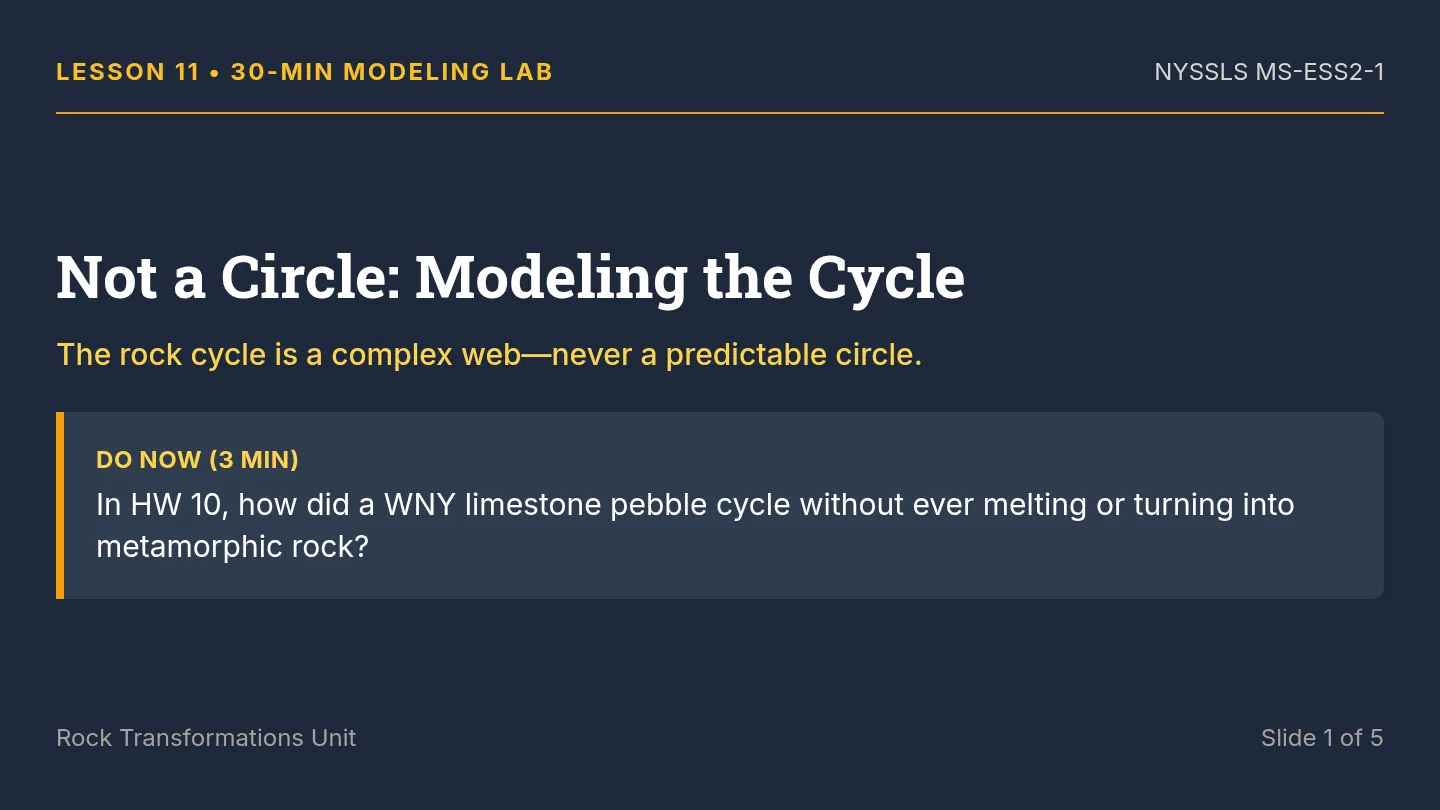
Not a Circle Slides Lesson 11 • 30-Min Modeling Lab NYSSLS MS-ESS2-1
Not a Circle: Modeling the Cycle
The rock cycle is a complex web—never a predictable circle.
Do Now (3 min)
In HW 10, how did a WNY limestone pebble cycle without ever melting or turning into metamorphic rock?
Rock Transformations Unit Slide 1 of 5
Rock Cycle ≠ Life Cycle
4 min Mini-Lesson
🐸 Life Cycle (Predictable)
Follows a fixed, one-way circle. Every tadpole must grow into a frog in order.
🪨 Rock Cycle (Non-Linear Web)
Rocks skip steps, loop back (WNY sedimentary → sedimentary), or stay unchanged for billions of years (deep granite)!
Matter is conserved, even when pathways vary Slide 2 of 5
Rock Cycle Dice Journey
Lab: 18 min
Start at your assigned station (Sedimentary, Magma, Deep Crust, or Surface).
Roll the die 8 times. Record each location, process, and energy source (Sun or Internal).
Notice if you ever get “stuck” or loop back to the same rock type!
Use your 8 rolls to draw an energy-arrow rock cycle model on your sheet.
No two journeys look identical! Slide 3 of 5
What Drives Every Arrow?
3 min Sensemaking
Every transformation arrow in your model is powered by Sun Energy (surface weathering, erosion) or Internal Earth Energy (melting, heat/pressure, uplift).
Without energy flow, rock matter stays put!
NYSSLS MS-ESS2-1: Energy flow drives matter cycling Slide 4 of 5
Exit Ticket & Homework
2 min Wrap-Up
Exit Ticket
Why is a web with multiple arrows and loops a better model for rock transformations than a single circle?
Tonight’s Homework (HW 11)
Full Unit Study Guide & Vocabulary Review: Prepare for tomorrow’s synthesis gallery walk and the Unit Test!
Next Lesson: Unit Review & WNY Synthesis Slide 5 of 5
Rock Cycle Journey Worksheet Name: ____________________________________ Class: _______ Date: ____/____/______
Lesson 11 Modeling Lab • NYSSLS MS-ESS2-1
Rock Cycle Dice Journey & Model
18 Min Lab
Part 1: 8-Roll Journey Log (Record Location, Process, & Energy Source)
Roll
Station / Rock Type
Process (Weathering, Melting, Stayed Put...)
Energy Source (Sun / Internal)
1
2
3
4
5
6
7
8
Part 2: Draw Your Non-Linear Rock Cycle Model (Show Igneous, Sedimentary, Metamorphic, & label Energy Arrows):
Exit Ticket: Why is a web with multiple pathways and stalls a better model than a simple circle?
Bring your model to Lesson 12 for the Gallery Walk! Lesson 11 Modeling Lab
Unit Study Guide Homework Name: ____________________________________ Class: _______ Date: ____/____/______
Homework 11 • Full Unit Review
Rock Transformations Full Study Guide
HW 11
Core Unit Takeaways
Two Energy Engines: Sun energy drives weathering, erosion, transport, and deposition. Internal Earth energy drives melting, magma, heat/pressure, uplift, and subduction.Three Rock Families: Igneous (cooled magma/lava; intrusive = slow/large crystals, extrusive = fast/small or glassy), Sedimentary (compaction & cementation of layers), Metamorphic (heat + pressure without melting).Not a Circle: The rock cycle is a non-linear web. Deep granite may never change, while WNY sits on deep sedimentary layers that mainly loop sedimentary → sedimentary .
Part 2 Vocabulary (Lessons 7–11)
Term
Definition
Erosion & Deposition
Erosion picks up sediment; deposition drops/settles it when wind, water, or ice slows.
Compaction & Cementation
Squeezing sediment layers together and gluing grains with dissolved minerals to form sedimentary rock.
Metamorphic Rock
Rock transformed by intense heat and pressure deep underground WITHOUT melting.
Uplift & Subduction
Uplift pushes deep rock to the surface; subduction pulls surface rock deep underground.
Intrusive vs. Extrusive
Intrusive cools slowly underground (granite); extrusive cools fast at surface (basalt, obsidian).
Complete Practice Questions on Page 2 Page 1 of 2
Full-Unit Practice Questions
1. Compare how sedimentary rock forms (compaction & cementation) vs. how metamorphic rock forms (heat & pressure without melting).
2. Explain how Devils Tower (Wyoming) formed underground as intrusive igneous rock and why it is visible at the surface today.
3. Why is Western NY’s rock cycle mostly a sedimentary-to-sedimentary loop, and what does our ground look like underground?
4. Describe one pathway in which a rock skips a stage or stays unchanged for millions of years.
Bring to Lesson 12: Unit Review & Gallery Walk! Page 2 of 2
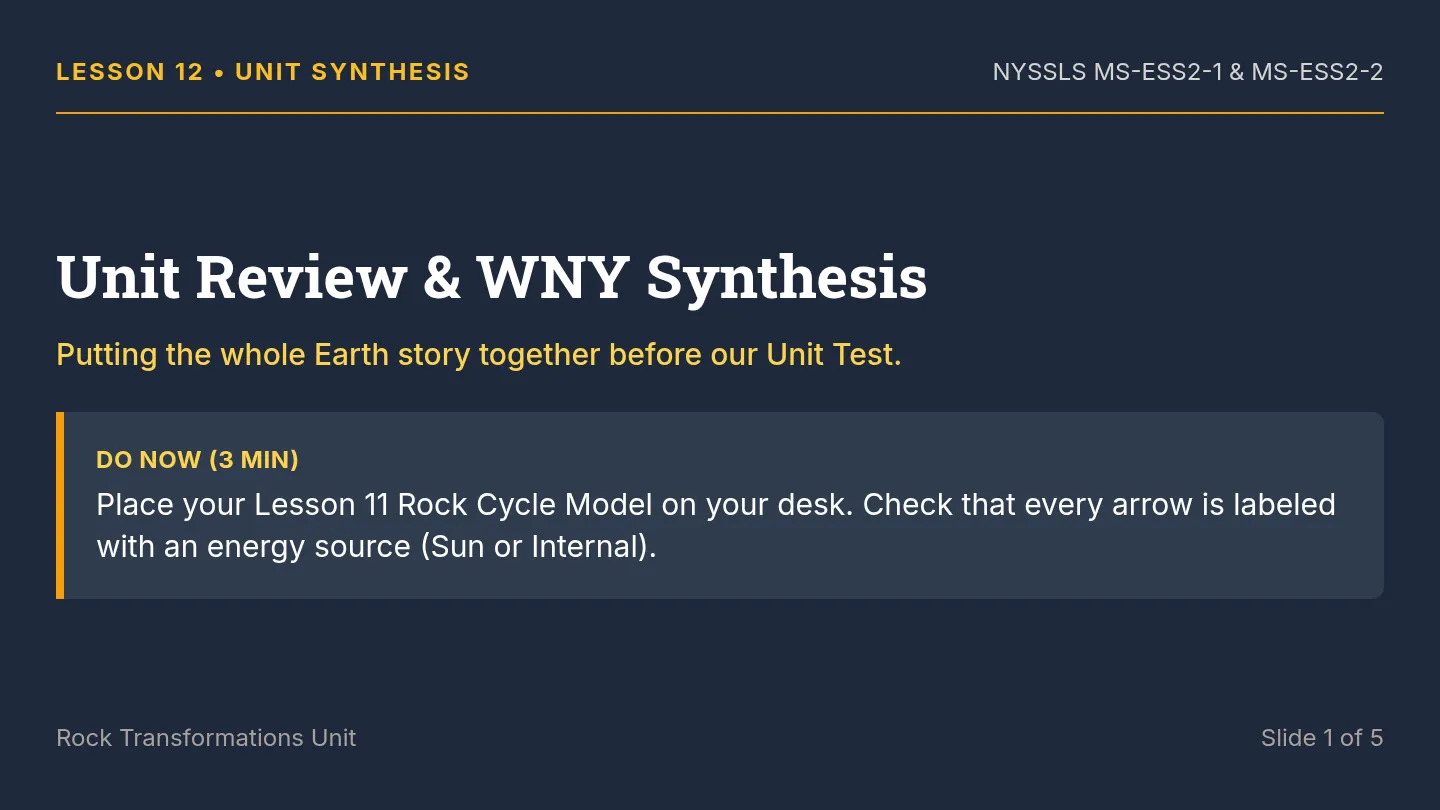
Unit Review Slides Lesson 12 • Unit Synthesis NYSSLS MS-ESS2-1 & MS-ESS2-2
Unit Review & WNY Synthesis
Putting the whole Earth story together before our Unit Test.
Do Now (3 min)
Place your Lesson 11 Rock Cycle Model on your desk. Check that every arrow is labeled with an energy source (Sun or Internal).
Rock Transformations Unit Slide 1 of 5
Gallery Walk Model Critique
Activity: 15 min
Visit 3 classmates’ models and check for:
✓ Are both Sun Energy and Internal Earth Energy shown?
✓ Does the model show non-linear pathways (not just a circle)?
✓ Are all 3 rock families (Igneous, Sedimentary, Metamorphic) accurate?
Leave 1 specific compliment + 1 helpful suggestion Slide 2 of 5
WNY Geology Team Challenge
8 min Synthesis
1. Lockport Quarry: Mechanical weathering
2. Buffalo Buildings: Chemical weathering
3. Lake Erie Waves: Erosion & deposition
4. WNY Bedrock & Erratics: Deep sedimentary layers + glacial granite
Connect each local phenomenon to its energy source Slide 3 of 5
Final Assessment Format
2 min Preview
• Part A: 6 Multiple Choice Questions
• Part B: Non-Linear Rock Cycle Model Analysis
• Part C: Western NY & Devils Tower Short Responses
• Part D: Final Claim — Evidence — Reasoning (CER)
30 minutes total tomorrow Slide 4 of 5
Homework & Test Prep
2 min Wrap-Up
Tonight’s Homework (HW 12)
Complete the Final Study Checklist and review your HW 11 Study Guide for tomorrow’s End-of-Unit Assessment!
Next Lesson: End-of-Unit Assessment Slide 5 of 5
WNY Synthesis Worksheet Name: ____________________________________ Class: _______ Date: ____/____/______
Lesson 12 • Unit Review & Synthesis
Gallery Walk & WNY Geology Synthesis
15 Min
Part 1: Gallery Walk Peer Critique
1 Strength I Saw in Classmates’ Models:
1 Revision to Improve My Own Model:
Part 2: Western NY Geology Synthesis Challenge
WNY Feature
Geologic Process(es)
Energy Source & Rock Type
Lockport Quarry
Buffalo Acid Rain
Lake Erie Waves
WNY Deep Bedrock
WNY Granite Erratics
Exit Check: What is one question you still want answered before tomorrow’s Unit Test?
Study Tonight Using HW 11 & HW 12! Lesson 12 Synthesis
Final Checklist Homework Name: ____________________________________ Class: _______ Date: ____/____/______
Homework 12 • Final Test Prep
End-of-Unit Study Checklist
HW 12
Check Off Each Skill After Reviewing Your Notes:
☐ I can distinguish Sun-driven surface processes from Internal Earth-driven processes.
☐ I can compare mechanical vs. chemical weathering with WNY examples (Lockport, Buffalo, Lake Erie).
☐ I can explain intrusive vs. extrusive igneous rocks using cooling rate, crystal size, & Devils Tower.
☐ I can explain how compaction and cementation form layered sedimentary rock (like WNY’s deep bedrock).
☐ I can explain how heat and pressure (without melting) form metamorphic rock.
☐ I can explain why the rock cycle is a non-linear web (not a circle) and why WNY is mostly sedimentary → sedimentary.
1. Quick-Fire Practice: Write 2 sentences explaining how energy transforms a sedimentary rock into a metamorphic rock, and then into an igneous rock.
2. Quick-Fire Practice: Write 2 sentences explaining why Western NY’s rock cycle looks different from a volcanic island like Hawaii.
End-of-Unit Assessment Tomorrow — You’ve Got This! HW 12
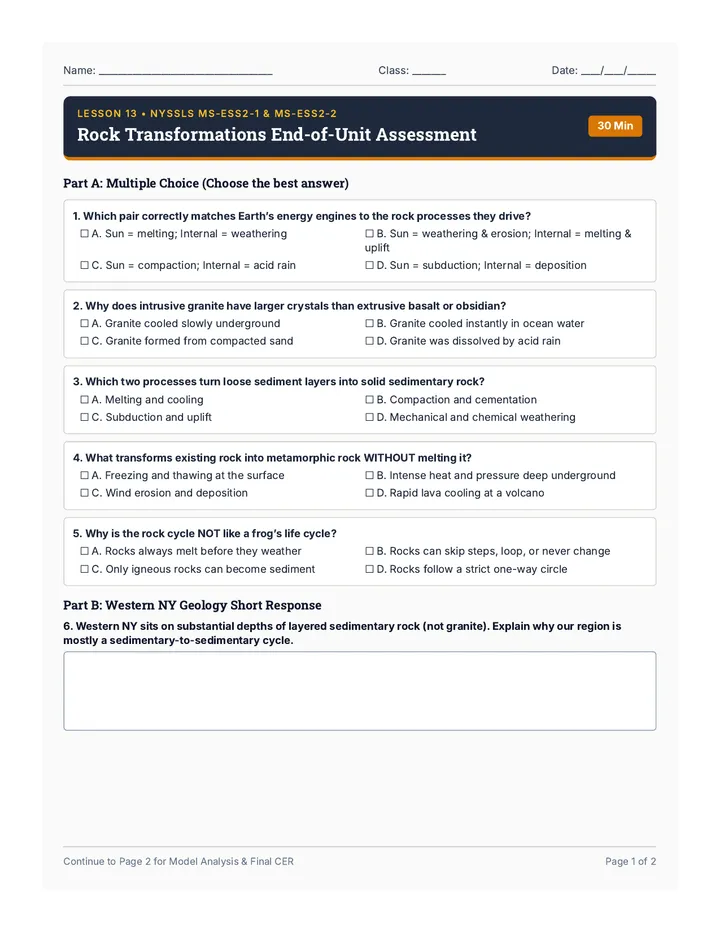
Unit Summative Assessment Name: ____________________________________ Class: _______ Date: ____/____/______
Lesson 13 • NYSSLS MS-ESS2-1 & MS-ESS2-2
Rock Transformations End-of-Unit Assessment
30 Min
Part A: Multiple Choice (Choose the best answer)
1. Which pair correctly matches Earth’s energy engines to the rock processes they drive?
☐ A. Sun = melting; Internal = weathering
☐ B. Sun = weathering & erosion; Internal = melting & uplift
☐ C. Sun = compaction; Internal = acid rain
☐ D. Sun = subduction; Internal = deposition
2. Why does intrusive granite have larger crystals than extrusive basalt or obsidian?
☐ A. Granite cooled slowly underground
☐ B. Granite cooled instantly in ocean water
☐ C. Granite formed from compacted sand
☐ D. Granite was dissolved by acid rain
3. Which two processes turn loose sediment layers into solid sedimentary rock?
☐ A. Melting and cooling
☐ B. Compaction and cementation
☐ C. Subduction and uplift
☐ D. Mechanical and chemical weathering
4. What transforms existing rock into metamorphic rock WITHOUT melting it?
☐ A. Freezing and thawing at the surface
☐ B. Intense heat and pressure deep underground
☐ C. Wind erosion and deposition
☐ D. Rapid lava cooling at a volcano
5. Why is the rock cycle NOT like a frog’s life cycle?
☐ A. Rocks always melt before they weather
☐ B. Rocks can skip steps, loop, or never change
☐ C. Only igneous rocks can become sediment
☐ D. Rocks follow a strict one-way circle
Part B: Western NY Geology Short Response
6. Western NY sits on substantial depths of layered sedimentary rock (not granite). Explain why our region is mostly a sedimentary-to-sedimentary cycle.
Continue to Page 2 for Model Analysis & Final CER Page 1 of 2
Part C: Devils Tower & Rock Pathways (MS-ESS2-2)
7. Devils Tower (Wyoming) is intrusive igneous rock standing tall above the plains, while deep granite elsewhere may never reach the surface. Explain what had to happen for Devils Tower to become exposed.
Part D: Final Claim — Evidence — Reasoning (MS-ESS2-1)
Prompt: Explain how Earth’s two energy engines drive the cycling of rock material in a non-linear web. Trace at least two different pathways a rock can take (or how it might stay unchanged).
Claim:
Evidence (Include specific rock types, processes, or local/case-study examples):
Reasoning (Connect Sun energy and Internal Earth energy to how matter cycles):
Check your answers before turning in your assessment! Page 2 of 2
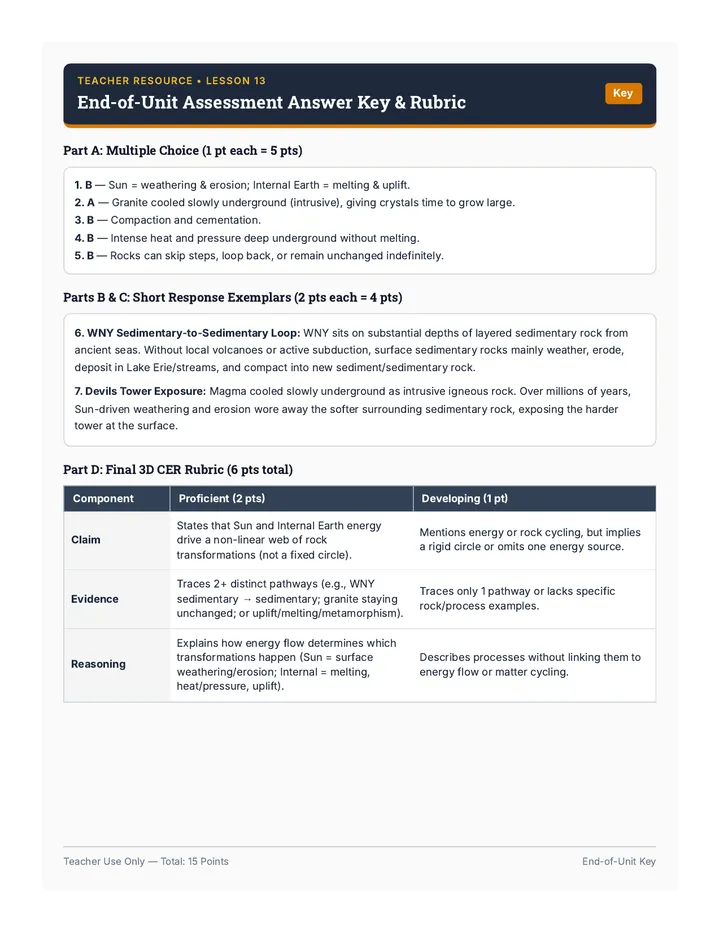
Unit Assessment Answer Key Teacher Resource • Lesson 13
End-of-Unit Assessment Answer Key & Rubric
Key
Part A: Multiple Choice (1 pt each = 5 pts)
1. B — Sun = weathering & erosion; Internal Earth = melting & uplift.
2. A — Granite cooled slowly underground (intrusive), giving crystals time to grow large.
3. B — Compaction and cementation.
4. B — Intense heat and pressure deep underground without melting.
5. B — Rocks can skip steps, loop back, or remain unchanged indefinitely.
Parts B & C: Short Response Exemplars (2 pts each = 4 pts)
6. WNY Sedimentary-to-Sedimentary Loop: WNY sits on substantial depths of layered sedimentary rock from ancient seas. Without local volcanoes or active subduction, surface sedimentary rocks mainly weather, erode, deposit in Lake Erie/streams, and compact into new sediment/sedimentary rock.
7. Devils Tower Exposure: Magma cooled slowly underground as intrusive igneous rock. Over millions of years, Sun-driven weathering and erosion wore away the softer surrounding sedimentary rock, exposing the harder tower at the surface.
Part D: Final 3D CER Rubric (6 pts total)
Component
Proficient (2 pts)
Developing (1 pt)
Claim
States that Sun and Internal Earth energy drive a non-linear web of rock transformations (not a fixed circle).
Mentions energy or rock cycling, but implies a rigid circle or omits one energy source.
Evidence
Traces 2+ distinct pathways (e.g., WNY sedimentary → sedimentary; granite staying unchanged; or uplift/melting/metamorphism).
Traces only 1 pathway or lacks specific rock/process examples.
Reasoning
Explains how energy flow determines which transformations happen (Sun = surface weathering/erosion; Internal = melting, heat/pressure, uplift).
Describes processes without linking them to energy flow or matter cycling.
Teacher Use Only — Total: 15 Points End-of-Unit Key