Light Sources Activity Grade 6 Science Lab • Energy & Light
Light Source Investigation
Name:
Date:
1. Natural Source
Made by nature. Stars, Sun, lightning, fireflies.
2. Artificial Source
Made by humans. Needs electrical or battery energy.
3. Reflected Object
Does not emit light. Only bounces light into our eyes.
Part 1: Test Room Objects (Does it make light or bounce light?)
Circle all that apply
Object Tested
Does it EMIT light?
Type of Light Maker
Can we see it in total darkness?
☀️ 1. The Sun
Yes, emits No, bounces
Natural Artificial
Yes No
🔦 2. Flashlight (On)
Yes, emits No, bounces
Natural Artificial
Yes No
🌕 3. The Moon
Yes, emits No, bounces
Natural Artificial
Yes No
📖 4. Science Textbook
Yes, emits No, bounces
Natural Artificial
Yes No
💻 5. Computer Screen
Yes, emits No, bounces
Natural Artificial
Yes No
Part 2: Grade 6 Science Model (How Light Travels to Our Eyes)
Number the steps 1, 2, and 3 in the correct order to show how you see a book on your desk:
Light bounces off the book cover.
A lamp gives off light energy.
Bounced light enters your eye so you see it.
Part 3: Scientific Explanation Questions
1. If you turn off all the lights in a room with no windows, can you see a cat? Why or why not?
No, because cats do not emit light and there is no light to bounce Yes, because cat eyes make their own bright light
2. Why is the Sun called our primary source of light energy on Earth?
It provides natural heat and light energy to our entire planet It runs on electricity made by power plants
3. Complete the scientific rule:
Light is a form of energy that travels through space until it hits matter.
☀️ Natural: Sun, Stars 💡 Artificial: Lamps, Screens 👁️ Vision: Light must enter the eye
Light Sources Worksheet Grade 6 Science Practice • Sources of Light
Classifying Light & Energy Sources
Name:
Date:
Word Bank (Write in Answer Column for #1–8)
☀️ Sun 🔦 Flashlight ✨ Stars 💡 Lightbulb ⚡ Lightning 🚥 Signal 🪲 Firefly 🕯️ Candle
A
Natural vs. Artificial Light (Questions 1–8)
Natural: Made by nature. Artificial: Made by humans with electricity or fuel.
Natural Light (Nature) Write 4 natural sources in box #1–4
Artificial Light (Human) Write 4 human-made sources in box #5–8
B
Emitter or Reflector? (Questions 9–12)
An emitter makes light waves. A reflector only bounces outside light.
9. 🌕 The Moon in the night sky Answer in #9 →
10. 🪞 Shiny bathroom mirror Answer in #10 →
11. 🚲 Red bike safety reflector Answer in #11 →
12. 🔥 Roaring campfire flame Answer in #12 →
C
Light Energy Concepts (Questions 13–15)
13. What energy turns into light in a flashlight? Choose [Chemical/Electric] or [Sound] in #13
14. Can light travel through outer space with no air? Choose [Yes] or [No] in #14
15. How fast does light travel? Choose [Fastest] or [Slow] in #15
★ MY ANSWERS ★ Write all answers here
Part A: Natural Sources
Part A: Artificial Sources
Part B: Circle E or R
Emitter Reflector
Emitter Reflector
Emitter Reflector
Emitter Reflector
Part C: Concepts
Electric Sound
Yes No
Fastest Slow
Total Score ____ / 15
Key Rule: We see objects because light reflects off them into our eyes. Without light energy, everything is completely dark!
Light Sources Answer Key Teacher Guide & SPED Scoring Key • Lesson 1
Light Sources Answer Key
TEACHER COPY
Key Misconception Alert (Moon & Mirror)
Many 6th graders think the Moon emits light like a lightbulb. Emphasize: the Moon is cold rock that only reflects sunlight. Same for mirrors!
1. Light Sources Activity (Lab Sheet Answers)
Part 1 Table & Part 2 Mechanism
☀️ Sun: Emits • Natural Visible in dark: Yes
🔦 Flashlight: Emits • Artificial Visible in dark: Yes
🌕 Moon: Bounces (Reflects) Visible in dark: No
📖 Textbook: Bounces (Reflects) Visible in dark: No
💻 Screen: Emits • Artificial Visible in dark: Yes
• Part 2 Vision Model Order: Order: 2, 1, 3 (1: Lamp gives light → 2: Bounces off book → 3: Enters eye)
• Part 3 Questions: 1. No, cats do not emit light and need light to bounce into eyes. | 2. Sun provides primary natural energy. | 3. Light is energy.
2. Light Sources Worksheet (Practice Sheet Answers)
Parts A, B, & C
Part A: Natural Bucket (4 items) The Sun • Distant Stars • Lightning Bolt • Firefly Part A: Artificial Bucket (4 items) Flashlight • LED Lightbulb • Traffic Signal • Wax Candle
Part B: Emitter vs. Reflector
1. Moon = Reflector
2. Bathroom Mirror = Reflector
3. Bike Safety Reflector = Reflector
4. Bonfire Flame = Emitter
Part C: Concept Solutions & Rule
1. Battery flashlight: Chemical & Electrical energy
2. Sunlight in empty space: Yes, light does not need air
3. Speed of light: Faster than anything in the universe (300,000 km/s)
Fill-in rule: We see objects because light reflects off them into our eyes.
Paraprofessional & IEP Prompting Guide
Level 1 (Visual Support): Have student shine a flashlight onto a book in a dark box to prove books need an outside light source to be seen.
Level 2 (Verbal Prompt): Ask: "Does the moon have batteries or flames?" (No → then it must be bouncing sunlight!).
Scoring: Lab Sheet (10 pts) Worksheet (10 pts) Total Mastery: 16/20 (80%)
Shadow Maker Activity Grade 6 Science Lab • Light Rays & Shadows
Shadow Geometry Investigation
Name:
Date:
🔦
Straight Light Rays Rule
Light travels in straight lines . Light cannot curve around solid obstacles. The blocked dark area is a shadow .
1
4 Variable Trials (Shine flashlight on object)
Perform each test and record your result in your Answer Column (#1–4) :
Trial 1: Move light CLOSER to object Object blocks more of the expanding beam
Record in #1 →
Trial 2: Move light FARTHER away Object blocks less of the light beam
Record in #2 →
Trial 3: Hold light LOW to side (Sunrise angle) Rays strike at a slanted low angle
Record in #3 →
Trial 4: Hold light DIRECTLY ABOVE (Noon sun) Rays strike straight down from top
Record in #4 →
2
Ray Diagram Analysis (Questions 5–6)
5. What outline shape does a shadow have? Choose [Same outline as object] or [Always round circle] in #5
6. Why is the center of a shadow dark? Choose [Solid matter stopped rays] or [Made cold dark waves] in #6
3
Space Connection: Solar Eclipse (Question 7)
During a solar eclipse, the Moon passes directly between the Sun and Earth.
7. What causes the daytime darkness on Earth? Choose [Moon blocks sun & casts shadow] or [Sun turns off] in #7
★ LAB ANSWERS ★ Record all results here
Part 1: Trial Results
1. Move Closer:
BIGGER SMALLER
2. Move Farther:
BIGGER SMALLER
3. Low Side Light:
LONG SHORT
4. Direct Overhead:
LONG SHORT
Part 2 & 3: Questions
5. Shadow Shape:
Same Outline Circle
6. Why Dark:
Rays Blocked Cold Waves
7. Solar Eclipse:
Moon Shadow Sun Off
Lab Rule:
• Light travels in lines.
• Closer light = shadow.
Lab Score ____ / 10
📐 Light travels in straight rays 🔍 Closer to light = BIGGER shadow 🌑 Solar Eclipse = Moon's shadow on Earth
Shadow Detective Worksheet Grade 6 Science Practice • Light & Shadows
Shadow Analysis & Sundial Science
Name:
Date:
A
Match Object to Shadow (Questions 1–4)
Look at each object and find its matching shadow description below. Write the letter (A, B, C, or D) in your Answer Column :
1. Pine Tree 🌲 Write in #1 →
2. Sitting Cat 🐈 Write in #2 →
3. Human Hand ✋ Write in #3 →
4. Coffee Mug ☕ Write in #4 →
[A] Five fingers & thumb outline
[B] Pointed evergreen tree shape
[C] Round cup with side handle
[D] Pointy ears & curved tail shape
B
Sundial Science: Sun & Shadow Direction (Questions 5–7)
Earth rotates, so the Sun moves across the sky. Shadows always point in the opposite direction of the Sun!
5. Morning (8:00 AM) • Sun is low in the EAST Which shadow forms? Choose in box #5
6. Midday (12:00 PM) • Sun is HIGH overhead What is shadow length at noon? Choose in box #6
7. Evening (5:00 PM) • Sun is low in the WEST Which direction does shadow point? Choose in box #7
C
Scientific Reasoning (Questions 8–10)
8. What kind of object casts the sharpest, darkest shadow? Opaque wood vs. Clear glass → Choose in #8
9. Why do shadow edges blur when far from a wall? Light rays spread out vs. Shadows melt → Choose in #9
10. How did people tell time using shadows before clocks? Sundials with pointers vs. Counting flashes → Choose in #10
★ MY ANSWERS ★ Record all answers here
Part A: Letters (A, B, C, D)
Part B: Sundial Science
5. Morning Shadow:
Points West Under Pole
6. Noon Shadow:
Shortest Longest
7. Evening Shadow:
Points East No Shadow
Part C: Science Questions
8. Sharpest Shadow:
Opaque Wood Clear Glass
9. Blurry Edge Reason:
Rays Spread Melt
10. Ancient Clocks:
Sundials Flashes
Total Score ____ / 10
☀️ Light travels in straight rays 📐 Low sun = LONG shadows ⏰ Noon sun = SHORT shadows
Shadow Chasers Answer Key Teacher Guide & SPED Scoring Key • Lesson 2
Shadow Chasers Answer Key
TEACHER COPY
Grade 6 Science Standard (Rectilinear Propagation)
Shadows exist because light travels in straight lines and cannot bend around solid obstacles. The shadow always falls directly opposite the light source.
1. Shadow Maker Activity (Lab Sheet Answers)
4 Trials & Solar Eclipse
Trial 1 (Closer): Shadow is BIGGER Blocks wider ray cone
Trial 2 (Farther): Shadow is SMALLER Blocks smaller ray angle
Trial 3 (Low Side Angle): Shadow is LONG Like sunrise/sunset
Trial 4 (Directly Above): Shadow is SHORT Like solar noon sun
• Part 2 Ray Analysis: A. Same outline shape as the blocking object | B. Solid matter stopped light rays from hitting there
• Part 3 Solar Eclipse: The Moon's solid body blocks sunlight and casts a giant shadow on Earth.
• Lab Wrap-Up Fill-in: Light travels in straight lines. Move closer to make shadow bigger.
2. Shadow Detective Worksheet (Practice Sheet Answers)
Parts A, B, & C
Part A: Silhouette Matching
1. Pine Tree 🌲 = Matches B (Pointed evergreen)
2. Sitting Cat 🐈 = Matches D (Pointy ears & tail)
3. Human Hand ✋ = Matches A (5 fingers outline)
4. Coffee Mug ☕ = Matches C (Round cup with handle)
Part B: Sundial Science
1. 8:00 AM (East Sun) = Long shadow pointing WEST
2. 12:00 PM (Noon Sun) = Shortest shadow of the day
3. 5:00 PM (West Sun) = Long shadow pointing EAST
Part C: Scientific Reasoning Questions
1. Darkest, sharpest shadow: A solid opaque wooden board (blocks 100% of light)
2. Blurry edges far from wall: Light spreads out as it travels (penumbra effect)
3. Ancient time-telling: They built sundials with pointers to track shadow movement
IEP Differentiation & Tactile Strategy
Hands-on Demonstration: Use a flashlight and a plastic dinosaur on butcher paper. Have students trace the dinosaur's shadow at 10 cm, then 30 cm, so they physically observe and measure the size change with a ruler.
Scoring: Lab Activity (10 pts) Worksheet (10 pts) Total Mastery: 16/20 (80%)
Beam Blockers Activity Grade 6 Science Lab • Transmission & Absorption
Light & Matter Testing Station
Name:
Date:
1. Transparent Transmits ALL Light Clear view, no dark shadow (Glass)
2. Translucent Transmits SOME Light Scatters rays, blurry view (Wax paper)
3. Opaque Blocks ALL Light Absorbs/reflects; makes shadow (Wood)
Part 1: Flashlight Testing Lab (Shine light through each sample)
Circle result for each item
Material Sample
How Much Light Transmits?
Scientific Classification
🥣 1. Clear Plastic Film
All Light Some Light No Light
Transparent Translucent Opaque
🕯️ 2. Wax Paper Sheet
All Light Some Light No Light
Transparent Translucent Opaque
📦 3. Thick Cardboard
All Light Some Light No Light
Transparent Translucent Opaque
📄 4. White Copy Paper
All Light Some Light No Light
Transparent Translucent Opaque
✨ 5. Shiny Aluminum Foil
All Light Some Light No Light
Transparent Translucent Opaque
💧 6. Clear Glass of Water
All Light Some Light No Light
Transparent Translucent Opaque
Part 2: What Happens to Blocked Light? (Light Energy to Heat Energy)
1. When black opaque paper blocks light rays, what happens to the energy?
It is absorbed and turns into heat It disappears forever
2. Why does shiny aluminum foil stay cooler in sunlight than black cardboard?
Foil reflects light rays away Foil eats the sunlight
Part 3: Engineer Application Questions
A. Best for car windshield:
Transparent glass (Driver sees road clearly) Opaque wood (Blocks all sunlight)
B. Best for bathroom window privacy:
Translucent frosted glass (Lets light in, blurs view) Clear transparent wrap (Everyone sees inside)
🔍 Transparent = Transmits Light ☁️ Translucent = Scatters Light 🧱 Opaque = Absorbs/Reflects Light
Beam Blockers Worksheet Grade 6 Science Practice • Matter & Light
Transmission, Scattering & Absorption
Name:
Date:
TRANSPARENT Transmits clear rays
TRANSLUCENT Scatters light rays
OPAQUE Blocks all light
A
Classify Everyday Materials (Questions 1–6)
Read each material description below. Choose your answer in your Answer Column (#1–6) :
1. 🥽 Science Safety Goggles (See clear view) Answer in #1 →
2. 🚪 Solid Oak Classroom Door (Cannot see through) Answer in #2 →
3. 🕶️ Tinted Sunglasses (Dims glare, partial rays) Answer in #3 →
4. 🧱 Heavy Brick Wall (Completely stops all rays) Answer in #4 →
5. 💡 Frosted Glass Lampshade (Soft glowing blur) Answer in #5 →
6. 🫙 Clear Glass Fish Tank (Allows sunlight inside) Answer in #6 →
B
Science Scenarios (Questions 7–9)
7. Tomato Greenhouse Roof: Plants need direct light energy. Choose material in #7
8. Dentist Opaque Lead Apron: Why wear lead during X-rays? Choose reason in #8
9. Why do opaque objects make shadows? Straight light rays cannot curve around. Choose in #9
C
Wave Rules (Questions 10–12)
Choose: Transmits • Scatters • Absorbs
• 10. Clear water ____________ light rays without distortion.
• 11. Wax paper ____________ light rays in random directions.
• 12. Black asphalt road ____________ light rays and heats up.
★ MY ANSWERS ★ Record all answers here
Part A: Circle Material Type
1. Goggles:
Transparent Translucent Opaque
2. Oak Door:
Transparent Translucent Opaque
3. Sunglasses:
Transparent Translucent Opaque
4. Brick Wall:
Transparent Translucent Opaque
5. Lampshade:
Transparent Translucent Opaque
6. Fish Tank:
Transparent Translucent Opaque
Part B: Scenarios
7. Greenhouse:
Clear Glass Wood
8. Lead Apron:
Blocks Rays Lets Thru
9. Shadow Cause:
Straight Rays Eats Air
Part C: Rules
[Transmits]
Total Score ____ / 12
1. Transparent: 100% Light Transmitted 2. Translucent: Partial Light Scattered 3. Opaque: 0% Light Transmitted
Beam Blockers Answer Key Teacher Guide & SPED Scoring Key • Lesson 3
Beam Blockers Answer Key
TEACHER COPY
Grade 6 Science Standard (MS-PS4-2 Wave Interaction)
When light hits matter, it can be transmitted (passes through), absorbed (converted to thermal energy/heat), or reflected (bounces away).
1. Beam Blockers Activity (Lab Sheet Answers)
6 Material Samples & Thermal Energy
1. Clear Plastic Film: All Light Transmitted Transparent
2. Wax Paper Sheet: Some Light Transmitted Translucent
3. Thick Cardboard: No Light Transmitted Opaque
4. White Copy Paper: Some Light Transmitted Translucent
5. Aluminum Foil: No Light Transmitted Opaque (Reflective)
6. Glass of Water: All Light Transmitted Transparent
• Part 2 Absorption & Heat: 1. Blocked light energy is absorbed and turns into heat (thermal energy). | 2. Foil stays cooler because it reflects light rays away.
• Part 3 Engineer Questions: A. Car windshield: Transparent glass | B. Bathroom privacy: Translucent frosted glass
2. Beam Blockers Worksheet (Practice Sheet Answers)
Parts A, B, & C
Part A: 6 Object Classifications
1. Safety Goggles = Transparent
2. Solid Oak Door = Opaque
3. Tinted Sunglasses = Translucent
4. Heavy Brick Wall = Opaque
5. Frosted Lampshade = Translucent
6. Glass Fish Tank = Transparent
Part B: Engineering Scenarios
1. Tomato Greenhouse = Transparent glass (direct light energy)
2. Dentist Lead Apron = Opaque lead blocks high-energy rays
3. Shadow Cause = Straight light rays cannot curve around matter
Part C: Wave Interaction Fill-in Rules
1. Clear water transmits light waves without distortion. | 2. Wax paper scatters light waves. | 3. Black asphalt road absorbs light waves and warms up.
Sensory & Hands-On Confirmation
Have students hold a sheet of black construction paper and a sheet of white paper under a desk lamp for 2 minutes, then touch both with their palms. The black paper feels noticeably warmer, demonstrating that absorbed light transforms into heat energy!
Scoring: Lab Testing (10 pts) Practice Sheet (10 pts) Total Mastery: 16/20 (80%)
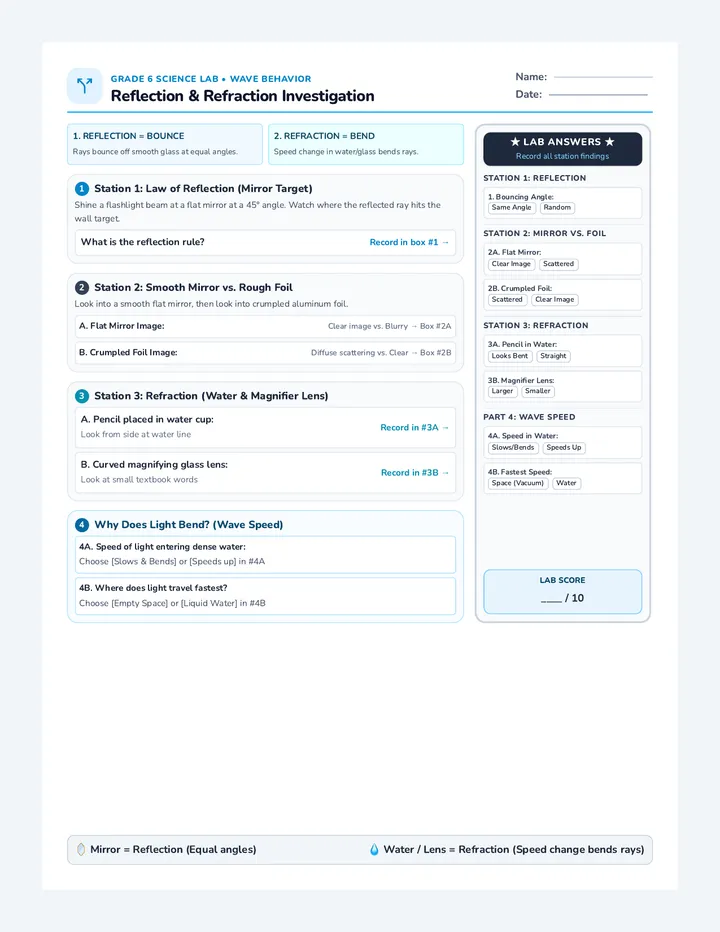
Bouncing Beams Activity Grade 6 Science Lab • Wave Behavior
Reflection & Refraction Investigation
Name:
Date:
1. REFLECTION = BOUNCE Rays bounce off smooth glass at equal angles.
2. REFRACTION = BEND Speed change in water/glass bends rays.
1
Station 1: Law of Reflection (Mirror Target)
Shine a flashlight beam at a flat mirror at a 45° angle. Watch where the reflected ray hits the wall target.
What is the reflection rule? Record in box #1 →
2
Station 2: Smooth Mirror vs. Rough Foil
Look into a smooth flat mirror, then look into crumpled aluminum foil.
A. Flat Mirror Image: Clear image vs. Blurry → Box #2A
B. Crumpled Foil Image: Diffuse scattering vs. Clear → Box #2B
3
Station 3: Refraction (Water & Magnifier Lens)
A. Pencil placed in water cup: Look from side at water line
Record in #3A →
B. Curved magnifying glass lens: Look at small textbook words
Record in #3B →
4
Why Does Light Bend? (Wave Speed)
4A. Speed of light entering dense water: Choose [Slows & Bends] or [Speeds up] in #4A
4B. Where does light travel fastest? Choose [Empty Space] or [Liquid Water] in #4B
★ LAB ANSWERS ★ Record all station findings
Station 1: Reflection
1. Bouncing Angle:
Same Angle Random
Station 2: Mirror vs. Foil
2A. Flat Mirror:
Clear Image Scattered
2B. Crumpled Foil:
Scattered Clear Image
Station 3: Refraction
3A. Pencil in Water:
Looks Bent Straight
3B. Magnifier Lens:
Larger Smaller
Part 4: Wave Speed
4A. Speed in Water:
Slows/Bends Speeds Up
4B. Fastest Speed:
Space (Vacuum) Water
Lab Score ____ / 10
🪞 Mirror = Reflection (Equal angles) 💧 Water / Lens = Refraction (Speed change bends rays)
Bouncing Beams Worksheet Grade 6 Science Practice • Wave Behavior
Reflection, Refraction & Lenses
Name:
Date:
🪞
REFLECTION = BOUNCE Light rays bounce off smooth mirrors.
🔍
REFRACTION = BEND Speed change in water or glass bends rays.
A
Classify Everyday Light Events (Questions 1–6)
Determine if light is bouncing (Reflection) or bending (Refraction). Record answers in your Answer Column :
1. Dentist mouth mirror checking back teeth Answer in #1 →
2. Reading glasses focusing tiny book words Answer in #2 →
3. Calm lake showing upside-down mountain sky Answer in #3 →
4. Rainbow forming when raindrops split sunlight Answer in #4 →
5. Submarine periscope viewing above ocean Answer in #5 →
6. Fish in tank looking shifted to the side Answer in #6 →
B
Science Truth Check (Questions 7–10)
7. Law of Reflection: Light rays bounce off at the exact same angle they hit. Choose in #7
8. Refraction Speed Rule: Light travels at the exact same speed in all matter. Choose in #8
9. Optical Lenses: Microscopes use curved glass lenses that refract light. Choose in #9
10. Rough Surfaces: Bumpy surfaces reflect light cleanly so you see your face. Choose in #10
C
Unit Science Rules (Questions 11–13)
Use Word Bank: straight • bounces • bends
• 11. Light normally travels in ____________ lines.
• 12. When light hits a mirror, it ____________ off (reflection).
• 13. When light enters water, it ____________ (refraction).
★ MY ANSWERS ★ Record all answers here
Part A: Reflection or Refraction
1. Mouth Mirror:
Reflection Refraction
2. Glasses:
Reflection Refraction
3. Lake Sky:
Reflection Refraction
4. Rainbow:
Reflection Refraction
5. Periscope:
Reflection Refraction
6. Tank Fish:
Reflection Refraction
Part B: True or False
T F
T F
T F
T F
Part C: Rules
[straight]
Total Score ____ / 13
🏆
Unit Master • Light and Matter Mastered: Sources, Shadows, Transmission, Absorption, Reflection, & Refraction!
Teacher Check:
Bouncing Beams Answer Key Teacher Guide & SPED Scoring Key • Lesson 4
Bouncing Beams Answer Key
TEACHER COPY
Grade 6 Science Standard (Reflection vs. Refraction)
Reflection: Light rays bounce off at equal angles (Law of Reflection).Refraction: Light waves change speed when moving into a different medium (air → water/glass), causing rays to bend.
1. Bouncing Beams Activity (Lab Sheet Answers)
3 Stations & Wave Speed
Station 1 (Mirror Target): Law of Reflection Bounces off at same angle (Angle in = Angle out)
Station 2 (Smooth vs. Rough): Diffuse vs. Specular Mirror = parallel rays; Foil = scattered rays
Station 3 (Water & Lens): Refraction / Bending Pencil looks bent; lens magnifies letters
• Part 4 Why Light Bends: 1. Speed of light in dense water: It slows down and bends. | 2. Faster in vacuum or water: Faster in empty space (vacuum has no particles to slow it down).
2. Bouncing Beams Worksheet (Practice Sheet Answers)
Parts A, B, & C
Part A: 6 Real-World Events
1. Dentist mouth mirror = Reflection
2. Reading glasses = Refraction
3. Calm lake reflection = Reflection
4. Rainbow in raindrops = Refraction
5. Submarine periscope = Reflection
6. Displaced fish in tank = Refraction
Part B: True or False Check
1. Light bounces at same angle = TRUE
2. Light travels same speed in all matter = FALSE (slows in water/glass)
3. Microscopes use curved lenses = TRUE
4. Rough surfaces give clear reflection = FALSE (scatters rays)
Part C: Scientific Vocabulary Fill-in
1. Light travels in straight lines. | 2. Smooth mirror bounces light (reflection). | 3. Water/glass bends light (refraction).
Overall Unit Mastery Criteria (SPED IEP Goal)
Target Goal: Student accurately differentiates between light emission vs. reflection, straight-line shadow formation, transparent/translucent/opaque transmission, and reflection vs. refraction with 80% accuracy on modified assessments.
Scoring: Lab Stations (10 pts) Practice Sheet (10 pts) Total Mastery: 16/20 (80%)