Kelp Forest Video Slides Science & Language Video Study
ELD Level IV Focus
The Kelp Forest
Underwater Kingdom
Discover how giant kelp anatomy works, watch the video, and master two key science questions.
Watch 4-Minute Video • Illustrated Kelp Anatomy
Slide 1 of 5
Watch & Listen
Focus on the gas bladders and how otters protect kelp
Run Time: ~4 Mins
Embedded media
Viewing Clue: Look closely at the yellow-green bulbs that keep giant kelp blades floating toward sunlight!
Slide 2 of 5
Question 1 of 2
Kelp Anatomy: Bulbs, Bladders & Blades
Slide 3 of 5
SUNLIT OCEAN SURFACE BLADES BULB / GAS BLADDER HOLDFAST
How do the bulbs (gas bladders) help the blades reach sunlight?
Bulbs / Gas Bladders
Hollow, air-filled bulbs that act like balloons to float kelp upward.
Blades (Fronds)
Wide leaves that catch sunlight to make food for the kelp.
Speaking Frame: "The gas bulbs fill with air and float the blades toward the surface."
Find these parts on your student worksheet!
Slide 3 of 5
Question 2 of 2
Otters, Urchins & Kelp
Slide 4 of 5
What happens to the kelp forest when sea otters disappear?
With Sea Otters
Otters eat sea urchins and keep their numbers small.
Result: Giant kelp grows tall and protects fish and marine life.
Without Sea Otters
Sea urchins multiply rapidly and eat all the kelp holdfasts.
Result: The kelp forest is destroyed, creating an empty "urchin barren."
Speaking Frame: "When otters disappear, urchins multiply and eat the kelp."
Partner Practice
Share Your Complete Sentences
Slide 5 of 5
Target Science Vocabulary:
Giant Kelp
Gas Bladders
Blades
Sea Otters
Read your answers aloud with your partner:
1. "Giant kelp floats toward sunlight because gas bladders lift the blades ."
2. "Without sea otters, sea urchins eat all the kelp and destroy the habitat."
Check your written worksheet before turning it in!
Slide 5 of 5
Kelp Forest Viewing Worksheet Kelp Forest Video Guide
ELD Level IV
Study the diagram, watch the video, and answer the two questions.
Name:
Date:
Vocabulary & Kelp Anatomy Diagram
WATER SURFACE (SUNLIGHT) 1. BLADE 2. BULB / GAS BLADDER 3. HOLDFAST
Bulb (Gas Bladder):
A round, hollow air bulb filled with gas. It acts like a float or balloon that lifts the kelp blades up toward the sunlight.
Blades (Fronds):
The wide, leaf-like parts of the kelp. They catch sunlight and make food for the plant through photosynthesis.
Holdfast:
The strong, root-like anchor that grips onto rocks so ocean currents do not sweep the giant kelp away.
Question 1
How do the bulbs (gas bladders) help giant kelp reach sunlight?
Part A: Select the correct statement:
A. The bulbs are heavy stones that push the kelp into dark sea caves.
B. The gas bulbs fill with air and float the wide blades up toward the sunny surface.
C. The bulbs dig into deep soil to search for underground fresh water.
D. The bulbs attract fish that pull the plant up to the dry beach.
Part B: Complete the sentence using the frame:
Sentence Frame: Giant kelp reaches sunlight because the gas bulbs ____________________________.
Question 2
What happens to the kelp forest when sea otters disappear?
Cause & Effect: Sea otters eat sea urchins. Without otters, urchins multiply and eat through the kelp holdfasts!
Explain what happens using the sentence frame:
Sentence Frame: When sea otters disappear, sea urchins __________, and they eat the kelp until __________.
Kelp Forest Kingdom • ELD IV Comprehension Worksheet Check: Did you write in complete sentences?
Kelp Forest Teacher Key Kelp Forest Teacher Key
Answer Key & Guide
Instructional guide, exemplar responses, and ELD IV language criteria.
NGSS: MS-LS2-2
ELD Level IV (Expanding/Bridging)
Vocabulary & Diagram Solutions
Bulbs (Gas Bladders)
Air bulbs providing positive buoyancy to keep kelp upright toward surface sunlight.
Blades (Fronds)
Photosynthetic tissue capturing solar energy and absorbing water nutrients.
Holdfast Anchor
Secures kelp to rocky seabed; does not absorb nutrients like terrestrial plant roots.
Question 1 Key
How do bulbs (gas bladders) help kelp reach sunlight?
Correct Answer: B
Part A Explanation: Option B is correct. Giant kelp lacks woody cellulose stems; gas-filled pneumatocysts lift the blades upward.
Model Student Responses (Part B Sentence Frame):
Target Response: "Giant kelp reaches sunlight because the gas bulbs fill with air and lift the blades up to the ocean surface."
Acceptable Variation: "Giant kelp reaches sunlight because the gas bulbs float like balloons toward the sun."
Question 2 Key
What happens when sea otters disappear?
Trophic Cascade Concept
Model Student Responses (Sentence Frame):
Target Response: "When sea otters disappear, sea urchins multiply rapidly / grow out of control, and they eat the kelp until the entire forest is destroyed and turns into an urchin barren."
Acceptable Variation: "When sea otters disappear, sea urchins overpopulate, and they eat the kelp until all the plants die and the animals leave."
Common Misconception: Students may think urchins eat otters, or that kelp dies of old age. Remind students that otters are the predators that keep urchin populations small and protect the kelp.
ELD IV (Expanding / Bridging) Scoring Guide
3 - Advanced (Bridging)
Uses complete sentences with accurate scientific vocabulary (bladders, blades, urchins) and explains cause-and-effect clearly.
2 - Proficient (Expanding)
Completes the sentence frame with correct ideas; minor spelling or grammar errors do not impede understanding.
1 - Developing
Needs teacher or partner prompting to connect otters, urchins, and kelp, or produces isolated words.
Kelp Forest Kingdom • Teacher Answer Key & Guide Classroom & Sub-Ready Resource
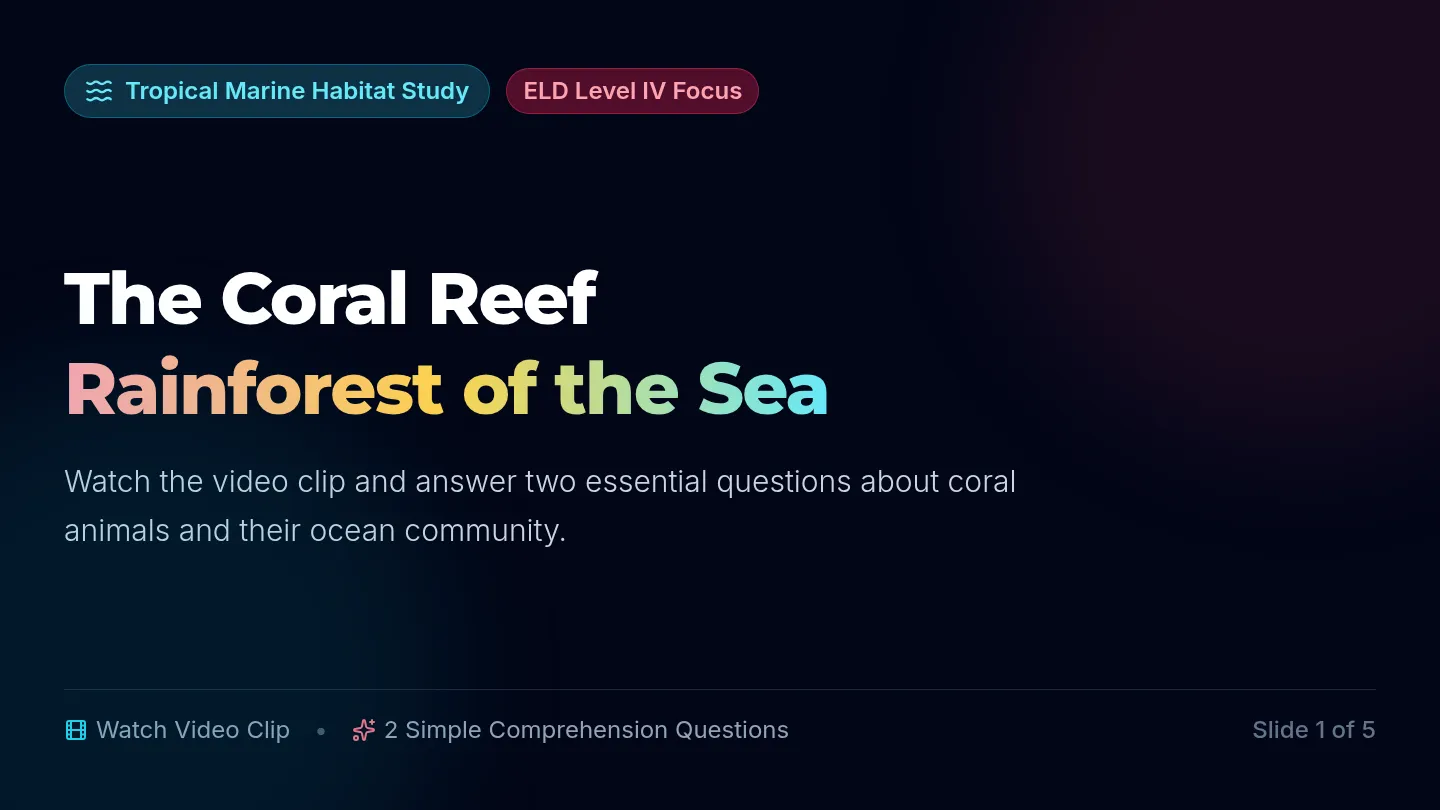
Coral Reef Video Slides Tropical Marine Habitat Study
ELD Level IV Focus
The Coral Reef
Rainforest of the Sea
Watch the video clip and answer two essential questions about coral animals and their ocean community.
Watch Video Clip • 2 Simple Comprehension Questions
Slide 1 of 5
Watch & Listen
Look for what coral polyps are and why fish need reefs
Run Time: ~4 Mins
Embedded media
Viewing Clue: Are corals rocks, plants, or animals? Watch how tiny animals build huge underwater structures!
Slide 2 of 5
Question 1 of 2
What is Coral? Polyps & Algae
Slide 3 of 5
TROPICAL SUNLIGHT LIMESTONE CUP TENTACLES TINY ALGAE (MAKES FOOD) HARD SKELETON
What is coral, and how do tiny algae help coral animals survive?
Coral Polyp
A tiny soft animal with tentacles that builds a hard rock skeleton.
Tiny Algae (Partners)
Plant-like algae live inside coral and make food using sunlight.
Speaking Frame: "Coral is a tiny animal, and tiny algae live inside to make food from sunlight."
Corals are living animals, not rocks!
Slide 3 of 5
Question 2 of 2
Rainforest of the Sea
Slide 4 of 5
Why are coral reefs called the "rainforests of the sea"?
Home & Shelter
Reefs cover less than 1% of the ocean floor, but provide shelter for 25% of all ocean life .
Examples: Clownfish, sea turtles, sharks, crabs, and sea stars all rely on reefs.
Protection for Coasts
Just like tropical rainforests protect land, coral reefs protect coastlines from large ocean storm waves.
Result: Healthy reefs prevent coastal flooding and erosion.
Speaking Frame: "Coral reefs are called rainforests of the sea because they provide shelter and food for thousands of marine animals."
Partner Practice
Share Your Complete Sentences
Slide 5 of 5
Target Science Vocabulary:
Coral Polyp
Tiny Algae
Limestone
Biodiversity
Practice reading your sentences aloud with a partner:
1. "Coral is an animal called a polyp , and tiny algae provide its food."
2. "Reefs are like rainforests because they give food and shelter to thousands of ocean animals ."
Check your written worksheet before turning it in!
Slide 5 of 5
Coral Reef Viewing Worksheet Coral Reef Video Guide
ELD Level IV
Study the polyp diagram, watch the video, and answer the two questions.
Name:
Date:
Vocabulary & Coral Polyp Anatomy Diagram
TROPICAL SUNLIGHT TENTACLES TINY ALGAE (FOOD MAKER) HARD SKELETON
Coral Polyp:
A tiny soft animal (related to jellyfish) with stinging tentacles that catches food and builds a hard rock shell.
Tiny Algae (Zooxanthellae):
Plant-like algae living safely inside the polyp. They absorb tropical sunlight to make sugar and food for the coral.
Limestone Skeleton:
The hard calcium cup built beneath each polyp. Over thousands of years, billions of polyps form gigantic reefs.
Question 1
What kind of organism is coral, and how does it get food?
Part A: Select the correct statement:
A. Coral is a non-living rock that grows by absorbing ocean salt.
B. Coral is a living animal, and tiny algae inside it use sunlight to make food.
C. Coral is a land plant that fell into the ocean during rainstorms.
D. Coral only eats sand from the bottom of the tropical seafloor.
Part B: Complete the sentence using the frame:
Sentence Frame: Coral is a living animal called a polyp, and it gets food from ______________________.
Question 2
Why are coral reefs called the "rainforests of the sea"?
Key Fact: Although reefs cover less than 1% of the ocean, they provide food and shelter for 25% of all marine species!
Explain what happens using the sentence frame:
Sentence Frame: Coral reefs are called the rainforests of the sea because they provide __________________.
Coral Reef Wonders • ELD IV Comprehension Worksheet Check: Did you write in complete sentences?
Coral Reef Teacher Key Coral Reef Teacher Key
Answer Key & Guide
Instructional guide, exemplar responses, and ELD IV language criteria.
NGSS: MS-LS2-2
ELD Level IV (Expanding/Bridging)
Vocabulary & Diagram Solutions
Coral Polyp
Invertebrate animal with tentacles; secretes a limestone cup to form colonial reefs.
Zooxanthellae (Algae)
Symbiotic algae that provide up to 90% of the polyp's energy via photosynthesis.
Limestone Skeleton
Calcium carbonate substrate that creates massive 3D architecture for marine life.
Question 1 Key
What organism is coral, and how does it get food?
Correct Answer: B
Part A Explanation: Option B is correct. Corals are cnidarian animals (related to sea anemones and jellyfish) that rely on endosymbiotic algae for photosynthetic nutrition.
Model Student Responses (Part B Sentence Frame):
Target Response: "Coral is a living animal called a polyp, and it gets food from tiny algae living inside it that turn sunlight into sugars."
Acceptable Variation: "Coral is a living animal called a polyp, and it gets food from microscopic algae that use sunlight."
Question 2 Key
Why are reefs called the "rainforests of the sea"?
Biodiversity Concept
Model Student Responses (Sentence Frame):
Target Response: "Coral reefs are called the rainforests of the sea because they provide food, nursery habitats, and shelter for thousands of diverse ocean species."
Acceptable Variation: "Coral reefs are called the rainforests of the sea because they provide safe homes for one quarter of all ocean animals."
Common Misconception: Students often classify coral as plants (because they branch and don't walk) or rocks (because they feel hard). Emphasize that living coral is an animal colony building a mineral home.
ELD IV (Expanding / Bridging) Scoring Guide
3 - Advanced (Bridging)
Accurately uses terms (polyp, algae, shelter) in complete academic sentences to explain symbiosis and biodiversity.
2 - Proficient (Expanding)
Correctly fills in sentence frames; minor grammatical flaws do not obscure the core scientific meaning.
1 - Developing
Requires teacher scaffolding to identify that coral is an animal or struggles to connect reefs to shelter.
Coral Reef Wonders • Teacher Answer Key & Guide Classroom & Sub-Ready Resource