Ice Melt Detectives Lesson Plan Teacher Guide NGSS K-PS3-1 & K-PS3-2
Ice Melt Detectives Lesson Plan
Grade Level: K - 2nd
Duration: 45 - 55 Minutes
Focus: Sunlight & Heat Energy
Core Objective
Students will observe, record, and compare the melting rates of ice cubes placed in direct sunlight versus under shade to demonstrate that sunlight warms Earth's surfaces.
NGSS Dimensions
SEP: Planning & Carrying Out InvestigationsDCI: PS3.B Conservation & Energy TransferCCC: Cause and Effect
Materials (Per Pair)
• 2 identical ice cubes
Investigation Prep & Safety
Outdoor/Window Scouting: Select a sunny asphalt/sidewalk patch and an adjacent shaded area (under a tree, building awning, or desk cardboard canopy).
Ice Uniformity: Keep ice cubes stored in an insulated cooler. Ensure both test cubes start at identical sizes and are placed simultaneously.
Step-by-Step Instructional Plan (Part 1)
Phase 1: Engage — The Warmth Mystery
10 Minutes
Take students outside or have them feel two surfaces: one in bright sunshine and one in the shade (or sunny windowsill vs inside room). Ask: "How does your skin feel in the sun? Why is the shade cooler?" Introduce the inquiry question: Does the sun give off enough energy to melt things faster?
Script Prompt: "Today, we are Ice Melt Detectives! We have two identical ice cubes. One will sit under the blazing sun, and one will hide in the cool shade. What will happen?"
Phase 2: Explore — Setting Up The Melt Race
15 Minutes
Distribute the Ice Melt Detectives Activity Sheet . Guide student pairs through their hypothesis:
Have students circle their prediction: Will the ice melt faster in the SUN or the SHADE ?
Give each team two dark paper plates labeled A (Sun) and B (Shade) .
Place Plate A directly under bright sunshine and Plate B directly under the shade canopy.
Simultaneously deliver two identical ice cubes onto the plates and start the timer.
Unit: Weather and Climate • Energy from the Sun Page 1 of 2 • Continue to Explanation & Differentiation
Ice Melt Detectives: Discussion, Extensions & Differentiation
Part 2 Facilitation
Phase 3: Explain — Drawing Evidence & Scientific Consensus
10 Minutes
At 10 minutes and 20 minutes, call students to observe both plates. Prompt them to record careful sketches in their Before and After observation boxes.
Key Question 1: "Look closely at Plate A (Sun). What do you see around the cube? Why is there a big puddle while Plate B still has a solid block?"
Key Concept to Reinforce: Sunlight carries heat energy . When sunlight hits surfaces (like the plate and ice), it warms them up. Shade blocks the sunlight!
Phase 4: Elaborate — Shade Engineering (NGSS K-PS3-2)
10 Minutes
Challenge students: "Animals and people get too hot in direct sun! How do we protect them?" Have students identify or construct mini shade canopies using cups, cardboard scraps, or leaves to see which structure protects the ice longest.
Phase 5: Evaluate — Exit Ticket & Quick Formative Check
5 Minutes
Distribute the Ice Melt Detectives Exit Ticket . Students identify where an ice cube melts slowest/fastest and explain why park benches under shade trees feel cooler in summer.
Common Misconceptions
Misconception: "Shade makes things cold like a freezer."
Misconception: "Air temperature is the only thing that melts ice."
Differentiation & Support
For Emerging Scientists (ELL / IEP): Use visual sentence starters: "The ice in the sun became a ______ (puddle/cube)." Allow drawing-first documentation.
For Advanced Learners: Introduce a thermometer or digital infrared temp gun to record the actual surface temperature of the sunny plate vs shaded plate.
Student Mastery Look-Fors
1. Observational Drawings
Accurately shows ice shrinking into liquid water faster under the sun than under the shade structure.
2. Cause-and-Effect Link
Identifies sunlight as the cause of warming/faster melting, and shade as a barrier blocking sunlight.
3. Real-World Transfer
Explains why animals, playgrounds, or humans seek shade when the sun feels hot on Earth's surface.
NGSS Primary Science Series • Ice Melt Detectives Page 2 of 2 • Teacher Facilitation Complete
Ice Melt Detectives Activity Sheet Young Scientist Lab Log
Ice Melt Detectives: Sun vs. Shade
Melting Lab
Detective Name:
Date:
Lab Partner:
1 Make a Prediction: Which ice cube will melt faster?
Look at the two spots for our experiment. Circle the picture you predict will melt into water first:
Direct Sunlight
Plate A sits right in the bright sun
Under the Shade
Plate B is blocked from the sun
My Reason: I think this will melt faster because:
2 Scientific Observation: BEFORE The Timer Starts (0 Minutes)
Draw exactly what each ice cube looks like right now!
Plate A: In Direct Sunlight Before
Draw Plate A ice cube and labels here
Solid ice cube Dry plate
Plate B: Under the Shade Before
Draw Plate B ice cube and shade canopy here
Solid ice cube Dry plate
Start the timer! Do not touch or move the plates during the melt race. Page 1 of 2 • Turn page for results
Lab Results: Melting In Action
20-Minute Melt Check
10-Minute Check: Which cube is creating water drops first?
Plate A (Sun) Plate B (Shade)
3 Final Observation: AFTER 20 Minutes
Draw the size of the ice and any water puddles on each plate!
Plate A: Sunlight (After) Final
Draw the melted puddle and any remaining ice here
What is on Plate A now? (circle): Water Puddle / Big Ice Cube
Plate B: Shade (After) Final
Draw the shaded ice cube and small puddle here
What is on Plate B now? (circle): Water Puddle / Big Ice Cube
4 Detective Findings & Earth Science Claim
1. Which ice cube melted faster?
The ice in the direct SUN The ice under the SHADE
2. Complete the science sentence (circle the correct word):
Sunlight gave off heat energy and made the plate WARMER / COOLER , which made the ice cube melt FASTER / SLOWER .
3. Detective Thinking:
Why do people open umbrellas or sit under big leafy trees on hot summer days?
Investigating Earth's Surface Warmth • NGSS K-PS3-1 Lab Investigation Complete!
Ice Melt Detectives Exit Ticket Quick Check
Ice Melt Detectives Exit Ticket
Name:
Date:
1. Where does an ice cube melt into a water puddle the fastest? (Circle one)
In direct sunlight
Under shade structure
2. Why does the ice cube melt faster in sunlight? (Circle the correct word)
Sunlight warms Earth's surfaces by giving off HEAT / SHADOW energy.
3. Real World Problem: The metal playground slide gets too hot to touch! What should we build?
A shade roof or plant a shade tree
Put a bright mirror pointing at it
How well do I understand how sunlight warms things?
😊 I've got it! 🤔 Getting there 🙋 Need help
Cut Here for Two Half-Sheets
Quick Check
Ice Melt Detectives Exit Ticket
Name:
Date:
1. Where does an ice cube melt into a water puddle the fastest? (Circle one)
In direct sunlight
Under shade structure
2. Why does the ice cube melt faster in sunlight? (Circle the correct word)
Sunlight warms Earth's surfaces by giving off HEAT / SHADOW energy.
3. Real World Problem: The metal playground slide gets too hot to touch! What should we build?
A shade roof or plant a shade tree
Put a bright mirror pointing at it
How well do I understand how sunlight warms things?
😊 I've got it! 🤔 Getting there 🙋 Need help
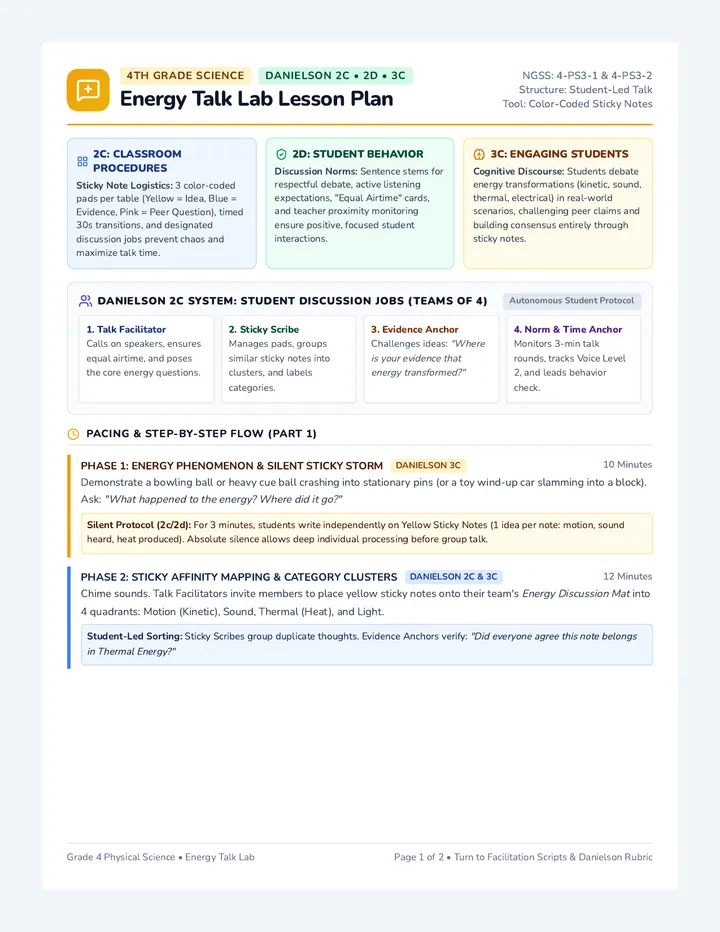
Energy Talk Lab Lesson Plan 4th Grade Science Danielson 2c • 2d • 3c
Energy Talk Lab Lesson Plan
NGSS: 4-PS3-1 & 4-PS3-2
Structure: Student-Led Talk
Tool: Color-Coded Sticky Notes
2c: Classroom Procedures
Kid-Friendly Roles & Routines: 4 clear discussion jobs, 3 color-coded sticky pads, and a 30s chime cue keep the talk moving smoothly without lost instructional time.
2d: Student Behavior
Kid-Friendly Norms & Voice Levels: Sentence starters for polite debate, Level 2 indoor voice standards, and student self-ratings maintain positive team focus.
3c: Engaging Students
Visual Cognitive Discourse: Illustrated collision cards (bowling pins, rubbing hands, flashlights) prompt student-led debate on energy transformations.
Danielson 2c: Simplified 4-Member Student Discussion Roles Autonomous Student Protocol
🎤 1. Discussion Leader
Calls on each person, ensures equal speaking turns, and asks the discussion questions.
📝 2. Sticky Note Boss
Passes out yellow & pink pads, places notes neatly into the 4 energy quadrants.
🔍 3. Evidence Detective
Asks for scientific proof: "What clue or observation proves that energy changed?"
⏱️ 4. Timer & Helper
Watches the 3-minute talk timer, keeps voice at Level 2, and leads the team high-five.
Pacing & Step-by-Step Flow (Part 1)
Phase 1: Energy Phenomenon & Silent Sticky Storm Danielson 3c
10 Minutes
★ Kid-Friendly Launch Demonstration:
Demonstrate a heavy ball crashing into bowling pins (or wind-up race car smashing into building blocks with an energetic sound). Ask with high energy: "What happened to all that speed? Did the energy vanish into thin air, or did it transform into something we heard and felt?"
Silent Sticky Storm Routine (2c/2d): Give students 3 minutes of quiet time. Each student writes their own ideas on Yellow Sticky Notes (1 thought per note: motion, sound, heat). Silence allows every thinker to prepare before talk begins.
Phase 2: Sticky Affinity Mapping on the 4-Quadrant Mat Danielson 2c & 3c
12 Minutes
Chime sounds! Discussion Leaders invite members to place their sticky notes onto their team's 4 Energy Zones Mat : Motion, Sound, Thermal (Heat), or Light/Electrical.
Sticky Note Boss Routine: The Sticky Note Boss groups similar ideas together in clusters. Evidence Detectives verify: "Did we put the bowling crash sound in the Sound quadrant?"
Energy Talk Lab Activity Sheet 4th Grade Energy Squad
Energy Talk Lab: Sticky Note Mat
Table Team #:
Discussion Leader
"I make sure everyone speaks!"
Sticky Note Boss
"I pass out & organize notes!"
Evidence Detective
"I ask: What is your proof?"
Timer & Helper
"I watch time & keep us quiet!"
Say it like a Scientist:
"I agree with this note because..." "Where is your evidence?" "I see it differently because..."
The 4 Energy Zones: Stick Your Yellow Notes Here! 1 Idea Per Sticky Note
1. Motion Energy (Kinetic) Moving Objects
Things that roll, run, fly, or crash!
Place Yellow Sticky Notes Here
2. Sound Energy Vibrations
Vibrations you hear: bangs, claps, hums!
Place Yellow Sticky Notes Here
3. Thermal Energy (Heat) Warmth
Warmth from friction, fire, or the sun!
Place Yellow Sticky Notes Here
4. Light & Electrical Energy Rays & Circuits
Glows from bulbs, batteries, and sunlight!
Place Yellow Sticky Notes Here
Discussion Leaders: Call on each team member in turn. Page 1 of 2 • Turn to Energy Collisions
Investigation Log
Energy Collisions & Gallery Walk
NGSS 4-PS3-2
What Happens in These 3 Collisions? (Circle the output energies)
Scenario 1: Bowling Ball Strikes Pins
Starts with: Motion Energy
Energy transforms into:
Sound (Crash!) Pins moving Tiny Heat
Scenario 2: Rubbing Hands Fast
Starts with: Motion Energy
Energy transforms into:
Warm Heat Rustle Sound Bright Light
Scenario 3: Turning On a Flashlight
Starts with: Battery / Stored Energy
Energy transforms into:
Beaming Light Warm Bulb (Heat) Motion
Pink Sticky Notes: What Feedback Did Our Visitors Leave? Glow & Push
🌟 A Glow (A smart idea our peers liked):
💡 A Push (A question our peers asked us):
Our Team's Energy Discovery Rule:
Energy never simply vanishes! When objects crash or work, energy TRANSFERS to other objects and TRANSFORMS into new forms like motion, sound, and heat!
Team Discussion High-Five: Rate Ourselves (1 to 4 Stars!)
Our Roles Did we do our jobs?
Energy Talk Lab Exit Ticket Energy Quick Check
Energy Talk Lab: My Exit Ticket
Name:
Date:
1 Energy In Action: The Big Baseball Hit! NGSS 4-PS3-1
CRACK!
A wooden bat swings with motion energy and hits the baseball with a loud sound. What happened to the bat's energy? (Circle the best answer)
A. The energy vanished into nothing when the bat stopped.
B. Motion energy transferred to the ball, sound, and a bit of heat.
C. Only sound energy was made; the ball flew on its own.
D. The energy turned into battery power inside the ball.
2 Sticky Note Detective: Who Has Stronger Evidence? Peer Critique
Two students wrote sticky notes explaining why your hands get warm when you rub them fast:
Sticky Note A
"Friction from our fast moving hands transformed motion energy into thermal (heat) energy!"
Sticky Note B
"Hands get warm because skin naturally gets hot whenever you touch someone else's hands."
Which sticky note is scientifically correct? (circle): Sticky Note A / Sticky Note B
Why?
My Discussion Role & Teamwork Check (Danielson 2c & 2d) Self-Reflection
Check your role today:
🎤 Discussion Leader (I invited everyone to speak) 📝 Sticky Note Boss (I organized our sticky notes) 🔍 Evidence Detective (I asked for proof & clues) ⏱️ Timer & Helper (I kept us quiet & on time)
Scientist Talk Sentence:
Finish one sentence starter you used during your table talk:
"I agreed with my teammate because..."
Teacher / Evaluator Danielson Scoring Snapshot U = Unsatisfactory • B = Basic • P = Proficient • D = Distinguished
2c: Procedures U B P D
Seamless sticky note use & autonomous student roles.
2d: Behavior U B P D
Equal airtime, Level 2 voice, respectful discourse stems.
3c: Engagement U B P D
Cognitive struggle, evidence defense, consensus building.
Energy Talk Lab • 4th Grade Formative Assessment Score: _____ / 10 • Great Job, Scientist!
Energy Talk Role Signs Punch Hole for Lanyard or Tape to Shirt
Wear On Chest
Team Role #1
DISCUSSION LEADER
"I make sure everyone gets a turn to speak!"
My Superpower Duties:
I call on each teammate by name so nobody is left out.
I make sure only one person talks at a time (no interrupting).
I ask: "What do you think about this energy scenario?"
What I Say: "What is your thought, teammate? It's your turn!"
Cut Line Between Wearable Signs
Punch Hole for Lanyard or Tape to Shirt
Wear On Chest
Team Role #2
STICKY NOTE BOSS
"I pass out, organize & cluster our ideas!"
My Superpower Duties:
I hand out yellow and pink sticky notes to teammates fairly.
I place sticky notes neatly into the 4 Energy Quadrants.
I group similar ideas into clusters so our mat looks organized.
What I Say: "Does this sticky note belong in Motion, Sound, or Heat?"
Punch Hole for Lanyard or Tape to Shirt
Wear On Chest
Team Role #3
EVIDENCE DETECTIVE
"I ask: Where is your scientific proof?"
My Superpower Duties:
I ask for real clues: "What observation proves your idea?"
I check if our claims match the collision drawings and data.
I politely challenge ideas that don't have scientific evidence.
What I Say: "What proof from our experiment supports that note?"
Cut Line Between Wearable Signs
Punch Hole for Lanyard or Tape to Shirt
Wear On Chest
Team Role #4
TIMER & HELPER
"I watch the clock & keep our voice at Level 2!"
My Superpower Duties:
I track the 3-minute discussion rounds so we finish on time.
I remind teammates to use indoor Voice Level 2 (table talk).
I lead our team self-rating high-five at the end of rounds.
What I Say: "We have 1 minute left! Let's keep our voices at Level 2!"
Punch Hole for Lanyard or Tape to Shirt
Wear On Chest
Team Role #5
GOOD LISTENER
"I listen with my eyes, ears, and whole body!"
My Superpower Duties:
I turn my body toward whoever is speaking and look at them.
I keep my hands still and quiet while my teammates share.